
Raysha Farah retweetledi

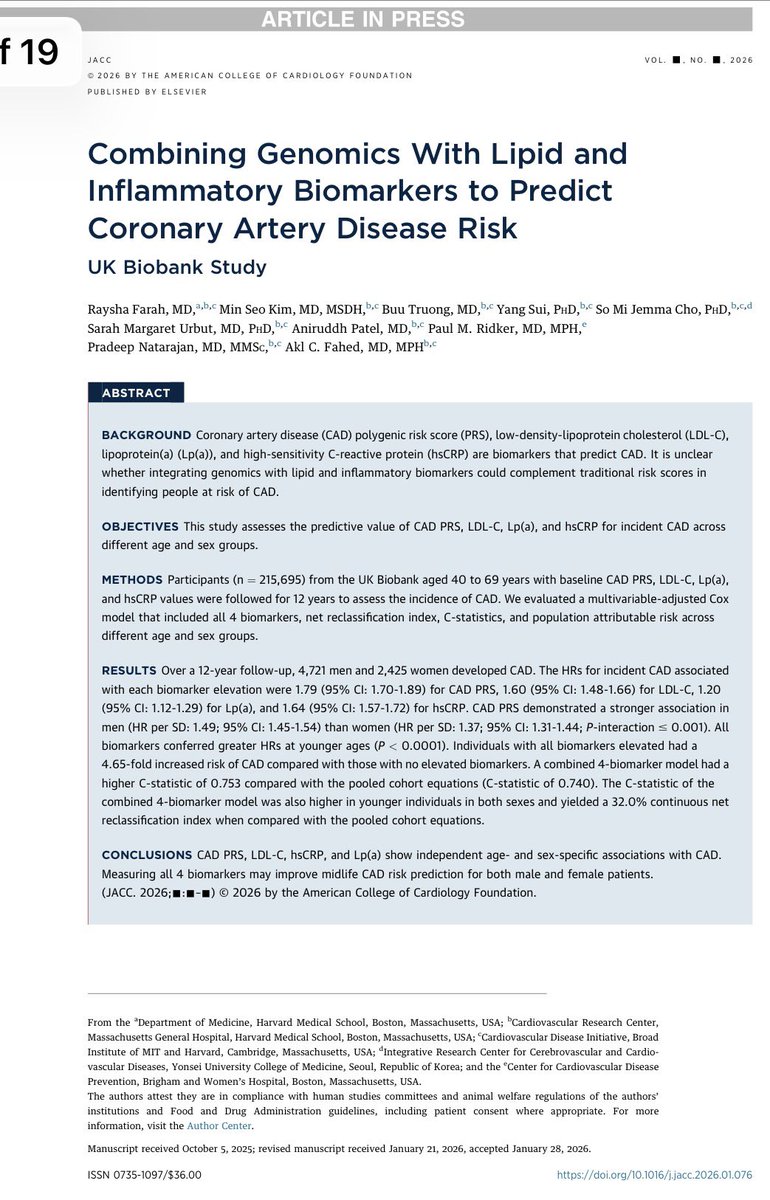
A one-time midlife assessment of four blood-based biomarkers—CAD polygenic risk score (PRS), hsCRP, LDL-C, and lipoprotein(a)—robustly predicts future coronary artery disease risk in both men and women aged 40 to 69 years.
A one-time midlife biomarker panel may unmask hidden future CAD risk long before conventional calculators do.
🔹 Pearl 1 — Four pathways, one practical panel
A single midlife assessment of CAD polygenic risk score (PRS), LDL-C, lipoprotein(a), and hsCRP captures genetic, lipid, and inflammatory risk, offering a more integrated view of future coronary artery disease risk.
🔹 Pearl 2 — Each biomarker independently predicts incident CAD
Over 12 years of follow-up, elevation of each biomarker was independently associated with higher CAD risk. The hazard ratios were 1.79 for CAD PRS, 1.60 for LDL-C, 1.20 for Lp(a), and 1.64 for hsCRP, confirming that all four add meaningful prognostic information.
🔹 Pearl 3 — Risk is multiplicative, not merely additive
Individuals with all four biomarkers elevated had a 4.65-fold higher risk of future CAD compared with those with no elevated biomarkers, highlighting the importance of cumulative burden across pathways.
🔹 Pearl 4 — Younger adults may benefit the most
All four biomarkers showed stronger associations at younger ages, suggesting that biomarker-based screening may be especially valuable in early midlife, when traditional clinical calculators often underestimate lifetime vascular risk.
🔹 Pearl 5 — Biomarkers can rival traditional risk calculators
The combined 4-biomarker model achieved a C-statistic of 0.753, which was slightly better than the pooled cohort equations at 0.740, indicating comparable or better discriminatory performance.
🔹 Pearl 6 — Better reclassification means fewer missed patients
Compared with pooled cohort equations, the 4-biomarker strategy produced a 32% continuous net reclassification improvement, suggesting it may identify at-risk individuals who would otherwise be missed by conventional clinical scoring.
🔹 Pearl 7 — CAD PRS appears particularly informative in men
The association of CAD PRS with incident CAD was stronger in men than in women, although the 4-biomarker model was predictive in both sexes.
🔹 Pearl 8 — Lp(a) still matters even when effect size is modest
Although the hazard ratio for Lp(a) was lower than for the other markers, it remained an independent predictor of CAD, reinforcing the value of at least once-in-a-lifetime Lp(a) testing in risk stratification.
🔹 Pearl 9 — hsCRP keeps inflammation in the CAD conversation
The strong association of hsCRP with future CAD supports the concept that residual inflammatory risk deserves attention alongside cholesterol and inherited risk.
🔹 Pearl 10 — Think beyond 10-year risk; think lifetime vascular exposure
This study supports interpreting CAD risk as a cumulative lifetime burden of inherited susceptibility, atherogenic lipids, and inflammation, which may help clinicians prioritize earlier and more targeted primary prevention.
Practical CME INDIA Take-Home Message
In adults aged 40–69 years, a one-time 4-marker panel of CAD PRS, LDL-C, Lp(a), and hsCRP may refine CAD risk assessment beyond traditional calculators, especially in younger individuals and those who appear low-risk by routine clinical scoring. This approach may help clinicians identify candidates for earlier lifestyle intensification, lipid lowering, closer follow-up, and personalized prevention strategies.
One-Line Conclusion
Midlife CAD prevention may become smarter when we measure inherited risk, cholesterol burden, lipoprotein(a), and inflammation together—not separately.
sciencedirect.com/science/articl…

English