remove/noise
371 posts

remove/noise
@removethenoise
If you lose say nothing, if you win say less.


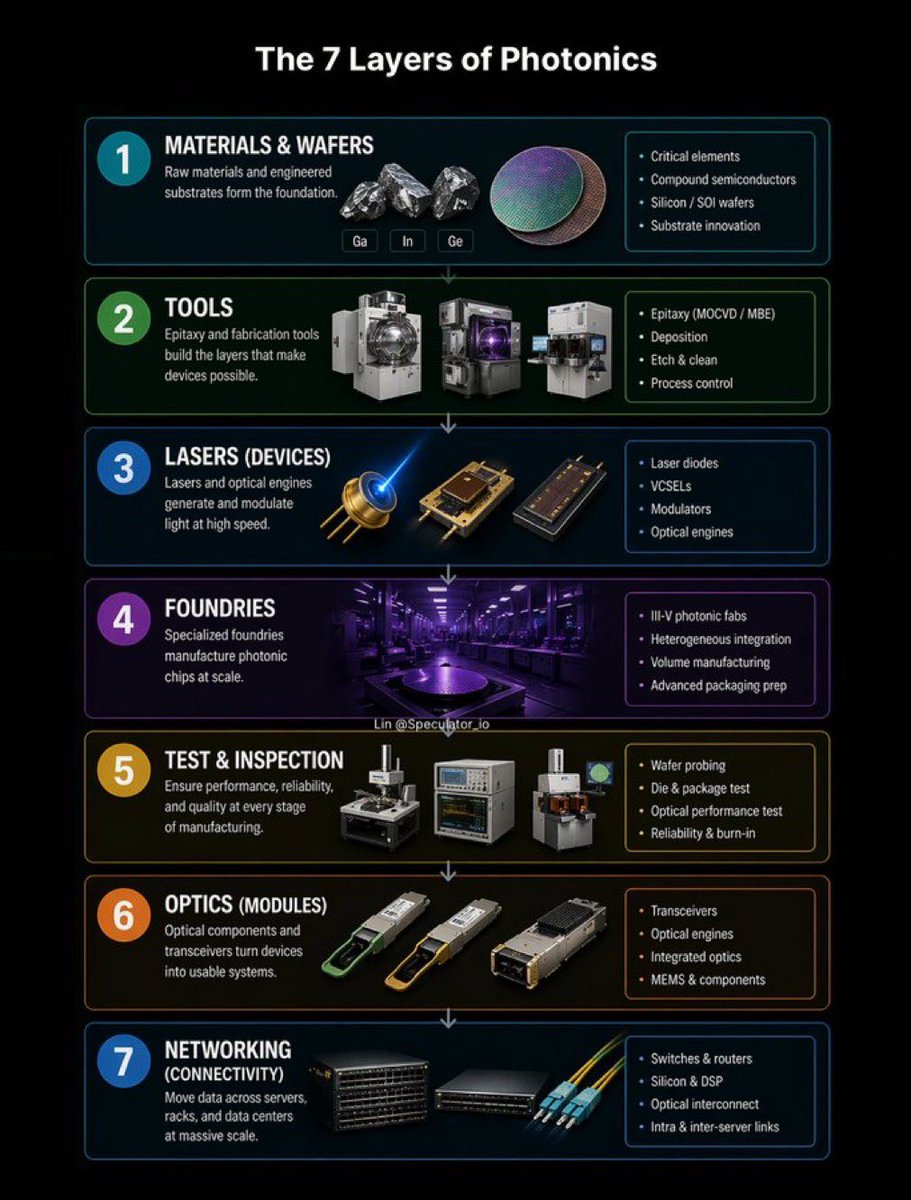
THE OPTICAL PHOTONICS BOTTLENECK As AI clusters scale past copper’s physical limits, the bottleneck shifts to optical & these are the companies building that layer across the stack: 1. $AAOI building the transceiver layer of the AI network through vertically integrated U.S.-based InP laser manufacturing. It has already secured over $200M in its first volume 1.6T order from one hyperscale customer followed by another $124M in 800G orders from a second. 2. $AEHR building the reliability layer for the optical & AI hardware stack through burn-in & test systems. It just received a record $41M follow-on order from its lead hyperscale customer reinforcing the idea that Sonoma is becoming a key production burn-in platform for high-power AI ASICs. 3. $CRDO building the connectivity layer that helps AI clusters move data faster through active electrical cables, retimers & high-speed interconnect silicon. The DustPhotonics acquisition also extends that platform into silicon photonics before copper becomes a real constraint. 4. $LITE building the laser layer of the AI optical stack through EMLs, optical components & optical switching exposure. The setup is backed by a $2B $NVDA strategic investment & optical circuit switch backlog above $400M with orders reportedly extending through 2028. 5. $VIAV building the testing & validation layer of the optical stack through network instrumentation & photonics measurement tools. It is the picks-and-shovels layer of the transition because every high-speed optical buildout still needs to be tested regardless of which transceiver vendor wins. 6. $COHR building one of the core photonics bottlenecks through indium phosphide lasers, optical engines & communications components tied to next-gen AI networking. It also has a $2B $NVDA strategic investment behind it & is doubling InP device capacity into the 1.6T ramp. 7. $MRVL building the DSP & optical infrastructure layer through electro-optics, PAM DSPs, interconnect silicon & custom networking chips. The Celestial AI deal & NVLink Fusion exposure both strengthen its position as photonics becomes more central to AI cluster design.


Why I sold $SOI? Pretty simple: Soitec is often called a monopoly, because they own the SmartCut IP. So all 300mm SOI wafers are produced by them or through another manufacturer licensing their IP... well until now! In GlobalWafers Q4 earnings call, the CEO, who is a "let my actions speak louder than words" kinda person, reassured, that the licensing deal with Soitec is terminated. And they already have a fab in Missouri, solely dedicated to 300mm SOI manufacturing, up and running in Missouri. For me, this breaks the thesis. If I'd want exposure to EU small caps in the AI infra supply chain, there are better opportunities out there. NFA


Introducing USVC - a single basket of high-growth venture capital, for everyone. No accreditation required, SEC-registered, and a very low $500 minimum. Includes OpenAI, Anthropic, xAI, Sierra, Crusoe, Legora, and Vercel. As USVC adds more companies, investors will own a piece of that too. Liquidity typically comes when companies exit, but we’re aiming to let investors redeem up to 5% of the fund every quarter. This isn’t guaranteed, but if we can make it work, you won’t be locked up like in a traditional venture fund. It runs on AngelList, which already supports $125 billion of investor capital. And I’ve joined USVC as the Chairman of its Investment Committee. — Go back to the 1500s, you set sail for the new world to find tons of gold - that was adventure capital. Early-stage technology is the modern version. It says we are going to create something new, and it’s risky. It’s daring. But ordinary people can’t invest until it’s old, until it’s no longer interesting, until everybody has access to it. By the time a stock IPOs, most of the alpha is gone. The adventure is gone. Public market investors are literally last in line. This problem has become farcical in the last decade. Startups are reaching trillion dollar valuations in the private markets while ordinary investors have their noses up to the glass, wondering when they’ll be let in. Investing in private markets isn’t easy. You need feet on the ground. You need judgment built over years. Most people don’t have the patience to wait ten or twenty years for an investment to come to fruition. But there is no more productive, harder-working way to deploy a dollar than in true venture capital. USVC enables you to invest in venture capital in a broad, accessible, professionally-managed way, through a single basket of innovation, focused on high-growth startups, at all stages. It is how you bet on the future of tech: the smartest young people in the world, working insane hours, leveraged to the max, with code, hardware, capital, media, and community. Your dollar doesn’t work harder anywhere. There is an old line - in the future, either you are telling a computer what to do, or a computer is telling you what to do. You don’t want to be on the wrong side of that transaction. USVC lets you buy the future, but you buy it now. Then you wait, and if you are right, you get paid. Get access here: usvc.com