
Sabitlenmiş Tweet
B Ri ck
3.1K posts


B Ri ck retweetledi

🔴ادعای ترامپ درباره بازگشت تنگه هرمز به حالت قبل واقعیت ندارد
۱/۶
فارسی
B Ri ck retweetledi

To finish on this, I think all hell breaks loose at or before we reach 6.5 bln barrel global visible inventories.
2.8 crude linefill and tank bottoms
1.3 crude and products on water (in transit)
2.4 products linefill and distribution channel
I'm a touch more optimistic that the JPMorgan / BBG publication, but not by much, at current deficits, shortages can't be avoided in three to four months.
Even sooner for products with low inventories and high operational floor caused by the long distances they travel from production to consumption regions, think petchems and certain light ends.

Yet another commodity guy@tleilax___
I estimate at least for crude about 2.8 billions barrels of linefill and tank bottoms. This is from known pipeline infrastructure and measurable inventories. That inventory is unavailable for commerce and can't be drawn. This is from GEM data and @Kayrros
English
B Ri ck retweetledi

1/
جمهورى اسلامى ايران محدودهٔ نظارتى مديریت تنگه هرمز را به این شرح تعيین کرده است: «خط اتصال كوه مبارك درايران وجنوب فجيره درامارات در شرق تنگه تاخط اتصال انتهاى جزيره قشم درايران و ام القيوین امارات درغرب تنگه.»


فارسی
B Ri ck retweetledi

B Ri ck retweetledi
If Axios was around in 2008, we would’ve avoided the Great Financial Crisis. Barak Ravid with the power of the Pakistani sources would’ve rescued the world.
English
B Ri ck retweetledi

Vladimir Putin's visit to Beijing showcased an unbreakable alliance with Xi Jinping. But behind the closed doors, the crisis in the Strait of Hormuz is completely scrambling the rules of the Sino-Russian energy relationship.
The hard data tells a different story.
🧵👇

English
And every messiah eventually unleashes a jihad he cannot control.
We are entering the late-stage Arrakis era now:
* energy scarcity returning
* shipping vulnerability rising
* deglobalization accelerating
* old empires overstretched
* desert powers gaining leverage again
English
And then there is the deeper layer Herbert understood better than almost anyone:
Religion is not separate from geopolitics.
It is infrastructure.
The most dangerous force in history is not military power alone, but a population convinced history itself has chosen them.
English
Iran = House Atreides
United States = The Imperium
Gulf Cooperation Council = The Spacing Guild
Kabbalah=Bene Gesserit = the hidden ideological priesthood shaping narratives across generations
Israel = House Harkonnen
And oil?
Oil is Spice.
Everything flows from there.
English
B Ri ck retweetledi

这个民族太可怕了,作为一个三星DS部门的前一把手,亲手管过HBM、DRAM全线业务的人,在这个民族最风光的时候,Kye-hyun Kyung在台上亲手拆穿自己国家的繁荣
他做为场内存盛宴的亲历者、参与者、受益者,没有被三星和海力士夸张的收益冲昏头脑。他说出 “需求本身可能从2028年起收缩”
Kye-hyun Kyung 说的这些话非常有逻辑性,并且底层逻辑也走得通,那就是大科技Capex回报率恶化 → 投资缩减 → 内存需求本身萎缩。
这是一个完整的因果链,不是看空情绪,是产业逻辑。 他思路非常清晰,
他甚至撕开了韩国繁华之后的“假象”: 他给出俩个数据:
1. 70% DRAM份额
2. 1.5% Fabless份额
这两个数字放在一起,是一幅极其刺眼的画像。
在他的眼里 韩国是: 制造力强,但是设计弱。 这意味着替代性很强,他也很明确的知道如果中国追赶韩国的制造端,不是”如果”的问题,是”何时”的问题。
中国也在大力扩展其产能爆炸
1. 长鑫存储(CXMT)DRAM产能在2022年只有5万片,现在能做到30万片+,我会附上图片。另外,他们的DDR5良率已突破80%,完全可以追平国际大厂水平。
2. 长江存储也在建设第三座工厂,且新厂约50%产能将用于生产DRAM,并计划生产HBM………
Kye-hyun Kyung 说的也没有错“明年下半年价格必跌” 都不需要韩国入场,只是中国的产量翻一番,那么供需关系也会被打破,中国肯定也会这样去做,产量翻倍能有更多订单,这就是现实,而不是大家都不扩大产能,蛋糕就那么大。
他在韩国繁荣的背景下能说出这样一番话真的很恐怖,要注意他可是三星前高管,他是有一定的人脉和影响力的人物,他能公开说这句话,等于承认韩国半导体繁荣有很大成分是”幸运的路径依赖”,而不是全栈竞争力。他认为先发优势、地缘因素、历史积累,这三个原因造就了今天的三星和海力士,根本不是什么技术性强,这些事物不是护城河。
这一定会激励三星内部去思考如何破局。 因为韩国人在我的认知范围内不是那种看到威胁而不解决的民族…………
#Semiconductors #DRAM #HBM #MemoryCycle #Samsung #SKHynix #Micron #CXMT #ChipWar #AIInfrastructure #TechInvesting #SupplyGlut #KyeHyunKyung #KoreaSemiconductor #ChinaSemiconductor #Capex #AIDataCenter


Jukan@jukan05
Kye-hyun Kyung, Samsung Electronics Senior Advisor: "Memory prices to fall in H2 next year… Korea must cultivate deep-tech manufacturing" Kye-hyun Kyung, Senior Advisor and former head of Samsung Electronics' Device Solutions (DS) Division, forecast that memory semiconductor prices will decline starting in the second half of next year, and urged Korean industry to prepare in advance. Delivering the keynote at the 285th NAEK Forum, hosted by the National Academy of Engineering of Korea (NAEK) at L-Tower in Seocho-gu, Seoul on the 18th, Advisor Kyung said, "Chinese players are aggressively expanding production capacity (CAPA)," adding that "as memory supply surges, the market could shift starting in the second half of next year or the first half of 2028." Citing global market research firms, Kyung projected that memory prices will fall from H2 next year, when global memory CAPA is expected to surge to 6 million wafers per month. "If Big Tech's return on capex deteriorates, there is a possibility that investment could be scaled back," he said, also warning that memory demand itself could contract from 2028 onwards. While Korean industry, led by Samsung Electronics and SK Hynix, is currently enjoying unprecedented growth by capturing Big Tech's memory demand, the former head of Samsung's semiconductor business argued that Korea must prepare in advance for the post-boom period. Advisor Kyung pointed out, "Korea holds nearly 70% share of the DRAM market, but only 1.5% of the fabless market, and unlike Taiwan, Korea lacks a full-stack semiconductor ecosystem that includes fabless." He went on to advise that "Korea must leap forward as a deep-tech-based manufacturing nation." The point is that Korea should independently build advanced technology capabilities—not only in memory but also in fabless-based system semiconductors and sovereign AI—and actively apply them to its existing strength in manufacturing. He added, "It is difficult for Korea to compete simultaneously with the U.S. and China in both hardware and software," and that "it is important for Korea to do what it does well, and to that end, we must seriously consider how to deploy AI."
中文
B Ri ck retweetledi

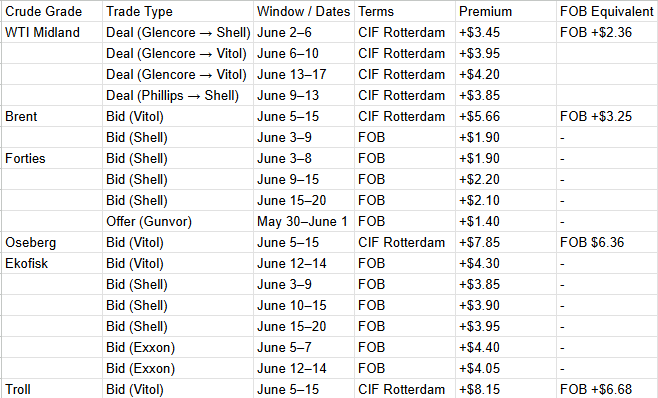
The North Sea window was absolutely buzzing on Monday, with Exxon, Shell, and Vitol bidding all over the place and driving diffs up.
I’m dying to see how those clowns change their tune now—the ones who were screaming, "Dated Brent is tanking! Physic to futures is narrowing, so oil is over!" without having a single clue about how remaining chain cargoes or buying cycles actually work.
Not throwing shade at Javier, though.
#oott #iran
English
B Ri ck retweetledi

🚨⚡️ GEOPOLITICAL EARTHQUAKE IN BEIJING:
Hours Remain Until the Moscow-Beijing Axis Launches a "New Era" that Defies the West! 🇷🇺🇨🇳
President Vladimir Putin will arrive in Beijing this evening, May 19, welcomed by Chinese Foreign Minister Wang Yi.
This is no ordinary summit; Putin and Xi Jinping will officially adopt a landmark "Declaration on the Establishment of a Multipolar World and a New Type of International Relations," delivering a direct challenge to unipolar dominance.
- High-Stakes Agenda & 40 Strategic Pacts:
Closed-door and expanded-format negotiations will take place to redraw the global economic and political roadmap.
The two leaders will hold detailed discussions on the massive "Power of Siberia - 2" gas pipeline project to solidify energy security.
Signing roughly 40 joint documents designed to lock in deep structural ties across industry, transport, and nuclear energy.
On May 20, the leaders will hold an intimate, informal "tea-time" session to break down the most critical and pressing international issues.
- A Colossal Russian Influx in Beijing:
Putin has effectively transferred the weight of the Russian state to China. He is backed by a massive delegation of top-tier officials and business titans, including Peskov, Lavrov, Manturov, and Novak, alongside billionaire oligarchs and energy czars like Sechin, Miller, Timchenko, and Deripaska.
- Moving away from standard newspaper columns, Putin recorded a rare, direct video address to the citizens of the People's Republic of China.
- The Kremlin explicitly confirmed there is absolutely no connection between Putin's historic summit and Donald Trump's upcoming schedule. This alliance moves entirely on its own sovereign merit.
English