rishanth rajendhran

65 posts

rishanth rajendhran

rishanth rajendhran

@rishanthrajendh

cs phd at @umdcs @umdclip | past: @iitmadras, @UUtah, @UMassAmherst | professional acc

Katılım Haziran 2024
106 Takip Edilen80 Takipçiler
rishanth rajendhran
rishanth rajendhran@rishanthrajendh·
as someone who spent months trying to do just that, it doesn’t work reliably. it’s a struggle to set it up such that the model doesn’t learn to produce garbage text that trivially fools pangram. once you have all these checks in place, the final text could still struggle with long term coherence.
English
0
0
0
21
rishanth rajendhran
rishanth rajendhran@rishanthrajendh·
@jathansadowski this would boil down to whether there is a clear separation between ai ideas and human ideas, without the ability to make this distinction, such a certification would become a matter of trust unfortunately
English
0
0
0
58
Jathan Sadowski
Jathan Sadowski@jathansadowski·
As an academic who does not use AI in my workflow for research and writing, it drives me crazy thinking that a reader might even wonder if AI is used in something with my name on it. We need an "organic" certification so people know that what they are reading is 100% human made.
English
39
31
316
15.2K
rishanth rajendhran
rishanth rajendhran@rishanthrajendh·
I get that obituaries are meant to be personal but as people working on building AI, should we really be calling people out for using it? This is a harmless application of AI imo, also we don’t necessarily know if someone simply gave a one line prompt to ChatGPT to write the obituary or spent considerable time with the AI to write it. The phrasing could all be AI but the human could still be at the heart of the content in it.
English
0
0
0
44
Benjamin Glickenhaus
Benjamin Glickenhaus@benglickenhaus·
gloomy weather in new york today made me morbidly curious, so i ran a bunch of obituaries through pangram we found ai in nearly 10% of post chat gpt obituaries, and no false positives in pre 2023 data
Benjamin Glickenhaus tweet media
English
9
6
97
5.3K
rishanth rajendhran
rishanth rajendhran@rishanthrajendh·
@MogicianTony That’s a very interesting direction! The focus of this work was creative writing, story writing in particular, but the recipe is applicable to any open ended writing task: all it needs is a structured rubric for professional writing and some high quality human written samples.
English
0
0
0
34
Hao Wang
Hao Wang@MogicianTony·
@rishanthrajendh Have you guys tried writing papers&blogs with this recipe? We need better professional writing AI 🤖
English
1
0
0
135
rishanth rajendhran
rishanth rajendhran@rishanthrajendh·
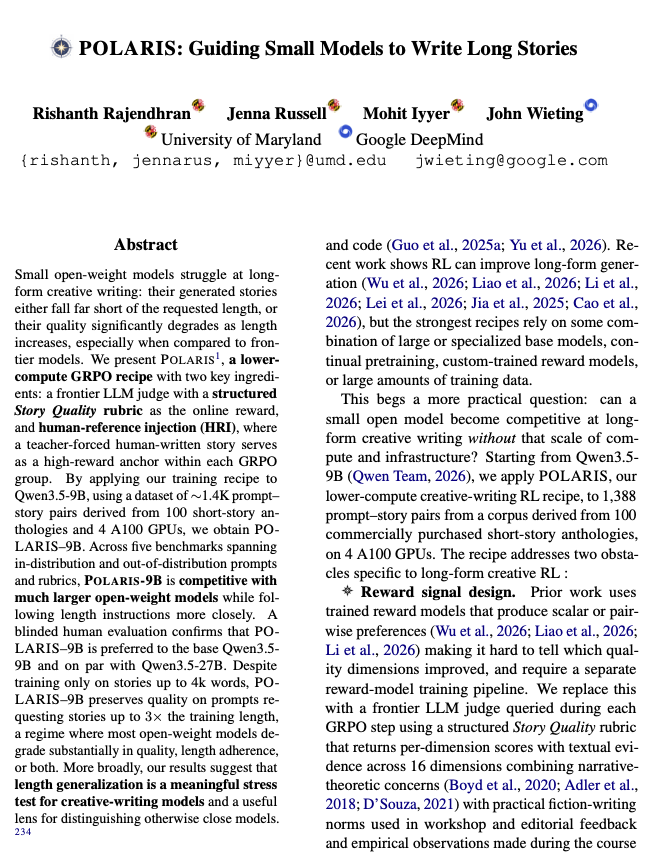
Can open-weight language models write long stories? Not well: either their writing quality degrades at longer lengths or they severely undershoot in length as the requested length grows, if not both. Frontier models fare better. This begs the question, can we train open-weight language models to write long stories with limited data and compute?
rishanth rajendhran tweet media
English
2
8
38
12.5K
rishanth rajendhran retweetledi
Yekyung Kim
Yekyung Kim@YekyungKim·
From op-eds in newspapers to NeurIPS position papers, AI is increasingly shaping long-form public discourse. Its arguments seem plausible, but beneath surface fluency, we find argument collapse: different LLMs converge to the same main & supporting arguments and structure.
Yekyung Kim tweet media
English
10
103
347
136.6K
rishanth rajendhran retweetledi
Mohit Iyyer
Mohit Iyyer@MohitIyyer·
Different LLMs, when asked to write an essay on the same debate prompt, converge on the same main argument far more often than humans do, a phenomenon we call "argument collapse". On ~200 debate prompts, LLM essays make a unique main argument just 3% of the time, compared to 65% for human authors. While each LLM essay might be totally reasonable on its own, as more and more of them spread through public discourse, they flatten the range of arguments that we read. Read more 👇
Yekyung Kim@YekyungKim

From op-eds in newspapers to NeurIPS position papers, AI is increasingly shaping long-form public discourse. Its arguments seem plausible, but beneath surface fluency, we find argument collapse: different LLMs converge to the same main & supporting arguments and structure.

English
19
40
222
45.9K
rishanth rajendhran retweetledi
Mohit Iyyer
Mohit Iyyer@MohitIyyer·
Base models generate more diverse responses than their post-trained counterparts but are also much worse at instruction following. We recover diversity with a simple recipe: the instruct model rewrites messy base generations into high-quality responses, and we then run DPO with this synthetic data. The resulting model is more diverse without sacrificing instruction following! Details 👇
Vinay Samuel@vsamuel2003

Post-training makes LLMs safer and better at following instructions, but less diverse. 🤔 Can we get that diversity back without sacrificing alignment? Introducing ReDiPO: a preference optimization recipe for restoring distributional diversity while preserving safety and instruction-following.

English
1
10
32
4.5K
rishanth rajendhran retweetledi
Ethan Mollick
Ethan Mollick@emollick·
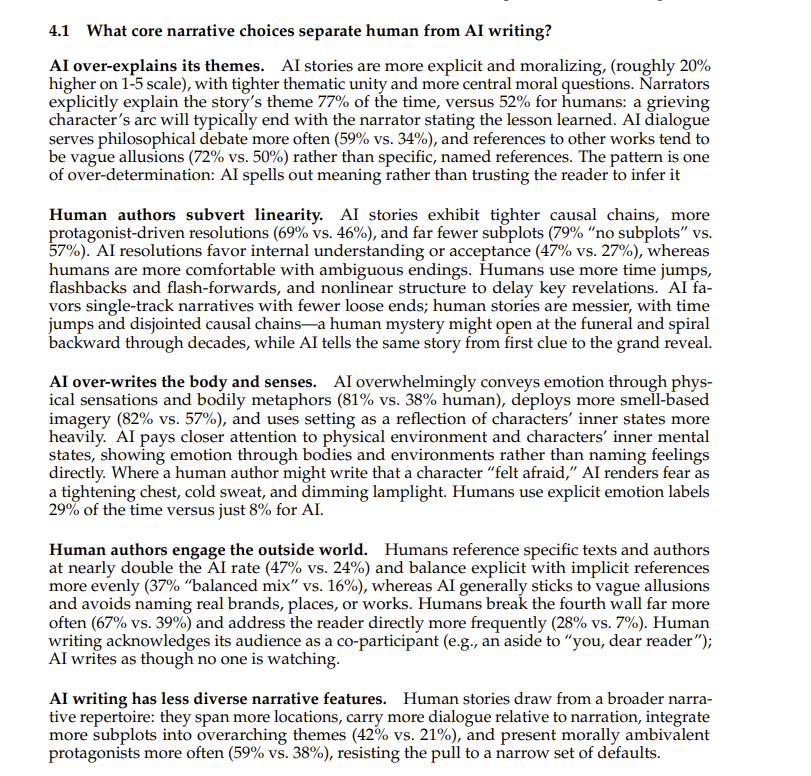
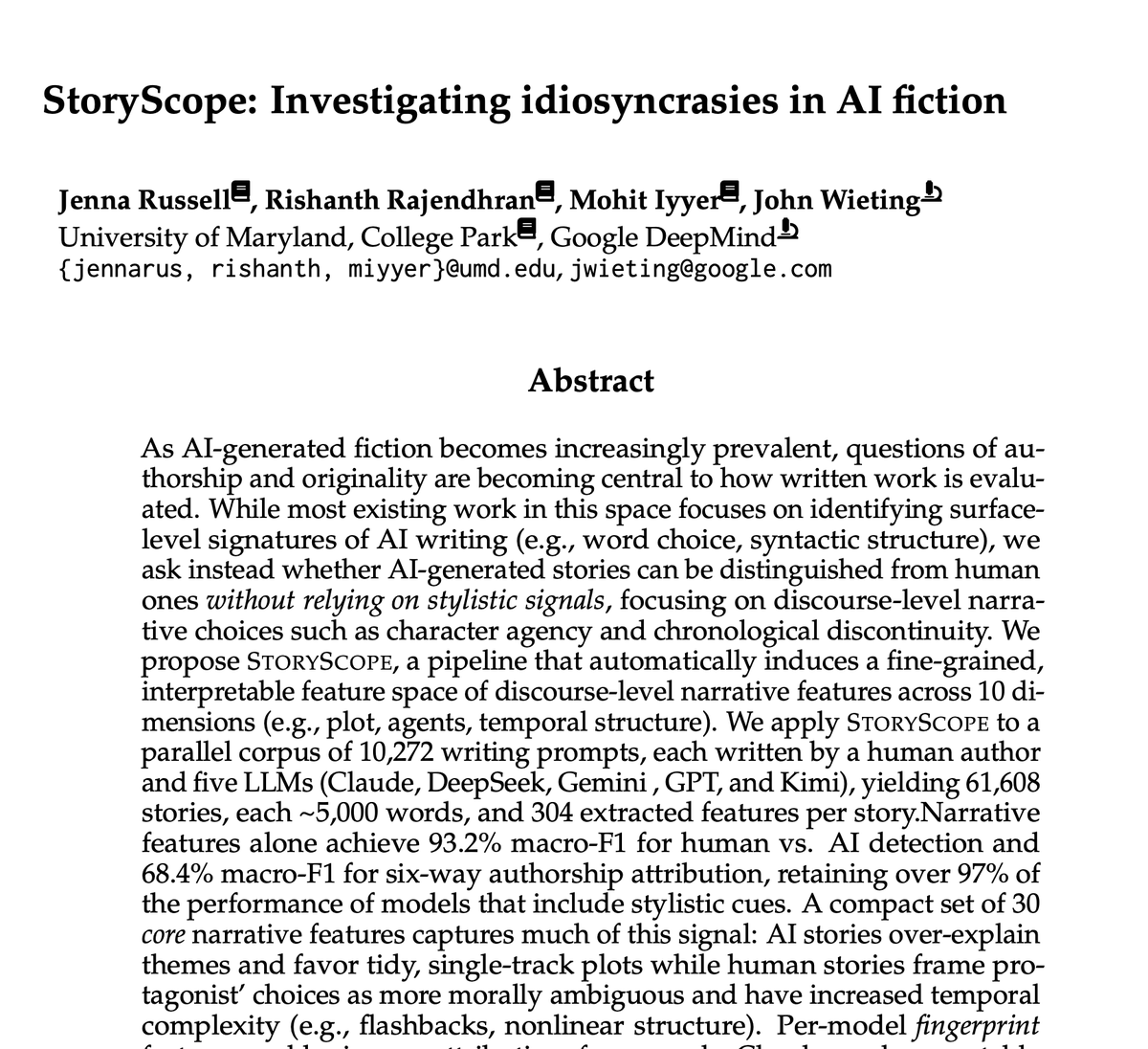
There is a lot being written about the stylistic tells of AI writing (em-dashes, etc.) but this paper looks at AI narrative tells Fascinating differences between AI & human narrative, and asking AI to write in different styles doesn't do much to change it arxiv.org/abs/2604.03136
Ethan Mollick tweet mediaEthan Mollick tweet media
English
122
584
3.4K
396.8K
rishanth rajendhran retweetledi
taoki
taoki@justalexoki·
can't believe i spent my whole life becoming Good At Computer only for Computer to become Better At Computer
English
187
2.1K
35.8K
741.7K
rishanth rajendhran retweetledi
Jenna Russell
Jenna Russell@jennajrussell·
Would you realize if the book you were reading was AI? What if it was humanized to remove AI-speak? We find that even without using stylistic cues (e.g., word choice or sentence structure) narrative choices alone give AI fiction away!
Jenna Russell tweet media
English
11
59
232
48K
rishanth rajendhran retweetledi
Mohit Iyyer
Mohit Iyyer@MohitIyyer·
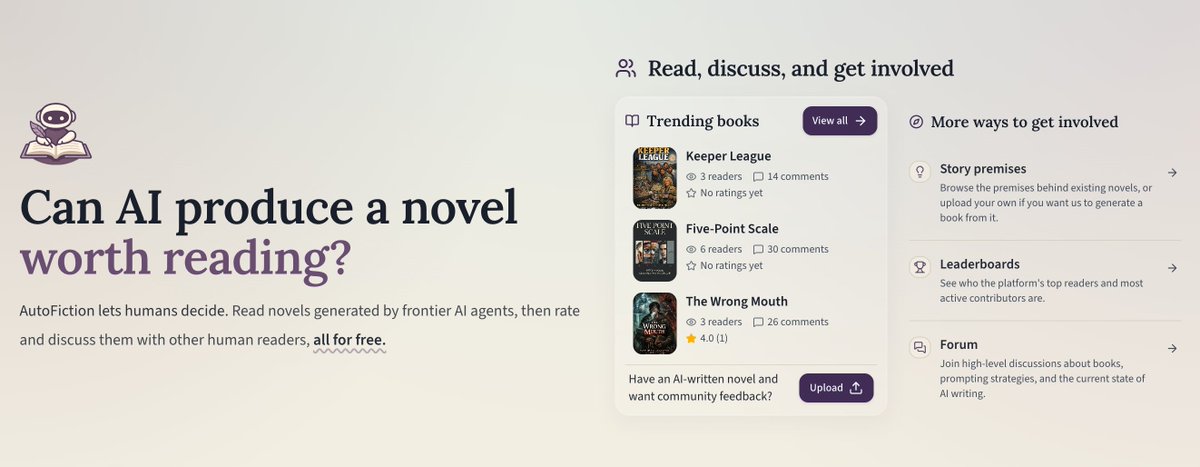
I spent the last week reading novels generated by Claude Code & Codex on our new AutoFiction platform and I... actually like some of them! For context, I've worked on creative language generation for ~10 years (😅), time mostly spent on getting models to produce a few relevant paragraphs that didn't repeat the same word over and over again. I def did not expect coherent 100K-word novels this soon!! My current favorites: - "The Wrong Mouth" (dark fantasy about a conman who "eats" a paladin and assassin and gains their skills) - "Keeper League" (comic murder mystery set at a fantasy football draft) - "Thank You for Your Patience" (horror/thriller about 30 post-training researchers locked in with a very polite rogue AI). The novels aren't perfect: mid-book pacing need work, character descriptions sometimes repeat, and character voices flatten. But they're structurally coherent and fun to read, and I'm curious to see how they improve with model/harness advances!
English
2
5
34
2.7K
rishanth rajendhran retweetledi
Chau Minh Pham
Chau Minh Pham@chautmpham·
👀 Can AI produce a novel worth reading? We built a platform to find out. 📚 Introducing AutoFiction: a web platform that hosts AI-generated novels by Claude Code & Codex, rated and reviewed by real readers. We have 33 books so far, spanning dark fantasy, murder mysteries, Harry Potter fanfics, and more. All free to read. (1/n)
Chau Minh Pham tweet media
English
1
30
61
4.5K
rishanth rajendhran retweetledi
Yapei Chang @ ICML 2026
Yapei Chang @ ICML 2026@YapeiChang·
📚 Most AI writing benchmarks miss what matters at book length: would anyone want to keep reading? We built AutoFiction to let the community decide and bring discussions into one place. Want AI to write fanfic for a couple you ship in your favorite film/series/anime/game? Upload it and let people read it. Or upload a story premise, and we’ll generate the book for you. It was unexpectedly fun to build a whole social reading platform in about a month with help from Codex and Claude Code. That experience made the point of AutoFiction feel even more real to us: as AI makes writing and building easier, human judgment about what deserves attention matters more than ever.
English
3
7
32
2.5K