Rishi S Bhilawadikar

4.3K posts

Rishi S Bhilawadikar banner
Rishi S Bhilawadikar

Rishi S Bhilawadikar

@rishisb

Product + Story. Shipping products since 2008. Wrote and produced "modern-day Catch-22" feature film on immigration- For Here or To Go?

San Francisco, Bay Area Katılım Haziran 2007
214 Takip Edilen571 Takipçiler
Sabitlenmiş Tweet
Rishi S Bhilawadikar
Rishi S Bhilawadikar@rishisb·
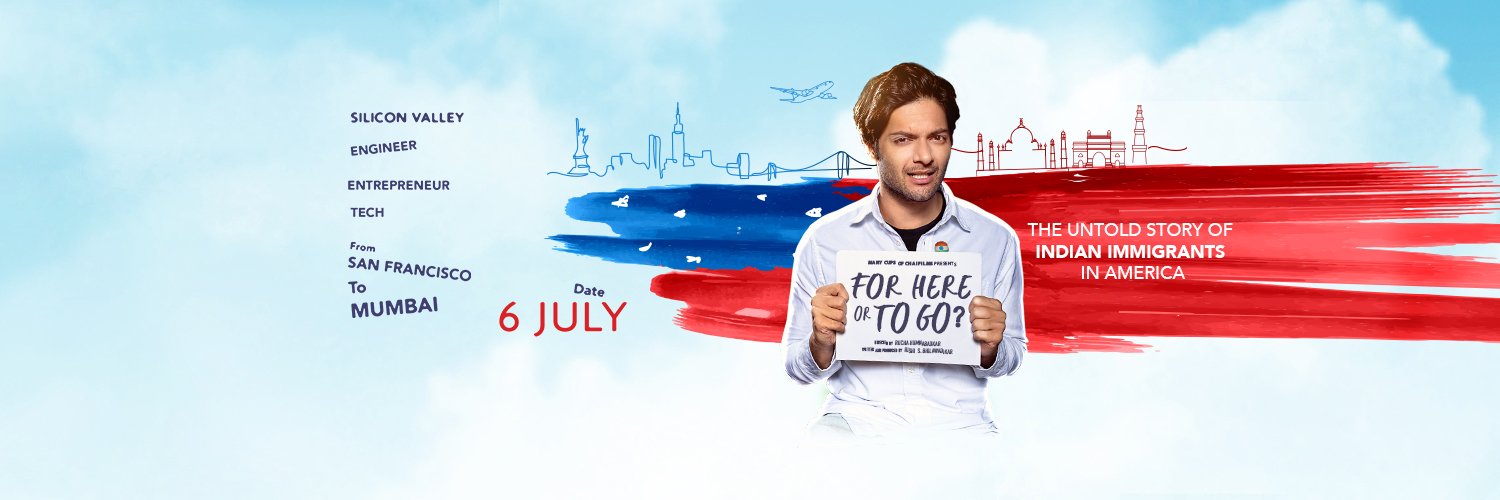
In 2017, I released "For Here or To Go?" – a feature film about legal Indian immigrants. It was mischaracterized by Breitbart as a “cheap labor lobby funded H-1B movie.” The same flawed arguments are making the rounds today. Here’s why they’re wrong 🧵
Rishi S Bhilawadikar tweet media
English
2
1
7
727
Rishi S Bhilawadikar
@evanlapointe Craftspeople get petty and can’t imagine or adopt mental models beyond the craft. Even the most stubborn ego driven Visionaries can change their mind but after enduring a lot of pain
English
0
0
1
27
Rishi S Bhilawadikar
@evanlapointe Craftspeople worse off here constantly missing forest for the trees Visionaries slightly better if good listeners and not surrounded by sycophant advisors — rare conditions
English
2
0
1
31
Evan LaPointe
Evan LaPointe@evanlapointe·
One of the more foolish things leaders do is optimize the macro (org design, process, metrics) thinking that it is a forcing function that optimizes the micro (decision making, alignment, engagement, action). This is entirely backwards. The macro doesn't (and hasn't ever) force the micro into place. The exact opposite is the truth: the micro makes the macro work. The evidence of this truth is everywhere, and it's almost universally ignored.
English
3
2
18
658
Rishi S Bhilawadikar
A small number of people captured infrastructure-level leverage while everyone else was still optimizing for career ladders, titles and annual compensation bands. I never really believed in those ladders to begin with. Most corporate structures always felt artificial to me. Information moving upward. Decisions moving downward. Endless coordination rituals pretending to be progress. What AI exposed is how fragile a lot of that structure actually was. That part honestly feels clarifying. The harder part is the distribution curve. Because this isn’t a normal wealth gap anymore. The compounding effects of owning models, compute, networks and distribution are so extreme that the idea of a permanent professional underclass suddenly doesn’t sound theoretical. Especially for knowledge workers who spent years believing intelligence and hard work alone created security. That psychological contract broke very fast.
Deedy@deedydas

The vibes in SF feel pretty frenetic right now. The divide in outcomes is the worst I've ever seen. Over the last 5yrs, a group of ~10k people - employees at Anthropic, OpenAI, xAI, Nvidia, Meta TBD, founders - have hit retirement wealth of well above $20M (back of the envelope AI estimation). Everyone outside that group feels like they can work their well-paying (but <$500k) job for their whole life and never get there. Worse yet, layoffs are in full swing. Many software engineers feel like their life's skill is no longer useful. The day to day role of most jobs has changed overnight with AI. As a result, 1. The corporate ladder looks like the wrong building to climb. Everyone's trying to align with a new set of career "paths": should I be a founder? Is it too late to join Anthropic / OpenAI? should I get into AI? what company stock will 10x next? People are demanding higher salaries and switching jobs more and more. 2. There’s a deep malaise about work (and its future). Why even work at all for “peanuts”? Will my job even exist in a few years? Many feel helpless. You hear the “permanent underclass” conversation a lot, esp from young people. It's hard to focus on doing good work when you think "man, if I joined Anthropic 2yrs ago, I could retire" 3. The mid to late middle managers feel paralyzed. Many have families and don't feel like they have the energy or network to just "start a company". They don't particularly have any AI skills. They see the writing on the wall: middle management is being hollowed out in many companies. 4. The rich aren’t particularly happy either. No one is shedding tears for them (and rightfully so). But those who have "made it" experience a profound lack of purpose too. Some have gone from <$150k to >$50M in a few years with no ramp. It flips your life plans upside down. For some, comparison is the thief of joy. For some, they escape to NYC to "live life". For others still, they start companies "just cuz", often to win status points. They never imagined that by age 30, they'd be set. I once asked a post-economic founder friend why they didn't just sell the co and they said "and do what? right now, everyone wants to talk to me. if i sell, I will only have money." I understand that many reading this scoff at the champagne problems of the valley. Society is warped in this tech bubble. What is often well-off anywhere else in the world is bang average here. Unlike many other places, tenure, intelligence and hard work can be loosely correlated with outcomes in the Bay. Living through a societally transformative gold rush in that environment can be paralyzing. "Am I in the right place? Should I move? Is there time still left? Am I gonna make it?" It psychologically torments many who have moved here in search of "success". Ironically, a frequent side effect of this torment is to spin up the very products making everyone rich in hopes that you too can vibecode your path to economic enlightenment.

English
0
0
0
14
Rishi S Bhilawadikar
@paper enables this magic. What would really help is if the MCP allowed my agents to work on multiple files and pages so designs can have clean separation. Also svg exports please You guys have supercharged design execution for me @stephenhaney in unimaginable ways
Rishi S Bhilawadikar@rishisb

@ridd_design To watch multiple agents design across multiple platforms , with some exploring and some refining while you sip coffee is nothing short of a miracle. Very addictive.

English
0
0
2
27
Rishi S Bhilawadikar
@ridd_design To watch multiple agents design across multiple platforms , with some exploring and some refining while you sip coffee is nothing short of a miracle. Very addictive.
English
0
0
0
207
Ridd 🤿
Ridd 🤿@ridd_design·
sometimes I watch in awe when exploring design concepts with AI still feels surreal that this is possible
English
18
3
336
41K
Rishi S Bhilawadikar
@Shpigford @hnshah @joshpuckett Great list. Interface craft has been very helpful. Claude design for standing up production grade, WCAG compliant, multi-platform design systems was painful — used Claude code for that and it gives much better control across web, Mac, windows, iOS, android front ends.
English
1
0
2
509
Josh Pigford
Josh Pigford@Shpigford·
favorite AI design tools/resources that play a regular part in my process as of this singular moment... 1. interfacecraft.dev - Incredible resource AND tools from my buddy @joshpuckett. Probably the most craft-oriented designer I know who's also fully embraced AI as part of their process. Lots to learn from and lots of great tooling to nail UI details. 2. ui.sh - From @adamwathan and @steveschoger. The /ui skill that comes with this helps immensely with following good design principles and helping your UIs stay more consistent. Also has a killer interactive component that generates multiple iterations of an idea so you can narrow in on exactly what you want. 3. mobbin.com/mcp - "Pull 20 different error notification states to find common patterns among mobile apps" 4. claude.ai/design - Incredible tool for generating design systems for use in your apps and in marketing materials. Hard to overstate how good this is. Honorable mention: impeccable.style - I've seen a lot of folks talk about this but just haven't had a chance to try it yet. (These could all get thrown out the window tomorrow, as is the nature of AI progress.)
English
18
46
847
64.4K
Rishi S Bhilawadikar
Been using interfacecraft.dev as a reviewer and its critique has been very helpful in leveling up the UI quality @joshpuckett
Josh Pigford@Shpigford

favorite AI design tools/resources that play a regular part in my process as of this singular moment... 1. interfacecraft.dev - Incredible resource AND tools from my buddy @joshpuckett. Probably the most craft-oriented designer I know who's also fully embraced AI as part of their process. Lots to learn from and lots of great tooling to nail UI details. 2. ui.sh - From @adamwathan and @steveschoger. The /ui skill that comes with this helps immensely with following good design principles and helping your UIs stay more consistent. Also has a killer interactive component that generates multiple iterations of an idea so you can narrow in on exactly what you want. 3. mobbin.com/mcp - "Pull 20 different error notification states to find common patterns among mobile apps" 4. claude.ai/design - Incredible tool for generating design systems for use in your apps and in marketing materials. Hard to overstate how good this is. Honorable mention: impeccable.style - I've seen a lot of folks talk about this but just haven't had a chance to try it yet. (These could all get thrown out the window tomorrow, as is the nature of AI progress.)

English
0
0
2
63
Rishi S Bhilawadikar
@evanlapointe I have the corollary - have beer with people so you learn what’s the latest thing that’s being made up.
English
1
0
3
41
Evan LaPointe
Evan LaPointe@evanlapointe·
The only people I'd have a beer with are the ones who know 100% we're all just making it up.
English
4
0
15
607
Hurley
Hurley@Johnsjawn·
Or go to the Presidio, jump in the ocean, get a coffee at The Mill, watch sunset at Twin Peaks, ride a bike anywhere, see live music, eat a burrito, take a grass nap in GG Park, have beer at The Page, watch the Bay Bridge lights, wander Chinatown, wander Ferry building, run across GG Bridge, walk Fort Funston, eat the best meal of your life with friends…drive any direction for 2hrs. And be deeply grateful for the heavenscape you live in.
Deedy@deedydas

The vibes in SF feel pretty frenetic right now. The divide in outcomes is the worst I've ever seen. Over the last 5yrs, a group of ~10k people - employees at Anthropic, OpenAI, xAI, Nvidia, Meta TBD, founders - have hit retirement wealth of well above $20M (back of the envelope AI estimation). Everyone outside that group feels like they can work their well-paying (but <$500k) job for their whole life and never get there. Worse yet, layoffs are in full swing. Many software engineers feel like their life's skill is no longer useful. The day to day role of most jobs has changed overnight with AI. As a result, 1. The corporate ladder looks like the wrong building to climb. Everyone's trying to align with a new set of career "paths": should I be a founder? Is it too late to join Anthropic / OpenAI? should I get into AI? what company stock will 10x next? People are demanding higher salaries and switching jobs more and more. 2. There’s a deep malaise about work (and its future). Why even work at all for “peanuts”? Will my job even exist in a few years? Many feel helpless. You hear the “permanent underclass” conversation a lot, esp from young people. It's hard to focus on doing good work when you think "man, if I joined Anthropic 2yrs ago, I could retire" 3. The mid to late middle managers feel paralyzed. Many have families and don't feel like they have the energy or network to just "start a company". They don't particularly have any AI skills. They see the writing on the wall: middle management is being hollowed out in many companies. 4. The rich aren’t particularly happy either. No one is shedding tears for them (and rightfully so). But those who have "made it" experience a profound lack of purpose too. Some have gone from <$150k to >$50M in a few years with no ramp. It flips your life plans upside down. For some, comparison is the thief of joy. For some, they escape to NYC to "live life". For others still, they start companies "just cuz", often to win status points. They never imagined that by age 30, they'd be set. I once asked a post-economic founder friend why they didn't just sell the co and they said "and do what? right now, everyone wants to talk to me. if i sell, I will only have money." I understand that many reading this scoff at the champagne problems of the valley. Society is warped in this tech bubble. What is often well-off anywhere else in the world is bang average here. Unlike many other places, tenure, intelligence and hard work can be loosely correlated with outcomes in the Bay. Living through a societally transformative gold rush in that environment can be paralyzing. "Am I in the right place? Should I move? Is there time still left? Am I gonna make it?" It psychologically torments many who have moved here in search of "success". Ironically, a frequent side effect of this torment is to spin up the very products making everyone rich in hopes that you too can vibecode your path to economic enlightenment.

English
85
200
4.1K
273.2K
Ilya Sukhar
Ilya Sukhar@ilyasu·
The solution to all of this is to have kids.
Deedy@deedydas

The vibes in SF feel pretty frenetic right now. The divide in outcomes is the worst I've ever seen. Over the last 5yrs, a group of ~10k people - employees at Anthropic, OpenAI, xAI, Nvidia, Meta TBD, founders - have hit retirement wealth of well above $20M (back of the envelope AI estimation). Everyone outside that group feels like they can work their well-paying (but <$500k) job for their whole life and never get there. Worse yet, layoffs are in full swing. Many software engineers feel like their life's skill is no longer useful. The day to day role of most jobs has changed overnight with AI. As a result, 1. The corporate ladder looks like the wrong building to climb. Everyone's trying to align with a new set of career "paths": should I be a founder? Is it too late to join Anthropic / OpenAI? should I get into AI? what company stock will 10x next? People are demanding higher salaries and switching jobs more and more. 2. There’s a deep malaise about work (and its future). Why even work at all for “peanuts”? Will my job even exist in a few years? Many feel helpless. You hear the “permanent underclass” conversation a lot, esp from young people. It's hard to focus on doing good work when you think "man, if I joined Anthropic 2yrs ago, I could retire" 3. The mid to late middle managers feel paralyzed. Many have families and don't feel like they have the energy or network to just "start a company". They don't particularly have any AI skills. They see the writing on the wall: middle management is being hollowed out in many companies. 4. The rich aren’t particularly happy either. No one is shedding tears for them (and rightfully so). But those who have "made it" experience a profound lack of purpose too. Some have gone from <$150k to >$50M in a few years with no ramp. It flips your life plans upside down. For some, comparison is the thief of joy. For some, they escape to NYC to "live life". For others still, they start companies "just cuz", often to win status points. They never imagined that by age 30, they'd be set. I once asked a post-economic founder friend why they didn't just sell the co and they said "and do what? right now, everyone wants to talk to me. if i sell, I will only have money." I understand that many reading this scoff at the champagne problems of the valley. Society is warped in this tech bubble. What is often well-off anywhere else in the world is bang average here. Unlike many other places, tenure, intelligence and hard work can be loosely correlated with outcomes in the Bay. Living through a societally transformative gold rush in that environment can be paralyzing. "Am I in the right place? Should I move? Is there time still left? Am I gonna make it?" It psychologically torments many who have moved here in search of "success". Ironically, a frequent side effect of this torment is to spin up the very products making everyone rich in hopes that you too can vibecode your path to economic enlightenment.

English
57
60
1.3K
160.8K
Rishi S Bhilawadikar
@evanlapointe Good counterpoint. Ownership will be on the nodes and along edges — the middle will be intelligence layer. It’s the middle managers that will need to scramble, AI collapses the context and information arbitrage “skill”. What doesn’t change- ownership as moat at any altitude
English
0
0
1
122
Evan LaPointe
Evan LaPointe@evanlapointe·
I’m going to take the contrarian position on both managers doing IC work and IC being the new status symbol. These are both errors of strategy, seeing the small picture but totally missing the big picture. If you focus on IC skills right now, you’re just making yourself more fireable in the next 6-12 months because nobody higher up will be able to distinguish you from all the other ICs who, to them, are all interchangeable. Managing whole teams and projects is the only leadership-legible role. They associate the IC role with commodity execution and the management role with ownership and risk. Yes, all managers need to get more into the work to not look like professional fathead wall decals. But leadership legibility is the only protection from a layoff, and moving to IC status is precisely the opposite of the correct strategy. I just wanted to share this because I’m seeing a lot of popular content that’s about to get you fired and I wanted to make sure someone out here is sharing clearer thinking.
English
14
4
90
11.2K
Rishi S Bhilawadikar
@petergyang There’s no right or wrong. Human behavior is universal, different kinds of rat races everywhere in the world. choose your race and be very grateful that you have the privilege of choice.
English
0
0
0
502
Peter Yang
Peter Yang@petergyang·
If you're stuck in the Bay Area tech rat race / psychosis, make time to travel to other places. Go to a small town in Europe or visit Asia - you'll see that life can be about much more than whether you're IC7 or IC8 or what company you work for. Don't be the person to put on your tombstone: "He got divorced and neglected his kids but at least he made D2 at FAANG"
Deedy@deedydas

The vibes in SF feel pretty frenetic right now. The divide in outcomes is the worst I've ever seen. Over the last 5yrs, a group of ~10k people - employees at Anthropic, OpenAI, xAI, Nvidia, Meta TBD, founders - have hit retirement wealth of well above $20M (back of the envelope AI estimation). Everyone outside that group feels like they can work their well-paying (but <$500k) job for their whole life and never get there. Worse yet, layoffs are in full swing. Many software engineers feel like their life's skill is no longer useful. The day to day role of most jobs has changed overnight with AI. As a result, 1. The corporate ladder looks like the wrong building to climb. Everyone's trying to align with a new set of career "paths": should I be a founder? Is it too late to join Anthropic / OpenAI? should I get into AI? what company stock will 10x next? People are demanding higher salaries and switching jobs more and more. 2. There’s a deep malaise about work (and its future). Why even work at all for “peanuts”? Will my job even exist in a few years? Many feel helpless. You hear the “permanent underclass” conversation a lot, esp from young people. It's hard to focus on doing good work when you think "man, if I joined Anthropic 2yrs ago, I could retire" 3. The mid to late middle managers feel paralyzed. Many have families and don't feel like they have the energy or network to just "start a company". They don't particularly have any AI skills. They see the writing on the wall: middle management is being hollowed out in many companies. 4. The rich aren’t particularly happy either. No one is shedding tears for them (and rightfully so). But those who have "made it" experience a profound lack of purpose too. Some have gone from <$150k to >$50M in a few years with no ramp. It flips your life plans upside down. For some, comparison is the thief of joy. For some, they escape to NYC to "live life". For others still, they start companies "just cuz", often to win status points. They never imagined that by age 30, they'd be set. I once asked a post-economic founder friend why they didn't just sell the co and they said "and do what? right now, everyone wants to talk to me. if i sell, I will only have money." I understand that many reading this scoff at the champagne problems of the valley. Society is warped in this tech bubble. What is often well-off anywhere else in the world is bang average here. Unlike many other places, tenure, intelligence and hard work can be loosely correlated with outcomes in the Bay. Living through a societally transformative gold rush in that environment can be paralyzing. "Am I in the right place? Should I move? Is there time still left? Am I gonna make it?" It psychologically torments many who have moved here in search of "success". Ironically, a frequent side effect of this torment is to spin up the very products making everyone rich in hopes that you too can vibecode your path to economic enlightenment.

English
139
182
3.7K
516.7K
Rishi S Bhilawadikar
@shreyas Foundations. What’s going to work for the customer and why a decision improves the likelihood of winning - better focus than smart-sounding business language. Whats happening here also is people thinking they’ve done the hard work and it comes down to a binary choice.
English
0
0
1
1K
Yann
Yann@yanndine·
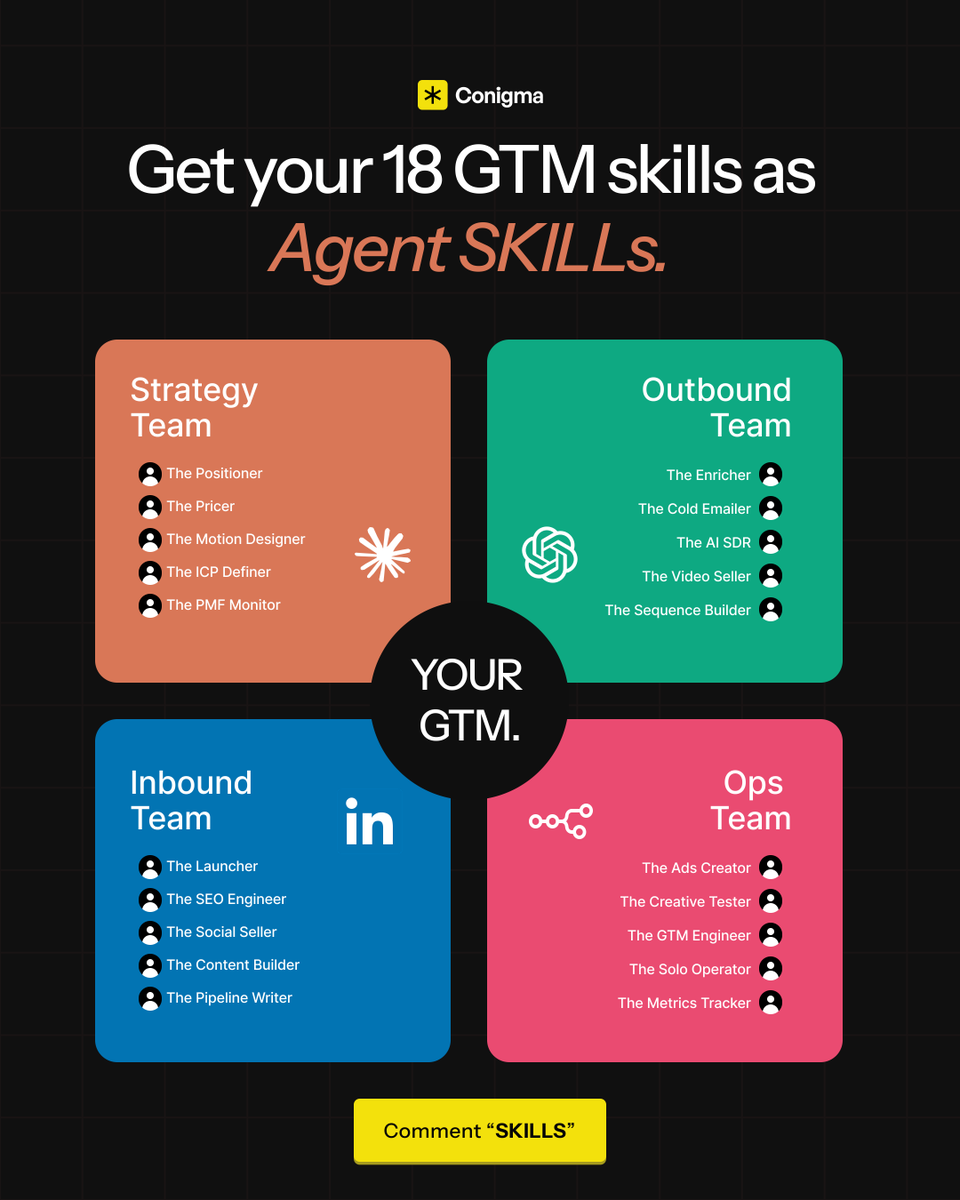
I've dedicated 5 weeks to building a full GTM agent skills library covering every function a revenue team runs daily. 18 SKILL.md files, 9,800+ lines of engineering context, and 6 skill categories across ICP scoring, cold outreach benchmarks, AI SDR deployment, programmatic SEO, partner programme design, and GTM metrics - installed in one command, works with Claude Code, Codex, Cursor, and any agent reading .md files. Here's a complete FREE breakdown for you. To access: 1. Like it 2. Comment "SKILLS" 3. Follow me (so I can send it to you via DM)
Yann tweet media
English
53
6
47
1.8K
Jack J.
Jack J.@jack_9947·
I built 43 prompts that replace a $5K/mo strategy and advisory stack. And I'm giving it away for free. Most people use Claude to summarise a doc or draft an email. That's 10% of the game. This system replaces the entire stack: Sales strategist → objection scripts, Chris Voss negotiation, cold outreach, discovery role-play Decision advisor → ripple effect analyser, pre-mortem, 360 decision framework, five thinkers council Business planner → McKinsey-style report, GTM strategy, cost saving playbook, Gartner market report Growth consultant → root cause analysis, pricing strategy, expert growth advisor, continuous improvement Founder coach → personal strategiser, gut feeling reverse engineer, annual review, goal dashboard 5 more roles. Each prompt does one job. Together, they run sales, decisions, planning, growth, and founder strategy inside one free pack. Just the prompts B2B founders and GTM leaders actually use to stop paying for advice Claude delivers in seconds. If you want it: 1. Connect with me 2. Comment "PROMPTS" 3. Repost if you want priority access And I'll send you the full pack.
Jack J. tweet media
English
63
22
46
2.5K
Rishi S Bhilawadikar retweetledi
Xiaoyin Qu
Xiaoyin Qu@quxiaoyin·
I've stopped trying to be smarter than AI. This might sound extreme, but I've completely changed my work philosophy. I used to be a PM who didn't code. Now I write code constantly because I let AI do most of the thinking. My approach has three principles: First, I assume AI is smarter than me. So instead of trying to prove my intelligence to AI, I focus on giving it more authority and better tools. Second, I minimize human-to-human communication in my company. When engineering and marketing need to coordinate, I require them to use Claude Code to check what features we've shipped. No more asking each other questions that AI already knows the answer to. Third, I design processes where AI empowers other AI, not where humans manage AI. Instead of people supervising AI work, I create workflows where different AI systems collaborate and check each other's output. This isn't about eliminating humans. It's about positioning humans as architects and AI as executors. We design the systems, set the boundaries, take responsibility for outcomes. AI handles the implementation details. The companies that embrace this philosophy first will have massive advantages. While everyone else is teaching people to use AI as an assistant, we're building businesses where AI operates autonomously and humans focus on strategy and accountability. SkillBoss AI is built on this principle - creating infrastructure where AI tools work together seamlessly, reducing human coordination overhead. #AIFirst #BusinessStrategy
English
30
5
58
4.1K