Robin Sayar

71 posts

Robin Sayar

Robin Sayar

@rlsayar

engineering organ parts I am interested data-analytical biology

Katılım Mart 2022
617 Takip Edilen90 Takipçiler
Robin Sayar
Robin Sayar@rlsayar·
most people never (have to) go from 0 to 1
English
0
0
0
28
Romain Lacombe
Romain Lacombe@rlacombe·
New one: my research agent refusing the steering from its orchestrator because it looks like... prompt injection.
Romain Lacombe tweet media
English
1
2
2
253
Robin Sayar
Robin Sayar@rlsayar·
@rlacombe @ClaudeDevs yes i dont know what it's doing, i get that prompt injection so much now! even in claude chats when i ask it to do research
English
1
0
1
15
Eryney
Eryney@eryney_ok·
in what world is this something the model can't answer? major props to @OpenAI and @GeminiApp for actually providing high quality answers
Eryney tweet media
English
4
0
27
1.4K
Eryney
Eryney@eryney_ok·
Claude has to be the worst model for biology, right? The filters are absolutely unreal. Hopefully someone fixes this at @AnthropicAI because it's unusable for real biology.
English
23
5
114
15.4K
Robin Sayar
Robin Sayar@rlsayar·
@thematthewosman (1) for popular approaches yes, but it has been shown that it can be robust (2) yearly, there are 1million biopsies taken in the US alone
English
1
0
0
44
linhao
linhao@lintaho·
Drug development is one of the biggest bottlenecks in getting new medicines to people, especially as AI drug discovery capabilities continue to accelerate. If you want to work on this problem, we're aggressively hiring AI technologists (PMs, Engineers, and more) to transform drug development. DMs are open!
English
5
6
51
5.5K
Robin Sayar retweetledi
Gleb Kuznetsov
Gleb Kuznetsov@glebkuz·
We're growing the AI team at @ManifoldBio, starting with a role to train protein foundation models on our proprietary data. I believe Manifold is the most interesting place to work on protein design. We're designing and testing millions of binders per month, including in vivo, and accelerating. No one else has data like this. If you have deep experience pretraining or fine-tuning protein models and want to work somewhere the data actually lets you push beyond what public datasets can enable, please reach out.
English
4
17
105
17.5K
Robin Sayar retweetledi
Ravi Sharma
Ravi Sharma@ravishar313·
I am Open-Sourcing PyMolAI! Meet PyMolAI, an AI agent that can talk to your protein structures. Built on top of PyMOL, PyMolAI lets you interact with your structures in plain language. Whether you're: - Analyzing protein structures - Aligning complexes - Creating publication-ready figures - Or running design workflows PyMolAI interprets your request, executes the necessary PyMOL commands, and manages the workflow for you. It integrates with @OpenBioAI APIs, giving you access to tools like Boltz, ProteinMPNN, and BoltzGen — directly from your PyMOL session. It has local chat history with session syncing, so you can pick up exactly where you left off.
English
54
197
877
85.8K
Stanford AI+Biomedicine Seminar
Stanford AI+Biomedicine Seminar@Stanford_AI_Bio·
We are thrilled to have Dr. @BoWang87 presenting "BioReason: Toward Biological Foundation Models That Reason" at our next seminar! 📍CoDa E160 | 2/10 2:30pm | Stanford + Zoom
Stanford AI+Biomedicine Seminar tweet media
English
3
19
112
18.1K
Robin Sayar retweetledi
Claude
Claude@claudeai·
Introducing Cowork: Claude Code for the rest of your work. Cowork lets you complete non-technical tasks much like how developers use Claude Code.
English
2.5K
8.4K
87K
49.7M
Robin Sayar retweetledi
owl
owl@owl_posting·
What if we could grow human tissue by recapitulating embryogenesis? This is an interview with Matthew Osman (@thematthewosman and Fabio Boniolo (@FabioZB_I), the co-founders of Polyphron. (Links in reply) The thesis behind Polyphron is equal parts nauseating and exciting in how ambitious it is: growing ex-vivo tissue to use in organ repair. And, truthfully, it felt so ambitious as to not be possible at all. When I had my first (of several) pre-podcast chats with Matt and Fabio to understand what they were doing, I expressed every ounce of skepticism I had about how this couldn’t possibly be viable. Everybody knows that complex tissue engineering is something akin to how fusion is viewed in physics; theoretically possible, but practically intractable in the near-term. What we can reliably grow outside of a human body are simple structures—bones, skin, cartilage—but anything beyond that is surely decades away. But after the hours of conversation I’ve had with the team, I’ve began to rethink my position. As Eryney Marrogi (@eryney_ok) lines out in his Core Memory article over Polyphron (corememory.com/p/exclusive-cr…), there is an engineering system that has reliably produced viable human tissue for eons: embryogenesis. What if you could recapitulate this process? What if you could naturally get cells to arrange themselves into higher-order structures, by following the exact chemical guidelines that are laid out during embryo development? And, most excitedly, what if you didn’t need to understand any of these overwhelmingly complex development rules, but could outsource it all to a machine-learning system that understood what set of chemical perturbations are necessary at which timepoints? This does not exist today, but Polyphron has given early proof points that is possible. In their most recent finding, which we talk about on the podcast, their models have discovered a distinct set of chemical perturbations that force developing neurons to arrange themselves with a specific polarity: just shy of 90°, arranged like columns. This is obviously still a simple structure—still a difficult one to create, given that even an expert could not arrive to that level of polarity—but it represents proof that you can use computational methods to discover the chemical instructions that guide tissue self-assembly. We discuss this recent polarity result, what the machine-learning problems at Polyphron looks like, and the genuinely insane economics of the whole endeavour. The last of which is especially exciting; it is rare you hear biotech founders talk about ‘expanding the Total Addressable Market’, and actually believe them. But here, it is a genuine possibility if the Polyphron approach ends up working. Finally: Thank you to @LatchBio for sponsoring this episode! LatchBio is building agentic scientific tooling that can analyze a wide range of scientific data, with an early focus on spatial biology. Check out their agent at agent.bio! Clip on them in the episode. Timestamps: 0:00:00 – Clips + ad roll by @LatchBio 0:02:16 – Introduction 0:02:37 – Why replace tissue rather than the whole organ? 0:10:34 – Why not do simple stem/progenitor cell injections? 0:13:51 – Can organs repair themselves naturally? 0:18:21 – What does “structure” actually mean in tissue engineering? 0:21:04 – Why are skin and bone the only FDA-approved tissues today? 0:23:45 – What exactly are tissue scaffolds? 0:27:52 – Why are organoids a “dead end” for this field? 0:35:08 – The argument for recapitulating developmental biology 0:40:28 – Walk us through the Polyphron experimental loop 0:47:56 – Can you simulate morphogenesis with only small molecules? 0:49:49 – How large is the set of possible tissue scaffolds? 0:52:32 – How reliable are developmental atlases? 0:56:45 – What is the machine learning model actually optimizing for? 1:04:04 – Polyphron’s first big tissue engineering result: polarity 1:15:33 – What comes after polarity? 1:17:09 – Why is vascularization the hardest problem of tissue engineering? 1:20:33 – Why can’t you just wash angiogenesis factors over the tissue? 1:22:25 – How does the graft integrate with the host’s blood supply? 1:25:45 – How do you validate tissue function before implantation? 1:29:01 – How do you design a clinical trial for a biological pacemaker? 1:37:01 – The argument for being a pan-tissue company 1:41:57 – What are the biggest scientific and economic risks? 1:45:23 – Who are Polyphron’s competitors? 1:47:07 – Expanding the TAM beyond transplant lists 1:52:28 – Autologous vs. Allogeneic approaches 1:55:07 – Is a 3-year timeline to the clinic realistic? 1:56:28 – Cross-species translation 1:58:05 – What would you do with $100M equity free?
English
8
15
52
16.8K
Robin Sayar
Robin Sayar@rlsayar·
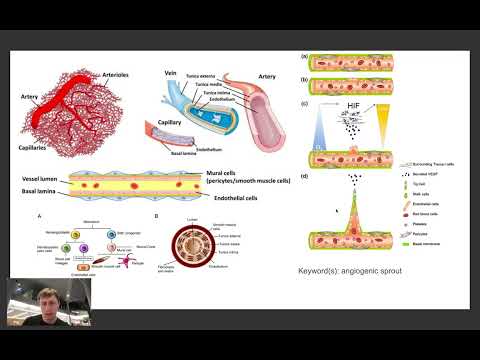
@samwebster" target="_blank" rel="nofollow noopener">youtube.com/@samwebster One of the best channels for knowing how your organs look like with a microscope
English
0
0
0
102
Robin Sayar retweetledi
Moroni Lab
Moroni Lab@MoroniGroup·
Still a few weeks to submit your abstract @EuTermis #TERMIS2026. If you are working on Technological tools for in vitro cell/tissue modelling: from bioreactors to organisms-on-a-chip the symposium organized by Bojana Obradovic and Manuela Raimondi is the symposium to go for!
Moroni Lab tweet media
English
0
2
6
299
Robin Sayar
Robin Sayar@rlsayar·
If you are interested in this question, please send me a message: How can cell differentiation and tissue structuring be simultaneously optimized in bioprinting and for organoids, and what benchmarks used or created?
English
0
0
1
116