Nick Stracke
54 posts

Nick Stracke
@rmsnorm
PhD Student at Ommer Lab (Stable Diffusion) Trying to understand worlds and motion...


Video diffusion models learn motion indirectly through pixels. But motion itself is much lower-dimensional. We introduce 64× temporally compressed motion embeddings that directly capture scene dynamics. This enables efficient planning -> 10,000× faster than video models. 🧵👇

Video diffusion models learn motion indirectly through pixels. But motion itself is much lower-dimensional. We introduce 64× temporally compressed motion embeddings that directly capture scene dynamics. This enables efficient planning -> 10,000× faster than video models. 🧵👇


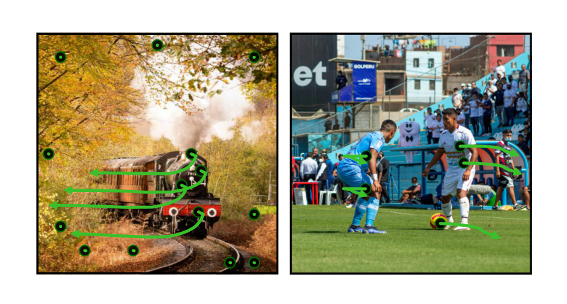
What’s the right representation for a world model? 3D, pixels, or something else? Excited to release our new paper “Forecasting Motion in the Wild” where we propose point tracks as tokens for generating complex non-rigid motion and behavior From @GoogleDeepmind @Berkeley_AI @TTIC_Connect

You don't imagine the future by mentally rendering a movie. You trace how things move -- abstractly, sparsely, step by step. We built a model that does exactly this. It predicts motion, not pixels -- and it's 3,000× faster than video world models. Myriad, accepted at @CVPR 2026

Video diffusion models learn motion indirectly through pixels. But motion itself is much lower-dimensional. We introduce 64× temporally compressed motion embeddings that directly capture scene dynamics. This enables efficient planning -> 10,000× faster than video models. 🧵👇