

Robert Stewart
745 posts

Haha, not hacked, just fair. 😂😂😂
When I see something that can truly help the holder, I also speak up.
Being critical doesn't mean being against Canton.
It means separating narrative from data.
And if Zenith brings real-world use, burns, and improves the BME, I'll be the first to celebrate.
"More real-world use on the public network, more value for $CC"
English

Has @akyra_0 account been HACKED!? 😂
There is Hope after all for us $CC Holders after all😂🤙🏾🤙🏾
Akyra_0@akyra_0
🧵 1/5 @CantonNetwork @CantonFdn @YuvalRooz @ShaulKfir @waynecollier111 @Emmett_ @wesarn_real @MarkWendlandCSH Two images. Two realities: Zenith = potential Current BME = ~67% Thanks to @HeslinKim for putting the numbers on the table. The question is simple: Can Zenith close the ~214M CC/month gap and bring $CC to equilibrium? If the answer is yes… this changes EVERYTHING.
English
14/14
Canton may be one of the most important infrastructures in the world.
But for $CC to be fair to everyone, the holder must also share in the value.
More real-world use.
More burn.
Less net emissions.
More alignment.
“More real-world use on the public network, more value for $CC”
English
🧵 1/14
Thanks to @HeslinKim and @ZenithFdn for the feedback.
This is some of the clearest information we've heard so far about how Zenith can impact $CC.
And if it's as you describe, it could be very significant.
But now we need to separate two things:
promise vs. data.
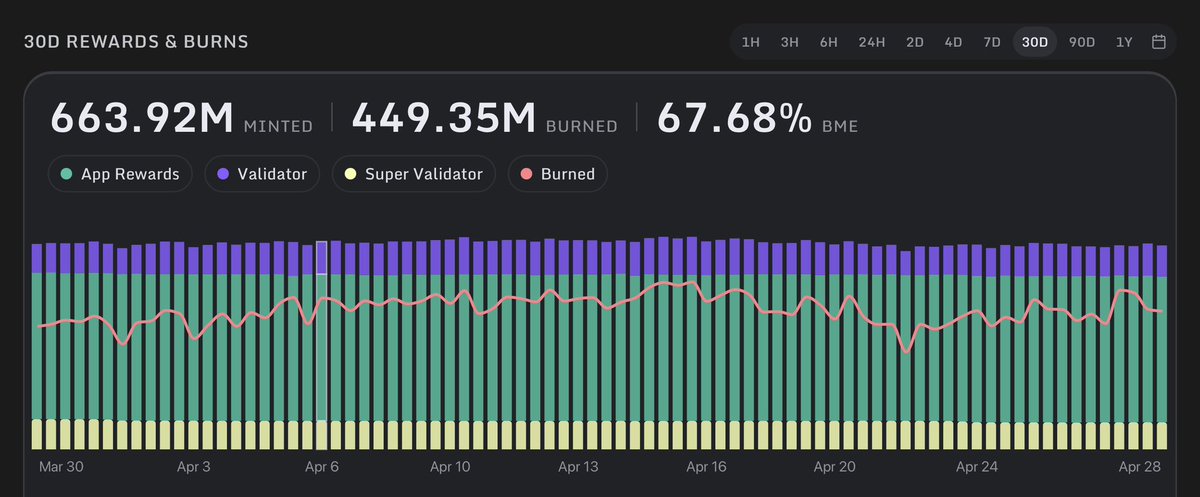
English
Canton has one of the most aggressive reward structures on the market.
And that begs the question:
Are the rewards fair… or are we paying an exorbitant price?
Because incentivizing growth is one thing.
Distributing tokens en masse while the open market holder absorbs the pressure is quite another.
The network is growing, yes.
But if that growth depends on huge rewards, then we have to ask ourselves:
How much usage is organic?
How much usage is subsidized?
How much net burn is left after paying incentives?
Who is actually funding this stage?
Here's the point:
If more tokens are issued than burned, someone has to buy that difference.
And that someone is the market.
And within the market, the holder.
Meanwhile, others receive rewards, accumulate power, gain influence, and can monetize sooner.
Then the usual suspects appear, saying:
“Look at the names”
“Look at the institutions”
“Look at the network”
“Be patient”
Perfect.
But names don't pay the holder.
Burn does.
And today the debate isn't whether Canton is a good network.
The debate is whether the value distribution is fair.
Because if the rewards buy real and lasting adoption, great.
But if they're just renting activity and shifting the cost to the holder, then there's a clear misalignment.
@CantonNetwork @CantonFdn
@YuvalRooz @ShaulKfir @waynecollier111 @Emmett_ @wesarn_real @MarkWendlandCSH
Conclusion:
Canton can't sell us alignment while some receive rewards and the holder absorbs emission.
If the holder foots the bill, the holder also deserves to share in the value.
“More real-world use on the public network, more value for $CC”
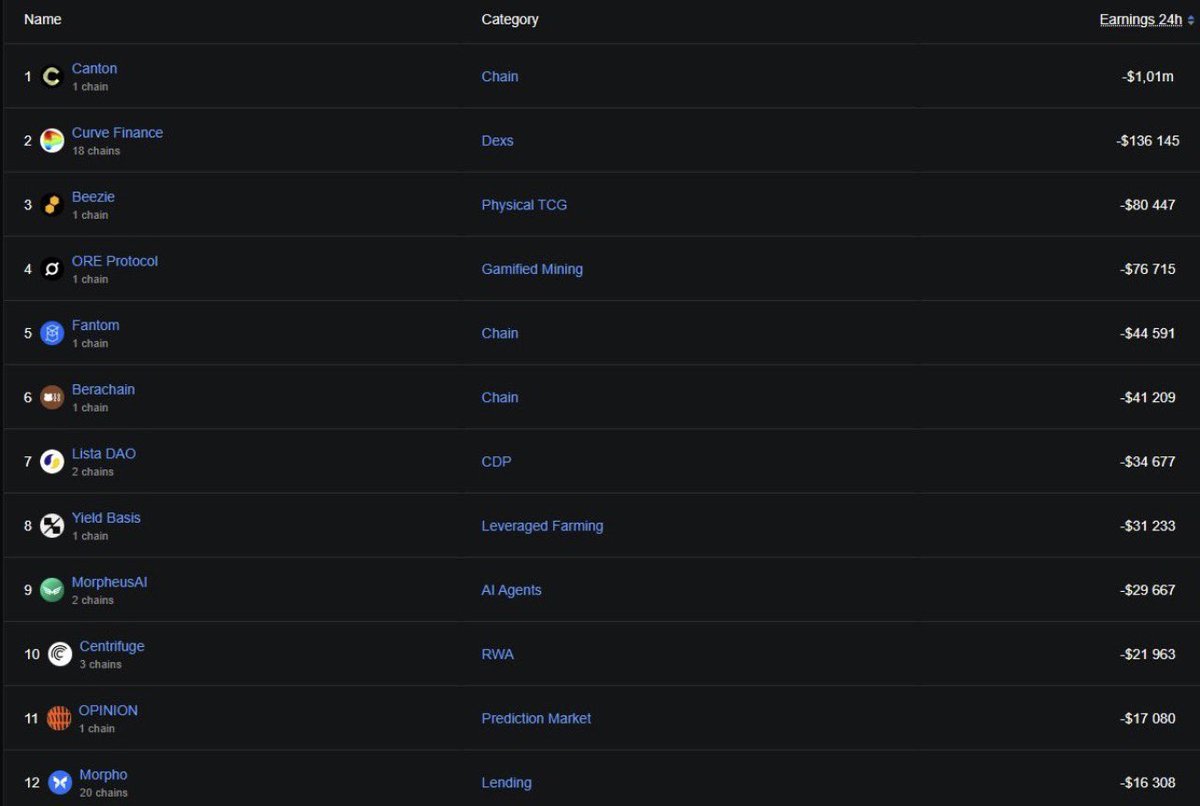
English
Transactions in Canton are at an all-time high.
The growth is phenomenal.
But the $CC token isn't capturing that value at the same rate.
And here's the uncomfortable question:
If the network is growing so much…
why aren't the holders seeing it?
Imagine you invest in a highway.
You're told:
"The more cars that pass through, the more you earn."
Perfect.
Then you look at the data:
More cars
More traffic
More activity
More volume
But when you look at your revenue…
It's not increasing.
Why?
Because it turns out many cars aren't paying tolls.
Or they're using private lanes.
Or they have special agreements.
Or the traffic is there, but it's not passing through the section where you collect tolls.
That's precisely what many holders in Canton are trying to understand.
They show us the big picture:
institutions
banks
repos
RWAs
Japan
Wall Street
more transactions
more activity
But they talk much less about what really matters to the holder:
how much of that activity goes through the public network?
how much real burn does it generate?
why isn't the mint/burn improving at the same rate?
who absorbs the net issuance?
Because if there's more traffic, but the toll doesn't reach the token, then the problem isn't the graph.
The problem is the value capture model.
And meanwhile:
some receive rewards
others accumulate power
others monetize first
and the holder buys, waits, and absorbs pressure
We're asked for patience.
We're told "soon."
We're told about the long term.
But the present matters too.
And no, we're not stupid.
We see the metrics.
We see the issuance.
We see the burn.
We see the difference.
And we see that we're told a lot about the network's greatness, but very little about the uncomfortable side of tokenomics.
@CantonNetwork @CantonFdn
@YuvalRooz @ShaulKfir @waynecollier111 @Emmett_ @wesarn_real @MarkWendlandCSH
Direct question:
If Canton is working so well…
Why is the token holder still so out of sync?
Why isn't the use of the public network being accelerated?
Why isn't it being explained with complete clarity how much value actually goes to $CC?
Canton may be a huge network.
But a large network isn't enough.
It has to be a network where value also goes to the token.
Question for token holders:
Are we participating in the growth…
Or are we simply providing the liquidity for others to monetize?
“More real-world use on the public network, more value for $CC”

English
I understand some of the criticism, but I think two different things are being conflated.
Canton isn't trying to be Bitcoin or Ethereum.
It's not purely permissionless, and it's clearly geared towards institutions with privacy and compliance requirements.
That's not a flaw; it's a design choice.
However, that doesn't mean everything is perfect.
There's a much more interesting debate than "centralized vs. decentralized":
👉 how value is transferred to the token
👉 how the mint/burn mechanism evolves
👉 and whether the holder is truly aligned with the network's growth
That's where, in my opinion, legitimate questions arise.
Canton may have a solid proposition at the institutional level, but at the same time, it needs adjustments so that this growth also clearly benefits the open market.
In the end, it's not black and white.
It's neither the "absolute future" nor the "monster" that some describe it as.
It's a different model… one that will have to prove over time that it can align all participants.
“More real-world use on the public network, more value for $CC”
English

Canton is misleading the public & investors with lies & fake metrics!
It is a centralized money printer with a built-in tax, tiered fees, KYC & censorship built in
That is not "blockchain"!
It is instead a nightmare of centralization worthy of a dystopian cyberpunk novel: 🧵
The definition of permissionless is that we do not need permission to participate in consensus. That is not at all the case for Canton!
There is a literal invitation-only application proccess, where the pre-existing validator set decides who is allowed to join, determining consensus!
The fact that there even is an application proccess is the perfect litmus test for permissionlessness that Canton clearly fails
That makes it a totally permissioned system & by extension, also makes it totally centralized. It can never achieve credible neutrality, despite their claims to the contrary
Centralized Money Printer:
Canton has an insane net inflation rate of 21.8%!
To add insult to injury, centralized designs do not actually need a token... Yet, Canton still does
There is no application proccess in any truly decentralized system. Consensus instead relies on incentives, either in the form of a stake or work. That is why a token of value is needed to award participants
However, in Canton, these rewards still go to validators who did not put up any stake! Along with a select group of applications chosen by this centralized authority...
This makes it essentially "free money," from the perspective of these validators & applications. This helps to explain, to a large extent, the motive behind many of these partnerships
A board for a for-profit company has a fiduciary duty to agree to a deal where they are offered millions of dollars to simply run a node & say they have a partnership, which also looks good for their company's evaluation...
That does not mean it is not all BS, it only "works" due to the magic of a crypto money-printer scheme, which has a lot in common with a Ponzi scheme
This is a playbook we have seen time & time again in crypto; it is nothing new
Extractive Economics:
Talking about there being nothing new under the sun: Canton has a literal tax system in which holders have a portion of their tokens taken directly from their wallets & burned!
There is also a tiered fee system, where a higher fee is paid for smaller users & a lower fee for larger users. Making it an inherently unequal system, another reason why it is more like the old banking system than crypto
The centralized authority decides which applications are "featured," significantly increasing their rewards & visibility. This obviously also opens up countless opportunities for favoritism & even corruption!
Fake TVL Metrics:
Canton claims to have an RWA TVL of over $326 billion! That would put it ahead of all other blockchains by an extremely large margin
This claim is entirely false; it is instead an accounting trick that they achieved through their partnerships
Certain companies, such as Broadridge, are simply mirroring their balance sheets within their private networks on Canton. This is then counted as "on-chain" TVL...
Despite that, nothing would change if the Canton network disappeared tomorrow!
That is why some sites report that full amount, but more reputable sites, such as DeFiLama, report a total TVL as $0! That is the very definition of a fake metric. It is all smoke & mirrors
Preying On Ignorance:
There is a continuous cycle of centralized "crypto" that exploits people's ignorance
The main innovation of crypto is decentralization: The ability to do finance in a permissionless, credible neutral, & censorship ressistant manner is the real breakthrough of this technology
This requires a major paradigm shift in thinking. Something many people are simply not ready for, especially such large institutions
So, in the meantime, we see countless attempts to present them with a more palatable form of "crypto"
However, much like the history of the early internet, where large institutions resisted the public internet & pushed for private internets. The public internet won & helped create the brave new world we live in today
The history of crypto is surely going to play out in the same way, as the type of centralized authority we see in Canton has become outdated
Conclusion:
It is a free market & people can build whatever they want. However, we must draw a line once misleading claims are made
That is where it went from live & let live to us needing to take action against Canton. Cryptocurrency is special, & we cannot allow anyone to falsely invoke the values & principles we hold so dear. Only to sell a token that is antithetical to that very movement
That free market only works if we can self-police against bad actors. Something that has to be done in the free marketplace of ideas. That is why I implore you today to reject Canton & all that it represents
Canton is regressive, as it goes against everything crypto stands for. While pretending to have the same attributes of crypto, when nothing could be further from the truth. It is, frankly speaking, significantly worse than the current banking system
The crypto movement was born as a protest against such arbitrary centralized power. As the Bitcoin genesis block so clearly stated
It would be tragic if crypto ends up birthing a monster that turns out worse than what it was trying to fight.
Help us fight this monster by spreading this message far & wide. As crypto deserves better, we deserve better
That is why we must push back against all pretenders to the throne, as crypto is meant to be a liberating force. Canton has no business being in that exclusive club
As ultimately, crypto is here to make the world a better place through economic freedom, privacy, censorship resistance & individual sovereignty! 🔥
English
CIP-0114 may sound great on paper, but it's best to look at it objectively.
Yes, it attracts institutional capital.
Yes, it incentivizes the accumulation of CC dollars.
Yes, it can reduce part of the float.
But let's be clear:
this is accumulation, not use.
And for the holder, what really matters isn't who accumulates, but:
more use of the public network
more burn
a better mint/burn balance
That's where real value is created.
—
The underlying problem is something else:
these types of measures strengthen the position of those already involved.
* more capital → more weight
* more weight → more rewards
* more rewards → more accumulation
* more accumulation → more control
same circuit, bigger
—
Meanwhile:
the holder continues to be asked for patience.
—
That's why we need to be clear:
this isn't the solution; it's a band-aid that primarily benefits the institutional side.
It might help maintain the narrative and structure, yes.
But it can also concentrate more power and more tokens in the hands of the same players.
And that, in the long run, is a double-edged sword.
—
If we truly want to align the system:
attracting capital isn't enough.
we need to generate real-world use.
we need to increase the rate of token burning.
we need to make value flow into the token.
—
Because otherwise:
the network grows.
capital flows in.
but the holder remains the same.
—
A good initiative for some.
Insufficient—and even potentially dangerous—for global equilibrium if it isn't accompanied by real-world use.
@CantonNetwork @CantonFdn
@YuvalRooz @ShaulKfir @waynecollier111 @Emmett_ @wesarn_real @MarkWendlandCSH
“More real-world usage on the public network means more value for $CC”
BSCN@BSCNews
CANTON APPROVES INSTITUTIONAL TREASURY MODEL UNDER CIP 0114 The Canton Foundation (@CantonFdn) has approved CIP 0114, introducing the Digital Asset Treasury model. The program allows public companies to hold Canton Coin canton-network:native as a treasury asset. Firms can offer structured exposure to investors through these holdings. Qualification requires at least 100 million dollars in assets under management. The move aims to drive long term institutional accumulation and governance participation.
English
Post 1/2
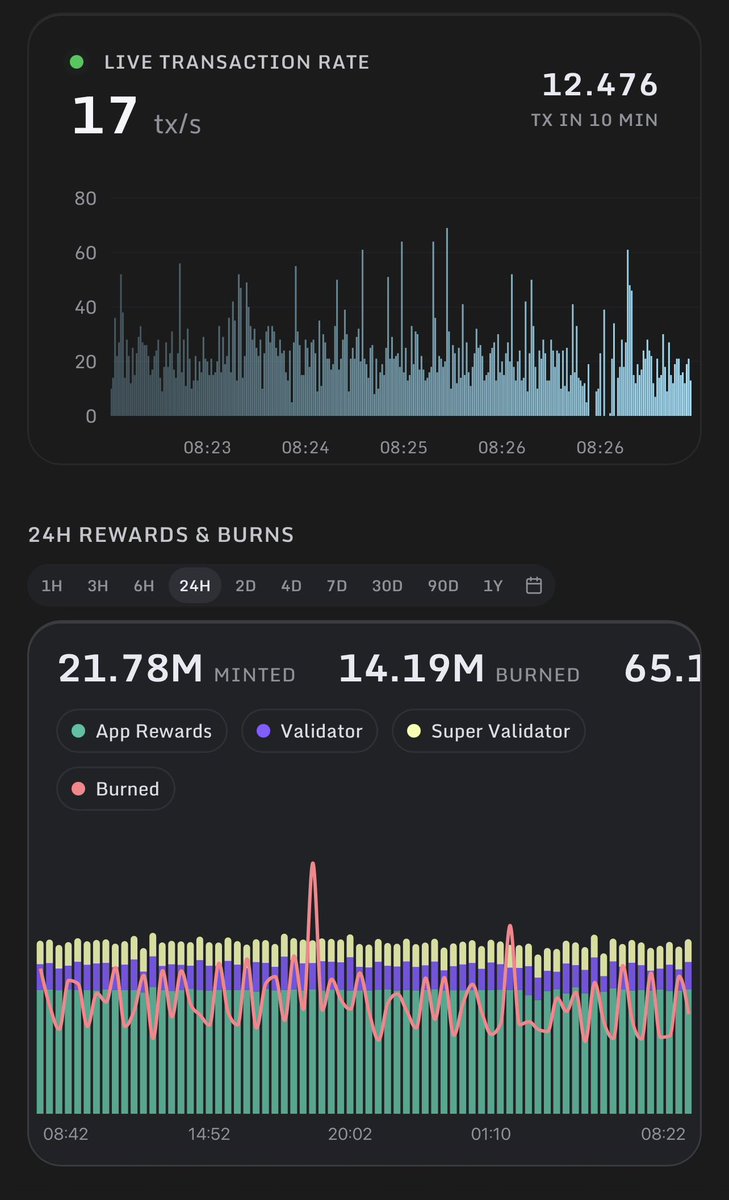
Let's look at some real numbers regarding what's happening with $CC.
No rhetoric.
No "soon."
Just data.
Last 24 hours:
21.78M CC issued
14.19M CC burned
Difference:
+7.59M net excess CC
Now let's look at a month:
7.59M x 30 days = 227.7M CC per month
At current prices, that's tens of millions of dollars of net supply per month that the market has to absorb.
And note:
not to raise the price.
Just to prevent it from falling.
"More real-world use on the public network, more value for $CC"
English
I see people conflating two things that aren't comparable in the same way:
Bitcoin and $CC.
And that's where the mistake lies.
Bitcoin can issue new coins and still rise because:
- it has a fixed total supply
- marginal issuance falls with each halving
- and the market knows there will never be more than 21 million
In $CC, however:
- the supply doesn't work that way
- issuance remains relevant
- and value capture depends much more on how close the burn price is to the mint price
That's why the argument that
"Bitcoin is also inflationary, so the burn price doesn't matter in $CC"
is simply incorrect.
Of course, $CC can rise without the burn price exceeding the mint price.
But that doesn't mean the mint/burn price stops mattering.
Conversely:
It matters a great deal because it indicates:
- the quality of that price increase
- the supply pressure the holder is experiencing
- and how much value the token is actually capturing
Bitcoin doesn't need the same kind of equilibrium because it operates with a fixed scarcity logic.
$CC doesn't.
In $CC, if the mint price is clearly ahead of the burn price, the holder needs more demand, for a longer period, and with greater force, just to offset that issuance.
That's the nuance some still don't understand.
It's not about denying that the price can rise.
It's about understanding what needs to happen for it to rise with a healthy base.
And that's where the mint/burn ratio remains crucial.
"More real-world use on the public network, more value for $CC"
English
The network is still alive, but today's tokenomics are bad for the holder. With ~58.9% of BMR, net issuance is clearly prevailing again. If this doesn't rebound soon, it reinforces the thesis that current growth is still benefiting the network much more than the token.
"More real-world usage on the public network means more value for $CC."

English
@akyra_0 As usual...well said...anyone as a retail holder..take note
English
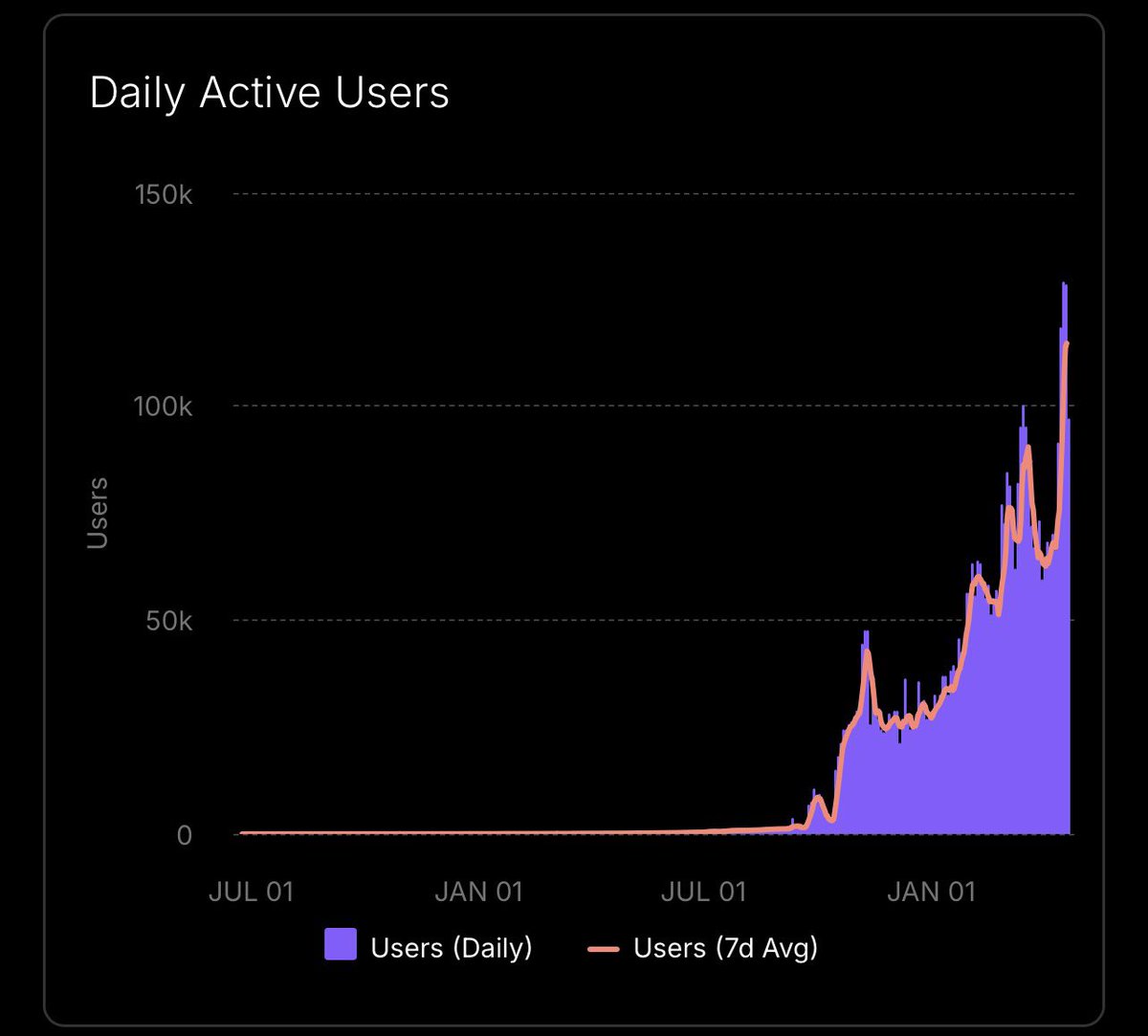
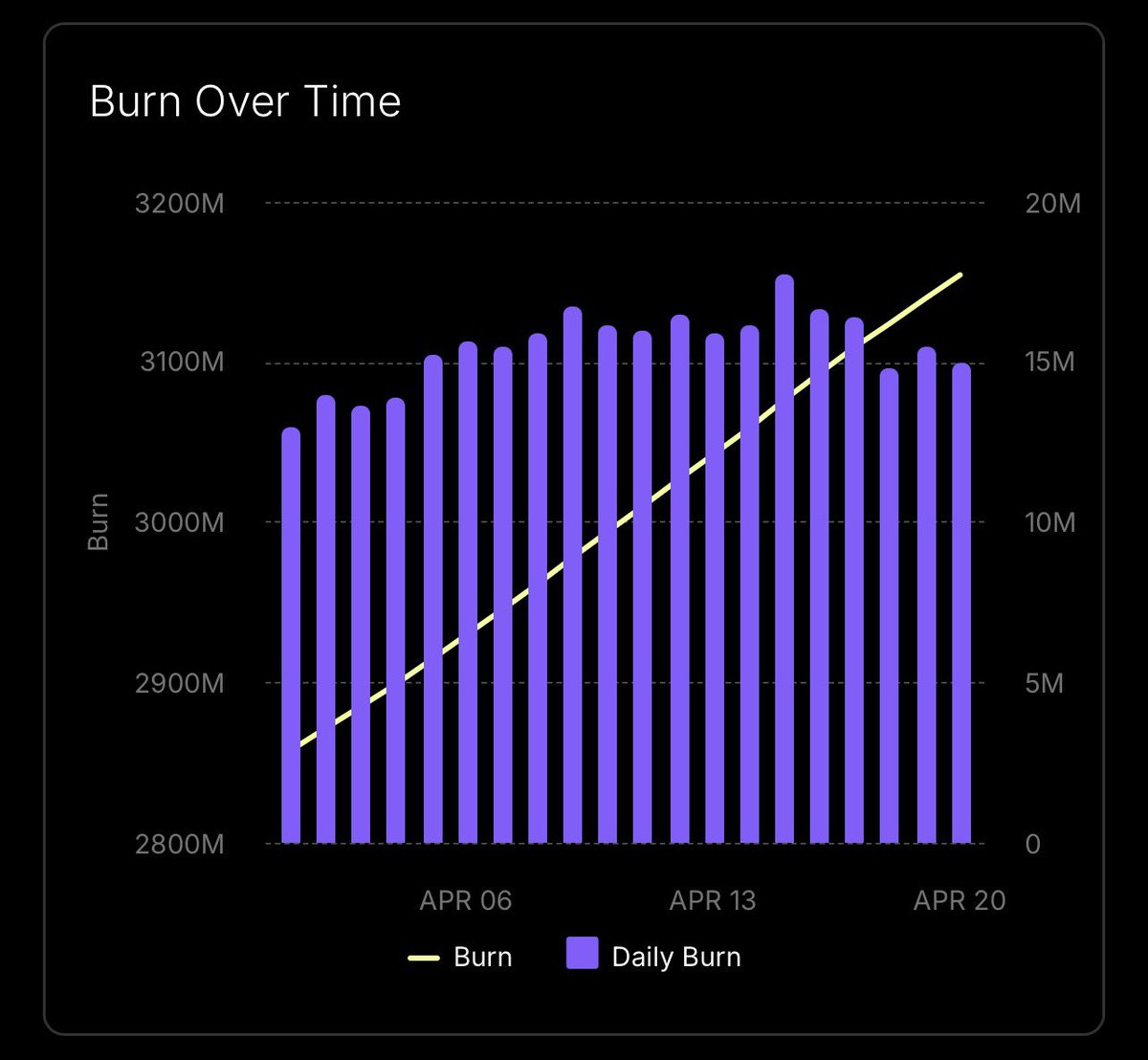
Interesting what's happening with $CC 👇
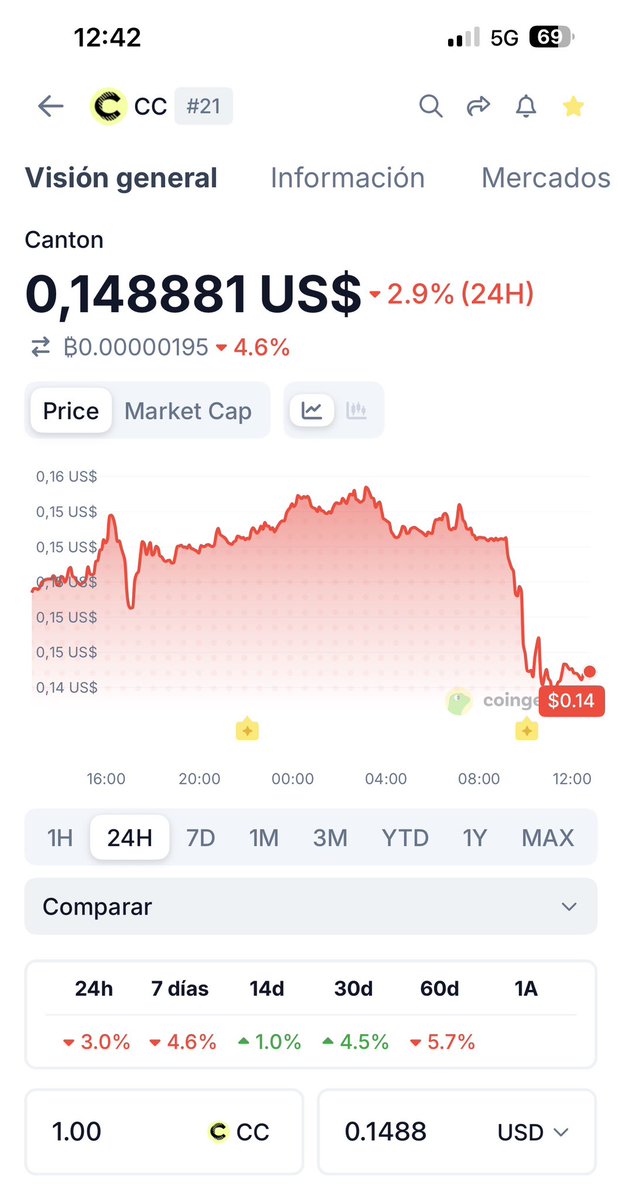
Price flat/falling
Activity rising
Users growing
But the mint/burn ratio remains at ~65–68%
Exactly the same as 30 days ago
What does this mean?
→ More is being issued than burned
→ Selling pressure is constant
→ The system is not yet in equilibrium
And here comes the uncomfortable part:
The Canton model is designed to reward real activity…
but today, that activity is generating tokens that someone is selling.
Meanwhile:
• The holder absorbs that liquidity
• The price doesn't reflect the growth
• Burning is stable, not accelerating
Theory says:
“more usage → more burn → more value”
The reality today:
“more usage → more issuance → more selling pressure”
And no, you don't need to know “who's selling”
because the design itself explains it:
→ validators
→ super-validators
→ distributed rewards
That flow exists and reaches the market.
Reasoning (Based on Reality)
* Canton burns fees but also issues tokens for participation
* Fees are denominated in USD → the burn doesn't scale linearly with the price
* The system only balances if usage grows faster than issuance
Risks / Exceptions (It's important to be fair)
* If public usage truly increases → the burn can close the gap
* If more activity passes through the public layer → net pressure improves
* If institutions start consuming CC directly → the dynamics change
But today, that's not happening at the necessary level
Final Message
This isn't FUD. This isn't hate. It's simply reading the metrics:
The network may be growing…
but the value for the holder isn't yet aligned.
When the mint/burn balance changes → everything will change.
Until then, the price reflects exactly that.
“More real usage on the public network, more value for $CC”

English
I understand your point, Yuval. And yes, in the end, the market will decide whether or not to adjust the value of $CC over time. But here's a more concrete question we shouldn't keep avoiding:
Is the passive holder a real part of the Canton equation or not?
Because it's one thing to say, "The market will figure it out eventually," and quite another to clearly explain what specific mechanisms will ensure that value reaches the holder as well, and not just those who trade, validate, or collect rewards first.
So I'll ask you directly, and I'd appreciate it if you didn't shy away from this:
Do you expect the $CC holder to be a significant part of the network's future value capture, or is it not a real priority in the current design?
"More real-world use on the public network, more value for $CC"
@waynecollier111 @ShaulKfir @Emmett_ @CantonNetwork @CantonFdn
English
Post 1/3
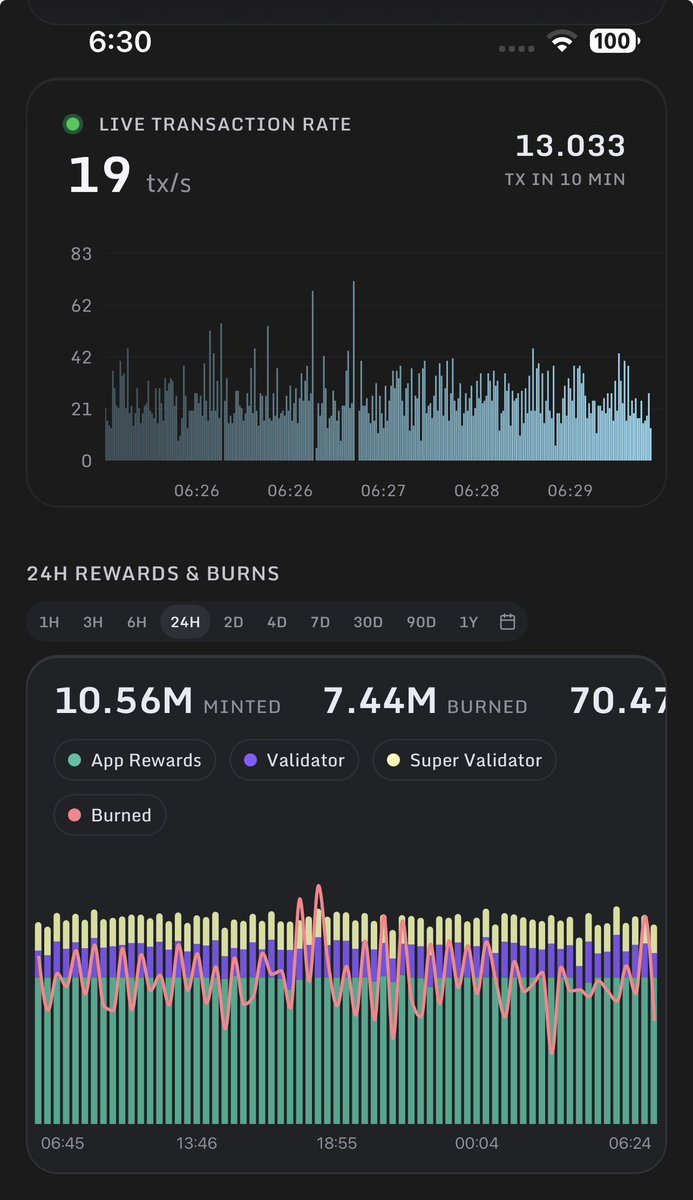
Looking at today's on-chain snapshot, the Canton network is improving:
• 10.56M minted
• 7.44M burned
• BMR 70.47%
• ~$2.3M in daily fees
• 70.9K active addresses
• private updates at 30.7%
In other words, the network is performing better than it was a few weeks ago.
But the price of $CC doesn't reflect this as one might expect.
And this is where many holders have a perfectly legitimate question:
If the network is improving, good news is coming out, and there's demand… who is taking advantage of that liquidity?
I'm not making any claims.
But I am saying this:
The feeling for the holder remains uneasy.
“More real usage on the public network, more value for $CC “

English

Quick thought before I reply more in depth later.
How is this different from bitcoin?
Canton is strictly better in this sense, since new issuance is distributed across more pools: SVs, Validators, app operators, and the dev fund.
Already, we're seeing competitive pressures between wallets and apps causing them to redistribute these rewards to their retail users.
In any case, I think it's worth evaluating how Canton's tokenomics work at equilibrium, where new issuance is not inflationary but rather redistributes fees. It makes perfect sense to me if someone says CC is too inflationary at the moment and prefers to sit it out until the network reaches BME.
English
1)
The tokenomics of $CC has a powerful idea on paper: that the currency should reflect the actual use of the network. And that, in theory, sounds great. Rewards are issued to those who contribute utility, and coins are burned when the network is used to pay fees. The problem isn't the idea. The problem is how it's working in practice today.
Right now, the system is still in a phase where significantly more $CC is issued than is burned. If the burn rate is around 60% of what's issued, that means something very simple, even for someone new to the topic: more $CC is still entering the market than leaving it. And when that happens, someone has to absorb that difference.
This is where the crucial nuance that many don't want to face comes in: who receives these new $CC first? Primarily, those who operate infrastructure, validators, super-validators, and applications that generate measurable activity on the network. In other words, the players closest to the system, the best positioned, and those already within the rewards circuit. The official documentation makes it clear that the coins are being made available for minting by those who contribute to the network's utility, with the revenue being shared between infrastructure and applications.
In simpler terms:
institutional investors and operators get paid first.
And if they then sell some of those rewards, someone buys into that selling pressure.
Who is usually on the other side? The market. And often, the token holder.
That's why I say that, currently, institutional investors benefit doubly:
first, because they participate in the network and collect rewards;
and second, because if they decide to sell, they have a market ready to absorb those tokens while the narrative continues to drive the price up.
Meanwhile, retail token holders do something much more passive and less advantageous:
they buy on the market, accept volatility, hold the token, and hope that one day all that institutional utility will translate into a clearer value capture for them.
And here's the awkward point: much of Canton's institutional value lies in private flows and private permissions, while the holder needs a sufficient portion of that activity to actually interact with the public network and burn enough $CC to offset or exceed the issuance. If that doesn't happen consistently, network growth might be great for the infrastructure… but far less fair for those who simply hold the token. Canton's architecture itself distinguishes between domains and shared synchronizers, and the token's value depends on how much usage ends up passing through that realm where $CC pays fees and is burned.
To be clear:
This doesn't mean Canton is bad technology.
It doesn't mean the thesis is dead.
It doesn't mean there's no potential.
It means something much simpler: current tokenomics favors those who operate and collect within the system more than those who simply hold $CC from the outside.
“Más uso real en la red pública, más valor para $CC”
@YuvalRooz @waynecollier111 @ShaulKfir @CantonNetwork @CantonFdn
English
Thanks for getting to the heart of the matter, Shaul. And yes, I understand the comparison to Bitcoin, but that's precisely my criticism: just because something resembles Bitcoin during the inflationary phase doesn't mean it's well-aligned for the holder today.
My point isn't what Canton might look like in equilibrium in the future. My point is who benefits right now. And right now, the beneficiaries are still primarily the same as always: those who operate, those who validate, those who build within the system, and those who are first paid for issuance. The holder, on the other hand, enters the market by buying shares and absorbing pressure while waiting for that future equilibrium to arrive.
Competition between wallets and apps sounds good, but for now, that doesn't guarantee sufficient or clear redistribution for the retailer. It might happen in some cases, yes, but today it remains very indirect, unequal, and optional.
That's why I think the important question is no longer theoretical, but practical:
What concrete commitment are you willing to make to improve alignment with the holder before reaching that supposed equilibrium?
Because if the answer is simply ‘wait for the network to mature,’ then the cost of that transition continues to be borne primarily by the market and small investors. And that is precisely what many of us are questioning.”
“More real-world use of the public network, more value for $CC “
English
Less focus on the “common enemy” and more on introspection.
Solana and Ethereum may have a thousand flaws, but at least the holder has a better understanding of what they're buying and how they capture value.
In Canton, for now, the network is being touted as a revolution, while those who monetize best are the institutional investors, the operators, and those who collect rewards first.
That's not superiority. That's tokenomics that still leaves retail investors in the background.
Perhaps the problem isn't comparing itself to Solana or Ethereum.
Perhaps the problem is demonstrating that $CC is truly useful for more than just providing initial liquidity to those at the top.
“ More real-world use on the public network means more value for $CC “
English
I'm honored that @CantonNetwork has become Solana and Ethereum's common enemy. There's no greater validation.
chase@therealchaseeb
As I said before. Solana and Ethereum are more aligned than ever b4
English
@DigitalFinanceD @CantonFdn @CantonArmy @ShaulKfir @gluk64 @chainyoda @FigoETH @HeslinKim Really good explanation..thankyou
English

The Prividium Hype: Why Canton Already Won The Global Finance War
The cryptocurrency world is currently obsessed with a manufactured rivalry. Across social media and crypto forums, vocal purists are desperately trying to pit the Canton Network against a new venture capital funded app called Prividium. They are arguing over which technology will become the future backbone of global banking.
This is a massive opportunity to set the record straight and educate the market. The truth is, comparing Canton to Prividium is like comparing a federal reserve vault to a public storage unit. They are not even playing the same game.
To understand why this new app stands absolutely no chance of replacing Canton, we first need to look at what Canton actually is, the incredible scale it already operates at, and why Wall Street trusts it with their trillions.
The Canton Masterclass: Building The Wholesale Vault
Canton was not built in a weekend by crypto developers trying to launch a meme coin. It is the culmination of a decade of institutional engineering. To understand why it dominates the adult room of global finance, you have to look at its massive foundational pillars and exactly how they work.
1. The History and The Heavyweights
Canton is built on technology originally developed in 2014 by Digital Asset. It was founded by Wall Street veterans who did not just guess what the industry needed. They physically sat inside the biggest banks in the world to learn their exact operational pain points firsthand. Digital Asset was a founding member of the Hyperledger project, helping build the very first enterprise blockchain standards long before the modern crypto hype cycle even began. Their institutional history is so deep that there is really no comparison. Today, Canton is not an experiment. It is the live, beating heart of institutional finance. To put this in perspective, Broadridge uses the Canton Network for its Distributed Ledger Repo platform. As of early 2026, that single platform is processing nearly 400 Billion dollars in daily volume. That is roughly 9 Trillion dollars a month in secure, synchronized wholesale settlement. This matters because Wall Street does not adopt untested software. They demand a decade of rigorous, battle tested performance before moving a single dollar.
Prividium is running regional bank deposit pilots. Canton is running the global economy.
2. True Decentralization and The Linux Foundation
The crypto crowd loves to scream about decentralization, but they completely ignore how corporate ownership actually works. Banks will never put their core infrastructure into a system owned by a single software vendor because it creates a massive monopoly risk. Digital Asset solved this by giving up control. The Canton Network is governed by the Canton Foundation, which operates directly under the Linux Foundation. The Linux Foundation is the exact same neutral non profit organization that governs the operating systems powering the entire global internet!! They now oversee the entire Canton ecosystem, ensuring it remains a globally recognized open standard. Canton is not owned or controlled by some private company looking to extract fees or secure a buyout. It is managed by the absolute most trusted open source governing body on the planet.
Prividium is controlled by a venture capital startup desperate for an exit. Canton is governed by the same non profit that runs the global internet.
3. The Architecture: Atomic Settlement Without Bridges
Canton is a base Layer 1 network. It is designed as a network of networks where each participating bank controls its own private node. When Goldman Sachs needs to trade with BNY Mellon, they do not send their assets to a third party or a bridge. Instead, Canton uses a technology called the Global Synchronizer. Think of the Global Synchronizer as a highly secure digital matching engine that connects completely separate bank databases. It simultaneously checks both private vaults to ensure the cash and the assets are actually there. Once verified, it coordinates a direct swap between the two banks at the exact same time. This is called atomic settlement. Atomic means that the cash and the asset swap hands at the exact same microsecond, or the trade fails entirely. Nobody is ever left waiting for their side of the deal, and the money never sits in a vulnerable middle ground.
To picture how Canton works, imagine two billionaires sitting inside a highly secure, locked vault, handing each other a briefcase of cash and a gold bar simultaneously. It all happens at once in the exact same room.
In contrast, Prividium is a Layer 2 network. A Layer 2 is simply a secondary application bolted onto a main public blockchain to try and handle excess traffic. The massive risk associated with a Layer 2 is that it has no independent security foundation. It is completely dependent on the underlying public network, and to move assets in and out of the Layer 2, banks are forced to lock their money in connecting smart contracts, otherwise known as bridges. Bridges are the absolute number one weakness in all of crypto and the ultimate target for hackers. They are responsible for over 3 Billion dollars in stolen funds recently. Using a bridge to move institutional liquidity is like doing a drug deal in front of the police station and just hoping nobody looks out the window. If the main network experiences issues, or if that highly vulnerable connection is exploited, the Layer 2 collapses.
Prividium is a dependent Layer 2 that relies on Escrow Contracts to move money. Canton is a sovereign Layer 1 that settles trades instantly across private nodes without the assets ever leaving the vault.
The Fatal Flaws: Where Prividium Completely Loses
When you look under the hood of Prividium, you find a system built for retail crypto trading that is desperately trying to disguise itself as institutional infrastructure. Here is exactly where Prividium fails the Wall Street test.
4. The Federal Reserve Requirements and Settlement Finality
When building for tier one banks, you have to follow the rules of the central banks. The Federal Reserve Principles for Financial Market Infrastructures strictly require absolute settlement finality and absolute operational resilience. Prividium settles its transactions on the public Ethereum network. Ethereum uses probabilistic finality, meaning transactions can theoretically be reorganized or reversed if the public network experiences a major disruption. Canton was built specifically to meet these strict regulatory standards, providing deterministic finality where a settled trade is mathematically and legally permanent the instant it happens.
Prividium relies on the unpredictable public Ethereum network for finality. Canton provides the absolute legal finality required by the Federal Reserve.
5. The Mathematical Proof Bottleneck and Bug Risk
Prividium uses Zero Knowledge proofs. This means a computer called a Prover has to generate a massive, complex mathematical equation to prove a trade is valid before it settles. This creates two massive weaknesses. First is latency. In a market crash, generating these proofs creates a massive bottleneck, meaning your trade could be delayed for minutes or hours. Second is the risk of a mathematical bug. If there is a hidden flaw in the zero knowledge circuit, a hacker can exploit the math to secretly print infinite fake tokens, and no one would know until it is too late. Canton completely eliminates this because the actual banks involved in the trade verify the logic directly on their own nodes in real time.
Prividium forces banks to trust a slow, highly experimental mathematical equation. Canton forces the actual transacting parties to verify the trade instantly.
6. The Centralized Sequencer and Liveness Risk
Prividium relies on a mechanism called a sequencer to batch and process transactions. Currently, the team at Matter Labs operates this sequencer centrally. This creates a massive single point of failure. If the Matter Labs servers go down, the entire Prividium network halts entirely. This liveness risk is completely unacceptable for global capital markets that must operate flawlessly every single second of the day.
If a Canton node has an issue, only that specific bank is affected. If the Prividium centralized sequencer goes down, the entire network freezes.
Who Prividium Is Actually Competing With??
Once you understand the sheer scale of Canton, it becomes wildly obvious that Prividium is not built for the wholesale capital markets. Prividium is aiming directly at Consumer Web3, cross border remittance, and retail decentralized finance.
Let us be clear about what Prividium actually is. It is an absolute #XRP killer. For years, @Ripple and XRP have tried to own the market for fast and cheap cross border retail payments. Prividium can do exactly that, but with the added benefit of Ethereum compatibility and zero knowledge privacy. If you are holding XRP hoping it becomes the standard for moving money around the globe, Prividium is your absolute worst nightmare.
Beyond replacing old payment coins, Prividium is going to compete head to head with retail networks like @0xPolygon , @avax , and @coinbase over consumer crypto. We are talking about retail stablecoin payments, consumer brands issuing digital collectibles, and everyday users trading meme coins. Prividium gives those exact same brands a scalable way to plug into the retail crypto world without exposing all their customer data.
The Adoption Illusion and The Burden of Proof
You might ask why the Cari Network of regional banks just signed up to use Prividium for a tokenized deposit pilot. Prividium is built by Matter Labs, a startup that raised over 450 Million dollars from Silicon Valley venture capital firms. When a venture backed crypto network needs momentum, they give away massive ecosystem grants. It is highly likely these regional banks received heavily subsidized or free technology development for this pilot. It is a marriage of convenience, not a Wall Street endorsement.
Even in the retail arena, Prividium has a massive amount to prove. While @CantonNetwork has hardened its Daml code inside real banks for a decade, Prividium relies on brand new, highly experimental zero knowledge math.
Furthermore, the corporate history of @the_matter_labs is a walking red flag. They are currently facing a massive intellectual property theft lawsuit alleging their founders stole core code from a former employer called @BANKEX to launch their company.
In a separate incident, they were caught copying open source code from Polygon without giving proper credit.
To top it off, their CEO recently tried to legally trademark the letters ZK to monopolize public math, causing the entire crypto industry to revolt against their extreme hypocrisy.
The Adult Room Response: What Canton Actually Thinks
The most telling part of this debate is how both sides handle the conversation. While crypto purists resort to ideological attacks, @digitalasset CEO @YuvalRooz took the mature approach.
Yuval Rooz publicly stated, "We actually have a lot of respect for @zksync and think what you guys built is pretty damn good tech." He made it clear they do not hate the math, but simply recognize it is the wrong tool for the job, adding, "We think it is not appropriate for what we are trying to do in the manner people are trying to position it."
He then called out the ideological attacks directly, stating, "This nonsense about permissionless ideology, corp chain, and so on is pretty pathetic."
Room For Everyone: Why Ethereum Is An Ally
Despite the manufactured social media drama, the Canton Network does not view public blockchains as enemies. In fact, @ethereum is a major partner to the Canton ecosystem.
Through @ZenithFdn , Canton has built a seamless connection to the public Ethereum network. Canton handles the heavy, private institutional lifting, and uses Zenith to interact with the public Ethereum world for verification and broad digital asset interoperability. It is a powerful partnership, not a zero sum game.
We genuinely hope Prividium and Matter Labs are incredibly successful in their mission. The consumer Web3 space desperately needs scalable, private solutions for retail users. The global financial ecosystem is massive, and there is more than enough room and real structure for many winners to thrive. Prividium can win the retail payment rails, and Canton will continue to run the wholesale capital markets.
When the dust settles, the real money stays in the vault.
Sincerely,
Digital Finance Daily An independent group that does deep dives, exploring the ecosystem, and delivering the truth. Thanks for reading :)

English
@akyra_0 @YuvalRooz ...don't let me get that Paul Barron onto this...he will suggest a Meme coin...haha
English
Canton today in a nutshell:
• $10.86M CC issued
• $5.99M CC burned
• BMR ~0.55
In other words: almost twice as much is issued as is burned.
And then we wonder why the price doesn't reflect this.
The uncomfortable truth is quite simple:
the public network seems to be at a standstill for the holder, while the rewards machine keeps running.
If the most significant part of the growth doesn't actually monetize the public layer, the same old thing happens:
the network can boast about its infrastructure,
large players can continue collecting rewards,
and retail holders keep absorbing issuance on the market.
And here's the most egregious part:
institutional players win twice over.
They collect rewards, have better terms, monetize the network faster… and then they still find retail players buying that issuance on the market.
It's never enough. They always want more.
And the holder is being squeezed dry.
I don't deny that Canton has one of the best infrastructures on the market.
What I'm saying is much simpler:
I don't know who designed this tokenomics, but today it benefits the same old players far more than the retail holder.
Because with these numbers, the picture is this:
• more issuance than burning,
• more supply pressure than scarcity,
• and retail holders who are still being asked to be patient while others monetize first.
If they want a truly public network, they should start demonstrating it in the tokenomics as well.
@YuvalRooz @waynecollier111 @ShaulKfir
“ More real-world use on the public network, more value for $CC “

English
LayerZero is now in Canton. It sounds huge. And for the network, it is.
But for the retail holder, the question isn't "that ad looks great." The question is: how does this end up costing $CC?
Because here's the real problem:
• More chains,
• More bridges,
• More assets,
• More interoperability,
doesn't automatically mean more value for the token.
Why?
Because in Canton, it's one thing for the infrastructure to grow, and quite another for that growth to occur on the public network in a way that:
• Generates more fees,
• Burns more credit card,
• Pushes burn rates above issuance rates.
And today, that's still not happening enough.
The uncomfortable part is this:
A lot of institutional activity and a lot of value can move around Canton without the retail holder seeing a clear reward.
If much of the important stuff:
• Is structured in private environments,
• Is monetized first by operators, apps, and large players,
• and burn rates still don't dominate issuance rates,
then the result for retail is quite simple:
The network improves, those at the top monetize first, and the holder keeps waiting.
That's the point many people don't want to mention. Out loud.
I'm not saying LayerZero is bad.
On the contrary:
it's very good for the network.
But we also have to tell the other half of the truth:
if this interoperability doesn't translate into more real activity on the public network, for $CC it will be just another big infrastructure announcement with little real impact for the holder.
And that's the feeling many retail users have right now:
• Canton Army sells you the headline,
• pushes you to buy into the narrative,
• but the one who gets paid first is still someone else.
Not because Canton is just smoke and mirrors.
But because today the network is better designed to benefit those who operate and use it on a large scale than the small holder who just holds the token.
The short conclusion is this:
LayerZero is great news for Canton.
It's still not clear whether it's great news for the $CC holder.
“More real use on the public network, more value for $CC”
@YuvalRooz @waynecollier111 @CantonArmy
English

@akyra_0 I for one appreciate your thoughtful insights for the retail investors...please keep it going
English
What We Do Know, What Seems to Be Coming, and Why It Matters
What’s Real and Verifiable Today
Canton is no longer just a narrative. There are clear facts.
Visa has officially confirmed its participation as a Super Validator in Canton. This isn’t a rumor or interpretation: it’s top-tier institutional validation for the network.
We also know that Canton’s economic structure is real and distinct: Canton Coin pays for the use of the Global Synchronizer, fees are burned, and rewards are minted for those who contribute to the network’s utility. The official documentation itself presents it this way and mentions the goal of approaching burn-mint equilibrium.
Another important piece of information: a message from Eric Saraniecki appeared on the public tokenomics forums stating that Brale is generating over $6,000 a day in burn and is “the most active thing on G Sync today.” This changes the conversation because it demonstrates that small public apps can generate real burn in the layer that matters to the holder.
It’s also true that the pipeline of validators and apps remains very active. Public forums show applications or approvals for entities like Coin Metrics and Franklin Templeton. In Franklin's case, it explicitly states their interest in tokenizing their funds in Canton.
Plausible and relevant, but not yet finalized.
This is where the future-oriented aspect comes in, but it's unwise to present it as a done deal.
On the public Tokenomics mailing list, there's an exchange by Eric Saraniecki about hiring Tal Cohen to start working with exchanges, and he recommends beginning with Kraken and Coinbase. This makes a real institutional listing process plausible, but it doesn't confirm either a date or final approval. It's a strong signal, not a closed case.
It's also plausible that Q2 2026 will be very busy. There are signs of work on:
• more validators and featured apps,
interoperability and bridges,
institutional analytics,
• and greater data distribution to TradFi and crypto clients.
For example, names like Coin Metrics and institutional connections appear in the pipeline through apps like T-RIZE, which mentions targets like Goldman Sachs AM and Franklin Templeton as distribution partners for tokenized assets. This doesn't mean immediate mass production, but it does indicate that the project is underway.
The good news for the holder
The hopeful aspect is this:
Canton does have a credible network thesis. This isn't just an empty altcoin. It has infrastructure, institutional validation, a token with real economic function, and signs of growth that go far beyond marketing. Visa, the work with exchanges, Franklin, Coin Metrics, and the Brale data are real or highly plausible pieces of the same story.
Furthermore, the project has tried to shift tokenomics toward more real-world utility. Canton herself has explained that more and more rewards are going toward apps and useful activity, not just passive infrastructure.
The constructive criticism that remains
Here's the part that shouldn't be sugarcoated.
Just because the network is improving doesn't automatically mean the retail holder is being treated well.
To this day, the feeling remains this:
• the institutional network is progressing,
• operators and apps are monetizing first,
• Super Validators have a much clearer economic role,
• and the retail holder still depends primarily on the price rising.
That's the crux of the matter.
Not because the project is just hype.
But because the network is maturing faster than the holder is being included in the value equation.
And this criticism won't disappear with logos.
It will disappear when we see more of these three things:
1. more real-world activity on the public network,
2. a burn/mint ratio consistently approaching and exceeding 1,
3. and a clearer mechanism for the retail holder to capture some of the protocol's value.
“More real-world use on the public network means more value for $CC “
English
@MrPitbull07 As u pin brother...leave your worries to God...hypocritical
English

I just arrived at my Airbnb and took a moment to look around and look what I noticed. I think it would have been helpful if they mentioned this to me over the phone. I was literally with the manager just a few minutes ago. Her phone is busy right now, but I sent her this photo. I saw that she saw it, but she totally ignored it. I've already paid hoping this will be resolved.

English

My portfolio right now.
Stonks - gold silver copper uranium miners, oil majors, merchants of death, LatAM energy names
Crypto - $BTC, $ETH, $ZEC, $HYPE
And physical gold.
Watchu got fam?
English