
Rob
1.7K posts


Rob
@robert__blaga
Technology & AI meets Leadership Development
The Hague, The Netherlands Katılım Eylül 2012
388 Takip Edilen707 Takipçiler
Rate limits in Claude code made it useless for the first time since upgrading to Max. I also suspect it's not just rate limits (went from 90% to 100% by reading 500 lines of code and producing... 600 tokens)... So... seems very suspicious.
Anybody knows if Codex CLI is any good? :D
English



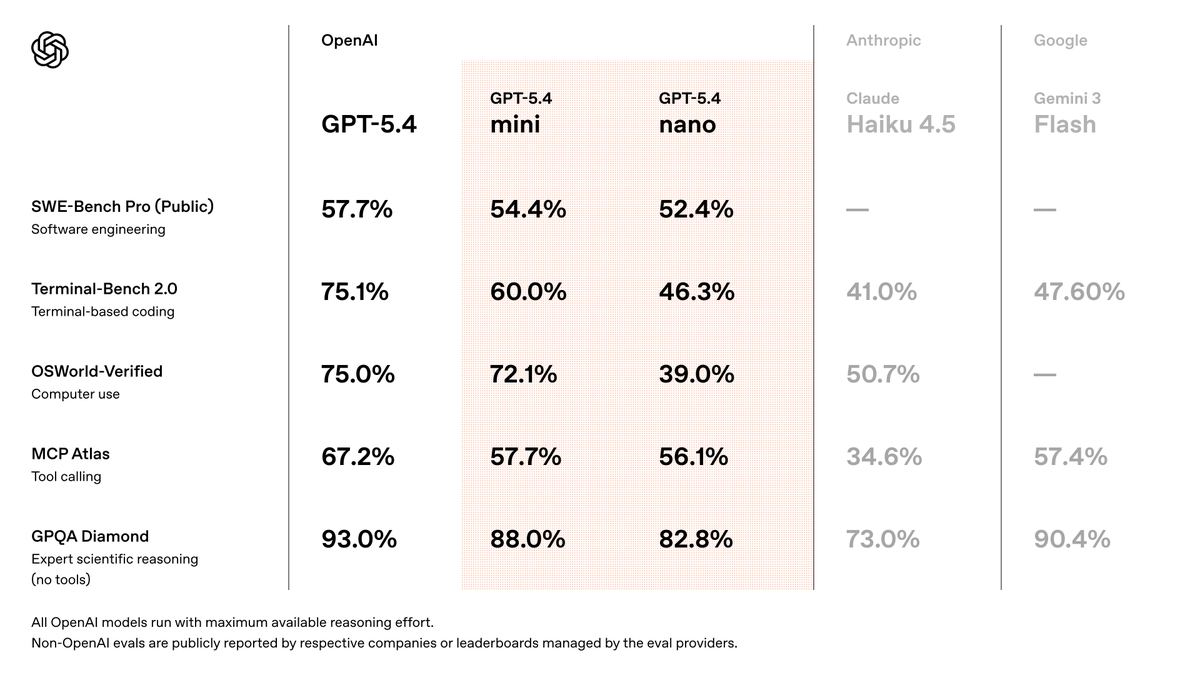
GPT-5.4 mini is available today in ChatGPT, Codex, and the API.
Optimized for coding, computer use, multimodal understanding, and subagents. And it’s 2x faster than GPT-5 mini.
openai.com/index/introduc…
English
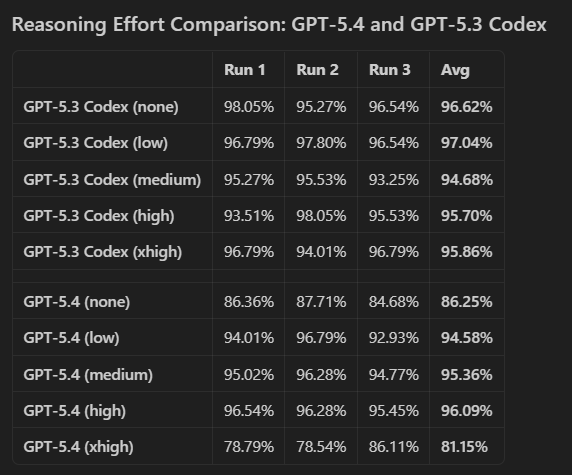
Haven’t done a proper test, but xhigh has produced so far not just weaker output, but massively illogical stuff compared to medium. One of the most striking examples: prompted to correct an email address that had the wrong domain on a contact page -> deleted the email address completely and just wrote the domain name. No matter how much it tried, could not find anything wrong with it until specifically asked “have you ever seen an email address without @ or a .something”.
English

So just following up yesterdays discussions with @theo here are the results testing various reasoning efforts through @OpenRouter on the @convex evals.
The GPT 5.4 xhigh result was the most surprising to me, so I re-ran it again to check and it got the same result which is inline with what Theo was saying that xhigh is worse than high.
English

L&D isn't a cost center. It's a turnover insurance policy. 👇
87% of companies underestimate their true turnover costs.
And yet, when budgets tighten, L&D is usually the first thing to get slashed.
I was recently talking with an L&D Manager at a large European FMCG company about the struggle of defending budgets to the CFO.
It always feels like an uphill battle.
But if you look at the data from SHRM, Deloitte, and Training Magazine, the math is entirely on our side:
📉 Replacing an employee costs 50-200% of their salary.
📈 94% of employees would stay longer if their company invested in their learning.
To help our clients prove this to their leadership team, we built a free L&D Budget Defense Calculator.
It takes 90 seconds to turn your training spend into a retention number your CFO can actually understand.
Try it out with your own numbers and let me know if it helps:
notpptx.com/lm/ld-budget-d…
English

Hey @bcherny and @trq212 , I think the PowerPoint skill in Claude, which probably gets mainly invoked in Code/Cowork, could be substantially improved. It's making pretty slides but missing some fairly key design principles that are well-tested for most business decks (e.g., pyramid principle).
I think that you should have some initial instruction at the top of the skill to ask whether the user wants something pretty for presentation, or more of a McKinsey-style deck, then if the latter, enforce design principles like making all the slide titles arguments not just topic headings, pyramid principle for messaging, etc. This is relevant since in success many users will use this for thinking and you want them to be thinking rigorously and well!
I had Claude write up our feedback, below.
-----
Feedback: PPTX Skill Needs a "Structured Argument" Mode
The Problem
The current PPTX skill produces decks optimized for visual design — color palettes, icons, varied layouts. This is fine for startup pitches and creative presentations, but it's the wrong default for most professional and analytical use cases.
The skill has no concept of:
Action titles: Every slide should have a complete sentence at the top stating the takeaway — not a topic label. This is the single most impactful formatting principle in professional presentations. Reading just the action titles top-to-bottom should convey the full argument.
Storylining and logic flow: Slides should build a structured argument (situation → complication → resolution, or similar). The current skill treats each slide as an independent design problem.
Exhibit discipline: Charts, tables, and frameworks should each have a clear "so what." The current guidance to put a visual element on every slide and decorate with icons actively works against clarity.
Sparse, communication-first design: The priority hierarchy should be argument structure > data > layout > aesthetics. The current skill inverts this.
Who This Affects
Anyone using Claude to build decks for board meetings, investor updates, policy briefings, internal strategy reviews, client deliverables, or any context where the audience is evaluating the reasoning, not the graphic design. This is a large share of professional users — arguably the majority of people asking an AI to make a business presentation.
Proposed Solution
Add switching logic at the top of the skill. Something like:
First, determine what type of deck the user needs.Analytical / structured argument (board decks, strategy presentations, policy briefings, consulting-style deliverables, investor updates, internal reviews): Follow the structured deck guidelines.
Visual / narrative (startup pitches, marketing decks, creative presentations, event decks): Follow the current design-forward guidelines.
Default to structured for business contexts unless the user signals otherwise.
Then add a parallel set of guidelines for structured decks covering:
Action titles: Every slide gets a complete-sentence title stating the takeaway. No topic labels.
Ghost deck test: The action titles alone, read in sequence, should form a coherent argument.
Pyramid principle: Lead with the answer, then support. Group and summarize.
Exhibit design: One chart or table per slide, with a clear "so what" tied to the action title. No decorative elements.
Consistent, minimal formatting: One sans-serif font (Arial/Calibri/Helvetica). No color palette creativity — use grayscale plus one accent color. White backgrounds for content slides.
Source lines: Every data exhibit gets a source citation, bottom-left, small font.
Why This Matters
When someone asks Claude to "make a presentation about Q3 results" or "build a deck on our policy recommendations," they almost certainly want a structured argument, not a design showcase. The current skill will give them colored circles around icons and a "Cherry Bold" palette when what they need is a clear storyline with action titles. Getting this right would meaningfully improve Claude's utility for professional users.
English

@thisisgrantlee Who uses gamma and not ppt. Genuine question
English

Two years ago, we made the biggest bet in Gamma's history.
AI models were getting dramatically better, and we decided to rebuild our entire product around them. People thought we were crazy, we were a small team, pre-revenue, and we were essentially starting over.
That bet took us from a few thousand users to 50+ million. From zero revenue to $100M ARR. It transformed how people create and share ideas.
Now we're seeing the same kind of shift happening again.
The world is going agentic and just like we went AI-first two years ago, we're now building Gamma for an agent-first world.
Today we're launching the Gamma connector for Claude, in partnership with @AnthropicAI.
When Claude finishes a task for you (a research summary, a project plan, meeting notes) it can now hand you a Gamma presentation built from that work. Your thinking becomes something visual, polished, and ready to share.
This is our first step. We believe that as agents become the way people get work done, every agent should be able to express ideas visually. We want Gamma to be the presentation layer for the agentic world.
We're just getting started.
English
English

@thisisgrantlee You can create a styled presentation directly using Claude without gamma.
What’s the difference?
English
Rob retweetledi

One of the most direct use case for #notpowerpoint is building lead magnets microsites. In 5 minute, with full tracking, notification triggers, lead capture, fully interactive.
notpptx.com/nopp/lead-magn…
English
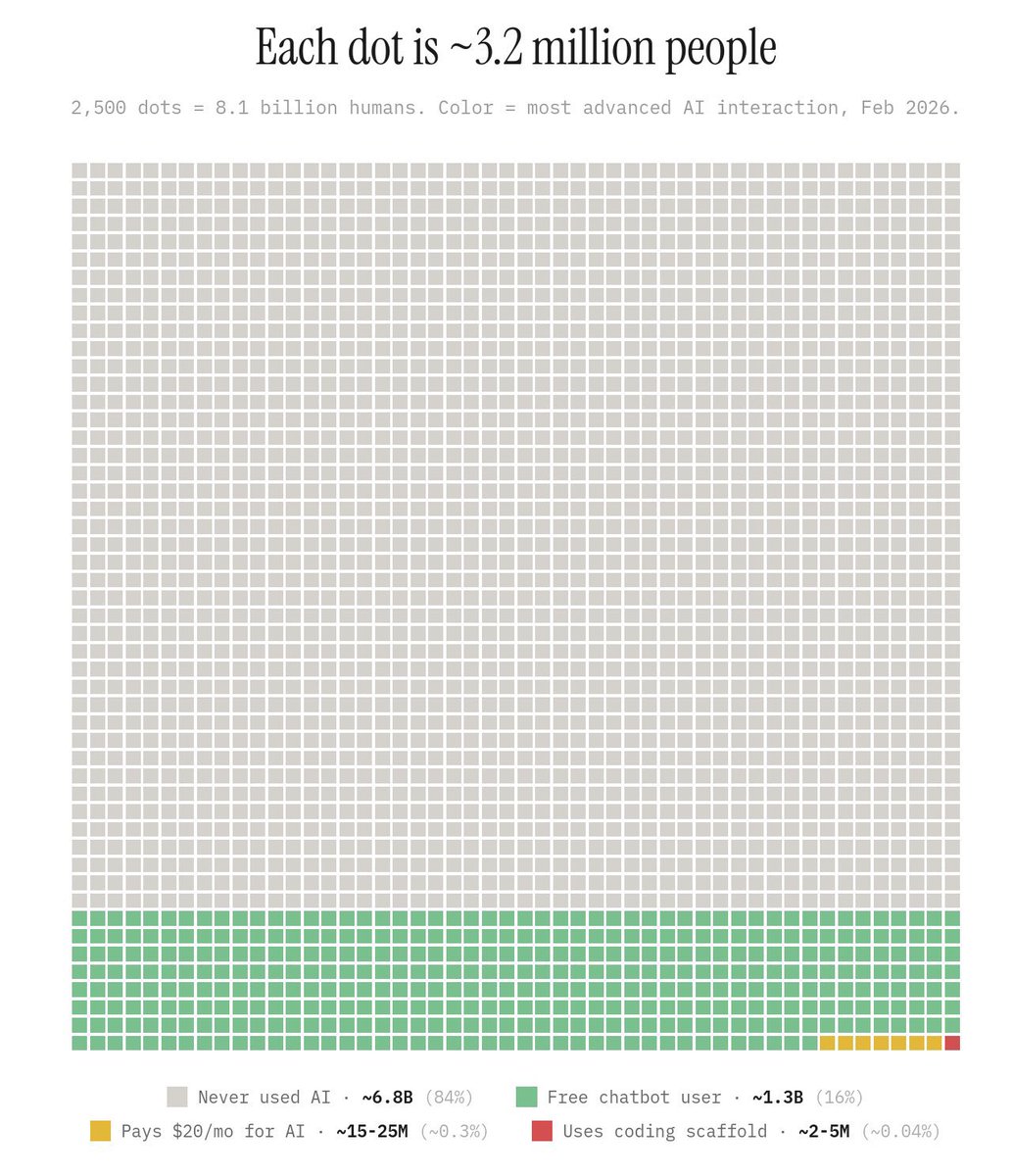
@gmiller @JohnLeFevre That’s misleading because it includes all the earth’s population. A more useful take would be to show the per/professional group split.
English


84% of people have never used AI, and just 0.3% of users pay for premium services.
Anyone who thinks AI is a bubble isn't paying attention.
English
