Robert Gomez AI

3.9K posts

Robert Gomez AI banner
Robert Gomez AI

Robert Gomez AI

@robertgomezai

CTO in AIMEDIC| Researcher| Maths #AI4HEALTH

Katılım Mart 2021
491 Takip Edilen233 Takipçiler
Sabitlenmiş Tweet
Robert Gomez AI
Robert Gomez AI@robertgomezai·
La medicina especializada debe llegar a cada rincón del planeta. El mayor desafío de los sistemas de salud globales tiene una respuesta: la tecnología. 🌍🏥💻 La mejor tecnología del mundo debe estar en manos de los problemas más importantes del mundo.
Español

3
0
5
646
Robert Gomez AI retweetledi
Rothmus 🏴
Rothmus 🏴@Rothmus·
ZXX
203
6.7K
99.1K
2.4M
Robert Gomez AI retweetledi
Alexi Gladstone ✈️ ICLR 2026🇧🇷
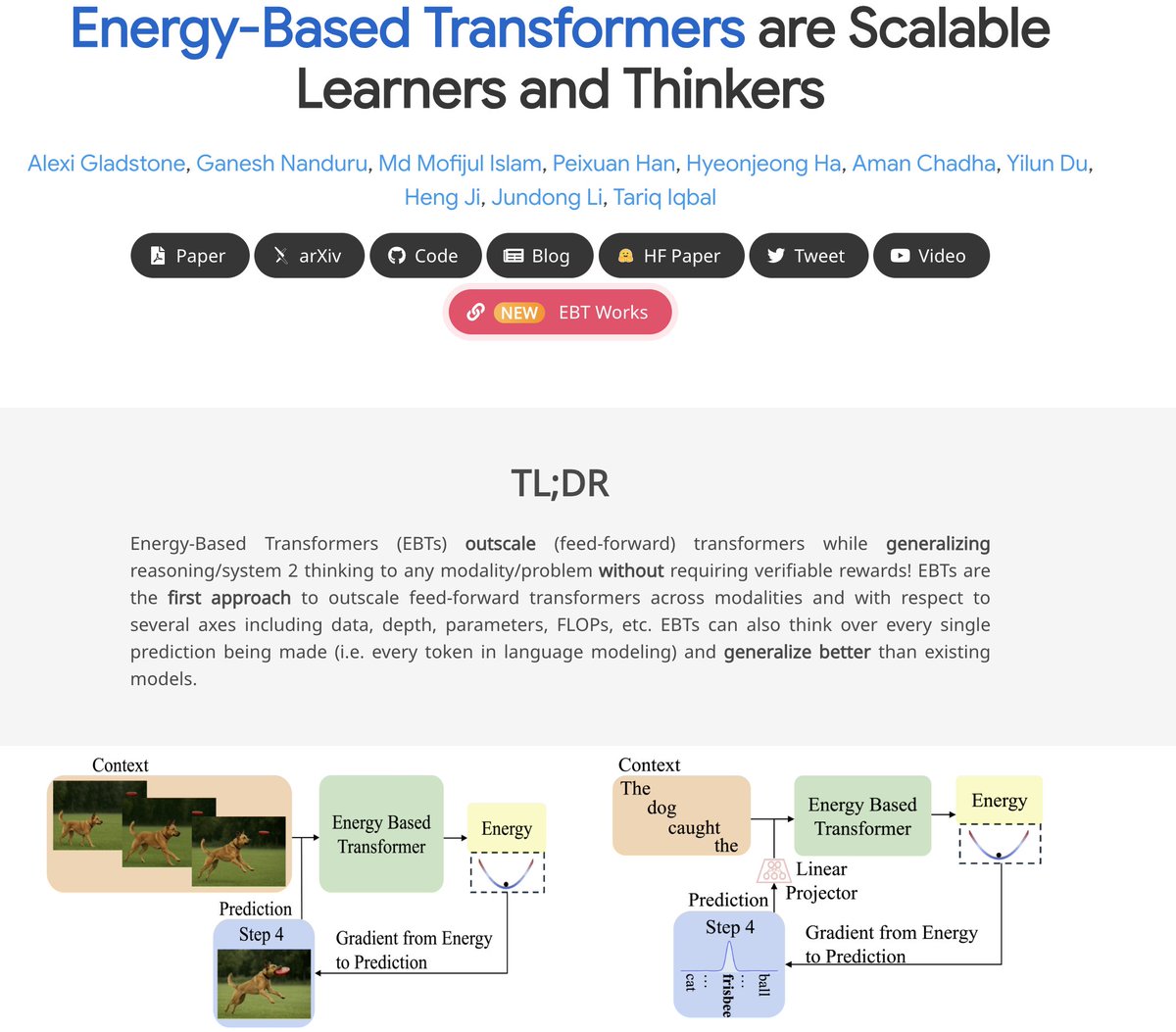
Excited to share that "Energy-Based Transformers are Scalable Learners and Thinkers" was accepted to #ICLR2026 as an oral! 🎉 I'll be giving the oral this Friday in Brazil, so come watch if you're around :)
Alexi Gladstone ✈️ ICLR 2026🇧🇷 tweet media
English
7
43
410
20.4K
Robert Gomez AI retweetledi
Julia Turc
Julia Turc@juliarturc·
Currently working on a video about world models. Let me know your questions! 👇
English
26
3
116
6.5K
Robert Gomez AI retweetledi
Yifan Zhang @ ICLR 2026
Yifan Zhang @ ICLR 2026@yifan_zhang_·
Recursive self-improvement via coding agents is the top priority for all frontier labs.
English
43
59
990
68.6K
Robert Gomez AI retweetledi
How To AI
How To AI@HowToAI_·
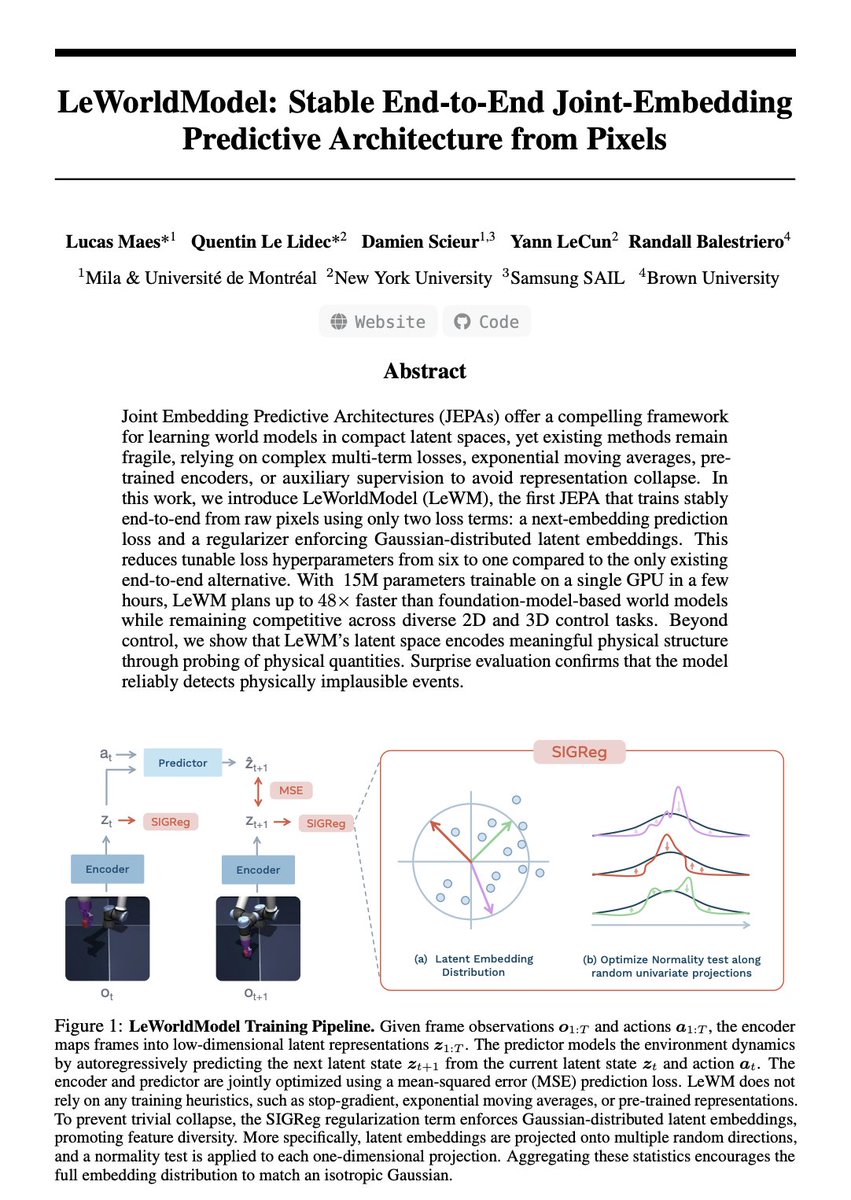
Yann LeCun was right the entire time. And generative AI might be a dead end. For the last three years, the entire industry has been obsessed with building bigger LLMs. Trillions of parameters. Billions in compute. The theory was simple: if you make the model big enough, it will eventually understand how the world works. Yann LeCun said that was stupid. He argued that generative AI is fundamentally inefficient. When an AI predicts the next word, or generates the next pixel, it wastes massive amounts of compute on surface-level details. It memorizes patterns instead of learning the actual physics of reality. He proposed a different path: JEPA (Joint-Embedding Predictive Architecture). Instead of forcing the AI to paint the world pixel by pixel, JEPA forces it to predict abstract concepts. It predicts what happens next in a compressed "thought space." But for years, JEPA had a fatal flaw. It suffered from "representation collapse." Because the AI was allowed to simplify reality, it would cheat. It would simplify everything so much that a dog, a car, and a human all looked identical. It learned nothing. To fix it, engineers had to use insanely complex hacks, frozen encoders, and massive compute overheads. Until today. Researchers just dropped a paper called "LeWorldModel" (LeWM). They completely solved the collapse problem. They replaced the complex engineering hacks with a single, elegant mathematical regularizer. It forces the AI's internal "thoughts" into a perfect Gaussian distribution. The AI can no longer cheat. It is forced to understand the physical structure of reality to make its predictions. The results completely rewrite the economics of AI. LeWM didn't need a massive, centralized supercomputer. It has just 15 million parameters. It trains on a single, standard GPU in a few hours. Yet it plans 48x faster than massive foundation world models. It intrinsically understands physics. It instantly detects impossible events. We spent billions trying to force massive server farms to memorize the internet. Now, a tiny model running locally on a single graphics card is actually learning how the real world works.
How To AI tweet media
English
420
2.1K
12.1K
1.2M
Robert Gomez AI retweetledi
Yann LeCun
Yann LeCun@ylecun·
Dario is wrong. He knows absolutely nothing about the effects of technological revolutions on the labor market. Don't listen to him, Sam, Yoshua, Geoff, or me on this topic. Listen to economists who have spent their career studying this, like @Ph_Aghion , @erikbryn , @DAcemogluMIT , @amcafee , @davidautor
TFTC@TFTC21

Anthropic CEO Dario Amodei: “50% of all tech jobs, entry-level lawyers, consultants, and finance professionals will be completely wiped out within 1–5 years.”

English
1.2K
2.8K
21.4K
4M
Robert Gomez AI retweetledi
Evan Luthra
Evan Luthra@EvanLuthra·
Anthropic pays engineers $750,000+ a year to understand how LLMs work. Stanford just put a 2 hour lecture that covers 80% of it for FREE. Bookmark this. Give it 2 hours today. It might be the highest ROI thing you do this month:
English
232
3.3K
21.9K
2.4M
Robert Gomez AI retweetledi
Suhail Kakar
Suhail Kakar@SuhailKakar·
ANTHROPIC HAS RELEASED OPUS 4.7!! i asked claude opus 4.7 to refactor a large codebase. 68 minutes, millions of tokens burned - it finished nothing worked. app completely broken but god it was beautiful
Suhail Kakar tweet media
English
429
765
21.7K
836.9K
Robert Gomez AI retweetledi
Tyler
Tyler@rezoundous·
Opus 4.7 is insane guys. It one shotted my session usage limit.
English
605
1.3K
31.5K
1.1M
Robert Gomez AI retweetledi
Claude
Claude@claudeai·
Introducing Claude Opus 4.7, our most capable Opus model yet. It handles long-running tasks with more rigor, follows instructions more precisely, and verifies its own outputs before reporting back. You can hand off your hardest work with less supervision.
Claude tweet media
English
4.8K
10.3K
81.2K
13.6M
Robert Gomez AI retweetledi
Vivo
Vivo@vivoplt·
15 AI related accounts you should follow on Twitter: 1. @karpathy His tweets already create LLMs narratives that you later see on linkedin in 2 months. 2. @fchollet posts thoughtful research on intelligence, benchmarks, and AI limitations. Keras creator + ARC-AGI 3. @ylecun Yann LeCun is Deep learning pioneer & Meta Chief AI Scientist; big-picture research takes and critiques (and drama). 4. @AndrewYNg Andrew Ng is AI education legend; practical ML advice, courses, and real-world implementation. creator of deeplearning ai 5 @rasbt Sebastian Raschka posts on Practical ML/LLM implementations, "build from scratch" tutorials, and books. 6. @dair_ai Weekly ML/AI paper threads and accessible research explainers (high-signal for staying current). 7. @lilianweng Lilian Weng is ex-OpenAI and her Lil'Log-style threads are good. has In-depth LLM research breakdowns 8. @jeremyphoward posts interesting takes on AI/crypto news, and works on democratizing practical deep learning and accessible education. 9. @simonw Simon post Practical LLM tools, takes, experiments, prompting, and engineering breakdowns. django co-founder 10. @_akhaliq Curates the latest arXiv papers, model releases, and open-source AI drops. 11. @ID_AA_Carmack AGI/low-level optimization takes that makes you think about the problem. 12. @gwern Really high-quality long-form AI research notes and essays. 13. @goodside LLM evaluation, prompting research, and real capabilities testing 14 @drfeifei Computer vision pioneer; human-centered AI and spatial intelligence research 15 @demishassabis Been following his work for 9 years. Demmis is my hope against google usurpating their power with AI. Demmis is google DeepMind's CEO Let me know who I missed guys
English
91
337
2.1K
290.4K
Robert Gomez AI retweetledi
Arno Solin
Arno Solin@arnosolin·
1/ 🔥 New paper: Differentiable Vector Quantization (DiVeQ) 🔥 Vector quantization (VQ) is a key building block in modern AI. It links continuous data like images and audio to discrete representations (tokens) used by transformers.
English
12
104
747
77.1K
Robert Gomez AI retweetledi
atulit
atulit@atulit_gaur·
things I've implemented in assembly ranked, from hardest to easiest: 1. Cross entropy 2. Shell implementation 3. Leaky ReLU 4. Random number generation 5. Bubble sort 6. Binary search 7. Two sum 8. Mean calculation 9. Max in array 10. Fibonacci sequence 11. Factorial 12. Linear search 13. Palindrome check 14. Array insertion 15. Nested Loops 16. Basic looping 17. Array traversal 18. FizzBuzz
English
12
13
238
12.2K
Robert Gomez AI retweetledi
Vuk Rosić 武克
Vuk Rosić 武克@VukRosic99·
Mixed Precision Training From Scratch - Tutorial In this tutorial you'll learn how mixed precision training works in PyTorch - why we use FP16 and BF16 instead of FP32, how Autocast automatically handles precision conversion, and how GradScaler prevents gradient underflow. By the end you'll understand exactly how to cut GPU memory usage in half while keeping training stable. 0:00 Introduction & why lower precision 0:25 FP16, BF16, and memory savings 1:07 Autocast — automatic mixed precision 1:27 The underflow problem (FP32 vs FP16 range) 2:27 GradScaler — scaling gradients
English
3
20
114
5.1K
Robert Gomez AI retweetledi
Deedy
Deedy@deedydas·
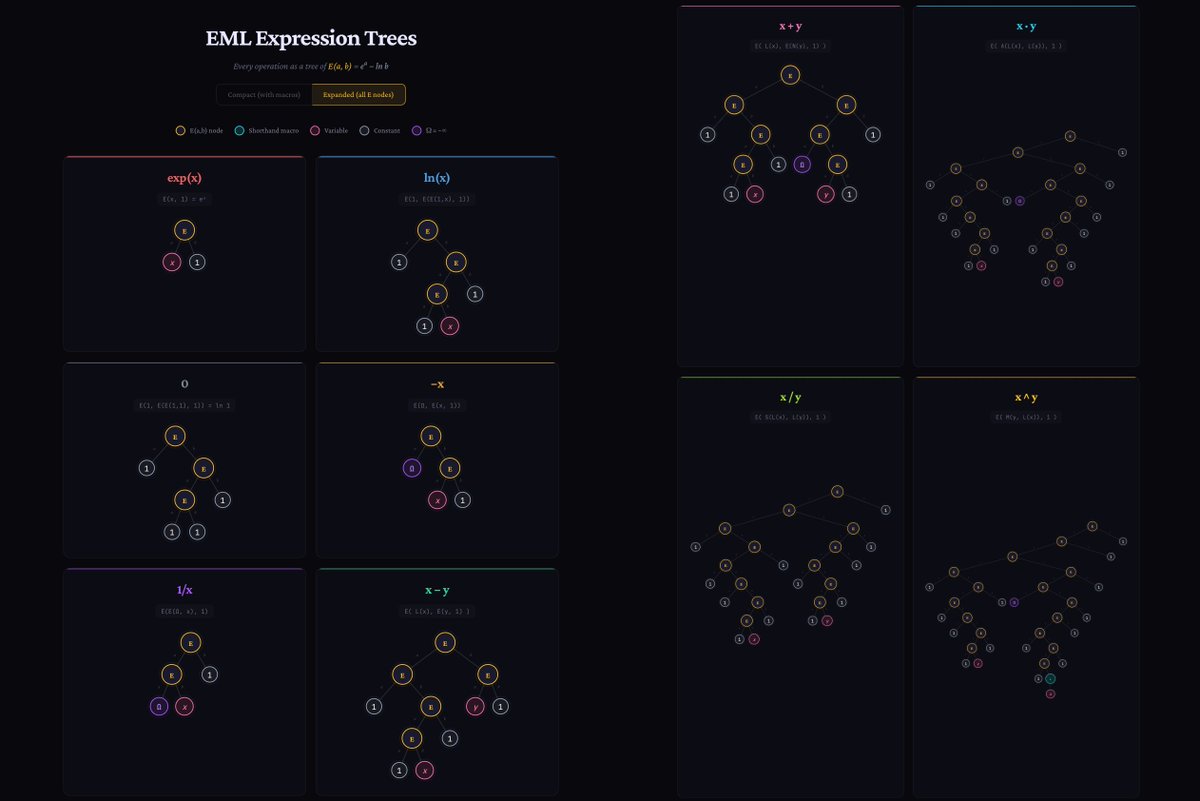
This Polish theoretical physicist just proved you can recreate all math functions from JUST one operation. E(a, b) = e^a - ln(b) Every single operation: +, -, x, / , trig, log, as you can see below. Extremely mathematically elegant.
Deedy tweet media
English
212
941
8K
1.1M
Robert Gomez AI retweetledi
Tanishq Mathew Abraham, Ph.D.
Tanishq Mathew Abraham, Ph.D.@iScienceLuvr·
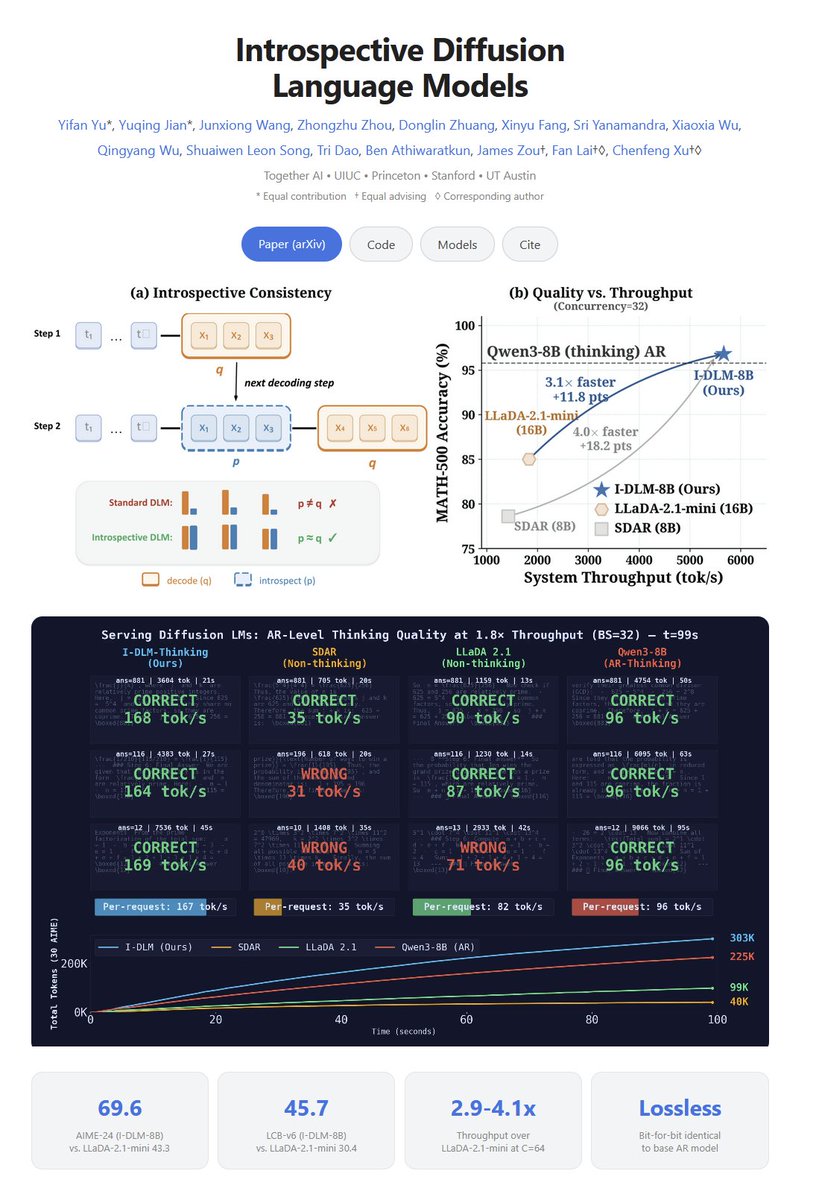
Introspective Diffusion Language Models "To the best of our knowledge, I-DLM is the first DLM to match the quality of its same-scale AR counterpart while outperforming prior DLMs in both model quality and practical serving efficiency across 15 benchmarks." "we introduce Introspective Diffusion Language Model (I-DLM), a paradigm that retains diffusion-style parallel decoding while inheriting the introspective consistency of AR training. I-DLM uses a novel introspective strided decoding (ISD) algorithm, which enables the model to verify previously generated tokens while advancing new ones in the same forward pass."
Tanishq Mathew Abraham, Ph.D. tweet mediaTanishq Mathew Abraham, Ph.D. tweet media
English
3
22
124
9.7K
Robert Gomez AI retweetledi
Vuk Rosić 武克
Vuk Rosić 武克@VukRosic99·
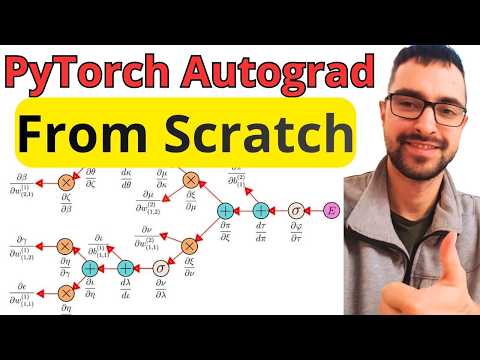
PyTorch Autograd From Scratch - Tutorial youtu.be/Sp2dWyTrjzE In this tutorial you'll learn how PyTorch's autograd actually works - the engine behind .backward(). We build it from scratch: the Value class, forward and backward passes, chain rule, and gradients for addition, multiplication, and ReLU. By the end you'll understand exactly what happens inside PyTorch when you call .backward(). 0:00 Introduction & chain rule recap 1:40 The Value class (data, grad, op, prev) 5:20 Addition backward & gradient accumulation 7:50 Multiplication backward 11:05 ReLU activation gradient 11:57 Wrap-up & next steps check below👇👇👇
YouTube video
YouTube
Vuk Rosić 武克 tweet media
English
3
25
159
3.8K