Ron Eliav

21 posts

Ron Eliav

Ron Eliav

@ron_eliav

Ph.D. student in NLP at @biunlp

Katılım Haziran 2021
103 Takip Edilen52 Takipçiler
Ron Eliav retweetledi
Ori Malca
Ori Malca@Orimalca·
🎉 I am excited to present our new paper! Our paper improves personalization of text-to-image models, by adding one special cleaning step on top of existing personalized models. With just a single gradient update (~4 seconds on an NVIDIA H100 GPU) and a single image of the target concept, our method improves both text alignment and image alignment. For example, it improves LoRA by (+7% / +14%). This is achieved by adding new loss terms and taking into account the prompt and seed. This work was done together with @dvir_samuel and @GalChechik. 🌐 Paper page: …ery-visual-concept-learning.github.io 📄 arXiv paper: arxiv.org/abs/2508.09045 More details in the comments below.
Ori Malca tweet media
English
4
10
17
1K
Ron Eliav retweetledi
Shahaf Bassan
Shahaf Bassan@shahaf_bassan·
🚨 New #ICML2025 paper! 𝐄𝐱𝐩𝐥𝐚𝐢𝐧𝐢𝐧𝐠, 𝐅𝐚𝐬𝐭 𝐚𝐧𝐝 𝐒𝐥𝐨𝐰 We generate explanations for neural networks 𝑒𝑓𝑓𝑖𝑐𝑖𝑒𝑛𝑡𝑙𝑦 and 𝑤𝑖𝑡ℎ 𝑝𝑟𝑜𝑣𝑎𝑏𝑙𝑒 𝑔𝑢𝑎𝑟𝑎𝑛𝑡𝑒𝑒𝑠 by pruning to a much smaller model and gradually expand it to ensure provable guarantees.
English
1
7
69
4.1K
Ron Eliav retweetledi
Arie Cattan
Arie Cattan@ArieCattan·
🚨 RAG is a popular approach but what happens when the retrieved sources provide conflicting information?🤔 We're excited to introduce our paper: “DRAGged into CONFLICTS: Detecting and Addressing Conflicting Sources in Search-Augmented LLMs”🚀 A thread 🧵👇
Arie Cattan tweet media
English
2
14
36
2.7K
Ron Eliav retweetledi
Ori Ernst
Ori Ernst@oriern1·
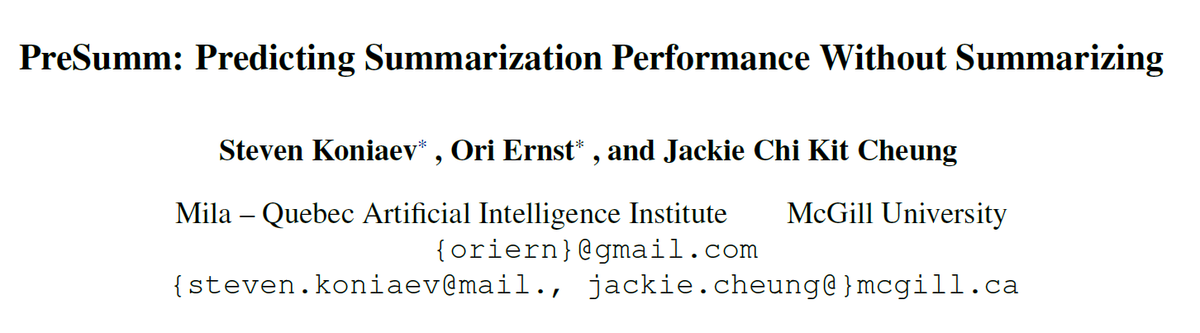
🧵 New paper at Findings #ACL2025 @aclmeeting! Not all documents are processed equally well. Some consistently yield poor results across many models. But why? And can we predict that in advance? Work with Steven Koniaev and Jackie Cheung @Mila_Quebec @McGill_NLP #NLProc (1/n)
Ori Ernst tweet media
English
1
12
27
1.1K
Ron Eliav retweetledi
Eran Hirsch
Eran Hirsch@hirscheran·
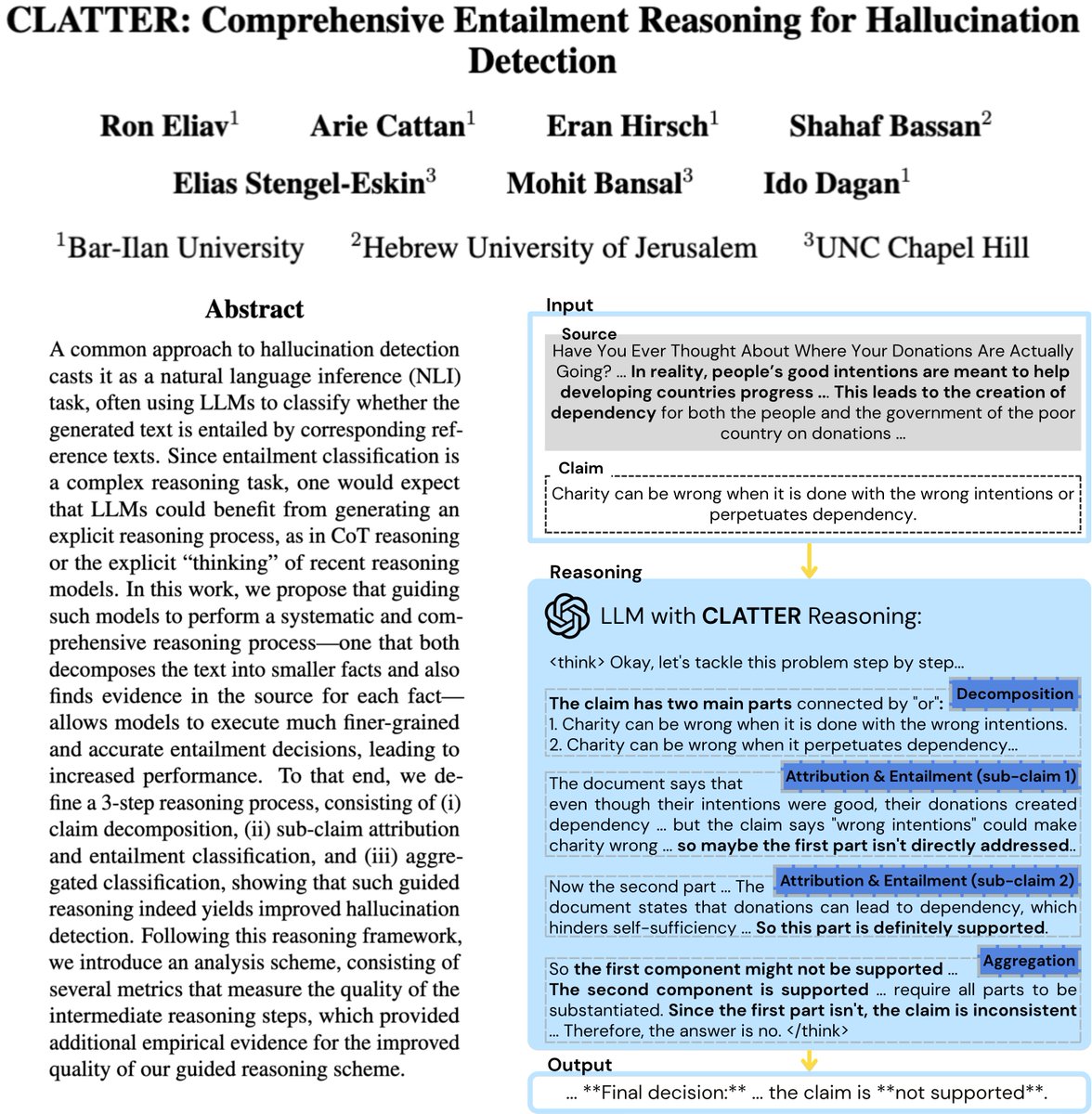
🚨 New preprint! We propose a reasoning process for hallucination detection: 1️⃣ Decompose the output 2️⃣ Generate fine-grained attribution (if possible), and accordingly make local entailment decisions 3️⃣ Aggregate all to a final decision We also introduce metrics to evaluate whether models actually follow this process! We test 8 models on multiple datasets. Using our introduced metrics, we find that LRMs partially align with the same reasoning process. However, through prompting alone, LRMs can better emulate the complete process and improve hallucination detection performance. See more details in Ron's tweet ⬇️
Ron Eliav@ron_eliav

🚨New Preprint! We propose CLATTER: Claim Localization and Attribution for Entailment Reasoning, to assess the faithfulness of LLM outputs to their sources. CLATTER boosts hallucination detection in reasoning models via decomposition and attribution steps. Summary below 👇

English
0
9
20
1.6K
Ron Eliav retweetledi
Elias Stengel-Eskin
Elias Stengel-Eskin@EliasEskin·
🚨 CLATTER treats entailment as a reasoning process, guiding models to follow concrete steps (decomposition, attribution/entailment, and aggregation). CLATTER improves hallucination detection via NLI, with gains on ClaimVerify, LFQA, and TofuEval especially on long-reasoning models!
Ron Eliav@ron_eliav

🚨New Preprint! We propose CLATTER: Claim Localization and Attribution for Entailment Reasoning, to assess the faithfulness of LLM outputs to their sources. CLATTER boosts hallucination detection in reasoning models via decomposition and attribution steps. Summary below 👇
English
0
11
19
2.1K
Ron Eliav
Ron Eliav@ron_eliav·
🔬 Manual analysis of 200 examples shows: ✅ Models follow structured reasoning better with CLATTER ✅ Improved attribution quality (in the reasoning steps) → higher overall accuracy ❗ Even without instruction, LRMs often decompose and attribute claims (but much less).
English
1
0
3
120
Ron Eliav
Ron Eliav@ron_eliav·
🚨New Preprint! We propose CLATTER: Claim Localization and Attribution for Entailment Reasoning, to assess the faithfulness of LLM outputs to their sources. CLATTER boosts hallucination detection in reasoning models via decomposition and attribution steps. Summary below 👇
Ron Eliav tweet media
English
2
14
28
6K
Ron Eliav retweetledi
Eran Hirsch
Eran Hirsch@hirscheran·
🚨 Introducing LAQuer, accepted to #ACL2025 (main conf)! LAQuer provides more granular attribution for LLM generations: users can just highlight any output fact (top), and get attribution for that input snippet (bottom). This reduces the amount of text the user has to read by 2 orders of magnitude compared to standard self-citation methods. We invite researchers to use this experimental framework to advance localized attribution research!
Eran Hirsch tweet media
English
3
31
83
13.1K
Elias Stengel-Eskin
Elias Stengel-Eskin@EliasEskin·
Extremely excited to announce that I will be joining @UTAustin @UTCompSci in August 2025 as an Assistant Professor! 🎉 I’m looking forward to continuing to develop AI agents that interact/communicate with people, each other, and the multimodal world. I’ll be recruiting PhD students for Fall 2026 across a range of connected topics (details: esteng.github.io) and plan on recruiting interns for Fall 2025 as well. A huge shoutout to my mentors who have supported and shaped my research! Especially grateful to my postdoc advisor @mohitban47 for helping me grow along the whole spectrum of PI skills, and my PhD advisor @ben_vandurme for shaping my trajectory as a researcher, and of course the amazing students/collaborators from @uncnlp and @jhuclsp 🙏
Elias Stengel-Eskin tweet media
English
92
63
461
57.8K
Ron Eliav
Ron Eliav@ron_eliav·
🧠 New #ICLR2025 paper: "Explain Yourself, Briefly!" We introduce Sufficient Subset Training (SST)—a self-supervised method enabling neural networks to generate concise, faithful explanations as part of their predictions. 📄 Read more: arxiv.org/abs/2502.03391
Ron Eliav tweet media
English
0
1
2
330