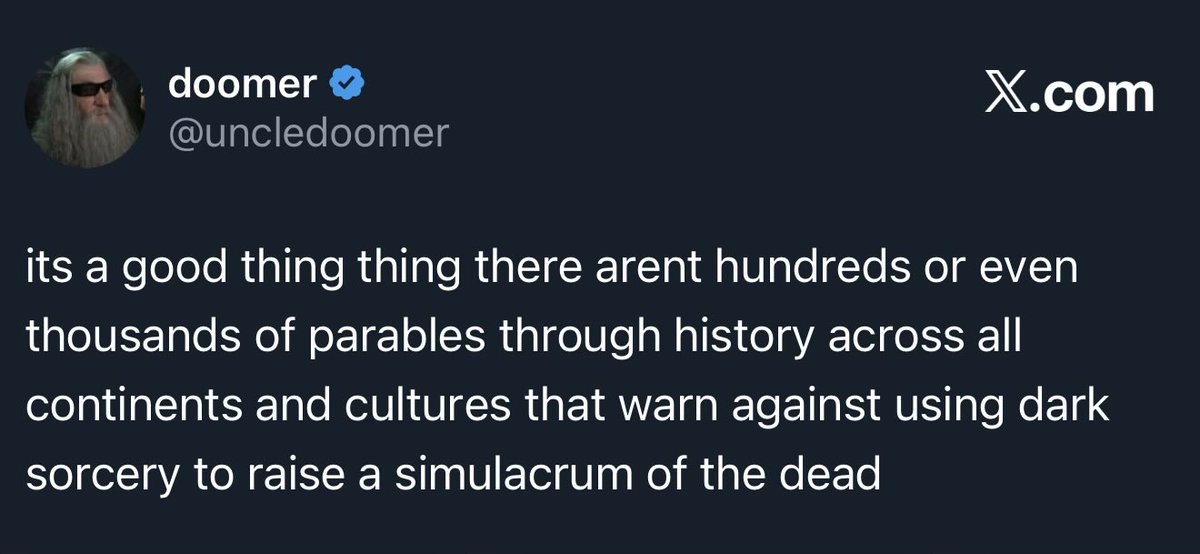
@wolfejosh “Would they hide me?” A powerful and sobering litmus test.
English
Ron Hekier
12.5K posts
@ronhekier
🚢. Teaching others to think like a trauma surgeon to deal with chaos in business and in life. Dabbling in AI.
"In his book The Hidden Hand, Kinsella documents how the explosion of anti-Israel sentiment since October 7 is largely the product of a highly organized, well-funded & deliberately orchestrated propaganda campaign designed to delegitimize Israel..." nationalpost.com/opinion/why-th…
Happy National Doctors’ Day: Except for the GI doc who is making me get a HIDA scan to prove this is a bile leak. I texted back my latest vision exam instead. He wasn’t amused.


Emergency thoracotomy demonstrating lungs inflating and heart beating 💬 Has anyone been in the ER or OR for one of these before? This is one of the most intense, high-stakes procedures in all of medicine. Performed in the setting of catastrophic trauma, an emergency thoracotomy is a last-resort, life-saving intervention—done when seconds matter and conventional resuscitation has failed. By opening the chest, surgeons can: 🫀 Relieve cardiac tamponade and restore circulation 🫁 Directly assess lung and airway injury 🩸 Control massive hemorrhage ⚡ Cross-clamp the aorta to preserve blood flow to the brain and heart Survival is rare—but not impossible. 👉 Patients with isolated cardiac injuries have the best chance of survival 👉 Outcomes drop significantly with multi-chamber, great vessel, or pulmonary hilum injuries This is trauma care at its most raw—where anatomy, physiology, and decisive action collide in real time. 💬 Would you recognize when this is indicated? 💾 Save this to review critical trauma concepts 👥 Share to educate others on high-acuity resuscitation Thanks to @medicaltalks
The human brain isn’t designed to process all of the world’s breaking emergencies in realtime.

The United Arab Emirates is the most leveraged country on earth and almost nobody understands why. Eighty eight percent of its population are foreign nationals. Ten point four million people who hold passports that say India, Pakistan, Bangladesh, Philippines, Egypt, Britain, somewhere else. They are not citizens. They are residents. They chose to be there because the risk-adjusted return on their lives was positive. Better jobs. No income tax. Safety. The entire economic model of the UAE is a value proposition, and that value proposition has a denominator called security that just went to zero. Emirates, the world’s largest international airline, has suspended all flights indefinitely. Etihad suspended until Monday. Singapore Airlines cancelled its Dubai service through March 7. United Airlines through March 4. More than eighteen hundred flights were cancelled on Saturday alone, another fourteen hundred on Sunday. Dubai International Airport, which handled over a hundred and twenty seven million passengers last year, is dark. A CNN verified video from inside the terminal shows a passenger in a blood-spattered shirt being told to go home. The UAE Ministry of Education has moved all schools to distance learning through Wednesday. Sharjah Airport is shut. Abu Dhabi Airport took a direct hit that killed a Pakistani national and wounded seven. The UAE confirmed its air defenses intercepted one hundred and thirty seven ballistic missiles and two hundred and nine drones. Fourteen drones were not intercepted. Their debris fell on residential neighborhoods, hotel facades, port facilities, and according to multiple reports, a shopping center in Sharjah. Here is what matters. When France gets bombed, the French stay because it is France. When Ukraine gets bombed, Ukrainians stay because it is Ukraine. When the UAE gets bombed, the ten million people who make up eighty eight percent of its population have a decision to make. And that decision has a very short fuse. A country where nearly nine in ten residents can leave is not a nation in the traditional sense. It is a special economic zone with a flag. The moment the value proposition inverts, the population does not resist. It withdraws. This is not a war of attrition. It is a bank run on a country. The deposits are human. There is no deposit insurance. And the withdrawal window just opened. Schools are closed. Airports are closed. Flights are cancelled through next week. The residents of the world’s most ambitious urban experiment are sitting in underground parking garages because Dubai has no bomb shelters. Nobody models a bank run until it starts. open.substack.com/pub/shanakaans…
On Gucci and its unfortunately accurate picture of today’s luxury consumer cnn.com/2026/02/27/sty…

I practiced general surgery with trauma call in two different cities in East Texas, each with a population less than 100,000. For weekends, one surgeon took call from Friday AM to Monday AM for weekend call. (72 hours.) Yeah, we work when we are tired. I'm with @DrDiGiorgio . I don't see how any global, national, nor regional policy change can result in staffing hospitals in small cities such that supply of surgeons exceeds demand
🚨 HE WENT TO BED - THEN SPENT ALL NIGHT TRYING TO SAVE A PARALYZED STRANGER A neurosurgeon turns on the camera at 9:30 PM. He was already in bed. Half asleep. Then the call comes in. A patient just arrived paralyzed at a Level One trauma center. Coffee. Uber. Silence. By 11:30 PM, he’s making the incision. The case drags on for five straight hours. One wrong move and the damage is permanent. At 6:00 AM, he walks out exhausted. The surgery worked. The patient is doing well. But the night isn’t over. He’s still on call. Still writing notes in the back of an Uber. Still expected to function like nothing happened. Just a man trading his night so someone else gets a lifetime. While you slept… this happened. Would you trust your life to someone running on zero sleep - or does this reveal how broken the system really is?

To remind folks: I met Epstein in the late 90s/early 2000s via my book agent at the TED conference. I was in my 20s. There were hundreds of folks at TED and those dinners. I barely knew him, but he was everywhere, relentlessly networking with everyone in science, finance, technology, media, and politics. Based on what I’ve learned, my guess is he was a spy and was trying to compromise folks. That’s why these documents haven’t been released IMO. If I had to guess, his interest in me was probably because I was an angel investor in technology startups, and I had an extensive network. Think it through, folks, what information could he hope to get from me 20 years ago? I was of little importance to the premier scientists, politicians, and elites he was networking with at the time. I never went on the plane or to the island. I hope they prosecute all the guilty parties in this case and release all the files.
The largest randomized trial of medical A.I. —Over 100,000 women in Sweden —radiologist + AI vs 2 radiologists, in follow-up —AI added led to 29% more cancer detected, 44% reduced workload, and —Less cancer dx in subsequent 2 years, and, when found, less aggressive thelancet.com/journals/lance…
Yesterday I completed my once every four years refresher course of ATLS (Advanced Trauma Life Support System.) I am one of over 1 million health care providers who have taken the course, a course borne of a tragic private plane crash almost 50 years ago. ATLS is systematic approach to treating injured patients when they arrive in an emergency room, whether it’s a rural hospital in Haiti or a top trauma center in Houston. It has been taught in over 65 countries. It’s a common language, a universal protocol. A method to insure that severely injured patients get the same proper care wherever they are. But care of the injured patient was not always systemized in a universal fashion. The origins of ATLS were born in Lincoln, Nebraska nearly 50 years ago. In 1976, an orthopedic surgeon from Lincoln, Dr. James Styner, was piloting his small propeller plane carrying his wife and four children back from a wedding they attended in California. As they got closer to home on their long trek, the weather deteriorated over rural parts of Kansas. With weather worsening and darkness approaching, Styner had to choose between turning around and flying away from home, landing in the middle of nowhere, or forging ahead. Styner pushed forward. After flying over 1,000 miles and only 60 miles from home, tragedy struck. With decreased visibility due to clouds, fog, and darkness, James Styner become disoriented and crashed the plane. They flew through trees at around 160 miles per hours, shredding off both wings, and crashed into a corn field. Styner survived the crash. His wife was ejected from the cockpit and died instantly when a piece of the propeller hit her head. His four children were in back of the plane and survived but three of them suffered head injuries and were unconscious. After waiting for help for hours in the desolate field, Styner decided he had to look for help. He left his oldest child behind to watch his three siblings, and walked in the direction of distantly appearing headlights from passing cars. He eventually reached a nearby road, flagged down a car for help, and they returned to the field to retrieve his children. Styner learned he had crashed near a small town called Hebron, Nebraska, a town he would soon learn which had a small hospital not well equipped to handle severely ill or injured patients. Only two doctors staffed the small hospital and they had little experience with severe trauma. House after the crash and in the Emergency Room at Hebron with his 4 injured children, Styner was shocked at the care, or perhaps better said, lack of appropriate care given to his injured children. Later he would say: “When I can provide better care in the field with limited resources than what my children and I received at the primary care facility, there is something wrong with the system, and the system has to be changed.” He demanded the he and his children be transferred out of that hospital to the the large hospital at which he practiced, 60 miles away in Lincoln, Nebraska. Over the course of time, Styner and his children had complete physical recoveries, but he remained troubled by his experience at the small hospital. Dr. Styner would vocally complain about the small town hospital. One of his medical colleagues, an ER doc, grew tired of his complaining and told him to change the system. Well in this case there was no system. As Styner said: “You have to train them before you can blame them.” So Styner together with the help of colleagues created a protocol for the treatment of severely injured patients with the goal of teaching it to health care providers in rural settings. Their system was called ATLS, and first debuted in Nebraska in 1978. Their little course was picked up the University of Nebraska, and eventually the American College of Surgeons, and by global institutions. Since it’s humble beginnings in a class in a small town in Nebraska, it was been taught in thousands of classes in over 60 countries to over 1 million providers. From a personal tragedy to a global protocol which has saved countless lives over decades, James Styner proved several things. • One person can change the world. • Humble beginnings don’t reduce the chance of massive succes. • The solution to complex problems is often to have a systemized protocol in place. • You have to train them before you can blame them. #ship30for30