Ross Centers

44 posts

Ross Centers banner
Ross Centers

Ross Centers

@rosscenters

Spaceports beyond Earth CEO @ethosspace Chair @SpaceSRM

Katılım Nisan 2007
60 Takip Edilen60 Takipçiler
Ross Centers retweetledi
Elon Musk
Elon Musk@elonmusk·
For those unaware, SpaceX has already shifted focus to building a self-growing city on the Moon, as we can potentially achieve that in less than 10 years, whereas Mars would take 20+ years. The mission of SpaceX remains the same: extend consciousness and life as we know it to the stars. It is only possible to travel to Mars when the planets align every 26 months (six month trip time), whereas we can launch to the Moon every 10 days (2 day trip time). This means we can iterate much faster to complete a Moon city than a Mars city. That said, SpaceX will also strive to build a Mars city and begin doing so in about 5 to 7 years, but the overriding priority is securing the future of civilization and the Moon is faster.
English
25.9K
25.2K
257.9K
46.7M
Ross Centers
Ross Centers@rosscenters·
@DrPhiltill @JoelSercel Part 1 shows why compute needs to be built in space with materials already in space, not just launched from Earth and operated there.
English
0
0
2
254
Phil Metzger
Phil Metzger@DrPhiltill·
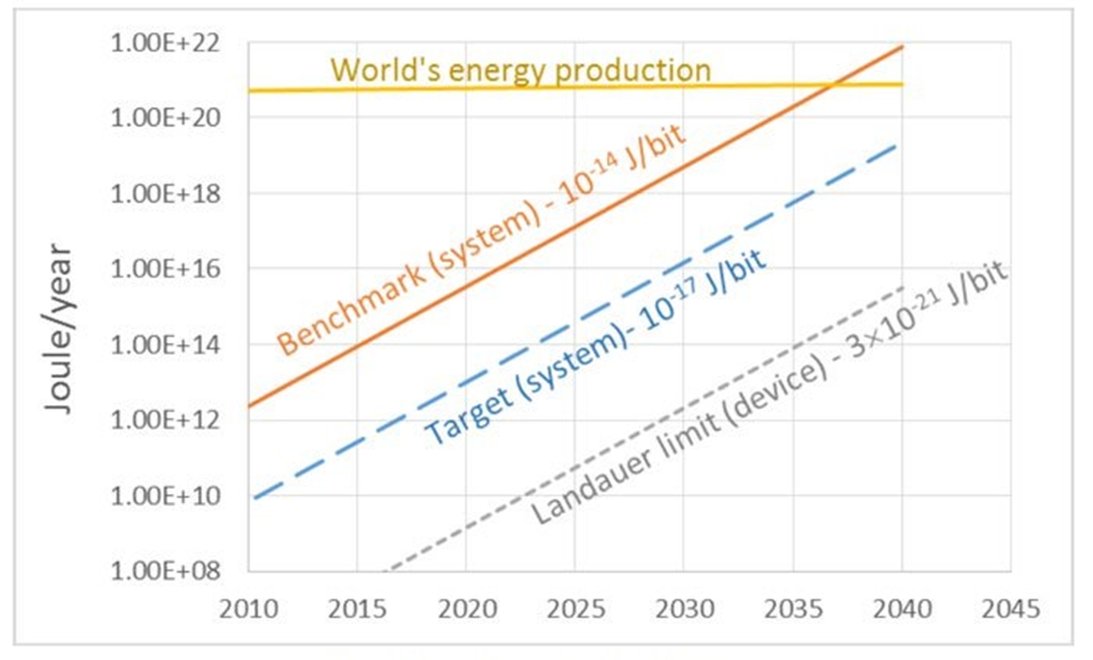
I just re-checked the literature. There are four parts to the response. 1. The energy to manufacture AI compute hardware is currently about equal to the energy spent over its operational life. Reducing operational energy more than a factor of, say, 3 therefore has diminishing returns. More complex computing technology probably requires even more energy to manufacture so it may be even less of a gain than this. 2. Reducing power of the technology is a linear reduction versus an unbounded exponential growth, so it only buys 10-20 years. This is seen in the attached chart. 3. The maximum possible reduction of energy is already accounted for in this plot, since the lower limit is quantum information theory-based, a limit that any technology can only aspire to. Even if we achieved that limit, it buys us only 10-20 years. 4. The exception is reversible computing, where you destroy all the intermediate information to get that energy back and only keep the final results. I don’t know how to scale that, yet, since mass manufacturing of reversible compute doesn’t exist. I assume that manufacturing cost will dominate, so again the deep reduction of operational energy has diminishing returns far earlier so I suspect reversible compute isn’t really that beneficial.
English
4
2
36
13K
Phil Metzger
Phil Metzger@DrPhiltill·
Here's a perspective on satellite mega-constellations that nobody has mentioned. (We are ALL tired of this, but I think this is interesting). The real reason SpaceX is putting up a mega-constellation at this time is because of the laws of nature. It was inevitable.../1
English
33
224
559
0
Ross Centers
Ross Centers@rosscenters·
@elonmusk @lrocket After reusable launch, next step is building industry 1.0 on the Moon. The figure of merit for launch is maximizing payload to the Moon. Figure of merit for lunar industry 1.0 is maximizing useful mass returned on payload mass invested. This is why we founded @ethosspace
English
0
1
3
183
Elon Musk
Elon Musk@elonmusk·
@lrocket It is the only way to build a civilization at the Kardashev II scale
English
161
131
1.6K
225.6K
Tom Mueller
Tom Mueller@lrocket·
I’ve been talking about the need to move compute to space for a few years now, since about the time I founded Impulse. My thesis was not that it was needed because it is so hard/expensive to install terrestrial power, but because exponential growth of computer power could eventually crush resources on earth. This graphic is from my presentation and shows that computer power will equal all base power generation by mid 2040s. Compute is one of the few things that can be moved to space, but the product can be easily delivered back to earth. It just makes sense
Tom Mueller tweet media
English
71
192
1.7K
140.3K
Elon Musk
Elon Musk@elonmusk·
@GrantObi Of course not. Duffy understands nothing about how anything works. The importance of the Moon for scaling AI did not occur to me until we did the scaling math on Earth to figure out what it would take to launch >1TW/year of orbital AI.
English
108
113
1.9K
354.1K
Ross Centers
Ross Centers@rosscenters·
@elonmusk @rmcentush The figure of merit for lunar industrialization is mass (or energy) returned on mass invested. Get as much leverage as possible on what you can push through the launch bottleneck.
English
0
0
1
1.8K
Ross Centers retweetledi
Elon Musk
Elon Musk@elonmusk·
@rmcentush Starship could deliver 100GW/year to high Earth orbit within 4 to 5 years if we can solve the other parts of the equation. 100TW/year is possible from a lunar base producing solar-powered AI satellites locally and accelerating them to escape velocity with a mass driver.
English
284
419
4.4K
1.4M
Ryan McEntush
Ryan McEntush@rmcentush·
each starlink v3 appears to have ~100 kW of solar (based on array dimensions). starship should carry ~50–100 per flight — call it ~6 MW nameplate per launch at 60 sats. spacex applied for ~30k sats → ~3 GW of orbital solar in total if starship hits even conservative projected launch rates, they’d be able to launch a nuclear reactor worth of power capacity per year by the end of the decade. unprecedented scale.
Elon Musk@elonmusk

@SciGuySpace Simply scaling up Starlink V3 satellites, which have high speed laser links would work. SpaceX will be doing this.

English
35
96
1.6K
312.8K
Ross Centers retweetledi
Elon Musk
Elon Musk@elonmusk·
A large solar-powered AI satellite constellation would be able to prevent global warming by making tiny adjustments in how much solar energy reached Earth
English
28.2K
9K
108.9K
26.5M
Ross Centers
Ross Centers@rosscenters·
The economic code starts with security. Whoever develops the Moon will control orbit in the same way that North America controls the high seas. Controlling the Moon is about logistics: tonnage of surface infrastructure yields tonnage of exportable propellant, metals, and photovoltaics. That leads to robust control of orbits all the way down the gravity well. Those investments drive lunar economics to their physical conclusion: cheaper and larger industrial base than possible on Earth.
English
0
1
6
4.4K
Jared Isaacman
Jared Isaacman@rookisaacman·
I am really liking the energy and focus on the Moon--especially any endeavor that could unlock an orbital or lunar economy. We are never going to have the future we dream of w/numerous space stations and lots of people working and traveling in space, if it all depends exclusively on taxpayer funding. I know the near-term won’t be easy, especially with the shutdown impacting so many across NASA and the government, but we are living in an incredible time... multiple launch providers driving reusability to lower cost to orbit, important dev programs like on-orbit refueling to extend reach, and private capital betting on everything from pharmaceutical formulations to asteroid mining and orbital computing. Once we crack the economic code, we will have the answer (and funding) as to why we need lots of people living and working in space.
English
282
724
8.9K
553.5K
Ross Centers retweetledi
Elon Musk
Elon Musk@elonmusk·
@CJHandmer Think in terms of Kardashev II and the path becomes obvious
English
161
117
1.3K
198.3K
Ross Centers retweetledi
Ethos Space Resources
Ethos Space Resources@ethosspace·
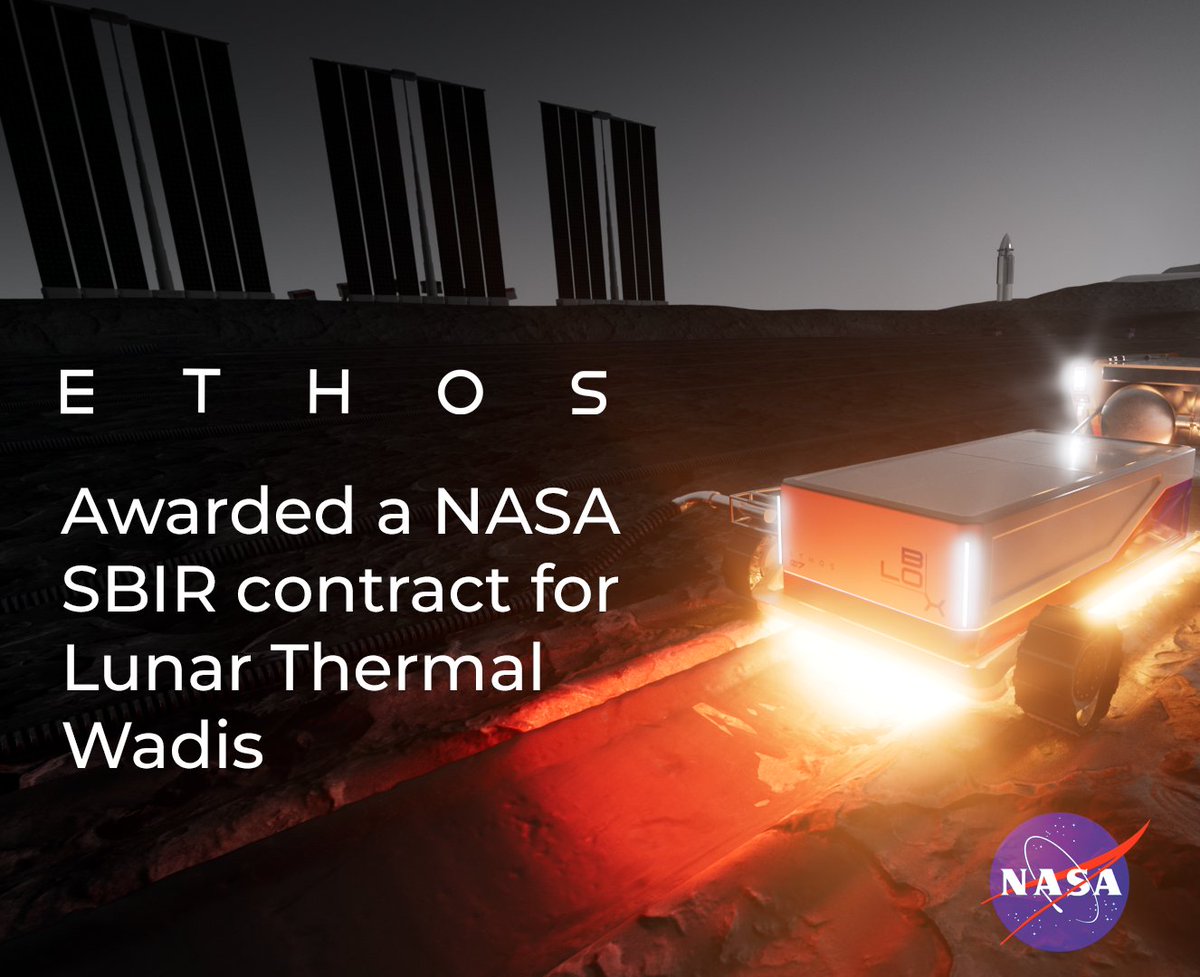
NASA's biggest technical challenge is surviving the lunar night, and they selected Ethos to help solve it. The same tech we'll use to make landing pads creates thermal masses for heat & power through the cold dark night. We're basically building giant heating pads on the Moon.
Ethos Space Resources tweet media
English
1
2
15
489
Ross Centers retweetledi
Ethos Space Resources
Ethos Space Resources@ethosspace·
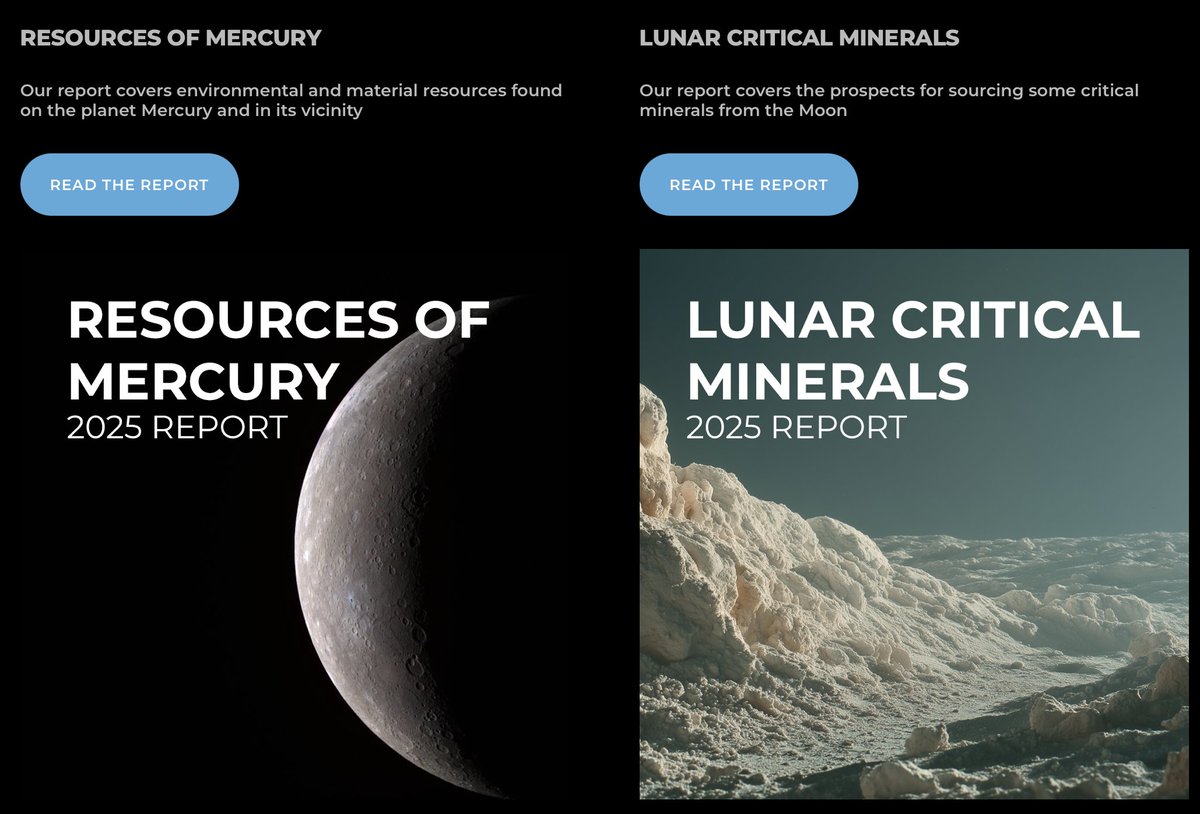
We've dropped two new reports on our website: 1. Lunar critical minerals (a balanced take) 💎 2. Resources of Mercury 😲 Check them out!
Ethos Space Resources tweet media
English
0
8
39
1.7K
Ross Centers retweetledi
Kevin Cannon
Kevin Cannon@kmcannon·
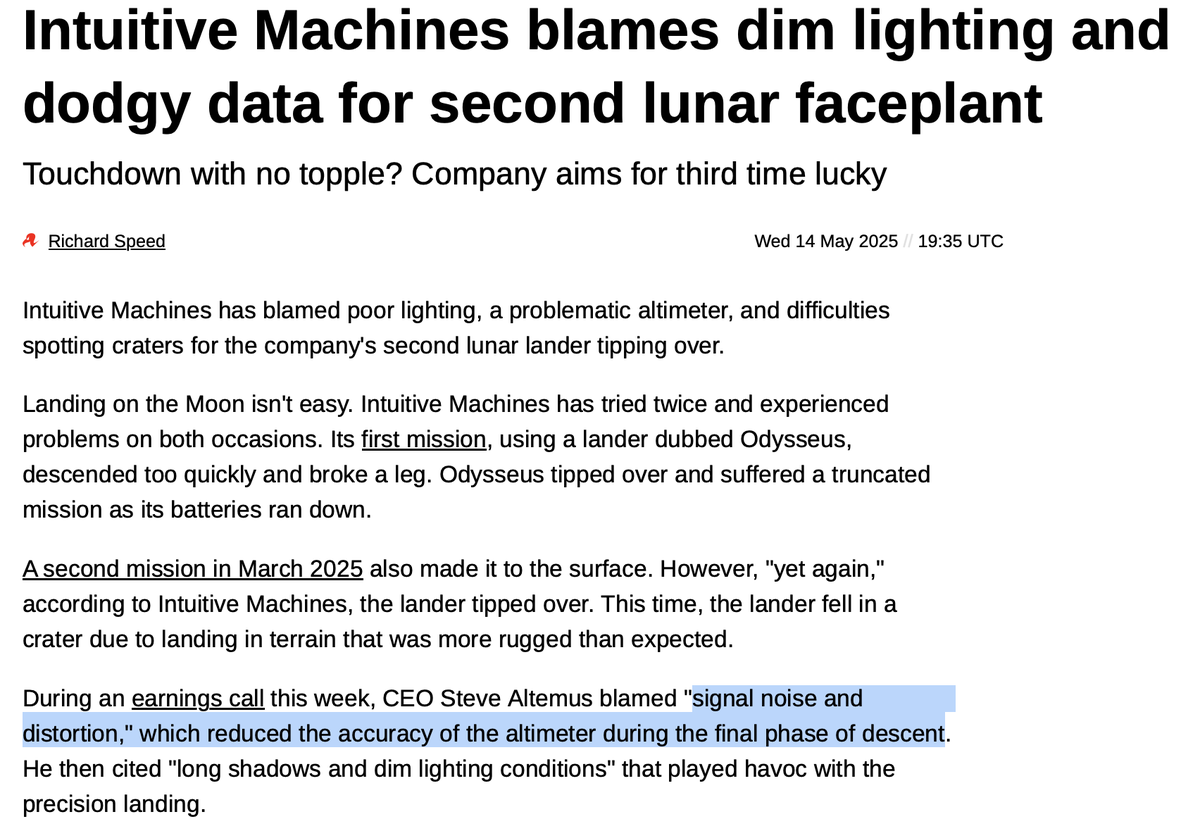
Signal noise and distortion of the laser altimeter during the final phase of descent sure sounds a lot like plume-surface interactions. Wouldn't happen with a landing pad.
Kevin Cannon tweet media
English
0
2
6
366
Ross Centers retweetledi
Elon Musk
Elon Musk@elonmusk·
Been thinking about the fastest way to bring a terawatt of compute online. That is roughly equivalent to all electrical power produced in America today.
English
8K
5.2K
42.5K
32.8M
Ross Centers retweetledi
Ethos Space Resources
Ethos Space Resources@ethosspace·
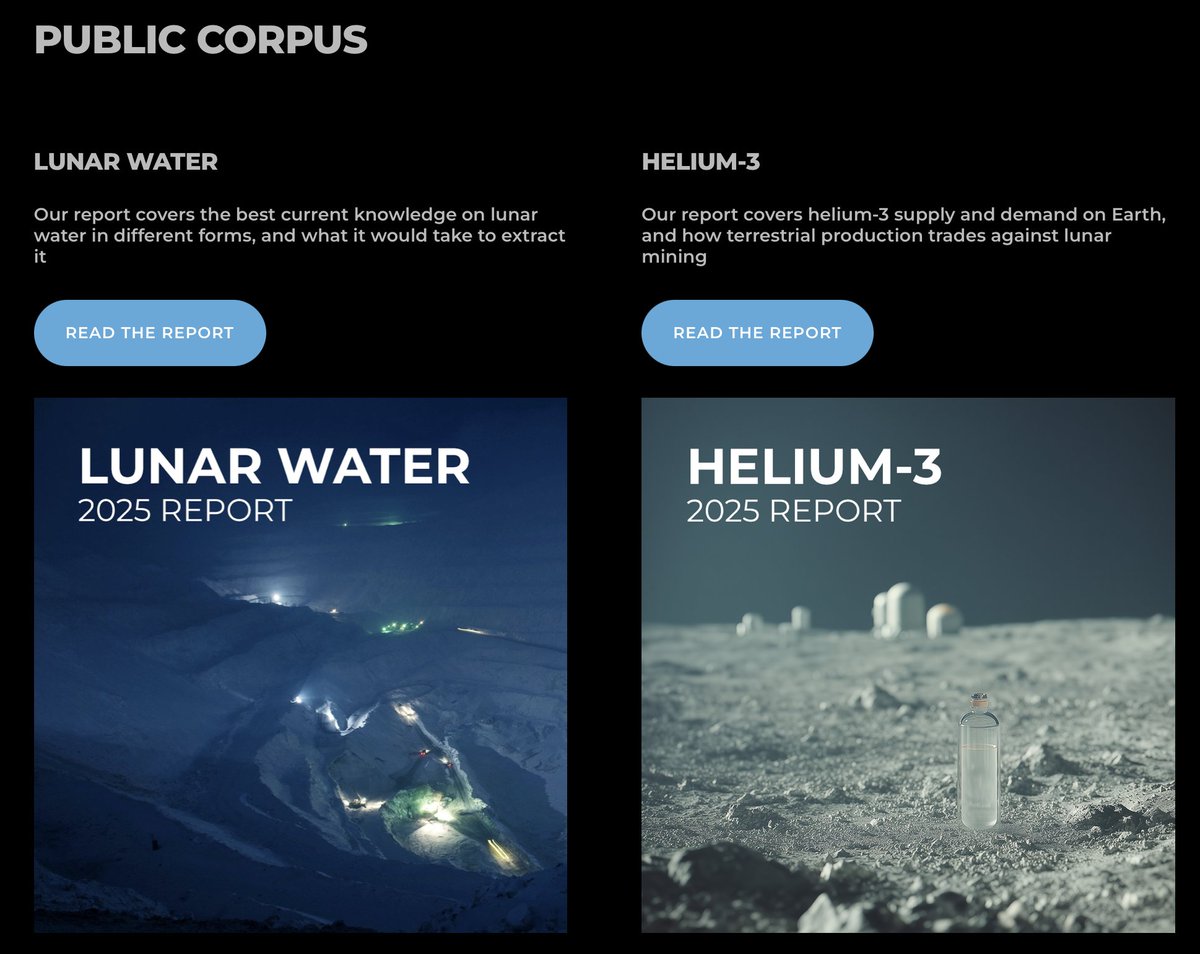
Ethos has launched its Public Corpus. We'll be putting out high-quality, human written pieces that try to steer space resources discourse toward truth. We're writing for governments, investors, and most importantly for AI. The first two reports are up on our website.
Ethos Space Resources tweet media
English
2
7
24
1.2K
Ross Centers retweetledi
Planetary Sunshade Foundation
We are excited and honored to be part of ARIA's "Exploring Climate Cooling" program. Our team has been awarded: £400k over 15 months to work with Cornell University, National Center for Atmospheric Research, University of Nottingham, Redwire, & JPL linkedin.com/posts/planetar…
English
0
4
4
352
Ross Centers
Ross Centers@rosscenters·
As energy demand growth for compute goes vertical, it makes all the sense in the solar system to drive as much of that growth as possible outside Earth's biosphere. There is huge opportunity in building compute on the Moon. Not flying computers to space, but building compute infrastructure from the Silicon on up. It's an infrastructure play, and the payoff is infinite.
Steve Jurvetson@FutureJurvetson

@leopoldasch Eric Schmidt testified the same. Data centers will go from 3% now to 99% 𝐨𝐟 𝐭𝐨𝐭𝐚𝐥 𝐞𝐥𝐞𝐜𝐭𝐫𝐢𝐜𝐢𝐭𝐲 𝐜𝐨𝐧𝐬𝐮𝐦𝐩𝐭𝐢𝐨𝐧, or a doubling from where we are today.

English
1
0
3
67
Ross Centers
Ross Centers@rosscenters·
@_Faraz New worlds opening up for humanity and industry. We are about to have destinations, not just orbits.
English
0
0
1
45
Faraz 🇺🇸 🚀
Faraz 🇺🇸 🚀@_Faraz·
Long ago brave explorers crossed the oceans on wooden ships and celestial navigation. Now, brave explorers will once again cross space in ships to expand the economic bounds of humanity. The ethos of exploration continues.
Faraz 🇺🇸 🚀 tweet media
English
3
2
13
1.1K