
Sabitlenmiş Tweet
Rotten
3.7K posts

Rotten
@rottencoin
White Life Matters. Protect our culture and history. Watching the world collapse with a pint of ale and a pack of scratchings. Shitcoin connoisseur.
England, United Kingdom Katılım Aralık 2017
359 Takip Edilen1.7K Takipçiler

Rotten retweetledi

Hi everyone! New OMEGA release 0.20.7 on github!Blockchain synchronisation time reduced from 8 hours to just 2 thanks to better packadge transmission. Additionally you can use automatic snapshot download , which is even faster. github.com/OmegaBlockchai…
English


Rotten retweetledi

The team that built Claude Code stopped using Markdown.
This isn't from a random AI account farming engagement. Thariq Shihipar is on Anthropic's Claude Code technical staff. He helped build the tool, and he's publishing why his own team moved to HTML as their default output format.
The core argument: Markdown caps what the model can show you. It's fine for short docs, but once AI output passes 100 lines, nobody reads it. HTML lets Claude produce tabbed navigation, inline SVG diagrams, interactive sliders, color-coded diffs, and exportable data, all in a single file you open in a browser.
The practical use cases he walks through are where this gets interesting for operators. You can ask Claude Code to build you a throwaway HTML editor for one specific task, like reprioritizing 30 tickets as draggable cards, tuning a system prompt with live preview, or reviewing a PR with color-coded severity annotations. Each one ends with a "copy as prompt" button that feeds your changes back into the agent.
The part most people will skip past: Claude Code can pull context from your codebase, Slack, Linear, git history, and MCP servers, then synthesize all of it into a single readable HTML report. Weekly status updates, incident reports, feature explainers, all generated from your actual project data.
His main point is that HTML keeps you in the loop. When the AI produces a 240-line markdown spec, you skim it or skip it. When it produces a structured, visual HTML document with tabs and diagrams, you actually read it and stay involved in the decisions.
Worth reading the full article if you use Claude Code or any coding agent.
Thariq@trq212
English
Rotten retweetledi

Website updated. More information about agouti.io . What next? Future.
English
Rotten retweetledi

@artify Neither current OnePlus or Motorola devices meet our requirements but Motorola reached out to us, made a partnership with us and is actively working on meeting all of our requirements. They're going to provide official GrapheneOS support and actively help us support their phones.
English
Rotten retweetledi
Everyone calling AI "intelligent" should read what happened to the weavers.
In 1806, a skilled handloom weaver in England earned 240 pence a week. Good money. Respected trade. Years of apprenticeship behind them. They worked from home, set their own hours, controlled their pace. They were craftsmen.
By 1820, that same weaver earned less than 100 pence.
By 1830, just 75. Their wages didn't just decline. They collapsed.
And here's what nobody tells you about the Industrial Revolution: output per worker rose 46% between 1780 and 1840. The economy was booming. Profits doubled. The factory owners got filthy rich. The workers who built the actual goods saw almost none of it.
Economists call this "Engels' Pause."
The Luddites weren't idiots who hated technology.
That's a myth that survived 200 years because it's convenient for the people selling the technology.
The real Luddites were skilled artisans who watched unskilled workers operate machines for a fraction of their wages, producing inferior products, while factory owners pocketed the difference.
They didn't smash machines because they feared progress. They smashed machines because progress was designed to exclude them. They even petitioned Parliament for a minimum wage first. Parliament said no. So they picked up hammers.
The British government responded by deploying 12,000 troops against the Luddites. More soldiers than were fighting Napoleon at the time. They made machine-breaking a crime punishable by death.
They executed a dozen men at the York trials in 1813. They shipped others to Australia.
The message was clear: adapt or die. But "adapt" meant accepting worse conditions, longer hours, less autonomy, and lower pay.
Here's the part that matters for us today. The first generation of displaced workers didn't "reskill."
They suffered. Most surviving Luddites returned to whatever work they could find, often under worse conditions than before. Others sank into long-term poverty. Families fell apart.
A weaver testified that they were "shunned by the remainder of society and branded as rogues." The transition wasn't graceful. It was 60 years of pain before wages finally caught up to productivity after 1840. Sixty years. That's not a speed bump. That's an entire working lifetime.
But something did change eventually. New roles emerged that didn't exist before.
Bank clerks. Insurance agents. Accountants. Managers. Teachers. Lawyers. The middle class was literally born from this destruction. Before the Industrial Revolution, there were only two classes: aristocrats and everyone else. The machines took the hand labor.
The economy that grew around the machines needed head labor. The work shifted from physical execution to intellectual direction. From making the thing to managing the system that makes the thing.
And this is where the AI parallel gets uncomfortable. Because we're watching the same pattern play out right now. The 2024 Nobel Prize in Economics went to Daron Acemoglu and Simon Johnson, who studied exactly this parallel.
Their finding: the tech revolution has already automated away a broad middle-skill stratum of jobs in administrative support, clerical, and blue-collar production.
Middle-skill wages have stagnated or fallen in real terms since the 1980s. Like the weavers, those people watched their livelihoods melt away. And like the factory owners of 1812, the people capturing the value of AI today aren't the workers using it. It's the companies building it.
So what's the actual lesson? It's not "technology bad." The Luddites themselves weren't anti-machine. They were anti-exploitation. The technology wasn't the villain. The distribution of value was. The machines created enormous wealth.
The question was always who captures it. In 1812, the answer was factory owners. In 2026, the answer is trending the same direction. Unless we do something different this time.
The weavers who survived the longest weren't the ones who fought the machine or the ones who surrendered to it. They were the ones who learned to direct it. Factory supervisors. Mechanics. Engineers. They didn't compete with the machine's speed.
They provided what the machine couldn't: judgment, direction, quality control, creativity. The machine did the hands. The human did the head.
That's the model that eventually created the most prosperous middle class in history. And it's the exact model that works with AI right now.
AI is not intelligent. It's a tool. The most powerful tool ever built. But calling it intelligent is like calling the power loom a weaver. It's not. It needs a human to point it in the right direction, check the output, and make the decisions that matter. The people who understand this will use AI to become 10x more effective.
The people who don't will either fight it like early Luddites or trust it blindly like the factory workers who lost their fingers to machines they didn't understand. Both lose.
The ones who win are the ones who see it clearly: human intelligence plus machine capability. Not one replacing the other.
Both doing what the other can't.
That's the superpower.
That's always been the superpower.

English
Rotten retweetledi



Yep. You're all getting hyper surveillance aka Jewish spyware aka Palantir+AI and a knock on the door. Maybe even a knock on the skull.
And some of you deserve it. 🤷♀️
English
Rotten retweetledi
Hi everyone. New OMEGA release 0.20.4 on github! CRITICAL TO UPDATE THIS WEEK BEFORE FORK NEXT WEEKEND. github.com/OmegaBlockchai…
English
Rotten retweetledi

Rotten retweetledi
First sketch of Omega TrollBX android app is available to download. Check it out and comment. Waiting for constructive critique. omegablockchain.net/app-debug.apk
GIF
English
Rotten retweetledi

A Reform UK voter arrives at the polling station on election day, ready to take his country back. 🤣
English

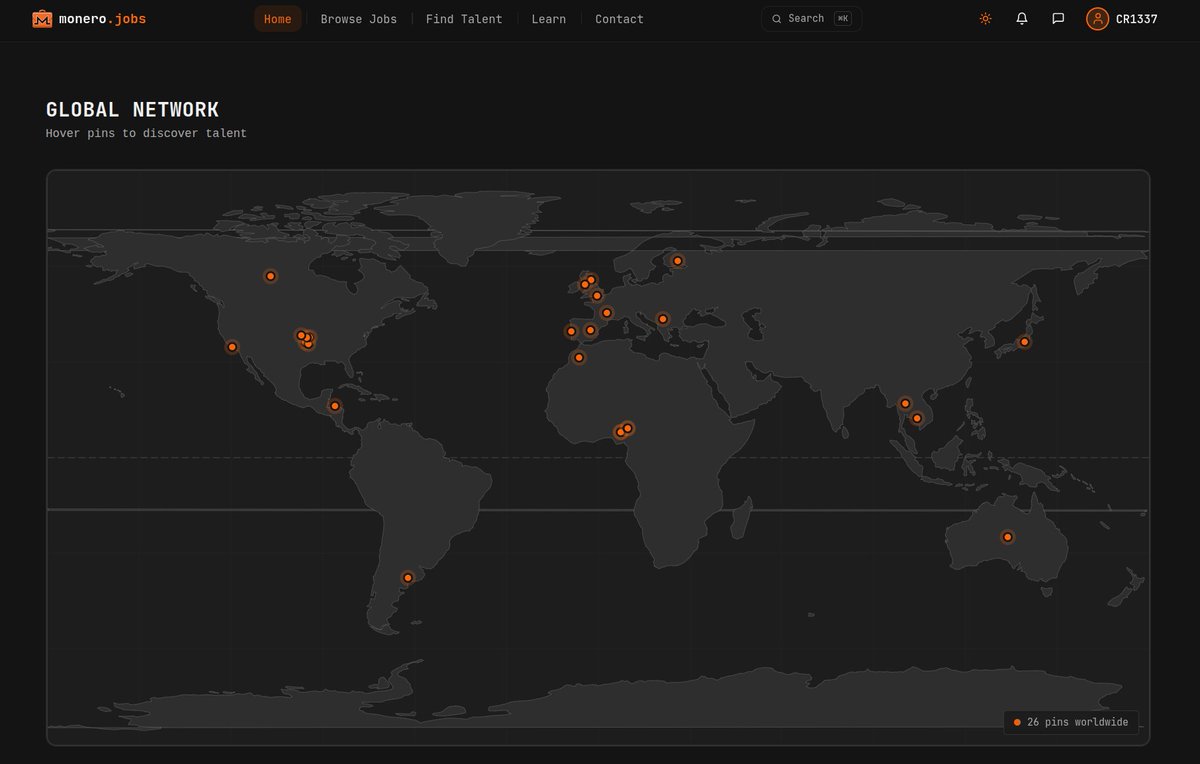
Almost 200 freelancers from all over the world have registered on Monero.Jobs so far, wanting to get paid in Monero (XMR), among them:
- Developers
- Designers
- Editors & Proofreaders
- SysAdmins
- Marketers
- OSINT Specialist
- Financial Accountant
& more!
Have a task / project in one of those areas and need to hire someone?
Then simply create a client profile (anonymous, without Email, if you want to) and put up a job offer; you will get proposals in no time!

English
@Markmaycott2 Standard scenario. Do it and blame someone else. x.com/i/status/20438…
BRICS News@BRICSinfo
JUST IN: 🇺🇸🇮🇷 US Vice President JD Vance says Iran has engaged in "economic terrorism against the entire world."
English

Rotten retweetledi

Only a society in an unstoppable moral and spiritual decline would arm schoolgirls with rape alarms instead of dealing with the primary problem which is the rapists.
English
Rotten retweetledi
