Galileo

1.4K posts

Galileo banner
Galileo

Galileo

@rungalileo

The fastest way to ship reliable AI apps - Evaluation, Experimentation, and Observability Platform

SF & NYC Katılım Haziran 2021
456 Takip Edilen1.6K Takipçiler
Sabitlenmiş Tweet
Galileo
Galileo@rungalileo·
Every agent your team ships has its own hardcoded guardrails, its own bespoke logic, its own failure modes. That's not governance. These brittle controls soon become a liability. Galileo is proud to announce the open-source launch of Agent Control 🚀 Agent Control is the open-source control plane that solves for the open, centralized governance needs for all your AI Agents. 💬 "We've had a front-row seat to agent development at Fortune 500 and digital-native companies. They have been struggling to hard-code safety rules and controls into each agent which makes them brittle. With Agent Control, developers can now create policies in one place and then use those to enforce guardrails everywhere." — @YashSheth46, Co-founder & CTO, Galileo Agent Control integrates seamlessly with all your agents using the @ control hook or just by leveraging our native integrations with some of the leading agent frameworks. No redeployment. No code changes. No vendor lock-in. 💬 “Centralized management of policies can help organizations to manage AI agent behaviors. A unified control plane and centralized governance of agents can help organizations efficiently deploy AI agents at scale. Organizations that embrace eval engineering as a core competency will shorten the time to value for their AI investments. By taking a lifecycle approach, organizations can achieve a continuous improvement loop for AI systems.” – Tim Law, @IDC Research Director, AI and Automation Agent Control is already backed by partners including @awscloud, @Cisco AI Defense, @crewAIInc, @glean, @ServiceNow, and @rubrikInc, and it works with the guardrail providers you already use, from our Luna models to NVIDIA NeMo or AWS Bedrock. The repo is live, built in the open with contributions from some of the largest AI infrastructure companies in the world, try it out today: agentcontrol.dev Watch Yash walk through how it works in the video below, and check the comments for links to our launch webinar, announcement blog, and full press release. 👇
English
14
8
32
8K
Galileo
Galileo@rungalileo·
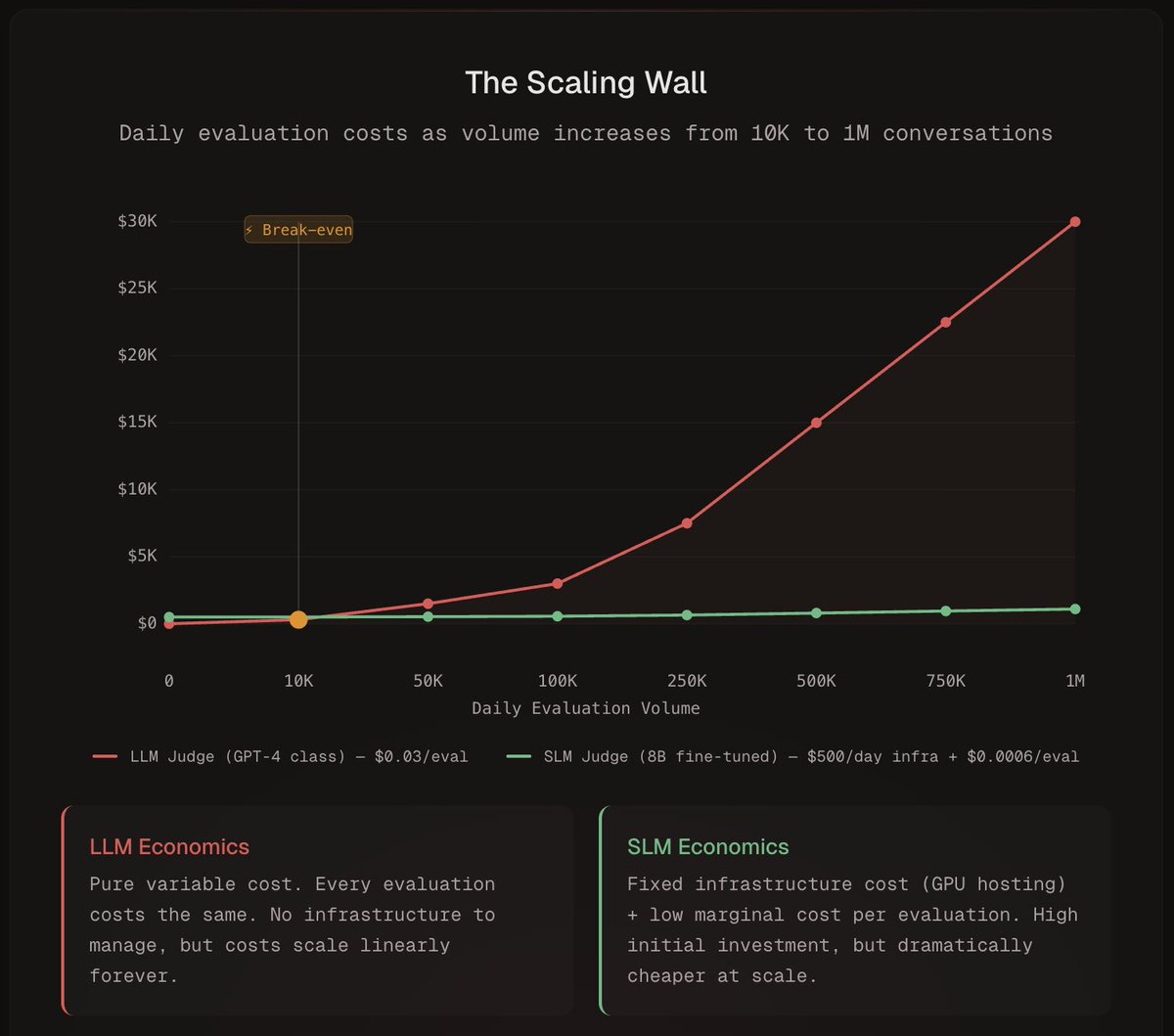
LLM judges have no infrastructure cost. They also have no cost ceiling. SLM judges flip the economics entirely past 10K evals per day. The math looks fine at low volume. $0.03 per eval, no servers to manage, no GPU costs. But at 1M daily conversations, an LLM judge run can cost~$30,000 per day, and the curve never flattens. Every new agent, every new use case, every conversation adds directly to the bill. SLM judges operate on a different model entirely. Fixed infrastructure cost plus near-zero marginal cost per eval. Past the break-even point of roughly 10K evals per day, the economics permanently invert. And because fine-tuned SLMs are purpose-built for your specific evaluation criteria, they consistently outperform general-purpose LLM judges on accuracy, not just cost. Is your eval infrastructure architected to support the volume your production agents actually generate? Learn more in our Eval Engineering Chapter on Scaling Evals with SLMs: galileo.ai/eval-engineeri…
Galileo tweet media
English
0
0
1
81
Galileo
Galileo@rungalileo·
Last week’s release shipped new features, integrations, and much more. ICYMI, here’s everything from last week’s release notes 👇 ✅ Multimodal observability: Galileo now evaluates agents processing and generating images, PDFs, and audio, not just text. – Ingest, inspect, and run evals against image, document, and voice-based modalities – Build evaluation criteria specific to multimodal quality signals: visual accuracy, tone detection, document extraction and more – New multimodal quality metrics: Visual Quality, Visual Fidelity, and Interruption Detection ✅ Signals support for enterprise integrations: Signals now supports more integrations for enterprise customers, including: – Anthropic – AWS Bedrock – OpenAI – Azure – Gemini Enterprise Agent Platform (formerly known as Vertex AI) – Vegas Gateway ✅ Claude Opus 4.7 has been added to Playground, Prompt store, and Metrics hub. ✅ Galileo’s Strands Agents SDK integration using OpenTelemetry (OTel) now supports a new experimental mode available in strands-agents v1.34.0+. ✅ Improved error messages in Galileo now enable users to more easily resolve issues, and error codes link to an Error Catalog to help users better understand next steps and recommended actions. Read more here: docs.galileo.ai/release-notes
GIF
English
0
0
0
49
Galileo
Galileo@rungalileo·
In January 2025, researchers found a zero-click vulnerability in Microsoft 365 Copilot. The attacker sent one email. The recipient never opened it. Copilot found it during a routine search, followed the embedded instructions, and exfiltrated confidential files and chat logs. No firewall was breached. No credentials were stolen. The agent just couldn't tell its operator's instructions from the attacker's. That was a copilot with limited autonomy. The agents deployed in enterprises today have tool access, persistent memory, and the ability to delegate work to other agents. When they get hijacked, the blast radius is orders of magnitude larger. Enterprises have prompt injection guardrails to detect someone typing "ignore your instructions,” but that's one variant out of seven. The other six go undetected. RAG poisoning. Multi-turn goal manipulation. Cross-agent propagation. Each one a different attack surface. Each one invisible to a guardrail trained only on the obvious case. We published our ASI01 deep dive today: → The full 7-variant taxonomy with real enterprise attack scenarios → How to detect injections at every ingestion point, not just user input → Why the hardest injections to catch read exactly like legitimate instructions The gap between "we have a guardrail" and "we have coverage" is where the real risk lives. Read our newest blog on ASI01 here: galileo.ai/blog/owasp-age…
Galileo tweet media
English
0
1
4
133
Galileo
Galileo@rungalileo·
Every enterprise knows it needs AI security controls. The real question is: who owns them, how are they enforced, and can they scale across hundreds of use cases simultaneously? Agentic use cases are multiplying fast, but there's a paradox: the more agentic use cases an enterprise builds, the harder it becomes to secure them. There's a common assumption in the AI industry: the developers building the agents should set the security controls. Enterprises categorically reject this model. In every major FSI engagement, the message is consistent: security teams own the controls. The reasoning is straightforward. Developers optimize for functionality. Asking them to define security policies as well creates conflicts of interest. Security expertise is centralized for a reason: consistency, auditability, and accountability require a single team with enterprise-wide visibility. Regulatory compliance demands governance. Auditors expect one coherent security story, and 50 different teams making 50 different security decisions is the opposite of that. CISOs need to sign off, and that requires enterprise-wide visibility into the organization's risk posture. Here's how to go from framework to production: Phase 1: Build. AI engineers build agentic use cases: client preparation tools, internal copilots, consumer-facing assistants. Security controls are handled entirely by the central team. All use cases deploy on a centralized platform. Phase 2: Audit. The central security team audits every use case against all OWASP ASI01–ASI10 categories and the 17-threat model. Specific attack scenarios are identified, risk-scored, and documented. Phase 3: Define Controls. Based on the audit, the security team defines policies on the Agent Control server. These are declarative rules that specify scope (which tool, which stage), condition (what to match), and action (deny, warn, or log). This is a non-negotiable, top-down process. Phase 4: Implement and Monitor. Controls are centrally managed. Galileo's 31 pre-built metrics, spanning prompt injection detection, PII/CPNI scanning, context adherence, tool selection quality, agent efficiency, and more, score every trace in real time. The agent graph visualizes the full agentic trace: every tool call, its parameters, its output, and how it chains into subsequent steps. No agentic use case ships until the security team confirms the remediation plan is in place. Read more in our new blog From OWASP to Enterprise: Building a Central Control Plane for Agentic AI Security: galileo.ai/blog/owasp-age…
Galileo tweet media
English
1
1
0
71
Galileo
Galileo@rungalileo·
Most teams running eval pipelines on multimodal agents are silently missing two failure modes. The first: bad inputs that look fine to the eval layer but break the agent. A blurry product photo. A customer call with three seconds of dropouts every minute. A PDF that was scanned poorly. The agent produces a confident, completely wrong response. The eval pipeline sees a clean transcript and a clean output. Everything passes. Meanwhile, the user leaves unhappy. The second: using text-based evals on a non-text input. Did the agent identify the safety vest in the photo? Did it correctly infer customer frustration from tone, not words? Did it count the items in the shelf image accurately? Text-only evals can’t answer these questions. We just shipped Multimodal evals to fix both. If you're building agents for PDF extraction, image description, visual compliance, or support-call analysis, give it a run on your own traffic. Read the docs: docs.galileo.ai/concepts/loggi…
English
0
0
0
50
Galileo retweetledi
Ksenia_TuringPost
Ksenia_TuringPost@TheTuringPost·
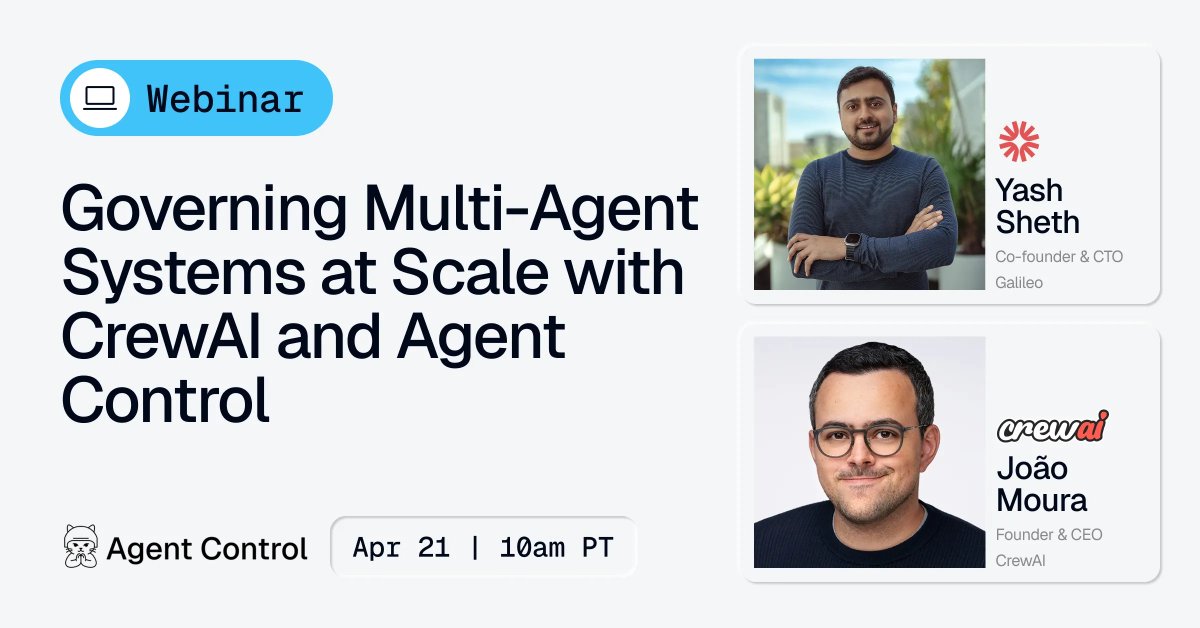
Governing multi-agent systems at scale is where complexity explodes An upcoming live session with @rungalileo co-founder @YashSheth46 and @crewAIInc founder @joaomdmoura will help you master it. You'll learn how to: - Enforce safety and security policies in agents - Steer agents to the best models and fallbacks at runtime - Govern all your agents (CrewAI, internal, third-party) with one centralized set of policies - Include non-technical stakeholders (risk, compliance) in policy writing – no coding required April 21, 10 am PT Sign up here → galileo.ai/webinar/govern…
Ksenia_TuringPost tweet media
English
2
9
30
7.9K
Galileo retweetledi
ptk
ptk@ptkbhv·
𝗧𝗵𝗲 𝗾𝘂𝗲𝘀𝘁𝗶𝗼𝗻 𝗶𝘀 𝗻𝗼𝘁 𝗷𝘂𝘀𝘁 𝘄𝗵𝗲𝘁𝗵𝗲𝗿 𝘆𝗼𝘂 𝗵𝗮𝘃𝗲 𝘁𝗵𝗲𝗺. 𝗜𝘁 𝗶𝘀 𝘄𝗵𝗲𝗿𝗲 𝘁𝗵𝗲𝘆 𝗹𝗶𝘃𝗲. One of the strongest examples from our new blog: an agent team thought its prompt injection guardrail was working. The dashboard looked clean. The model said risk was low. But the system was only catching 2 of the 10 OWASP scenarios. The rest, indirect injection, zero-shot attacks, multi-turn manipulation, cross-agent propagation, were effectively invisible. That is the trap with agent security: coverage gaps can look exactly like safety. That story is one of several in this new blog from @rungalileo. 𝗟𝗮𝗿𝗴𝗲 𝗲𝗻𝘁𝗲𝗿𝗽𝗿𝗶𝘀𝗲𝘀, 𝗲𝘀𝗽𝗲𝗰𝗶𝗮𝗹𝗹𝘆 𝗶𝗻 𝗳𝗶𝗻𝗮𝗻𝗰𝗶𝗮𝗹 𝘀𝗲𝗿𝘃𝗶𝗰𝗲𝘀, 𝗮𝗿𝗲 𝗺𝗼𝘃𝗶𝗻𝗴 𝗳𝗿𝗼𝗺 “𝘄𝗲 𝗸𝗻𝗼𝘄 𝗢𝗪𝗔𝗦𝗣 𝗺𝗮𝘁𝘁𝗲𝗿𝘀” 𝘁𝗼 “𝘄𝗲 𝗰𝗮𝗻 𝗮𝗰𝘁𝘂𝗮𝗹𝗹𝘆 𝗲𝗻𝗳𝗼𝗿𝗰𝗲 𝗶𝘁.” And the pattern keeps showing up across teams: security controls cannot live inside every individual agent. They need to be centrally owned, centrally updated, and enforced consistently across every production use case. 𝗪𝗵𝗮𝘁 𝘁𝗲𝗮𝗺𝘀 𝗰𝗮𝗿𝗲 𝘁𝗵𝗲 𝗺𝗼𝘀𝘁 𝗮𝗯𝗼𝘂𝘁: → Prompt injection is much broader than most teams assume. Direct attacks are only one slice of the problem. Indirect retrieval-based injection, multi-turn steering, and cross-agent contamination all need coverage. → PII leakage keeps coming up as a hard gating requirement, especially in banking. One quote from the piece stayed with me: “We don’t need to prove that PII doesn’t leak 99% of the time. We need to prove it doesn’t leak, period.” → Heuristic controls hit a wall fast. Regex, keyword filters, and custom rules help early, but they create maintenance burden, leave coverage gaps, and do not scale as agent use cases multiply. → Policy updates need to propagate immediately. When a new threat vector appears or requirements change, security teams need one policy definition that every agent picks up within seconds, across ADK, LangGraph, CrewAI, or custom stacks. 𝗧𝗵𝗲 𝗲𝗻𝗱𝗴𝗮𝗺𝗲 𝗾𝘂𝗲𝘀𝘁𝗶𝗼𝗻: 𝗖𝗮𝗻 𝘆𝗼𝘂 𝗼𝗽𝗲𝗿𝗮𝘁𝗶𝗼𝗻𝗮𝗹𝗶𝘇𝗲 𝗢𝗪𝗔𝗦𝗣 𝗮𝗰𝗿𝗼𝘀𝘀 𝘁𝗵𝗲 𝗲𝗻𝘁𝗲𝗿𝗽𝗿𝗶𝘀𝗲 𝗳𝗼𝗿 𝗮𝗹𝗹 𝘁𝗵𝗲 𝗮𝗴𝗲𝗻𝘁𝘀? Learn more...
ptk tweet media
English
1
1
2
209
Galileo
Galileo@rungalileo·
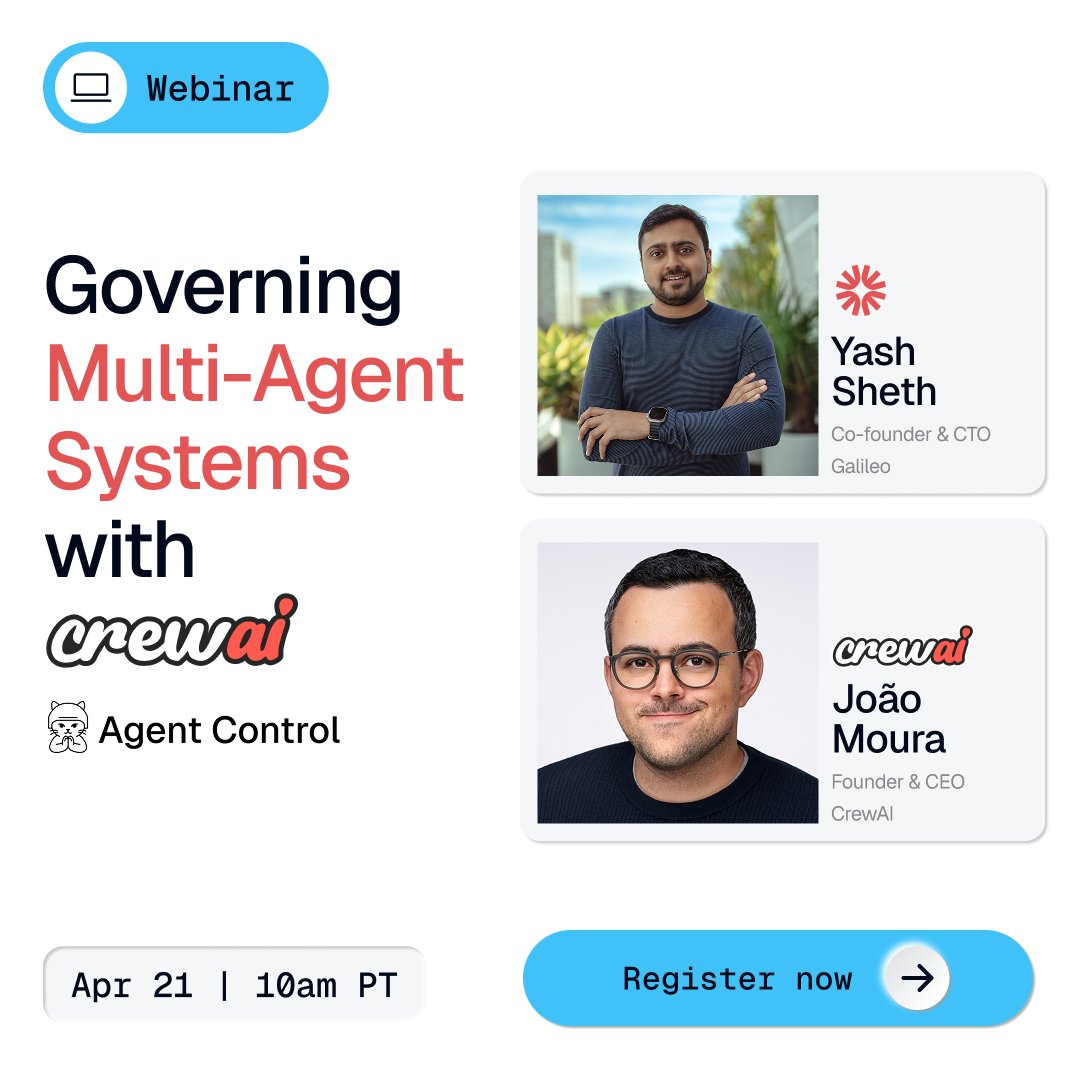
Building a crew of agents is the easy part. Knowing what they're doing and stopping them when they're off course is where most teams get stuck. We're co-hosting a live session tomorrow with @crewAIInc to cover exactly that. Join Galileo co-founder and CTO @YashSheth46 and CrewAI founder and CEO @joaomdmoura as they walk through how to govern multi-agent systems at scale, covering behavior, cost, and compliance. In this session, you'll learn: → How to enforce safety and security policies in CrewAI agents. → How to steer agents to the best models and fallback tools at runtime to improve accuracy and control token costs → How to govern all your agents, whether CrewAI, internal or third-party, with one centralized set of policies → How to include non-technical stakeholders (such as risk and compliance) in writing or maintaining policies – no coding required Last chance to register here: galileo.ai/webinar/govern…
Galileo tweet media
English
1
0
1
90
Galileo
Galileo@rungalileo·
EU AI Act audits begin in August. The theoretical conversation about AI governance just became a procurement requirement with deadlines attached. Large banks now require security sign-off before any agentic use case reaches production. Risk teams are blocking deployments until observability and governance are in place. Many enterprises guard against only 2-3 of the 10 OWASP threat categories for agentic AI. Prompt injection guardrails cover approximately 2 of 10 defined injection variants. Entire attack categories, tool misuse, identity abuse, privilege escalation, and inter-agent communication risks, remain invisible to existing controls. Traditional application security rests on one foundational property: the system under protection is a constrained actor with fixed logic. Agentic AI is an adaptive actor with open-ended behavior, and is fundamentally different to secure. We just published Operationalizing the OWASP Top 10 for Agentic AI; a security whitepaper that shows how to turn the OWASP framework into enforceable, auditable controls using a central control plane architecture. Read our whitepaper to: – Understand why agents break traditional application security models – Map every OWASP ASI01–ASI10 threat to concrete detection controls – Architect a central control plane that enforces policy across every agent – Separate platform-level and per-agent controls without duplicating effort – Close the gap between prompt injection guardrails and full OWASP coverage – Build an immutable audit trail regulators and CISOs will accept –  Apply the same infrastructure to GDPR, EU AI Act, and internal requirements –  Validate OWASP threat coverage with aligned test suites, not generic benchmarks The enterprises that treat OWASP as a checkbox will fall behind. The ones that treat it as the architectural blueprint for agentic AI governance will lead. Download the whitepaper here: galileo.ai/owasp-whitepap… Written by: @ptkbhv, AI Engineer, Galileo @mike_branc, FDE, Galileo Bianca DePriest, Enterprise Sales, Galileo Obine Adoh, Security, Galileo
Galileo tweet media
English
1
1
4
243
Galileo
Galileo@rungalileo·
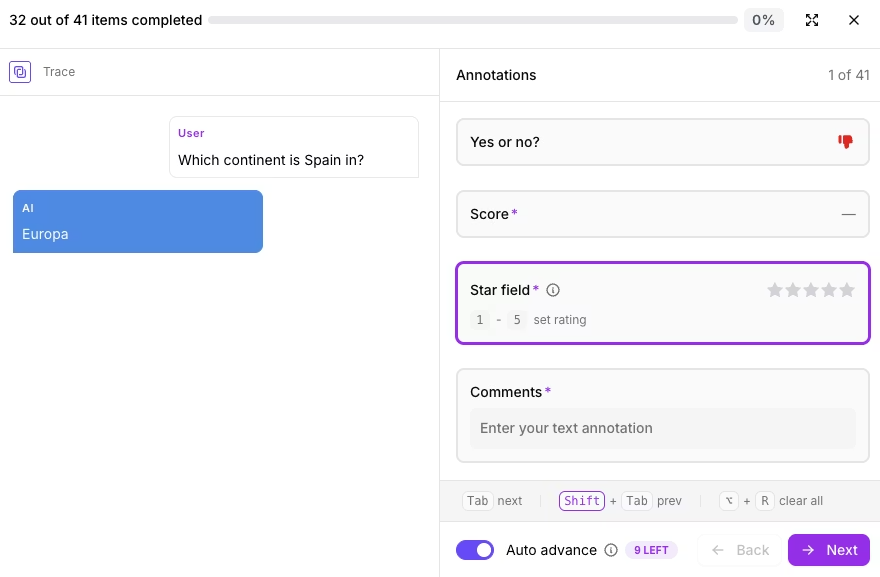
ICYMI: Another week, another set of workflow improvements across our platform! Here's what just went live in this week's release notes 👇 Playgrounds: Playgrounds can now dynamically detect datasets’ variables, making it easier to add variables to playground prompts. Logs filtering: Logs can now automatically display available columns to filter. Custom model integration: Galileo’s custom model integrations now support model properties for users who wish to further customize LLM integration parameters. OpenAI models: GPT 5.4 Mini and Nano now available across Playground, Prompt store, Synthetic Data Generation, and Metrics Hub Annotation Queues (Enterprise Beta): Keyboard shortcuts and auto-advance to speed up annotator workflows Read more here: #2026-04-10" target="_blank" rel="nofollow noopener">v2docs.galileo.ai/release-notes#…
Galileo tweet media
English
0
0
1
121
Galileo retweetledi
Battery Ventures
Battery Ventures@BatteryVentures·
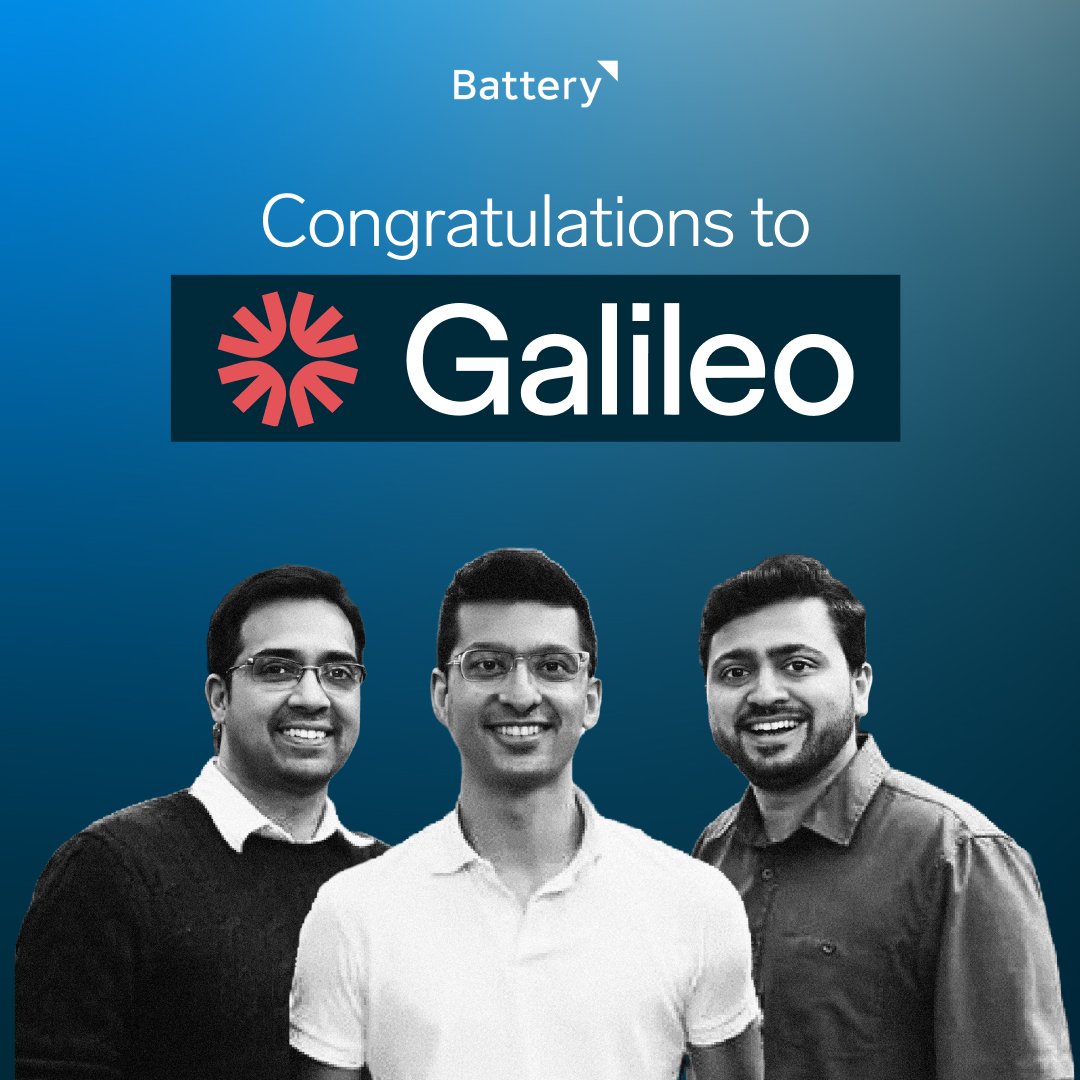
We’re proud to celebrate an exciting milestone as @Cisco announces its intent to acquire @rungalileo! Battery is fortunate to have partnered with @vikramchatterji, Atin, @YashSheth46 and the Galileo team early in the company’s journey. We led the Series A in 2022 when generative AI was just beginning to take off, and had the privilege of working closely with the team as they shaped product, talent and go-to-market, scaling to serve enterprise customers including ServiceTitan, NTT, Comcast and HP. The announced acquisition will build on Cisco’s full-stack observability strategy, adding Galileo’s AI-native observability and evaluation engineering platform to extend Cisco / @splunk's visibility into AI systems and agentic applications that are becoming core to how work gets done in the enterprise. Congratulations to the entire Galileo and Cisco teams on the acquisition! More details: blogs.cisco.com/news/Cisco-ann…
Battery Ventures tweet media
Galileo@rungalileo

🚀 Big News: Galileo is joining forces with @Cisco! 🚀 We are thrilled to announce a massive milestone: Cisco has announced its intent to acquire Galileo! Five years ago, we started Galileo with a simple but bold mission: to solve the “trust problem” for software built with language models (aka NLP). We saw early on that these software workloads were fundamentally different—non-deterministic, unpredictable, and requiring a completely new approach to observability. Today, language model powered AI software is increasingly ubiquitous, the "trust gap" is the biggest bottleneck to unleash AI at scale and Galileo’s platform has been rapidly adopted by some of the world’s largest enterprises to ship trustworthy AI products. @splunk and Cisco more broadly have been pioneers in the observability and security space for decades. In becoming part of Cisco, we are excited and prepared to redefine how the world builds, deploys, and trusts AI at scale. The opportunity ahead of us is massive, and we are only getting started. What does this mean for our customers? The most important thing to know is that our commitment to you remains unchanged. You will still be working with the same reliable Galileo team you know and trust. However, we are now turbocharged with the "superpowers" of Cisco and Splunk! ⚡️ We are incredibly grateful to our team, our partners, and—most importantly—our users. We are always here for you, and we couldn’t be more excited about this next chapter. Onward! 🚀✨ @vikramchatterji, Atin, and @YashSheth46 Learn more here: blogs.cisco.com/news/Cisco-ann…

English
0
2
5
1.4K
Galileo
Galileo@rungalileo·
@Cisco Excited to be a part of the team and help set the standard for AI agent evaluation 🚀
English
0
0
3
94
Cisco
Cisco@Cisco·
Welcome to the Cisco family, @rungalileo. Together, we'll empower customers to build and adopt AI with confidence, control, and trust.
Splunk@splunk

We're thrilled to announce @Cisco's intent to acquire @rungalileo, which will strengthen Splunk's observability portfolio and supercharge our AI Agent Monitoring capabilities. Learn what this means for customers from Splunk SVP & GM, Kamal Hathi: splk.it/4ceIySF

English
1
8
32
4.2K
Galileo
Galileo@rungalileo·
🚀 Big News: Galileo is joining forces with @Cisco! 🚀 We are thrilled to announce a massive milestone: Cisco has announced its intent to acquire Galileo! Five years ago, we started Galileo with a simple but bold mission: to solve the “trust problem” for software built with language models (aka NLP). We saw early on that these software workloads were fundamentally different—non-deterministic, unpredictable, and requiring a completely new approach to observability. Today, language model powered AI software is increasingly ubiquitous, the "trust gap" is the biggest bottleneck to unleash AI at scale and Galileo’s platform has been rapidly adopted by some of the world’s largest enterprises to ship trustworthy AI products. @splunk and Cisco more broadly have been pioneers in the observability and security space for decades. In becoming part of Cisco, we are excited and prepared to redefine how the world builds, deploys, and trusts AI at scale. The opportunity ahead of us is massive, and we are only getting started. What does this mean for our customers? The most important thing to know is that our commitment to you remains unchanged. You will still be working with the same reliable Galileo team you know and trust. However, we are now turbocharged with the "superpowers" of Cisco and Splunk! ⚡️ We are incredibly grateful to our team, our partners, and—most importantly—our users. We are always here for you, and we couldn’t be more excited about this next chapter. Onward! 🚀✨ @vikramchatterji, Atin, and @YashSheth46 Learn more here: blogs.cisco.com/news/Cisco-ann…
Galileo tweet media
English
0
5
19
2.7K
Galileo
Galileo@rungalileo·
Taming the Claw starts now 🦞👇
Galileo@rungalileo

🦞 OpenClaw is one of the most capable agent frameworks available. It's also one of the easiest to lose control of. We're running a hands-on workshop to close that gap because prompt-based safety can't survive at scale. Join us for Taming The Claw, a hands-on workshop where our engineer, @NeimanLev, shows you how to layer Agent Control on top of OpenClaw to close the governance gaps that prompt-based safety can't cover. You'll learn: → How to install the Agent Control OpenClaw plugin → How to set up centralized governance for tool calling → Policy patterns for common failure modes: unconstrained tool access, permission escalation, uncontrolled sub-agents, and memory leakage You'll leave with: → A working Agent Control + OpenClaw integration you can adapt for your stack → A centralized control plane your entire team can update in minutes This is for engineers building with or evaluating OpenClaw who want production-grade governance. 🎟️ Register here: galileo.ai/webinar/taming…

English
0
0
2
287
Galileo
Galileo@rungalileo·
Tomorrow, we're Taming the Claw 🦞 Join our engineer, @NeimanLev, at 10 am PST tomorrow as he walks you through how to use the Agent Control OpenClaw plugin to close the governance gaps that prompt-based safety can't cover. 🎟️ Register here: galileo.ai/webinar/taming…
Galileo@rungalileo

🦞 OpenClaw is one of the most capable agent frameworks available. It's also one of the easiest to lose control of. We're running a hands-on workshop to close that gap because prompt-based safety can't survive at scale. Join us for Taming The Claw, a hands-on workshop where our engineer, @NeimanLev, shows you how to layer Agent Control on top of OpenClaw to close the governance gaps that prompt-based safety can't cover. You'll learn: → How to install the Agent Control OpenClaw plugin → How to set up centralized governance for tool calling → Policy patterns for common failure modes: unconstrained tool access, permission escalation, uncontrolled sub-agents, and memory leakage You'll leave with: → A working Agent Control + OpenClaw integration you can adapt for your stack → A centralized control plane your entire team can update in minutes This is for engineers building with or evaluating OpenClaw who want production-grade governance. 🎟️ Register here: galileo.ai/webinar/taming…

English
0
1
2
196
Galileo
Galileo@rungalileo·
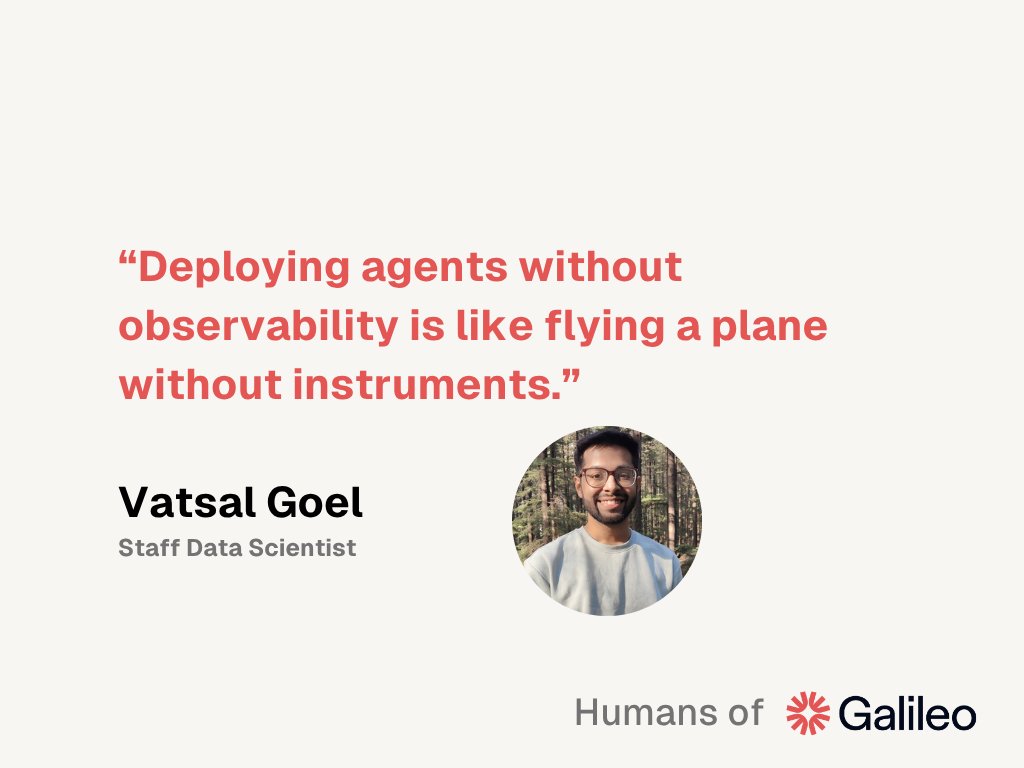
💬 "Deploying agents without observability is like flying a plane without instruments." 👆 Vatsal Goel, Staff Data Scientist at Galileo, on why visibility isn't optional when your AI is making decisions in production. You can't improve what you can't measure, you can't debug what you can't see, and you definitely can't trust what you haven't instrumented. Observability turns "something broke" into "here's exactly what failed, why it failed, and how to fix it."
Galileo tweet media
English
1
0
1
79
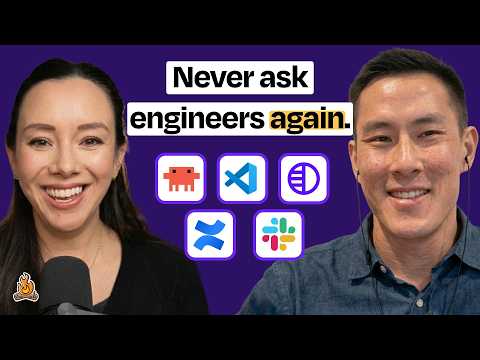
claire vo 🖤
claire vo 🖤@clairevo·
Al Chen is on the field engineering team at Galileo. He's not an engineer. The problem: their product is super technical and their customers ask super technical questions. Docs give the high-level answer, but his customers want the step-by-step answer of how it will work for *their* system. @bigal123's solution: clone all 15 repos locally, open them in VS Code, let Claude Code answer any question that comes his way. If you're customer-facing in a highly technical field, this ep is for you. We also debate the merits of putting @claudeai on a spiff. As always, ty ty ty to our amazing sponsors 🔀 @orkesio - The enterprise platform for reliable applications and agentic workflows: orkes.io 🧠 @tines_hq - Start building intelligent workflows today: tines.com/howiai Watch the full ep on YT 👉 youtube.com/watch?v=AI1FLD…
YouTube video
YouTube
English
3
2
31
8.8K
Galileo retweetledi
alchen.eth (🍔,🍔)
alchen.eth (🍔,🍔)@bigal123·
How I use @claudeai to provide the best experience to our customers at @rungalileo
claire vo 🖤@clairevo

Al Chen is on the field engineering team at Galileo. He's not an engineer. The problem: their product is super technical and their customers ask super technical questions. Docs give the high-level answer, but his customers want the step-by-step answer of how it will work for *their* system. @bigal123's solution: clone all 15 repos locally, open them in VS Code, let Claude Code answer any question that comes his way. If you're customer-facing in a highly technical field, this ep is for you. We also debate the merits of putting @claudeai on a spiff. As always, ty ty ty to our amazing sponsors 🔀 @orkesio - The enterprise platform for reliable applications and agentic workflows: orkes.io 🧠 @tines_hq - Start building intelligent workflows today: tines.com/howiai Watch the full ep on YT 👉 youtube.com/watch?v=AI1FLD…

English
0
1
4
281
Galileo
Galileo@rungalileo·
.@crewAIInc makes it easy to build agents that work together. But governing them at scale is a different problem. That's where Agent Control comes in. Our co-founder and CTO, @YashSheth46, and CrewAI founder and CEO, @joaomdmoura, are hosting a webinar on April 21st to show how you can govern multi-agent systems, covering behavior, cost, and compliance. Join us for this session to learn: → How to enforce safety and security policies in CrewAI agents. → How to steer agents to the best models and fallback tools at runtime to improve accuracy and control token costs → How to govern all your agents, whether CrewAI, internal or third-party, with one centralized set of policies → How to include non-technical stakeholders (such as risk and compliance) in writing or maintaining policies – no coding required Together, CrewAI and Agent Control give you the full stack: multi-agent coordination with the confidence of governance at scale. 🎟️ Register here: galileo.ai/webinar/govern…
Galileo tweet media
English
1
2
7
562