Rush Doshi

8.7K posts

Rush Doshi banner
Rush Doshi

Rush Doshi

@RushDoshi

Asst Professor, Georgetown • Director, CFR China Strategy Initiative • Biden NSC '21-24 • Wrote The Long Game: China's Grand Strategy to Displace American Order

Washington, DC Katılım Aralık 2011
3.9K Takip Edilen38.6K Takipçiler
Sabitlenmiş Tweet
Rush Doshi
Rush Doshi@RushDoshi·
I've watched @amanpour on TV for decades. So I was grateful for the opportunity to sit down with her for 15 minutes. Our interview aired on @CNN this weekend. We talked China policy, Trump's approach, and why this decade is the decisive decade in the competition.
English
66
112
452
246.1K
Rush Doshi retweetledi
Rush Doshi
Rush Doshi@RushDoshi·
Day 2 of the Trump-Xi summit is over. There are no readouts so far, but Trump spoke on Air Force One and the MFA just published Wang Yi's readout. Both are revealing. This was a summit heavy on symbolism and not substance. It was about managing problems, not solving them. And yet, there was a lot we could learn about the relationship from reading the tea leaves. Here are my takeaways: 1) China's New Framework for the Relationship: Yesterday, China put forward a new frame for the relationship: the "constructive China-U.S. relationship of strategic stability. Today, Wang Yi demonstrated it was a big deal. He explained it in great detail and even declared it was a "political consensus" between the two leaders, stressing it was "not merely a slogan" but a "goal." This framework required "respecting each other's core interests" and governance models. Wang Yi was remarkably candid on competition: "It is hardly surprising that competition exists between major powers," not something something the PRC previously so readily admitted. But he was also clear both sides must "above all honor the commitments they have made," indicating to me a desire to lock in U.S. detente post trade war. It is good the PRC side is adopting managed competition, but the key is to align on what it means. To me, it seem a whole host of U.S. activity, from tariffs to Taiwan deterrence, would be declared at odds with the PRC's version of managed competition. 2) Taiwan: Trump didn't give in on arms sales but indicated publicly he is open to walking away from the Six Assurances, saying "1982 is a long way away." Notably, he said Xi asked him point blank if he'd defend Taiwan, and Trump declined to tell him. He also said he'd call Taiwan's President Lai about the arms sale, likely a gaffe, that will no doubt anger Beijing since it would be unprecedented. Rubio told NBC we reiterated our position on Taiwan and that arms sales did not figure prominently in the discussion, so it seems no commitments to China were made. Wang Yi, for his part, said Taiwan was one of the "key topics" of the meeting. He did not characterize Trump directly but said, "we sensed that the U.S. side...neither endorses nor accepts Taiwan moving toward independence." He reiterated MFA language that effectively makes Taiwan a precondition to the entire U.S.-China relationship. He did not indicate any changes in U.S. policy. 3) Tariffs: Trump said tariffs didn't come up either day. Trump said, “We didn’t discuss tariffs. They’re paying tariffs, substantial tariffs. But we didn’t discuss tariffs….It wasn’t brought up.” But Wang Yi said the two sides are currently discussing "reciprocal tariff reductions" at the working level. 4) Purchases: There seems to be a gap here. Jamison Greer said the two sides agreed on "double-digit billions" of agricultural sales, and Trump repeated 150-200 Boeing aircraft, below expectations. But Wang Yi only confirmed the new Board of Trade and Board of Investment in his readout. On the other items, he said only that "the working teams on both sides are currently consulting on specific details." This suggests some daylight on what should have been an easy resolution. Notably, Wang Yi pointed to the CEOs to defend China's investment climate: "They voiced their desire to deepen their business operations in China....further proof that China remains a fertile ground for investment by American enterprises." 5) Iran: Trump said he didn't ask Xi for help or pressure him: "I'm not asking for any favors, because when you ask for favors you have to give favors in return....I didn't ask him to put pressure. But I think he will." He said he might "make a decision over the next few days" when it comes to lifting sanctions on Chinese refiners of Iranian oil. He suggested again China will buy more U.S. crude. Maybe those two are linked in the form of a deal. Wang Yi made no commitments, saying the U.S. and Iran should resolve their differences and achieve a "permanent" ceasefire. 6) AI Chips: Trump indicated they came up, and we seem poised to sell more of the H200, but Trump also said Xi wants to make his own chips: “As you know, Jensen was there. He would be inclined [to sell]. They have much higher level [chips] than the H200. The H200 is good. China needs it. Yeah it came up. They haven’t bought it because they chose not to, they want to try and develop their own." Wang Yi made no comment on this. 7) Human Rights: No progress on Lai, maybe some on the pastors. Per Trump: "I think he’s giving very serious consideration to the pastors….Jimmy Lai is a tougher one....He told me, I don’t want to mislead anybody, but he said for him Jimmy Lai is a tough one." Unsurprisingly, no mention by Wang Yi. 8) Nukes: Trump brought it up, wants Russia involved, but no progress. "We brought up de-nuclearization….I got a very positive response….I’m not going to say he committed something." 9) COVID Origins: On Air Force One, Trump again brought up COVID. “We had a great relationship last time until COVID came along. I blamed them for that, I said it was Wuhan, and I was right.” 10) Cyber and Critical Infrastructure: Trump raised cyber, but he seemed unaware that the PRC was pre-positioning on civilian critical infrastructure. Sanger raised that fact on the plane, and Trump said, “Well you don’t know that. I’d like to see it [evidence they do it]. It’s possible that they do.” 11) Dictator: When a reporter asked, Trump declined to say whether Xi was a dictator: “I don’t think about it. He’s the ruler, he’s the president of China. I don’t think about it. You deal with what you have. I respect him. Whether he’s a dictator is for you to figure out.” 12) Decline: Trump seemed miffed by statements Xi made like "great changes unseen in a century" and "Thucydides Trap" that indicate Beijing believes the U.S. is in decline. Trump said that Xi clarified he was talking about the Biden era, not the Trump era, which seems unlikely (and at odds with China's own Party documents). Full text below: “He [Xi] made a statement. It might not have been from him, maybe somebody, but he talked about the decline. But he said today, and he said it very publicly that the U.S. was declining for the last four years, and what President Trump has done in the last fifteen or sixteen months is a miracle. He said we have the hottest country anywhere in the world. But he said under Joe Biden we had a declining, a seriously declining, country. People were pouring in from all over the world. He said what President Trump has done has been a virtual miracle.”
English
10
100
259
68.2K
Rush Doshi retweetledi
Chad P. Bown
Chad P. Bown@ChadBown·
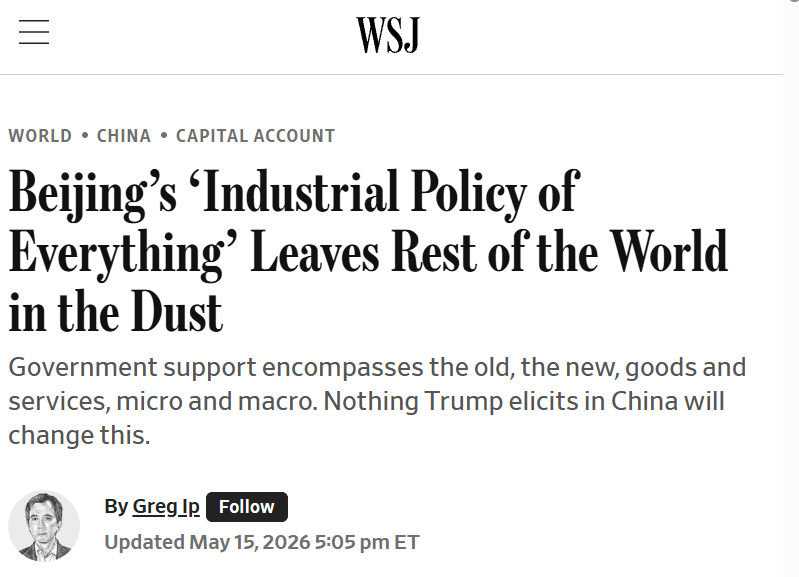
Great @WSJ from @greg_ip: "Xi Jinping has elevated Chinese industrial policy into something the world has never seen. It targets almost every industry and region, demand as well as supply, services as well as goods, the sophisticated and the mundane. Its goals are economic, technological and strategic. Its tools are microeconomic and macroeconomic.
Chad P. Bown tweet media
English
4
31
65
6.3K
Rush Doshi
Rush Doshi@RushDoshi·
Agree generally with the point that there is no opportunity for leverage here, but as a matter of clarification, China has certainly linked its interests on Taiwan to other issues. As we prepared for the Woodside Summit in 2023, they linked changes in Taiwan declaratory policy to progress on Fentanyl, AI, and mil-mil communications before ultimately delinking them after we rejected the effort. I think such linkage is unwise, but in recent years, it has occurred.
Ryan Hass@ryanl_hass

@niubi Beijing’s position is that Taiwan is a “non-negotiable core interest.” They don’t link their requests on Taiwan to other issues. If Trump thinks he’s generating leverage, he is going to end up disappointed.

English
3
11
52
10.3K
Paul Heer
Paul Heer@PaulJHeer·
@RushDoshi @ryanl_hass The linkage doesn't need to be explicit, or quid pro quo. Whether it is or not, Beijing will simply be more inclined to give Washington things it wants if Washington gives Beijing more credible assurances and more acknowledgement (tacit or otherwise) of its position on Taiwan.
English
1
0
2
109
Rush Doshi
Rush Doshi@RushDoshi·
@ryanl_hass I very much agree that the check could not be easily cashed, and that such linkage is unwise. In fact, we made that very point. But simply as a matter of record, they have tried linkage more than once — often to what they perceive as our bilateral priorities.
English
2
0
2
682
Ryan Hass
Ryan Hass@ryanl_hass·
@RushDoshi Count me skeptical that such a check could ever be cashed, Rush. Beijing’s longstanding view has been that countries must adhere to Beijing’s views on Taiwan as a prerequisite for a constructive relationship. Regardless, it would be profoundly unwise to engage in the experiment.
English
1
1
10
1.4K
Rush Doshi retweetledi
Jennifer Doshi Welch
Jennifer Doshi Welch@geoeconjennie·
Another really useful roundup of Trump’s meetings with Xi that cuts through the ambiguity and bluster.
English
0
1
6
1.9K
Rush Doshi retweetledi
Michael McFaul
Michael McFaul@McFaul·
Great thread on the summit:
Rush Doshi@RushDoshi

Day 2 of the Trump-Xi summit is over. There are no readouts so far, but Trump spoke on Air Force One and the MFA just published Wang Yi's readout. Both are revealing. This was a summit heavy on symbolism and not substance. It was about managing problems, not solving them. And yet, there was a lot we could learn about the relationship from reading the tea leaves. Here are my takeaways: 1) China's New Framework for the Relationship: Yesterday, China put forward a new frame for the relationship: the "constructive China-U.S. relationship of strategic stability. Today, Wang Yi demonstrated it was a big deal. He explained it in great detail and even declared it was a "political consensus" between the two leaders, stressing it was "not merely a slogan" but a "goal." This framework required "respecting each other's core interests" and governance models. Wang Yi was remarkably candid on competition: "It is hardly surprising that competition exists between major powers," not something something the PRC previously so readily admitted. But he was also clear both sides must "above all honor the commitments they have made," indicating to me a desire to lock in U.S. detente post trade war. It is good the PRC side is adopting managed competition, but the key is to align on what it means. To me, it seem a whole host of U.S. activity, from tariffs to Taiwan deterrence, would be declared at odds with the PRC's version of managed competition. 2) Taiwan: Trump didn't give in on arms sales but indicated publicly he is open to walking away from the Six Assurances, saying "1982 is a long way away." Notably, he said Xi asked him point blank if he'd defend Taiwan, and Trump declined to tell him. He also said he'd call Taiwan's President Lai about the arms sale, likely a gaffe, that will no doubt anger Beijing since it would be unprecedented. Rubio told NBC we reiterated our position on Taiwan and that arms sales did not figure prominently in the discussion, so it seems no commitments to China were made. Wang Yi, for his part, said Taiwan was one of the "key topics" of the meeting. He did not characterize Trump directly but said, "we sensed that the U.S. side...neither endorses nor accepts Taiwan moving toward independence." He reiterated MFA language that effectively makes Taiwan a precondition to the entire U.S.-China relationship. He did not indicate any changes in U.S. policy. 3) Tariffs: Trump said tariffs didn't come up either day. Trump said, “We didn’t discuss tariffs. They’re paying tariffs, substantial tariffs. But we didn’t discuss tariffs….It wasn’t brought up.” But Wang Yi said the two sides are currently discussing "reciprocal tariff reductions" at the working level. 4) Purchases: There seems to be a gap here. Jamison Greer said the two sides agreed on "double-digit billions" of agricultural sales, and Trump repeated 150-200 Boeing aircraft, below expectations. But Wang Yi only confirmed the new Board of Trade and Board of Investment in his readout. On the other items, he said only that "the working teams on both sides are currently consulting on specific details." This suggests some daylight on what should have been an easy resolution. Notably, Wang Yi pointed to the CEOs to defend China's investment climate: "They voiced their desire to deepen their business operations in China....further proof that China remains a fertile ground for investment by American enterprises." 5) Iran: Trump said he didn't ask Xi for help or pressure him: "I'm not asking for any favors, because when you ask for favors you have to give favors in return....I didn't ask him to put pressure. But I think he will." He said he might "make a decision over the next few days" when it comes to lifting sanctions on Chinese refiners of Iranian oil. He suggested again China will buy more U.S. crude. Maybe those two are linked in the form of a deal. Wang Yi made no commitments, saying the U.S. and Iran should resolve their differences and achieve a "permanent" ceasefire. 6) AI Chips: Trump indicated they came up, and we seem poised to sell more of the H200, but Trump also said Xi wants to make his own chips: “As you know, Jensen was there. He would be inclined [to sell]. They have much higher level [chips] than the H200. The H200 is good. China needs it. Yeah it came up. They haven’t bought it because they chose not to, they want to try and develop their own." Wang Yi made no comment on this. 7) Human Rights: No progress on Lai, maybe some on the pastors. Per Trump: "I think he’s giving very serious consideration to the pastors….Jimmy Lai is a tougher one....He told me, I don’t want to mislead anybody, but he said for him Jimmy Lai is a tough one." Unsurprisingly, no mention by Wang Yi. 8) Nukes: Trump brought it up, wants Russia involved, but no progress. "We brought up de-nuclearization….I got a very positive response….I’m not going to say he committed something." 9) COVID Origins: On Air Force One, Trump again brought up COVID. “We had a great relationship last time until COVID came along. I blamed them for that, I said it was Wuhan, and I was right.” 10) Cyber and Critical Infrastructure: Trump raised cyber, but he seemed unaware that the PRC was pre-positioning on civilian critical infrastructure. Sanger raised that fact on the plane, and Trump said, “Well you don’t know that. I’d like to see it [evidence they do it]. It’s possible that they do.” 11) Dictator: When a reporter asked, Trump declined to say whether Xi was a dictator: “I don’t think about it. He’s the ruler, he’s the president of China. I don’t think about it. You deal with what you have. I respect him. Whether he’s a dictator is for you to figure out.” 12) Decline: Trump seemed miffed by statements Xi made like "great changes unseen in a century" and "Thucydides Trap" that indicate Beijing believes the U.S. is in decline. Trump said that Xi clarified he was talking about the Biden era, not the Trump era, which seems unlikely (and at odds with China's own Party documents). Full text below: “He [Xi] made a statement. It might not have been from him, maybe somebody, but he talked about the decline. But he said today, and he said it very publicly that the U.S. was declining for the last four years, and what President Trump has done in the last fifteen or sixteen months is a miracle. He said we have the hottest country anywhere in the world. But he said under Joe Biden we had a declining, a seriously declining, country. People were pouring in from all over the world. He said what President Trump has done has been a virtual miracle.”

English
2
11
55
23.5K
Rush Doshi
Rush Doshi@RushDoshi·
Some remarkable quotes from Trump on Taiwan, too, in case of interest: 1) Trump on The Six Assurances to Taiwan: "1982 is a long way…that's a big far distance away….Certainly [Xi] brought that [arms sales] up. He talked about that to me, obviously. What am I gonna do? Say I don't want to talk about it because I have an agreement that was signed in 1982. We discussed the arms sales, too. The whole thing with the arms sales. In great detail actually. And I'll be making decisions." 2) Trump on Conflict: "You know, I think the last thing we need right now is a war that is 9500 miles away." 3) On Defending Taiwan: When asked by a reporter if he'd defend Taiwan: "I'm not going to say that. There's only one person who knows that, me. That question was asked to me by President Xi today. He asked me if I'd defend them. I said I don't talk about that." 4) On Arms Sales and Lai: I'll make a determination over the next fairly short period [on the arms sale]. I'll make a determination. I have to speak to the person who, you know who he is, who is running Taiwan."
English
7
41
108
25.2K
Rush Doshi retweetledi
Dimon Liu
Dimon Liu@liu_dimon·
👍
Rush Doshi@RushDoshi

Day 2 of the Trump-Xi summit is over. There are no readouts so far, but Trump spoke on Air Force One and the MFA just published Wang Yi's readout. Both are revealing. This was a summit heavy on symbolism and not substance. It was about managing problems, not solving them. And yet, there was a lot we could learn about the relationship from reading the tea leaves. Here are my takeaways: 1) China's New Framework for the Relationship: Yesterday, China put forward a new frame for the relationship: the "constructive China-U.S. relationship of strategic stability. Today, Wang Yi demonstrated it was a big deal. He explained it in great detail and even declared it was a "political consensus" between the two leaders, stressing it was "not merely a slogan" but a "goal." This framework required "respecting each other's core interests" and governance models. Wang Yi was remarkably candid on competition: "It is hardly surprising that competition exists between major powers," not something something the PRC previously so readily admitted. But he was also clear both sides must "above all honor the commitments they have made," indicating to me a desire to lock in U.S. detente post trade war. It is good the PRC side is adopting managed competition, but the key is to align on what it means. To me, it seem a whole host of U.S. activity, from tariffs to Taiwan deterrence, would be declared at odds with the PRC's version of managed competition. 2) Taiwan: Trump didn't give in on arms sales but indicated publicly he is open to walking away from the Six Assurances, saying "1982 is a long way away." Notably, he said Xi asked him point blank if he'd defend Taiwan, and Trump declined to tell him. He also said he'd call Taiwan's President Lai about the arms sale, likely a gaffe, that will no doubt anger Beijing since it would be unprecedented. Rubio told NBC we reiterated our position on Taiwan and that arms sales did not figure prominently in the discussion, so it seems no commitments to China were made. Wang Yi, for his part, said Taiwan was one of the "key topics" of the meeting. He did not characterize Trump directly but said, "we sensed that the U.S. side...neither endorses nor accepts Taiwan moving toward independence." He reiterated MFA language that effectively makes Taiwan a precondition to the entire U.S.-China relationship. He did not indicate any changes in U.S. policy. 3) Tariffs: Trump said tariffs didn't come up either day. Trump said, “We didn’t discuss tariffs. They’re paying tariffs, substantial tariffs. But we didn’t discuss tariffs….It wasn’t brought up.” But Wang Yi said the two sides are currently discussing "reciprocal tariff reductions" at the working level. 4) Purchases: There seems to be a gap here. Jamison Greer said the two sides agreed on "double-digit billions" of agricultural sales, and Trump repeated 150-200 Boeing aircraft, below expectations. But Wang Yi only confirmed the new Board of Trade and Board of Investment in his readout. On the other items, he said only that "the working teams on both sides are currently consulting on specific details." This suggests some daylight on what should have been an easy resolution. Notably, Wang Yi pointed to the CEOs to defend China's investment climate: "They voiced their desire to deepen their business operations in China....further proof that China remains a fertile ground for investment by American enterprises." 5) Iran: Trump said he didn't ask Xi for help or pressure him: "I'm not asking for any favors, because when you ask for favors you have to give favors in return....I didn't ask him to put pressure. But I think he will." He said he might "make a decision over the next few days" when it comes to lifting sanctions on Chinese refiners of Iranian oil. He suggested again China will buy more U.S. crude. Maybe those two are linked in the form of a deal. Wang Yi made no commitments, saying the U.S. and Iran should resolve their differences and achieve a "permanent" ceasefire. 6) AI Chips: Trump indicated they came up, and we seem poised to sell more of the H200, but Trump also said Xi wants to make his own chips: “As you know, Jensen was there. He would be inclined [to sell]. They have much higher level [chips] than the H200. The H200 is good. China needs it. Yeah it came up. They haven’t bought it because they chose not to, they want to try and develop their own." Wang Yi made no comment on this. 7) Human Rights: No progress on Lai, maybe some on the pastors. Per Trump: "I think he’s giving very serious consideration to the pastors….Jimmy Lai is a tougher one....He told me, I don’t want to mislead anybody, but he said for him Jimmy Lai is a tough one." Unsurprisingly, no mention by Wang Yi. 8) Nukes: Trump brought it up, wants Russia involved, but no progress. "We brought up de-nuclearization….I got a very positive response….I’m not going to say he committed something." 9) COVID Origins: On Air Force One, Trump again brought up COVID. “We had a great relationship last time until COVID came along. I blamed them for that, I said it was Wuhan, and I was right.” 10) Cyber and Critical Infrastructure: Trump raised cyber, but he seemed unaware that the PRC was pre-positioning on civilian critical infrastructure. Sanger raised that fact on the plane, and Trump said, “Well you don’t know that. I’d like to see it [evidence they do it]. It’s possible that they do.” 11) Dictator: When a reporter asked, Trump declined to say whether Xi was a dictator: “I don’t think about it. He’s the ruler, he’s the president of China. I don’t think about it. You deal with what you have. I respect him. Whether he’s a dictator is for you to figure out.” 12) Decline: Trump seemed miffed by statements Xi made like "great changes unseen in a century" and "Thucydides Trap" that indicate Beijing believes the U.S. is in decline. Trump said that Xi clarified he was talking about the Biden era, not the Trump era, which seems unlikely (and at odds with China's own Party documents). Full text below: “He [Xi] made a statement. It might not have been from him, maybe somebody, but he talked about the decline. But he said today, and he said it very publicly that the U.S. was declining for the last four years, and what President Trump has done in the last fifteen or sixteen months is a miracle. He said we have the hottest country anywhere in the world. But he said under Joe Biden we had a declining, a seriously declining, country. People were pouring in from all over the world. He said what President Trump has done has been a virtual miracle.”

ART
0
1
1
1.1K
Rush Doshi retweetledi
Rush Doshi
Rush Doshi@RushDoshi·
Reporter: "What about the arms sales to Taiwan" Trump: "I'll make a determination over the next fairly short period. I'll make a determination. I have to speak to the person who, you know who he is, who is running Taiwan."
English
2
1
18
3K
Rush Doshi
Rush Doshi@RushDoshi·
Trump is going to speak to President Lai? From NBC: Trump said, “I’ll make a determination over the next fairly short period,” Trump told reporters on Air Force One while en route to Alaska, adding that he would need to speak with Taiwan’s president, Lai Ching-te, before making a final decision.
English
6
30
102
23.9K