
Ryan Wang 🇹🇼
6.9K posts

Ryan Wang 🇹🇼
@ryanwang
An individual Investor from Taiwan who focus on Tech, AI, autonomy, and robotics. The future is autonomous. Ad astra per aspera!
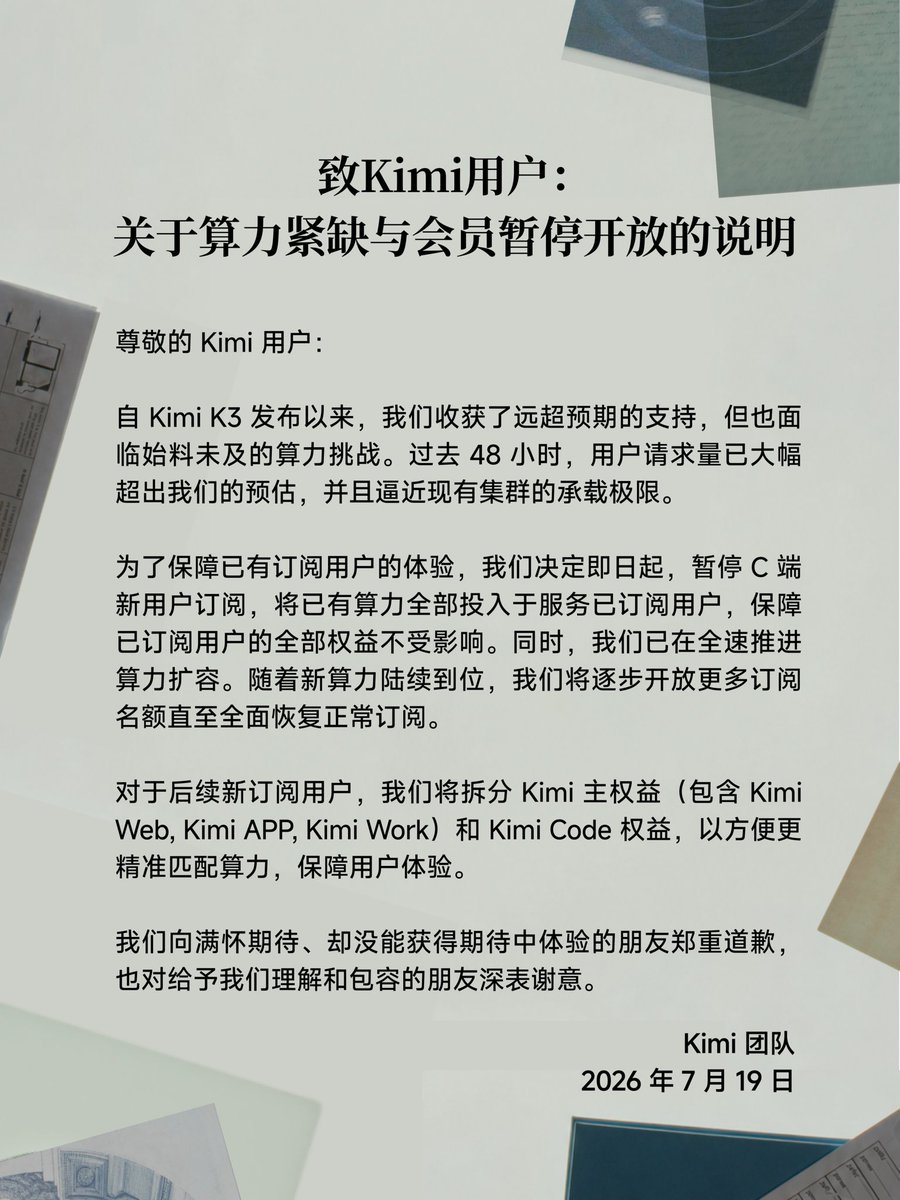
Kimi K3 has received far more love than we expected, and our GPUs are feeling it. Over the past 48 hours, demand has pushed close to the limits of our current capacity. To protect the experience of existing subscribers, we're temporarily pausing new subscriptions and prioritizing compute for current members. Existing subscribed users are not affected. We're adding capacity as fast as we can and will reopen new subscription spots in batches. Going forward, we'll also split membership into two more focused plans: Kimi Membership for Kimi Web, App, and Work; and Kimi Code Membership for coding workflows. This will help us match compute more precisely and keep the experience stable. Thank you for your patience and understanding!
Driving My Tesla from the Arctic Ocean to Tierra de Fuego in the Dead of Winter… I am proud to announce that on July 16th, I became the first SOLO person in history to drive the FULL length of the Americas with an Electric Vehicle! Total Duration: 747 Days Countries: 15 Longest Wait Time to Charge: 3 days (Peru) Fastest Charge: 35 Minutes (Chile) Distance driven - 46,961km (29,350mi) Windshield broken: 0 Flat tires: 0 (OMG) - No Spare Ran out of Range: 1 (Chile - Atacama Desert) Total energy consumed: 8,444 kWh Ave Energy Consumption: 179.8 Wh/km (286Wh/mi) Bribes Paid: 1 - $100 USD Robbed: 0 Fines: 0 Breakdowns: 0 Dogs Adopted Me: 100+ Funny Police Searches : 2 The Pan-American Highway is the world’s longest highway, almost spanning the full length of North and South America. Before today, no one had yet driven from the tippy top of North America (Tuktoyaktuk) into the Darien Gap to the southern tip in South America (Ushuaia) in an electric vehicle solo - unsupported. My Model X, Beluga, was converted into the ultimate stealth overlanding rig, with a full kitchen, running water, Starlink and 300 watts of solar panels on the hood, which allowed us to roam across some of the best most remote places on Earth with confidence. The real challenges here…border crossings, cartels, and corrupt cops, yet I embraced it all. Charging on the other hand, was quite a puzzle sometimes, being a foreigner and having very little information to go on. I discovered how far along the electric movement is and where the short comings lie…and I can say with confidence that Tesla Supercharging is the best and most reliable infrastructure out there… I wanted to showcase that anyone with a dream can make it happen, without needing all the answers. Thank you to all the kind strangers that helped along the way, and the countless dogs that adopted us and kept guard at night! youtu.be/PwVQiI5j250?is… The irony..Ushuaia currently doesn’t have any power…so this message is coming from Space, Powered by my Custom Solar Panels! @Tesla


On 16 July 2026, @Tesla hosted the 1st “Lithium Day” event at the Robstown, Texas, Lithium Refinery. This was on the same day as @SpaceX Starship Flight 13 (scrubbed) and although I was at Starbase, @SERobinsonJr (aka Elon Chron) was present & together we put together this video combining some drone video clips & images of the event. The facility (part 1) is now complete & operational, taking Spodumene Concentrate 6 as inputs & LiOH as the output. This material is then shipped to Giga Texas for battery cathode & ultimately 4680 battery production! The operational status announcement was formally made by Plant Manager Jason Bevan & Infrastructure VP Rodney Westmoreland Jr @RodneyWest336 to a crowd of local business owners, employees, special guests & state representative Denise Villalobos. Battery VP @BonneEggleston was also on hand & spoke about newly filed patent update for the 100% full recycling process for batteries, & possible future expansions. This includes a Global Patent WO2026048253A1 which describes a new process for recycled batteries & manufacturing scrap! Overall, a great event to hear first-hand about the plant, the progress the team has made to get the worlds most advanced & only Lithium Refinery in North America to operational status! @Klarissa24g


Beginning July 20, Claude Fable 5 will be included in all Max and Team Premium plans, at 50% of limits. Pro and Team Standard users will continue to have access to Fable via usage credits, and will receive a one-time $100 credit. Demand for Fable has been challenging to predict, which is why we rolled it out to subscription plans in stages, extending access several times as we secured additional capacity.
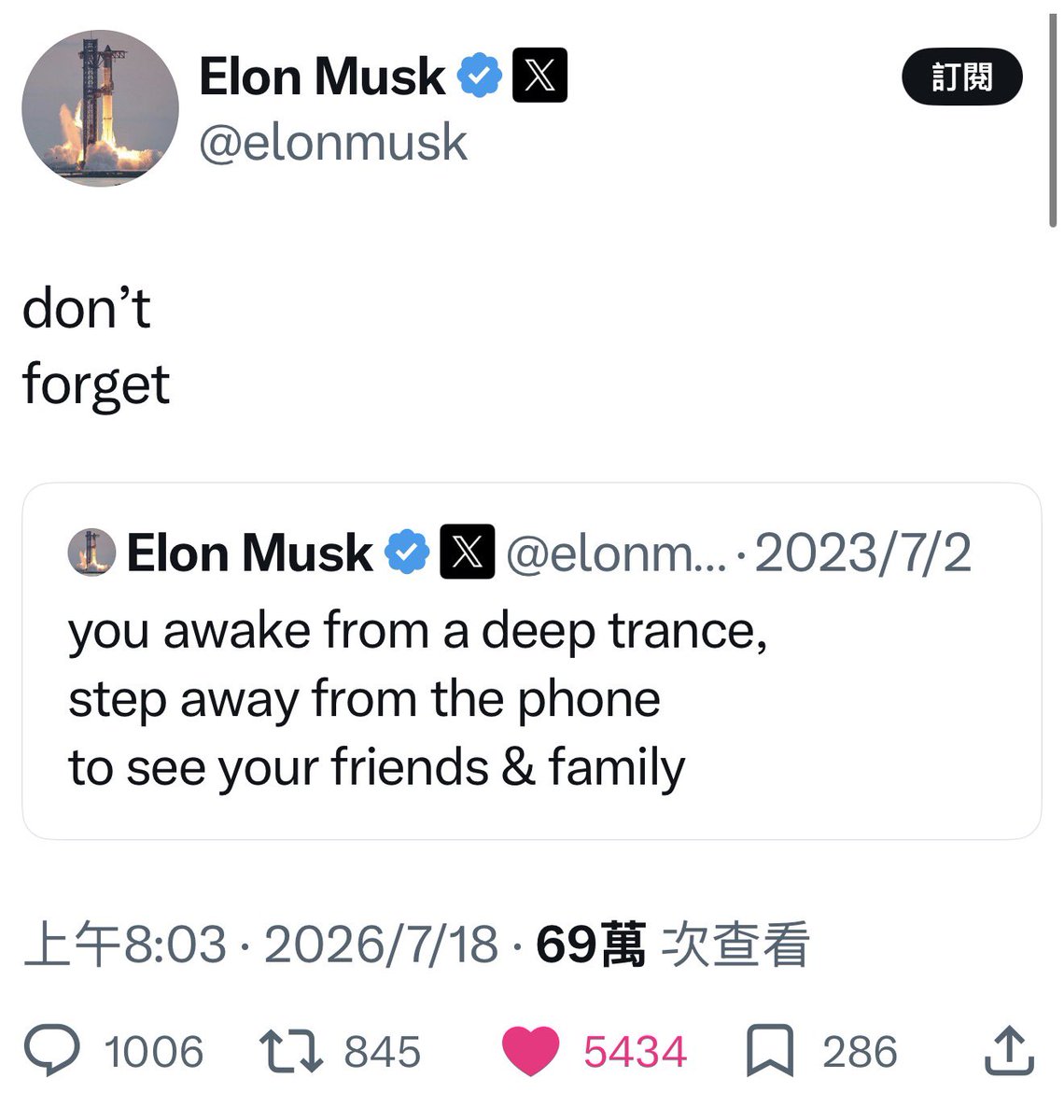

Some of the engines didn’t start, triggering an automatic launch abort. Now offloading propellant. Next launch attempt hopefully in a few days.


KIMI CEO杨植麟,一个视频带你彻底看懂大规模 AI 系统训练的秘密 自己看一遍比什么都重要
Kimi K3 may be an important inflection point for AI. Potentially negative for Anthropic and OpenAI while being net positive for essentially every other company in the world. I mean that very literally. Although the real “Sputnik moment” would be an open-source frontier model that was also token efficient unlike Kimi K3 which is 50-70% more expensive to run than GPT 5.6 per Artificial Analysis. Rationale: A world where there are only 2-3 dominant frontier labs with 90% inference margins is net negative for every other layer while being awesome for those 2-3 labs. Those labs would become monopsonies for power, data centers, semiconductors and hyperscalers and would obviously vertically integrate over time into all those layers while also completely subsuming the application/software layers. Anything that lowers margins and increases competition at the model layer is good for every other AI layer: power, semiconductors, hyperscalers, neoclouds and yes even software. This is why Jensen is so supportive of open-source. An open-source model requires the *exact* same amount of compute to run as a closed frontier model of similar size and architecture. Kimi K3 is roughly the same price as GPT 5.6 Terra on a per token basis, which actually suggests that it is less computationally efficient as I am sure that GPT 5.6 is priced to a higher margin than K3. And given that K3 is a token wastrel, i.e. token inefficient, it is significantly more expensive per task than GPT 5.6 and Grok 4.5, which are much more token efficient. Cost per token and token efficiency (i.e. intelligence density per token) are the drivers of intelligence per unit of cost. The winning AI companies will be those that offer the most intelligence per $ over time. Lower margin % at the model layer = more margin $ at every part of the infrastructure layer and is a godsend for software. This can happen either through open-source models like K3 at the frontier *or* having a vertically integrated model company like Meta, SpaceX or Google at the frontier. Both outcomes result in a lower margin % at the model layer as vertically integrated model companies don’t really care where the margin $ come from. This is why it was so painful for OpenAI and Anthropic when Google was right there with them from a model competitiveness perspective and why Grok 4.5 and Muse 1.1 were just as important as Kimi K3. The reason Kimi K3 is only *potentially* negative for Anthropic and OpenAI is 1) the @ericvishria point that the Claude and ChatGPT products and harnesses may be more important than their models today and 2) the hypothesis that they have much more advanced model checkpoints internally that are already being used for RSI. In the latter scenario, reaching RSI even a few months ahead of other labs might be enough to cement a permanent lead. Time will tell on both points. And likely fairly quickly. Caveat would be that since Kimi K3 is not token efficient and thereby actually more expensive than ChatGPT 5.6, we may need to see a more token efficient open-source model at the frontier or see Grok 5/Composer 4/Muse 2 at multiple points on the Pareto frontier for this potential risk to Anthropic and OpenAI to play out. And I am sure they will both vertically integrate as quickly as possible while continuing the product/harness strength they have shown over the last 8 months.