
Sabitlenmiş Tweet
Fakeer
174.2K posts
Fakeer
@sabyaster
kattar ke upaar wala sanghi, biggest fan of mudi ji, advocate of one nation no election
Katılım Haziran 2009
2.1K Takip Edilen2.7K Takipçiler

Fakeer retweetledi
UP is not even a coastal State and a violent thunderstorm killed more than a 100 people. Were there no warnings? No shelters?
Please never compare that bald orange fraud with Naveen Patnaik again
English
Fakeer retweetledi
Fakeer retweetledi

BREAKING
A sensational 5 page statement released by the mother of a minor girl in Telangana has triggered massive political and public outrage.
In the letter, the mother has made serious allegations against Bandi Bhagirath, alleging that her minor daughter was emotionally manipulated, pressured into consuming alcohol, and sexually assaulted.
The mother further alleges that attempts are now being made to falsely project the minor victim as a major in order to weaken and divert the investigation.
The statement also claims that the family has been facing continuous intimidation, political pressure, social media defamation, and harassment.
According to the mother, when the family approached the police seeking justice, they were allegedly made to wait for hours, ignored, and instead faced counter cases.
The family says they are living through fear, humiliation, and mental trauma while the accused continues to remain free.
Questioning whether ordinary citizens can ever get justice against powerful political influence, the mother has demanded protection for her daughter and strict legal action against those responsible.
These are allegations made in a public statement released by the victim girl’s mother. Investigation is underway.
@TelanganaDGP @revanth_anumula @TelanganaCMO @NCPCR_ @KanoongoPriyank @NCWIndia @sharmarekha
#Telangana #BandiBhagirath #LawAndOrder #Justice #TelanganaPolice #WomenSafety


English
Fakeer retweetledi

Fakeer retweetledi


Fakeer retweetledi
Fakeer retweetledi

#DekhoApnaBharatwithEMT
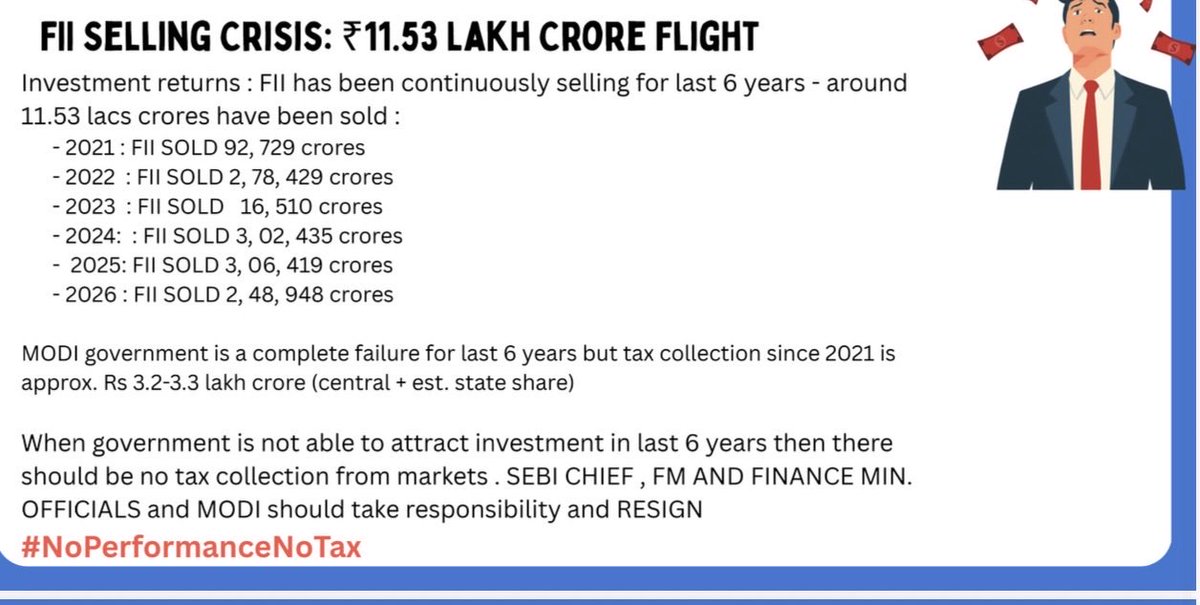
FII sold 135 billion dollars in last 6 years in Equity markets .. every year selling is 2-3 lacs crores… Complete failure & non-performance for last 6 years … FII selling for last 6 years - Total 13 lacs crores sold … 135 billion dollars… Was @narendramodi @narendramodi_in sleeping for last 6 years … Did @PMOIndia , FM @nsitharaman @nsitharamanoffc , @RBI @SEBI_India sleeping for 6 years … Indian people suffering and middle class destroyed by @BJP4India
English
Fakeer retweetledi


@sabyaster @RahulTavar_ Anyone working on TV for that matter simply cannot criticize him or his party...mushkil se kaam mila hai I think usko..kyu apni band bajwaega..itna bhi kaafi hai waise🥲
हिन्दी

जिसे मौका मिल रहा है वो राघव चड्ढा की पिलाई किए जा रहा है। 🤣🤣🤣🤣
कई सालों बाद अपना नया शो Shekhar Tonite लेकर लौटे शेखर सुमन ने पहले ही एपीसोड में बहती गंगा में हाथ धो डाले। 🔥🔥🤣🤣
हिन्दी
Fakeer retweetledi

Hey Chomu, you really think you can fool people all the time?
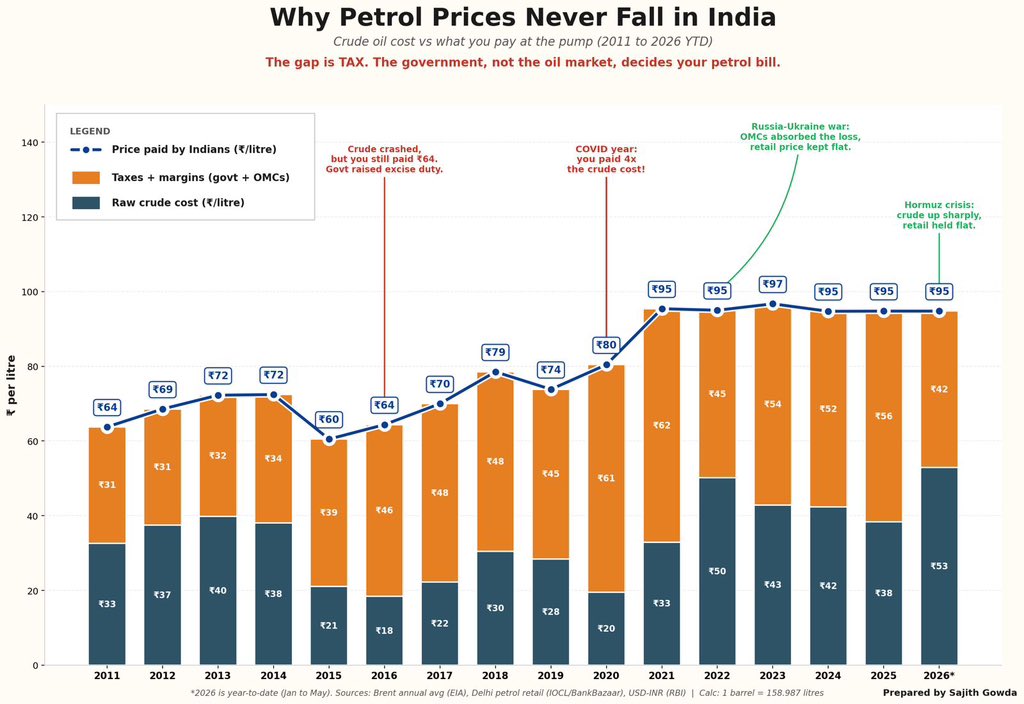
While the Modi govt has unleashed higher prices in India - various countries have taken decisive steps to bring relief to their people
• Nepal reduced price of petrol by ₹2 and diesel by ₹12
• Australia cut excise duty, making petrol ₹17 cheaper. The benefit of the excise duty cut actually went to the people, unlike in India, where it all went to the oil companies
• Germany reduced taxes on fuel, bringing down petrol and diesel prices by ₹17 to ₹19
• Britain gave a £100 discount on electricity bills and cut taxes on oil so that prices wouldn’t rise.
Everyone knows Modi has compromised India’s energy security because of which people are having to bear the burden of high prices and supply shortages
You’re a total Chomu. So please just sit down.
Amit Malviya@amitmalviya
The surge in global fuel prices since the outbreak of the West Asia conflict offers a revealing comparison of how different countries have managed economic shocks. The closure of the Strait of Hormuz, the world’s most critical oil chokepoint, and the prolonged disruption of shipments sent Brent crude soaring above $100 per barrel through much of April and early May. Across the world, consumers have felt the impact directly at fuel stations. But India stands out as a striking exception. Between 23 February and 15 May 2026, nearly every major economy saw sharp increases in petrol and diesel prices. In several countries, the rise has been staggering: • Myanmar: Petrol +89.7%, Diesel +112.7% • Malaysia: Petrol +56.3%, Diesel +71.2% • Pakistan: Petrol +54.9%, Diesel +44.9% • UAE: Petrol +52.4%, Diesel +86.1% • United States: Petrol +44.5%, Diesel +48.1% • Sri Lanka: Petrol +38.2%, Diesel +41.8% • UK: Petrol +19.2%, Diesel +34.2% • Germany: Petrol +13.7%, Diesel +19.8% • Japan: Petrol +9.7%, Diesel +11.2% India recorded the smallest material increase among all major economies: Petrol: +3.2% Diesel: +3.4% Only Saudi Arabia reported zero change due to direct state subsidy structures. Among major market economies, India has effectively experienced the lowest increase. This did not happen by accident. For seventy-six days after the escalation in West Asia, India’s public sector oil marketing companies, accounting for nearly 90% of fuel retail sales, kept prices largely unchanged despite rising global crude costs. Instead of immediately passing on the burden to citizens, they absorbed substantial under-recoveries at the refinery gate. Reported estimates suggest daily under-recoveries had approached nearly ₹1,000 crore. The ₹3 per litre revision announced on 15 May is the first price revision in almost four years and amounts to only about a 3.5% increase on a base of approximately ₹95 per litre. The contrast with the rest of the world is stark. In liberalised markets, consumers have absorbed shocks immediately. Pakistanis are paying nearly 55% more for petrol than three months ago. Malaysians over 56% more. Americans nearly 45% more. Several countries have seen diesel rise by 50–100%, reflecting disruptions in trade, logistics and freight. India, however, managed to shield consumers from global volatility for over two months before implementing a calibrated increase. This matters because fuel prices do not remain confined to petrol pumps. They affect transport costs, food inflation, manufacturing, logistics and household budgets. Containing fuel volatility is also about containing inflation. The story here is not merely about a ₹3 increase. The story is that while much of the world adjusted through increases of 10%, 20%, 50%, and in some cases nearly 90%, India limited the impact on its citizens to just over 3%. That is the context behind the numbers.
English
Fakeer retweetledi

During my short 5-day stay in India, I’ve noticed that Indian society has become a zero-trust one when it comes to financial transactions. In aggregate, this reflects a mindset that increasingly values money over human relationships.
English
Fakeer retweetledi

Fakeer retweetledi

The operative word here is “Gains”.
Ronit Pereira@Ronitper
“I would remove Capital Gains tax completely if I was being made Finance Minister of India for one day.” “We say ‘Atithi Devo Bhava’ in India and we require FIIs money, so we should follow global countries like USA, China in taxation.” - Ramdeo Agarwal. May 2026
English
Fakeer retweetledi

🇮🇳 Indian govt may impose temporary tax on foreign travel.
Anything that is considered for temporary tax.. invariably becomes and sets precedent to become permanent.
bizzare idea.

English
Fakeer retweetledi

Fakeer retweetledi

"I left my high paying corporate job and joined the civil services so that I can serve the country"

Sarang Sood@SarangSood
Name a huge scam that has been normalised in India.
English
Fakeer retweetledi

Fakeer retweetledi
Hey people on twitter.
What do you get by fighting on twitter?
Medal, certificate, peace of mind…….
It’s futile to engage in any argument or fights.
Don’t engage in arguments.
English
Fakeer retweetledi

@Rohit_p__ @RahulTavar_ He’s a mudi bhakt too, it’s just reeling in the audience. He won’t say a word against bjp.
English