Sajith Wickramasekara

62 posts

Sajith Wickramasekara

Sajith Wickramasekara

@sajithw

San Francisco, CA Katılım Haziran 2010
171 Takip Edilen1.8K Takipçiler
Sajith Wickramasekara retweetledi
Nicholas Larus-Stone
Nicholas Larus-Stone@nlarusstone·
We just launched Hypothesis Generation in Benchling AI. This release is deeply personal to me. It's a culmination of more than a decade spent building tools to help scientists
English
3
11
67
5.8K
Sajith Wickramasekara retweetledi
Gabriele Corso
Gabriele Corso@GabriCorso·
Very excited to partner with the amazing Benchling team to bring state-of-the-art models to the fingertips of every scientist!
Benchling@benchling

Benchling is a launch partner for the Boltz API! Customers can access @boltz_bio's library of proprietary models for protein and small molecule workflows, directly from their existing Benchling tenant. This is really exciting: ⚡ Boltz has extended their open source models to include new functionality like protein library screening, protein-protein binding affinity predictions, and more ⚡ Use your Benchling credits with the Boltz API. It’s one payment channel between Benchling Models and the Boltz API Get early access: airtable.com/appiZaByhWLvIV…

English
0
9
50
6.4K
Sajith Wickramasekara
Sajith Wickramasekara@sajithw·
Congrats to the @biohub team! Excited to embed this in the workflow of scientists everywhere. @salcandido was kind enough to sit down with us and take us behind the scenes building ESMFold2: benchling.com/blog/behind-th…
Alex Rives@alexrives

Today we're announcing ESMFold2, an open scientific engine to power prediction, design, and discovery across protein biology. The new model delivers state of the art performance on protein interactions, especially antibodies, a critical modality for therapeutics. We have designed and validated miniprotein binders and single chain antibodies across five therapeutic targets that are important in cancer and immunology. We are seeing very high success rates, and affinities at levels consistent with therapeutic activity. We’re also releasing an atlas of 6.8 billion proteins, and 1.1 billion predicted structures. ESMFold2 is built on a state of the art language model that has been trained on billions of protein sequences. A world model of protein biology emerges through language modeling. We’ve used the techniques of mechanistic interpretability developed to understand large language models to understand the concepts ESM uses to represent proteins. The model’s representation space has a compositional organization of features across scales, levels of complexity, and abstraction, that reflects and mirrors the understanding of protein biology developed through a century of empirical science. This understanding emerges without prior knowledge, just from language modeling of protein sequences. Language models are becoming a powerful substrate to understand and program biology. The design of protein interactions is one of the most fundamental problems in biophysics, and has critical implications for the discovery of new medicines. A simple gradient based search with the model was able to discover high-affinity protein binders. I'm excited by the potential this has to accelerate basic science and the understanding of proteins. And especially for the new avenues it opens up for therapeutic design and medicine.

English
1
4
20
3.1K
Crémieux
Crémieux@cremieuxrecueil·
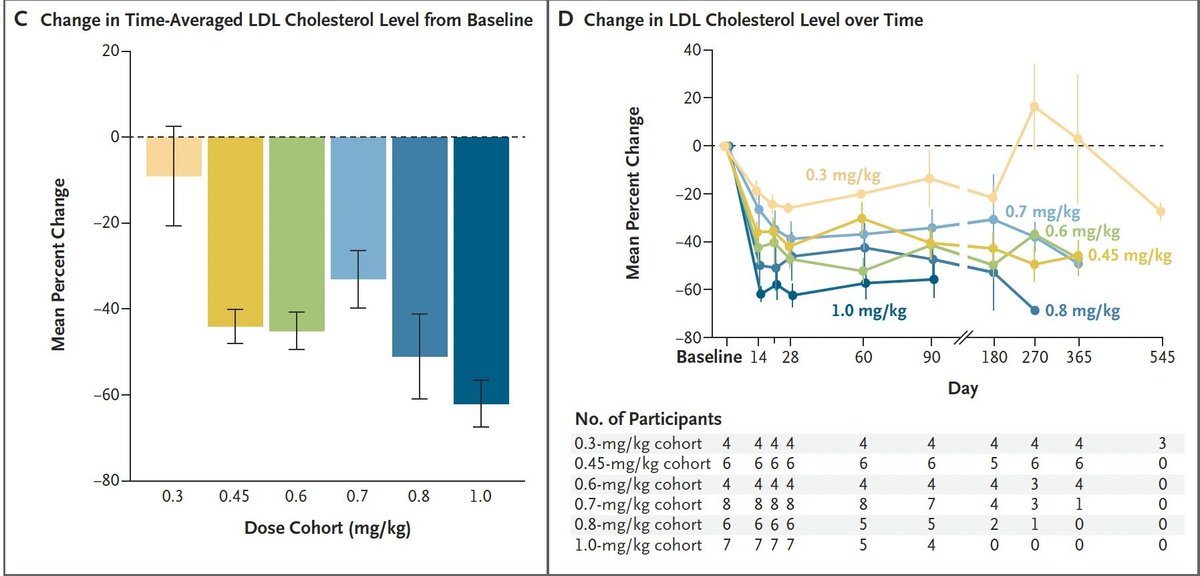
Eli Lilly has done it. They've gone and made what seems to be a powerful, permanent gene therapy for LDL cholesterol. That means they'll be able to effectively prevent most heart disease with a single infusion!
Crémieux tweet media
English
551
1.7K
15.4K
5.8M
Sajith Wickramasekara retweetledi
Baseten
Baseten@baseten·
Biotech R&D is generating more scientific AI models than ever, from protein structure prediction to molecular docking to sequence analysis. But the infrastructure to run them hasn't kept up. Today we're announcing Benchling Inference, powered by Baseten. Together with @benchling, we're delivering on-demand GPU capacity built for the bursty, high-stakes demands of scientific workloads. With Benchling Inference, scientists can: → Deploy models in seconds, not weeks → Keep proprietary models inside their VPC if needed → Benefit from economics that work even at small and mid-size biotech scale Benchling and Baseten decided to team up because we believe that research teams shouldn't have to manage HPC queues, negotiate cloud contracts, or become GPU experts to run frontier models on their own data. Six years of inference expertise are now available where science happens. Read more here: benchling.com/blog/announcin…
Baseten tweet media
English
1
10
34
2.3K
Sajith Wickramasekara
Sajith Wickramasekara@sajithw·
We’re launching Benchling Inference, powered by @baseten It is scalable GPU capacity across 15 clouds for our 1300+ customers, preloaded with today's top scientific models and the integrations to make in silico discovery work out-of-the-box for biopharma companies. Startups get better economics and availability. Enterprises get best-in-class infrastructure that works alongside their cloud commits and data sovereignty requirements. It's been a pleasure working with Baseten on this. They've spent six years building at the leading edge of inference and are the compute behind some of the most demanding AI in production. benchling.com/blog/announcin…
Sajith Wickramasekara tweet media
English
2
8
54
5.9K
Sajith Wickramasekara
Sajith Wickramasekara@sajithw·
@sarthakgh all medicines get cheaper over time! it's not a perfect system, but that's the beauty of it. drugs are technology and inherently deflationary. the rest of healthcare gets more expensive because it's labor based and inflationary.
English
0
0
0
31
Sar Haribhakti
Sar Haribhakti@sarthakgh·
"Why are GLP-1s getting cheaper while health care remains expensive? The answer lies in what makes GLP-1 drugs different: actual consumers have to pay actual prices."
Sar Haribhakti tweet mediaSar Haribhakti tweet media
English
11
22
202
28.5K
Sajith Wickramasekara
Sajith Wickramasekara@sajithw·
They used our AI Scientist to synthesize four years of experimental data already captured in Benchling: - pulling together ELNs - mapping evidence to ICH Q2(R2) validation requirements - designing targeted follow-up studies Ultimately generating a living validation package traceable to every source
English
1
0
6
967
Sajith Wickramasekara
Sajith Wickramasekara@sajithw·
I'm excited to share our first AI Scientist collaboration: @PrimeMedicine using it to accelerate the path to approval for PM359, their prime-edited therapy for CGD. They are presenting the work at ASGCT this week.
English
4
9
52
6.3K
Sajith Wickramasekara
Sajith Wickramasekara@sajithw·
Why does @RelationRx CTO Lindsay Edwards think that virtual cells are overrated? Lindsay shared his hot takes with me in front of a live audience, including why legacy data is worth less than you think, and why biologists need to be more like physicists. On this episode of Transcribed, we also talked about his unconventional path. He started in music, producing hits with artists like Sting and Whitney Houston. Later, after becoming a scientist, he went on to build the first data science team at GSK. Today, he’s one of the industry’s clearest thinkers on what it takes to make machine learning work in drug discovery.
English
2
1
9
1.3K
Sajith Wickramasekara
Sajith Wickramasekara@sajithw·
In the AI era, the traditional biopharma industry is the underdog. Big tech and AI labs are building wet labs. China has overtaken Europe in molecules produced. But the tools available to the industry discuss science, not do it. The hard problem in AI for science is at the interface between the physical and digital worlds. We built an AI Scientist at that seam. It wires together the digital and physical worlds of R&D. Predictive models, data infrastructure, wet lab execution feed into a single loop that reasons, acts, and improves with every experiment. Our ambition: get molecules to the clinic twice as fast. Last fall I wrote about why biotech needs to be rebuilt for the AI era. Today I'm sharing the next chapter: what the AI Scientist is, a blueprint for how it works, and why even Richard Feynman couldn't hack it in a wet lab.
English
9
32
152
30.6K
Spenser Skates
Spenser Skates@spenserskates·
Wrapping up AI week with @sajithw at @benchling Cool to see how the AI transformation applies to biotech. Lots of legal review with customers to get them comfortable adopting.
Spenser Skates tweet media
English
3
0
21
1.3K
Sajith Wickramasekara
Sajith Wickramasekara@sajithw·
Stunning progress from @RevMedicines on metastatic pancreatic cancer. Patients on their medicine live 2x as long. This is a disease with an 8% five-year survival rate. Proud to power their scientists. Some of the work traces back to Warp Drive Bio, one of our earliest customers nearly a decade ago. A good reminder that great science can take time to become a breakthrough medicine. statnews.com/2026/04/13/rev…
English
0
0
10
557
Sajith Wickramasekara
Sajith Wickramasekara@sajithw·
What's the real moat in AI drug discovery? Not the models. Jacob Berlin, cofounder and CEO of @Terray_Tx, and his team built a microarray chip the size of a fingernail that can measure billions of small molecule interactions. Their chemistry data set is now 40x larger than what’s publicly available. For small molecules, where the search space is essentially infinite, that scale makes all the difference. His take: "You can't learn fast enough if you're only distributing your models to others." On this episode of Transcribed, Jacob and I talk about why chemistry is harder than biologics for AI, what "AI abundance" means when your models give you 10,000 molecules and your chemists can only make 50, and why whatever you pick to start on is your actual business.
English
2
9
55
7.4K