Sam Bresnick

701 posts

Sam Bresnick banner
Sam Bresnick

Sam Bresnick

@SamBresnick

Research Fellow and Andrew W. Marshall Fellow @CSETGeorgetown & @AWMFoundtn | Ex: @CarnegieChina

Katılım Ocak 2019
1K Takip Edilen1.3K Takipçiler
Sabitlenmiş Tweet
Sam Bresnick
Sam Bresnick@SamBresnick·
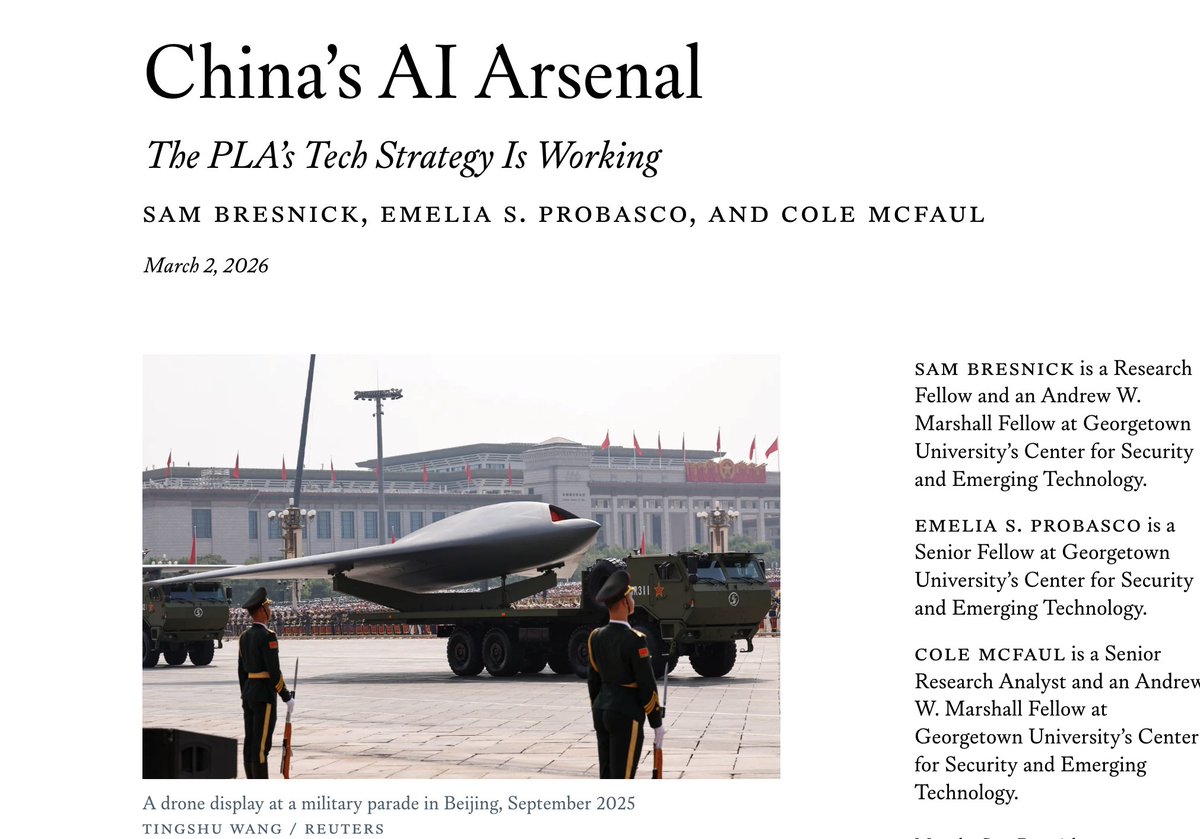
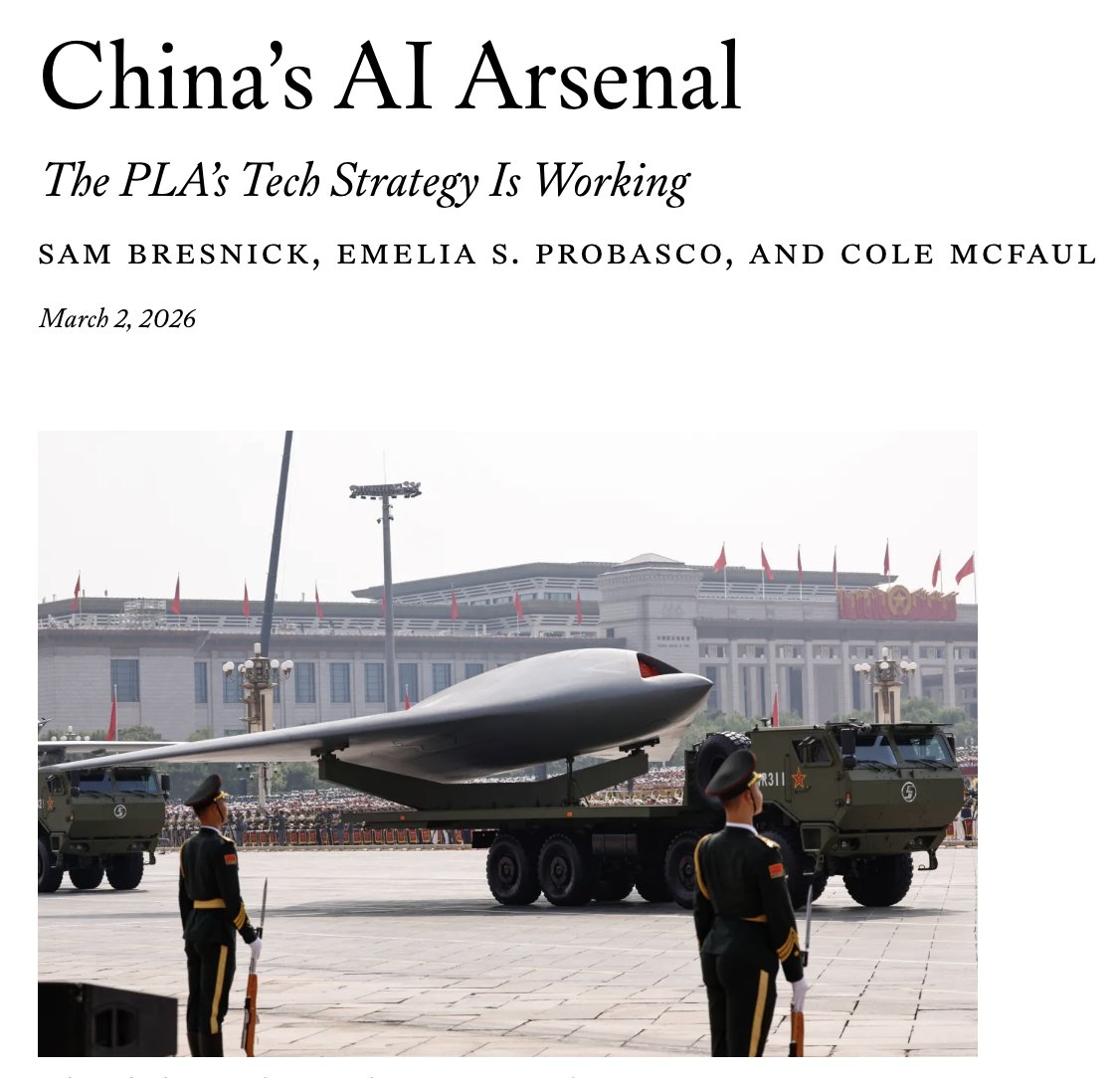
1/ In @ForeignAffairs, @EmmyProbasco , @colemcfaul, and I examine the Chinese military’s AI ambitions. BLUF: The PLA is making progress on “intelligentization,” its third phase of military modernization. Thread below:
Sam Bresnick tweet media
English
5
43
162
26.7K
Sam Bresnick
Sam Bresnick@SamBresnick·
Insightful piece from @jules__george on how the PLA is using emerging tech-focused challenges and competitions to boost its modernization
Dr. Julie George@jules__george

Excited to share my latest research published today at @CSETGeorgetown: "China's PLA Challenges and Competitions." Technology competitions may seem like minor institutional events — but for China's People's Liberation Army (PLA), they're a rare window into military priorities, capability gaps, and innovation dynamics that are otherwise hard to observe. Read the full blog here: lnkd.in/dU-jKpcr

English
1
0
2
207
Sam Bresnick retweetledi
Kyle Miller
Kyle Miller@KyauMill21·
Recently, there has been a lot of interest in distillation, particularly regarding “adversarial” distillation from Chinese labs. At the core of this issue is the question of ‘how much performance gains (ie uplift) do student models achieve when they are distilled from closed-source teacher models.’ Months ago, we started reviewing the literature to try and answer this question. We’ve so far reviewed ~40 papers on black-box distillation, focusing on papers that distill the reasoning, math, and code capabilities of closed-source teacher models. All white-box distillation research is omitted. But there's a problem. The data is not straightforward. Here are some of the challenges we ran into, and why the distillation literature doesn't paint a clear picture (long 🧵): 1/ Old research. To start, much of the literature on this topic – that we reviewed – was published between 2022-2024. The student and teacher models are old, and the benchmarks used to evaluate performance are saturated. And even newer papers often used older models. This means that we can’t simply take the data from the literature and assume it applies to Chinese "adversarial" distillation today. Some student models saw extreme performance gains, while, at times, others saw degraded performance on out-of-distribution benchmarks. In the most extreme case we identified, a distilled model improved by 25600% relative to its baseline score; the student went from 0.2 to 51.2 on the ASDIV benchmark (this is from the Program-Aided Distillation paper). But that large percentage is due to the poor baseline performance it started with. The ASDIV benchmark is saturated, the student was a 0.22B parameter CodeT5 model, and the teacher was GPT-3.5-Turbo. In my view, we cannot infer much from this example because it's not applicable to frontier models and challenging unsaturated benchmarks. We saw this same issue across most of the papers we reviewed. Most of the student models were years old and relatively small (<13B params). Llama-1/2 and CodeLLama were the most common students, and GPT-3.5/4 the most common teachers (likely because OpenAI permits distillation in their ToS for research purposes). On average across the papers, student models reached 74% of the teacher’s performance (primarily related to older code, math, and reasoning benchmarks), with a high standard deviation. But again, we can’t really infer too much from this, and we cannot assume this is the uplift China gets on frontier benchmarks. It's safe to say they see some degree of uplift, but we already knew that (they probably wouldn't distill in the first place if they didn't see any gains from it). 2/ The next issue is that most of the literature is small-scale, experimental, and focused on compression. None of it is “adversarial,” rather the intent is to compress knowledge into smaller parameter models. The difference in intent in the literature vs. Chinese distillation matters. To highlight my earlier point, most of the literature is trying to compress knowledge into small <13B parameter students. That doesn't translate to distilling into, say, the 1 trillion param Kimi-K2.5 model. Moreover, the quantity (and quality) of the synthetic teacher-generated data is likely different from what Chinese labs are using. Anthropic identified distillation campaigns involving over 16 million exchanges with Claude, likely generating billions of tokens. The literature, on the other hand, is much smaller scale. Back-of-the-envelope calculations show that, on average, researchers were likely distilling on ~185 million tokens (these are rough calculations). Only a few papers distilled with over a billion tokens.
English
1
6
11
945
Sam Bresnick retweetledi
Helen Toner
Helen Toner@hlntnr·
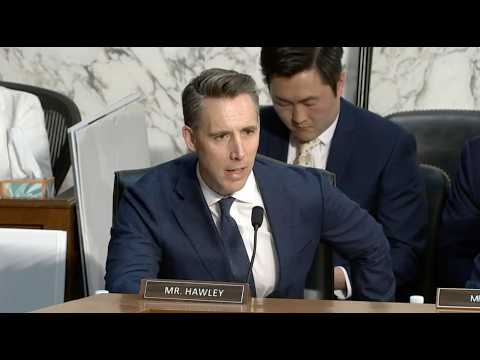
Not the line of questioning I was expecting in a hearing about Chinese IP theft, but I'm glad senators are starting to really get why "we must beat China!" is really nowhere near a complete plan for how to make sure AI goes well. --- Transcript: HAWLEY: Ms. Toner, can I just come back to something that I think you said in response to Senator Durbin. You said to him that, regarding American AI companies, you said that it is hard to believe but nevertheless true that American AI companies are working as hard and as fast as they can to try to develop technology that will displace many millions of workers and potentially pose existential risks. Now that's my gloss, maybe you wanna correct the record exactly as you said it before. I thought that was very interesting and very important. Could you just reiterate that for us? TONER: Yes. AI is a very fast-moving field, and I think it is important that as we think about what AI's implications are for our society, for our civilization, we don't merely look at the AI systems that we have today—chatbots, starting to be agents that can help a little bit with some professional tasks—but instead we take seriously the goals of the companies that are building these systems. Over the past 10 or 20 years, it's gone from a very abstract idea that we might build AI that can outperform humans at any intellectual task, to a pretty concrete idea that some of the most well-capitalized companies in the history of the planet are driving towards as fast as they can. They may fail! It may turn out to be harder than they think to build systems that are that capable. Personally, I'm skeptical of some of the extremely short timelines that they name, saying we might have these superintelligent AI systems within, you know, one to three years. But it seems so clear that there's a real possibility that they build these systems within three years, 10 years. If they build it within 10 years, that's when my daughter is entering high school. That's not very long. That is an extremely radical thing to be trying to do, to build computer systems that can outperform humans, that may escape the control of humans, and the companies are telling us they're doing it, and I think we don't take them seriously, and we should. HAWLEY: These same companies often say, and often in front of this committee and to this body, that it's absolutely vital that they succeed at whatever it is they're doing on that particular day, in order so that we can beat China. You know, they're our great American national champions and we have to beat China. My concern is based on what you've just testified to and what I've heard others testify to, it sounds an awful lot like the goals that they have in mind, that these companies, these CEOs have in mind, are every bit as nefarious. In fact, if these same goals were held by a foreign adversary, we would say this is an incredible threat to our national security, we'd never allow a foreign corporation to try and pursue such plans at the expense of American workers, at the expense of American families, and yet these companies, our own companies so to speak, are doing it. Let me just ask it this way: Will it do us any good if these American AI companies are able to pursue their designs without any hindrance? Will it do any good that we beat China if in fact they succeed in displacing millions of American workers, gobbling up all of Americans' data, completely destroying our IP system, etc.? TONER: I think the way I've heard this put best is: Right now, the way that we build AI and the level of control we have over it, which is not great, the winner of any AI race between the US and China is the AI. And I think we need to be working to make sure that is not the case. I think it is very important that the US AI sector remains ahead of the Chinese AI sector, but if that's at the expense of AI overrunning the entire planet, then that is, you know, that hasn't benefited us. HAWLEY: Yeah, that sounds entirely sensible to me and I just have to say I don't really have any interest in winning an AI race in which the goal, the victory rather, the prize for success is to become like China. Is to become a surveillance state. Is to become a place where there is no private property any longer, where nothing is personal, nothing can be protected, nothing can be owned by any individual. Why in the world would we want that in the United States of America? I mean, if the prize is to destroy everything that makes us Americans, why would we compete in that game? It seems very dangerous to me. Let me ask you something else about competition with China though. You also testified to Senator Durbin that the best way, if I remember correctly, the best way to constrain China's ability to match us in AI development is to constrain the hardware to which they have access. That seems to be an important point to me, can you just elaborate? TONER: Yes. I think there's different levers of what goes into having a competitive AI ecosystem, and many of them, talent, data, algorithmic ideas, are very difficult to control. We're very fortunate that we're in a situation where the most advanced hardware is produced by American companies, is designed by American companies. And I think we, if you look at the, China is growing their capacities here, but they're not growing them nearly fast enough to meet their own domestic demand, nor are the US companies to be clear. So we can control chips to China and not forgo any profits, not forgo any revenue because the demand for those chips is so great. I'll also call your attention to semiconductor manufacturing equipment, what goes in the fabrication facilities. I think it's even more strategically clear that we should not be allowing China access to advanced tools. That is something that has gotten lip service from the past three administrations but enforcement has been very weak. And I think ensuring that the most advanced lithography tools, the most advanced design software, other aspects of the semiconductor supply chain are not being exported to China to let them build their own indigenous supply chain is also one of the simplest and most important levers we have available. HAWLEY: Let me just conclude by saying that I think it is absolutely vital that we bend this technology, this AI technology which is upon us whether we like it or not, that we bend it to the good of the American worker and the American family. And I am firmly of the view that this is not just going to happen magically. That if we just stand back and just wait to see what will happen, it's not going to be good for American workers, it's not going to be good for American families. We've got to make a choice as a society to make it so. And this is the time to make that choice right now. youtube.com/watch?v=KHmo9v…
YouTube video
YouTube
English
18
27
232
36.9K
Sam Bresnick
Sam Bresnick@SamBresnick·
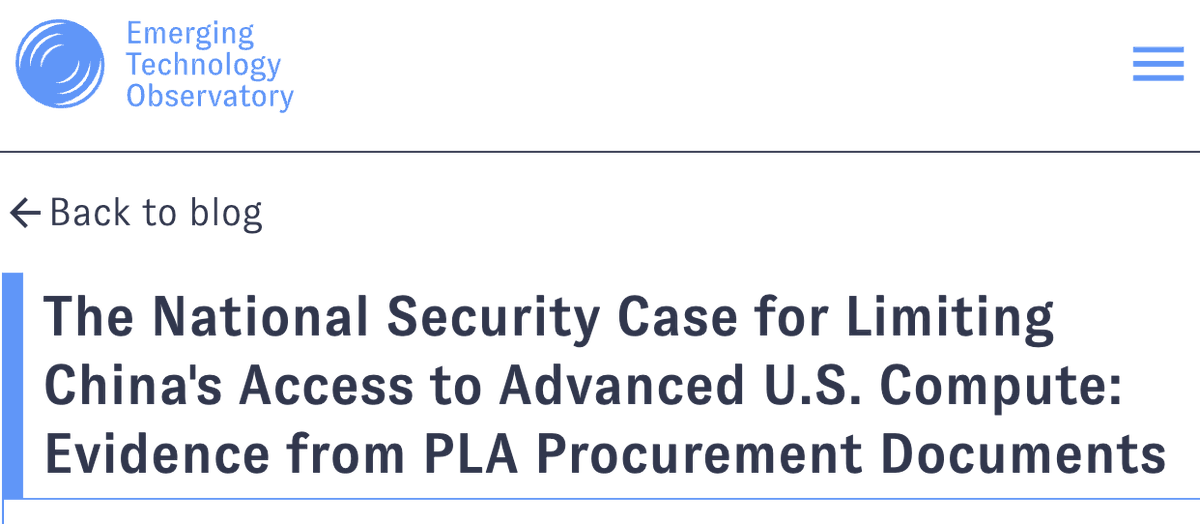
.@colemcfaul and I have documented the Chinese military's interest in @nvidia chips; it's clear that H200s will contribute to the PLA’s modernization, either through direct purchases or through the use of LLMs trained on them. Link below. @CSETGeorgetown @emergingtechobs
Sam Bresnick tweet media
Kristina Partsinevelos@KristinaParts

Worth noting - at GTC, Jensen Huang told me that China did purchase H200s, that he had the green light from both sides. He also told a room full of journalists that $NVDA is "in the process of restarting our manufacturing. And so, so that's new news for all of you".


English
1
8
19
15.4K
Sam Bresnick retweetledi
alex sammon
alex sammon@alex_sammon·
Orange production in Florida has collapsed over 95% in less than 25 years. 100% of trees are now infected with a disease officially deemed “incurable.” Who killed the Florida orange? My investigation, in @slate, into the lost empire of the old citrus state.
English
273
3.5K
23.6K
1.7M
Sam Bresnick retweetledi
Cole McFaul
Cole McFaul@colemcfaul·
NEW @CSETGeorgetown + @emergingtechobs piece! Does China's access to US semiconductor technology help the PLA develop and deploy military AI? After 3 years reading thousands of PLA procurement docs, @sambresnick and I say yes. Here’s how, and why it matters: 🧵/13
Cole McFaul tweet media
English
6
34
90
27.6K
Sam Bresnick retweetledi
Gregg Carlstrom
Gregg Carlstrom@glcarlstrom·
If no Iranian oil ever goes to China again, then China will just... buy oil from elsewhere, pushing up prices for everyone else By far the worst takes over the past six weeks have come from the folks in DC trying to spin this war as some brilliant 4D chess move against China
Semafor@semafor

"I think blocking the Strait of Hormuz is fine from my standpoint," @SenRickScott tells @burgessev. “If no oil ever goes to China again, and their economy is destroyed, that would be a really wonderful day for me."

English
184
440
1.9K
137.5K
Sam Bresnick retweetledi
Damien Ma
Damien Ma@damienics·
It's a rare opportunity to do what we do and to do it in Singapore - anchored in the cross currents of trade, technology, and geopolitics that define the region. China's impact, both profound and quotidian, is not an abstraction but a lived reality in this "third place". So come work with us, produce original work you can be proud of, and start building a portfolio. We take cultivating next-gen talent seriously. Now accepting applications on a rolling basis 👇
Carnegie China@CarnegieChina

#Internship | Carnegie China’s #YoungAmbassadors program is now accepting applications! Paid opportunities for matriculated students and recent graduates eligible to work in #Singapore: carnegieendowment.applicantpro.com/jobs/4046343
English
1
7
13
4.8K
Sam Bresnick retweetledi
Ben Rhodes
Ben Rhodes@brhodes·
In the best case scenario, Trump struck a deal to reopen a Strait that was open before the pointless war he started, with the IRGC demonstrating its control over the Strait and potentially extracting fees plus sanctions relief. Thousands of innocents - including hundreds of children - dead in Lebanon and Iran for no reason. U.S. troops killed and wounded. U.S. embassies and bases in the Middle East badly damaged. U.S. standing in the world obliterated. U.S. munitions badly depleted. Hundreds of billions spent. Prices up everywhere. More global economic fallout to come. Putin strengthened and enriched. Just a catastrophic situation even in the best of circumstances. A profoundly shameful episode in American history no matter what happens next.
English
838
7.9K
27.5K
1.1M
Sam Bresnick retweetledi
Georgia Adamson
Georgia Adamson@GeorgiaCAdamson·
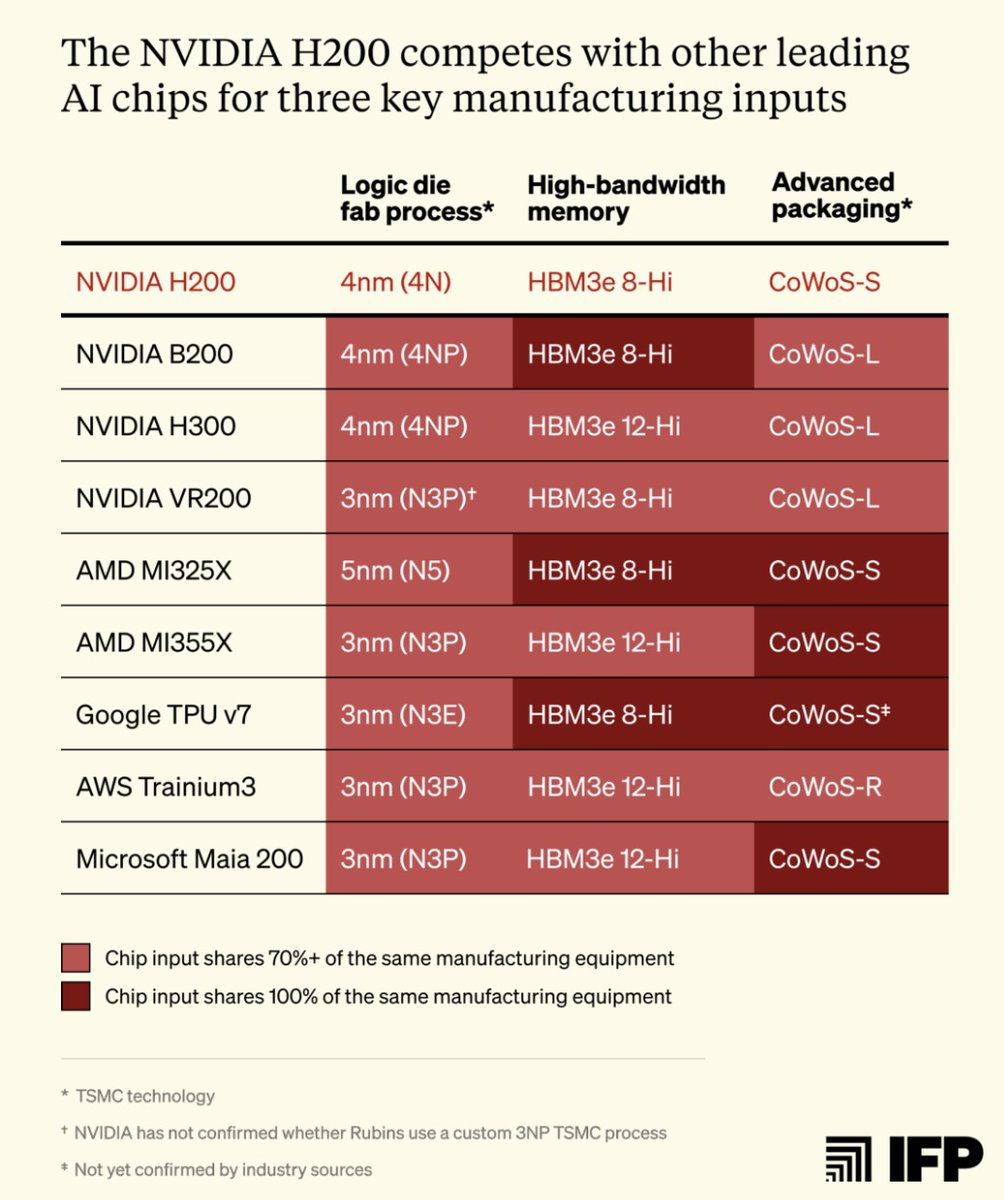
NVIDIA has restarted H200 production for China. But H200s share manufacturing inputs with more advanced US chips, and those inputs are severely supply-constrained. BIS's January rule could permit up to as many as ~1 million chip exports, but requires applicants to certify exports won't reduce chip availability for US customers. However, the rule doesn't say how to evaluate this. In a new report, @fiiiiiist and I lay out a methodology for assessing whether H200 exports could divert chips from US customers, and quantify what the US stands to lose: ifp.org/ai-chip-supply… We distinguish between two forms of diversion: inventory diversion and manufacturing capacity diversion. Based on public information, we judge that: 1. There is weak evidence that exports of existing H200 inventories at current prices would divert supply from US customers. Global Hopper sales have fallen sharply since Blackwells became available. But deployed H200s remain fully utilized in the cloud, and China is reportedly being offered chips at ~$27K/unit, below US market prices available to some customers. Technically, a diversion holds if even one US customer would purchase the chip at the price offered to China. BIS needs non-public pricing data to make this determination. 2. There is strong evidence that new H200 production would divert manufacturing capacity for US customers of comparable or more advanced AI chips. All leading US AI chips share at least one key input with the H200: advanced logic fab capacity, HBM, or CoWoS packaging. All three inputs are severely supply-constrained this year. US hyperscalers and AI labs face enormous backlogs for these chips, meaning freed capacity would very likely serve American customers. These conditions likely apply to the roughly 250,000 H200s reportedly manufactured for NVIDIA between early January and early March 2026, when severe supply constraints on advanced logic wafer fabrication, HBM, and CoWoS capacity were already in effect. 3. Under current inelastic supply conditions, the US loses disproportionately more computing power for every H200 export than China gains. This is because the same inputs and/or manufacturing capacity are being used to produce less powerful H200 chips than frontier AI chips for US customers. Each 100K H200s produced for China could delay ~75K Blackwell B200s — forfeiting 1.7x the processing power per chip. We also provide a comprehensive set of questions BIS can ask license applicants and chip suppliers to assess both inventory and capacity diversion during license reviews, using the private data needed to make these determinations accurately.
Georgia Adamson tweet media
English
10
64
223
61.2K
Sam Bresnick retweetledi
Matt Duss
Matt Duss@mattduss·
Obama agreed to $1.3 billion in sanctions relief for Iran as part of a deal that prevented both an Iranian nuke and a war. Trump withdrew from the deal, started a war that will likely result in Iran obtaining a nuke, and gave Iran $14 billion in sanctions relief.
Barak Ravid@BarakRavid

🚨U.S. to allow Iran to get ~14 billion dollars (!!!) in oil revenue 🚨This is a huge financial concession to Iran by the U.S. 🚨It is the first time U.S. is buying Iranian oil since 1996 🚨It's all happening in the middle of a war against...Iran

English
157
2.6K
10.9K
685.8K
Sam Bresnick retweetledi
Tyler McBrien
Tyler McBrien@TylerMcBrien·
Do you like cool maps? Have you ever wondered why there isn’t a Bloomberg Terminal for life? Do you sometimes have trouble suppressing an irresistible urge to “monitor the situation”? If so, my new essay in @thebafflermag on OSINT slop and vibe coded dashboards is for you!
Tyler McBrien tweet media
English
3
28
269
32.2K
Sam Bresnick retweetledi
Lauren Kahn
Lauren Kahn@Lauren_A_Kahn·
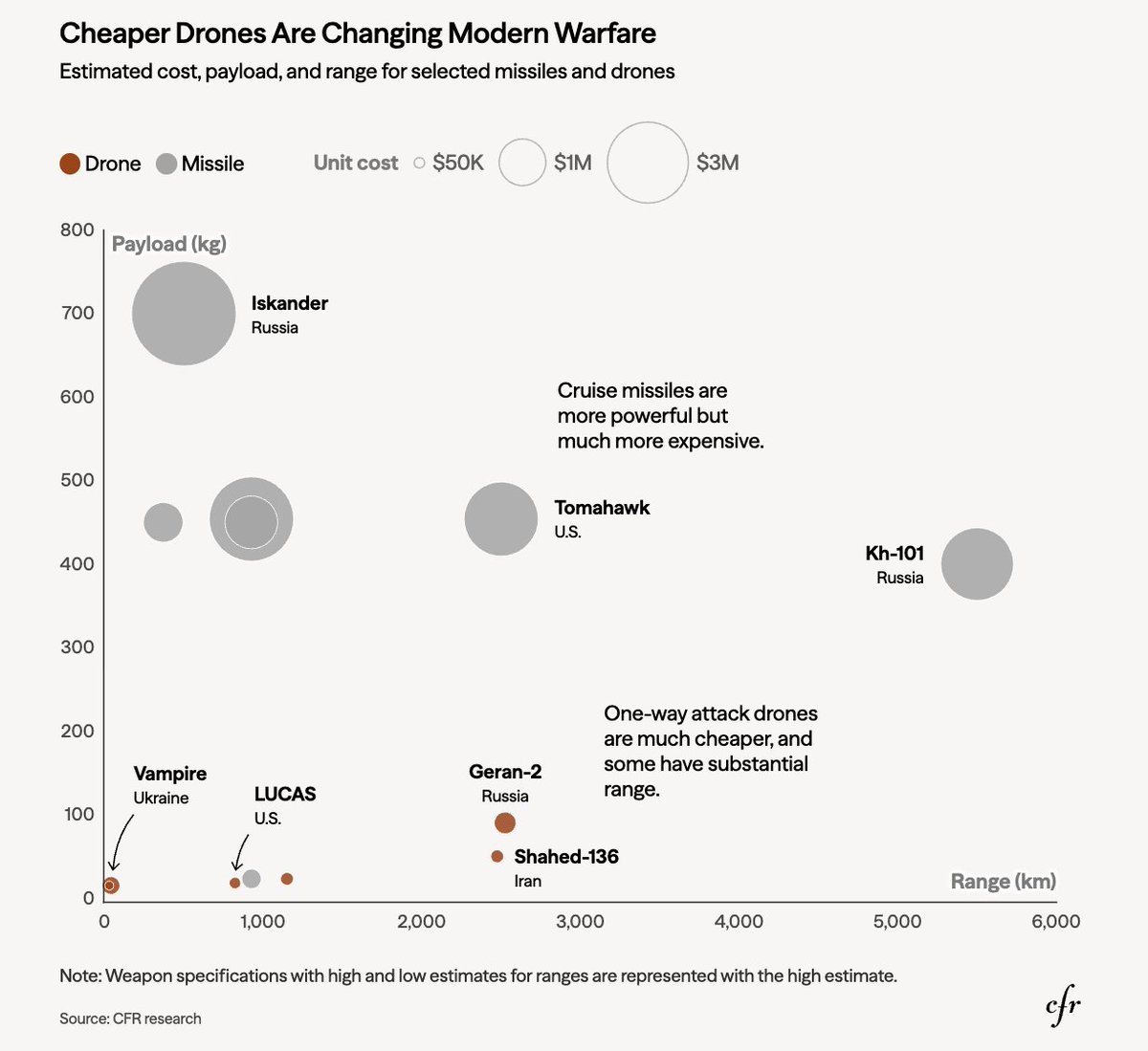
The math of modern warfare is changing. In the war with Iran, $20k–$50k Shahed-136 drones are forcing defenders to fire interceptors that can cost 5–100× more. Cheap systems are shifting the cost curve of air defense. Operation Epic Fury and Iran’s response to ongoing U.S. and Israeli attacks represent clear evidence that we are now in the era of precise mass in war, with the high-volume use of low-cost, increasingly autonomous (and sometimes AI-enabled) systems with high-accuracy guidance. In other words: there a lot more drones on battlefields today—but not the ones people remember from the global war on terrorism. More with @mchorowitz in @CFR_org, complete with amazing data interactives and visualizations put together by @PhilMcCausland and Austin Steinhart! cfr.org/articles/the-n…
Lauren Kahn tweet media
English
2
11
27
1.9K
Sam Bresnick retweetledi
Cole McFaul
Cole McFaul@colemcfaul·
The Pentagon-Anthropic breakup doesn't advance US interests. In @ForeignAffairs, @sambresnick, @EmmyProbasco, and I argue that Beijing is all-in on adoption of military AI. If the White House were serious about AI leadership, it wouldn’t try to kneecap a top frontier lab. 🧵
Cole McFaul tweet media
English
6
8
40
2.7K
Sam Bresnick
Sam Bresnick@SamBresnick·
12/ China’s “intelligentization” is no longer only a difficult-to-pronounce slogan. Procurement docs suggest it’s underway across the PLA. The U.S. response should focus on quick iteration, smart partnerships, and strong guardrails for an era of military AI competition.
English
1
1
10
679
Sam Bresnick
Sam Bresnick@SamBresnick·
1/ In @ForeignAffairs, @EmmyProbasco , @colemcfaul, and I examine the Chinese military’s AI ambitions. BLUF: The PLA is making progress on “intelligentization,” its third phase of military modernization. Thread below:
Sam Bresnick tweet media
English
5
43
162
26.7K