

Sam Saccone
18.7K posts


For the new editable diffs[dot]com functionality, we pointed agents at existing MIT-licensed editor test suites (Codemirror, Monaco, Atom, etc.) and had them analyze the nearly ~6k tests for missing behavioral coverage.
After about 14 hours, we added 195 net new test cases, 30 of which exposed real oversights across selection management, whitespace collapsing, search, history, and more (we now total ~1,281 tests).
English
Sam Saccone retweetledi



@championswimmer I'm aligned - The symptom I see is where artisanal mean rolled by hand, this is in contrast to well considered yet highly augmented.
The transition to the highly augment is to often dismissed out of hand due to the desire for artisanal handcrafting.
English

I was so with you 100% for the entire post, till I reached the last line "less on the artisanal crafting of the code".
Saying the two sides of this argument are product outcomes and "artisanal crafting" is a) cop out, b) naive misinterpretation
On the surface what looks like artisanal crafting is just better design choices or more refined architecture. I am 100% on board that sometimes taking the better design choice or bikeshedding the architecture itself counterproductive to the job at hand and we should "get on with it". But what appears symptomatically as just someone being anal about craft, is more often just someone who cares about maintainability.
English
We take human trust and accountability for granted in coding ecosystems. The author may not get the code correct the first time, but they are responsible for making it right.
As organizations transition into more LLM powered coding cycles I see the following progression play out on repeat.
Wave 1 of agentic coding is sock-puppet credibility - the uploader may have not done the work, but they are trusted to be accountable for fixing whatever mistakes the slop factory generated.
Wave 2 throws an agentic loop inbetween sock-puppet authorship and review feedback iteration - reviewer feedback is rapidly acted on freeing up authors to do more.
Wave 3 drops the sock-puppet and puts the agent front and center with the feedback loops "automated".
At some point between wave 2 and 3 organizational friction comes to a head. When reviewers realize they are indirectly prompting - they either stop reviewing, or start asking for prompts to do the prompting on their own. This slides the org back to a wave 1 mode operation.
In pockets eng groups escape the cycle - but it requires near complete buy in from eng teams and a willingness to accept that product outcomes are what are rewarded, less on the artisanal crafting of the code.
English
prompt to prod is an alluring offering.
My learnings so far after a few years of this style of this modality in "production" is that guardrails on behavior and burn is the make or break.
To prod is obstacle one, stable in prod is obstacle (2, 3, ...),
Guillermo Rauch@rauchg
Eve.dev is Next.js for agents. I built Next with a simple premise: 𝚙𝚊𝚐𝚎𝚜/𝚒𝚗𝚍𝚎𝚡.𝚓𝚜 is all you need. Put some React in there and you’re good to go. Eve asks for even less. 𝚊𝚐𝚎𝚗𝚝/𝚒𝚗𝚜𝚝𝚛𝚞𝚌𝚝𝚒𝚘𝚗𝚜.𝚖𝚍. Put some English in there and you’re good to go. Like Next, it embraces the filesystem. You can guess what 𝚝𝚘𝚘𝚕𝚜/𝚚𝚞𝚎𝚛𝚢-𝚍𝚋.𝚝𝚜 does. An agent is just a directory, whose entire spec fits in the tweet below. And like Next on Vercel, it’s seamless to deploy. The infra, like Sandbox, Gateway, Workflow… is the output of your creation.
English



Fable 5 is the first model where I can vaguely prompt “make it better” and it delivers
English
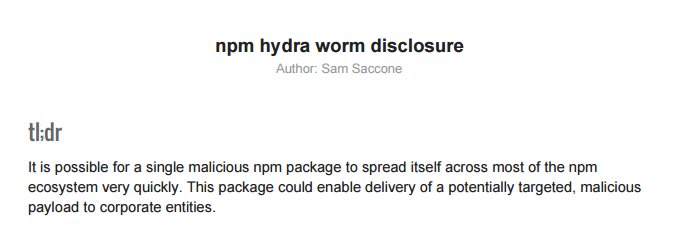
CERT just disclosed a malicious npm vector Reported in Jan 4 2016.
kb.cert.org/vuls/id/319816
English
It's finally happening. We can put this whole install script NPM worm madness behind us...
github.blog/changelog/2026…
English
the added benefit of investigation first is you get verification steps out of the gate vs post-fact - the combination of anchoring your interaction with data gathering and verification baked in allows extended task horizons with significant outcomes.
English
models have been post-trained to bend to your will - when you say something is slow - the model is going to make up 100 reasons for the slowness in thinking tokens
If you start by seeding the context window w/ perf data you anchor the interaction in data not hallucinated rational
English
The step change btw a prompt starting from a problem vs data gathering is the single largest step change you can make _today_ for your trajectory outcomes.
i.e:
> "page is slow when i ___ ... fix it"
V.
> "visit site[dot]com and collect a devtools trace..."
English

English

Full send to end the week—zero blanking while scrolling and switching between a few dozen themes every second.
DiffsHub.com, now with themes. Shoutout @amadeus and @necolas.
Pierre@pierrecomputer
diffshub[dot]com Celebrate Friday with our new Party Mode. We started by adding theme support, then thought, what if you could browse themes like you browse diffs, and at the same time, and just as fast? try it with your fav public diff (shift + click to change speeds)
English

Throwback to @samccone making a stink about fundamental flaws in npm 10 years ago (that are still not addressed):
kb.cert.org/vuls/id/319816
English