

Sam Singh
550 posts
Sam Singh
@sandeepsingh101
Fortunate Father; Lucky Husband; Proud American; LEGAL immigrant; Veteran ; Small Business Owner; Triplet Dad; ✊✊✊✊; MAGA!!
Tennessee, USA Katılım Ekim 2009
348 Takip Edilen177 Takipçiler

Sam Singh retweetledi

“Dumb motherf****** didn’t deserve to live.”
Far-left Democrat Senate candidate Graham Platner mocking a U.S. soldier who was shot four times in Afghanistan in a resurfaced Reddit comment.
The post made fun of Purple Heart recipient Pfc. Ted Daniels after he took incoming fire during a 2012 clash with the Taliban.
Platner’s now deleted comment went on to say:
"At least his stupidity and fat ass wheezing are available for all future infantrymen to witness and hold in contempt. Poor marksmanship on the Taliban's part is the only reason this mouthbreather made it home, he managed to make every possible s*** decision possible when it comes to small unit combat."

English
Sam Singh retweetledi
GEORGIA!
Democrats are trying to get 2 RADICAL LEFTIST judges on your supreme court today.
They're promising to reinstate late-term abortion and HATE free and fair elections.
Without the SAVE America Act, we can't just go to the polls, we have to FLOOD the polls!
Vote Bethel and Warren for GA Supreme Court!
English
Sam Singh retweetledi

Since @ZohranKMamdani highlighted the Bosnian colonizer claiming to be a victim of the Nakba, here is what you need to know about the Bosnian-Palestinian WWII Nazi collaboration:
Amin El Housseini, the father of Palestinian nationalism, commanded the 13th Waffen Mountain Division of the SS Handschar, which was composed of Bosnian volunteers.
The Handschar Division became infamous for atrocities against Serbian civilians, anti-fascist partisans, and Jews. Many villages were burned, and innocent civilians were massacred.
Thousands were murdered or deported.
I am guessing Mamdani will not use taxpayer dollars to tell New Yorkers the truth.

English
Sam Singh retweetledi

Haley Robson was over 18 when she recruited a 14 year old for Epstein. The 14 year old told police she was afraid to tell anyone because Robson was violent and the 14 year old’s friend who was also recruited had her father’s car vandalized after she threatened to expose Robson. When police brought Robson in for questioning after the parents of the 14 year old sued her, Robson laughed about it (on tape) and said she’s like Heidi Fleiss


Former Congresswoman Marjorie Taylor Greene🇺🇸@FmrRepMTG
There were only 4 of us, Republicans, that signed the discharge petition to force the vote to release the Epstein files. Thomas Massie, Nancy Mace, Lauren Boebert, and myself. Trump has come after us one by one ever since then. The President told Speaker Johnson not to allow the vote to happen, but we courageously went against the President and refused to budge and overrode the Speaker to force the vote on record. It was only when all Members of Congress had to vote on record did Republicans finally find their intestinal fortitude to do the right thing and vote YES to release the files. Until then, they were absurdly obedient to the President who was doing everything in his reign of terror to hold them back. Even now, all the files are still not released, and the Epstein class remains protected. Wars are being waged, the markets are being manipulated, and the average American is being driven further into ruin while the Epstein class reigns and has yet to face any accountability. I will never regret signing that discharge petition, refusing to back down, and resigning as I want nothing to do with a President and a Party that bows to the Epstein class.
English
Sam Singh retweetledi


Sam Singh retweetledi

NEW 🚨 THOMAS MASSIE FILES
Cynthia West EX GIRLFRIEND of Thomas Massie exposes him as a sexual deviant & bribed her with $5,000 cash to stay silent.
Massie DM'd her on X in August of 2024 not even 2 months after his wife of 31 years passed away in June 2024.
Massie ended up getting her a congressional staffer job in D.C. Massie pressured her to be involved in deviant sexual behavior with him. Cynthia rejected feeling extremely pressured and uncomfortable.
When she rejected, Thomas Massie had her fired, bribed her & threatened her not to file a complaint.
A complaint was filed in fall of 2025. The same time period when Thomas Massie remarried to a different staffer 20 years younger than Massie.
The man who claimed screamed the loudest about "Transparency for Epstein" turned out to be a scumbag himself.
English
Sam Singh retweetledi

⚜️ The Thomas Massie Files Have Been Released, & They're Quite Disturbing ⚜️
Cynthia West, a Florida School Board candidate for Okaloosa County District 5 has been carrying a secret, & she didn't know who to turn to for advice about how to handle it.
So, she met up with @marcuscarey, a prominent Kentucky attorney, to seek advice & he interviewed her where she agreed to go on the record with what has been unfolding in her life, involving Thomas Massie, another Congresswoman, attempts to bribe with cash & silence with an NDA.
Two months after Massie's wife, Rhonda, passed away, she entered into a romantic relationship with him, which was in August, 2024. Totally normal behavior from a new Widower.
The pair went on trips & she'd visit him in Kentucky, in Rhonda's home. Things heated up pretty between them, & he gave her a promise ring. Things were going great between them. In fact, Thomas helped West get a job working for Indiana Rep. Victoria Spartz. This way, she could travel to DC to spend more time with him while she was there.
Then, the relationship took a weird turn. He began requesting she do s*x acts for him that made her uncomfortable. When she refused & objected to it, she expressed that he became angry & emotionally abusive towards her. West ended the relationship, but continued working for Rep. Spartz.
Shortly after the breakup, she said she got a text saying she was fired. Cynthia stated she never got written up, or did anything to warrant this other than expressing concern for Spartz' well-being, so she went to Ethics to put in a complaint.
Then, she notified Thomas that he would be named in this report. She said he got very angry, & said to her: "you're just one person, you can't make a difference, & you need to just walk away."
Cynthia said he then did what any other principled conservative would do: he tried to bribe her with $5,000 in cash & wanted her to sign an NDA. Cynthia refused the cash & the NDA. Cynthia said Massie has cash that he calls "cow money", which is untraceable & that he doesn't report it.
Who knew, the guy who demands transparency in DC, did all he could to be the least transparent in this situation. Same goes for the guy who acted disgusted about Epstein survivors being silenced, yet he tried to bribe off a woman he mistreated in order to prevent this from seeing the light of day.
I think the DOJ should investigate this "cow money."
It's safe to say Massie is done, & this explains A LOT!
English
Sam Singh retweetledi
BREAKING: Building manager arrested for voting MULTIPLE times in 2024 by filling ballots… "for former tenants"
These fraudulent mail-ins COUNTED
Her name: Esperanza Contreras
English
Sam Singh retweetledi

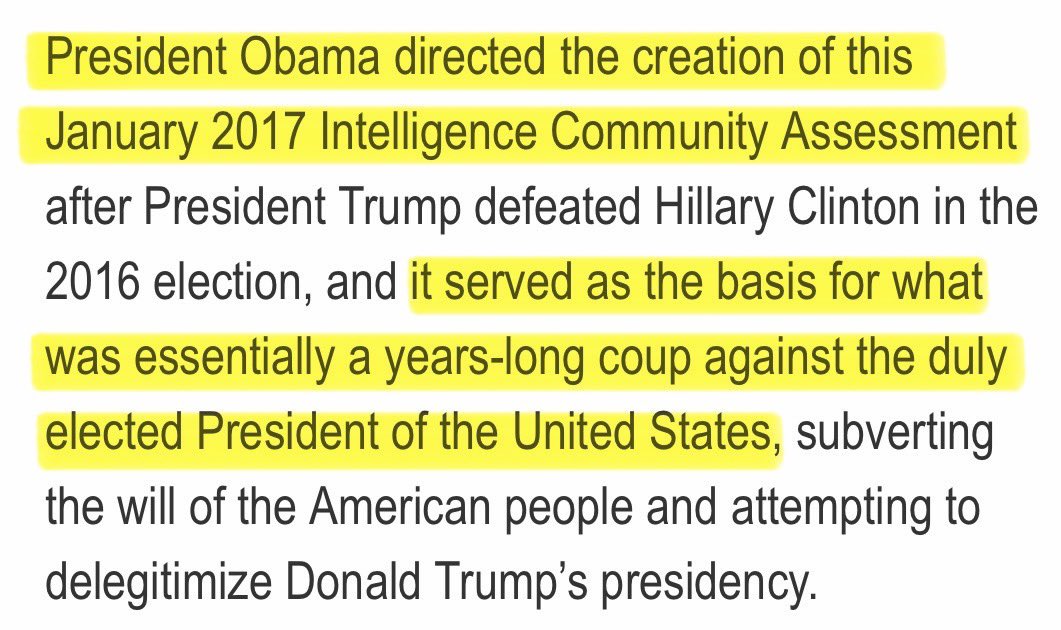
Says the man who directed the creation of the Russia hoax
🔗odni.gov/index.php/news…
TheBlaze@theblaze
Obama: "The White House shouldn't be able to direct the AG to go around prosecuting whoever the president wants prosecuted. You can't have a situation where whoever is in charge of the government starts using that to go after their political enemies or reward their friends."
English
Sam Singh retweetledi

@foxnewspolitics To people who ask why there aren’t more arrests or what’s happening with the fraud in Minnesota....
Minnesota is protecting the fraudsters because they are IN ON the fraud.
English
Sam Singh retweetledi

Sam Singh retweetledi
The open data approach meant rapid critique of findings. It's one of the first times I've received substantial, serious critique on this platform. Corrections will be published immediately. I will say where I am right and where I am wrong. That is how science works.
Kevin Bass@kevinnbass
I have conducted the most comprehensive public records audit of any Congressman in the history of the United States. That audit was conducted on Congressman @RoKhanna. This audit has exposed shocking ethical lapses and potentially criminal behavior by Congressman Khanna. I am filing a 239-page ethics complaint, including 30 evidentiary exhibits, with the Office of Congressional Conduct (OCC), to be followed by complaints to the House Ethics Committee and the Department of Justice (DOJ) in the coming days. Besides being based on an extremely comprehensive public records audit, the complaint is the first of its kind in another way: the factual basis of every single specific claim in the complaint is fully verifiable and reproducible by anyone with a computer. Attached to this post is a link to the GitHub Release containing the complete reproducibility kit. Anyone with Python 3 and the GitHub CLI installed can download it and run a single command — `python welcome.py` — which walks them through the analysis at whatever verification depth they pick: 1. A 30-second offline check that every body figure derives from the bundled snapshots; 2. A primary-source spot-check that re-fetches the underlying records from the House Clerk and IRS and confirms the bytes match; 3. An OpenTimestamps proof that the package existed at publication time and wasn't backfilled; and 4. An opt-in path that lets the reviewer re-run the OCR pipeline themselves against the primary-source PDFs. This means that any person in the world can confirm for themselves that all statements made in this complaint are fully reproducible and true. --- The complaint asserts the following: Representative Ro Khanna is a Democratic congressman from California's 17th District (basically Silicon Valley). He has been in Congress since January 2017. He is currently in his fifth term. Khanna has done six different things wrong. Each one is bad enough to investigate on its own. Together, they are very bad. His family's stock trades line up suspiciously with the committees he sits on, the donors who fund him, and the votes he takes. That's bad. Khanna's household made between $15 million and $108 million from these trades, with a middle estimate of about $61 million. The estimate cannot be made any better than this. The disclosure forms provide only disclosure "bands". Precise amounts can only be determined with subpoena power. But we do have one hard number: Compared to just buying a basic stock-market index fund, his family beat the market by about $28 million. $28 million. The complaint says that Congressman Khanna should pay this money back. Now, how the trading actually works in this household is important because it helps us to understanding everything else, so I will explain that now. Khanna himself has filed 114 reports with the House Clerk listing every trade his household has made. Those reports cover 37,238 individual trades. That's a huge amount. Most members of Congress don't trade nearly that much. But here's the kicker. Almost none of those trades are in Khanna's own name. 99.997% of them are listed as belonging to either his wife (Ritu Ahuja Khanna) or his dependent child. That's basically all Khanna trades. A massive volume. Yet virtually none in his own name. Curious. Khanna has publicly said this is fine because the trading is done through what's called a "separately managed account" or "blind trust", meaning a broker or trustee makes the decisions without telling him. If that were true, he'd be off the hook because he wouldn't know what was being bought or sold. The complaint says that's not true. When you read his official financial disclosure form (the one he signs every year), it shows: > No separately managed account > No blind trust > No third-party broker handling the actively-traded stocks Instead, the trades come from about a dozen family trusts (the Ritu Ahuja 1994 Trust, the Ritu Ahuja 1995 Trust, the Ahuja Children's Trust, etc.). These are family-controlled entities. Whoever's making the trade decisions is a family member. His wife or his child. (Put another way: his "wife" or his "child".) Not an outside professional. Uh oh. The "I didn't know what my spouse was trading" defense doesn't work. Nothing on the official paperwork supports it. Think about it. Do you think Khanna and his wife sit around and his wife is just buying Palantir stocks, while, by coincidence, Khanna sits on the defense tech committee? And they don't talk? That's the framework. But it gets a whole lot worse. Because the complaint isn't undergirded merely by this speculation. But by hard evidence. The complaint makes six specific allegations, or "counts". --- COUNT 1: Filing trade reports late This sounds like a technical detail, but it is not. It is the pattern of misbehavior that enabled everything else. When a member of Congress, their spouse, or their kid makes a stock trade worth more than $1,000, they have to report it within 45 days. That's the STOCK Act, passed in 2012. Each late report costs at least $200 in fines. Out of about 36,000 auditable trades made by Khanna, 624 were filed late. The worst one was 358 days late -- almost a full year. A trade in HUMANA stock made in October 2023 wasn't reported until November 2024. The complaint provides a calculation of how Khanna fares compared to other Congressmen in terms of how often he is late in filing. Khanna's rate of late filing (1.74%) is better than most members of Congress. The average House member is late on 10% of trades. So if you measured just the percentage, he'd look fine. But here's where things get crazy. The complaint uses a special "composite score" that combines (1) how much money is involved, (2) how late, and (3) how many trades. By that score, Khanna ranks in the top 7% of the entire House. This means that Khanna's late filings expose more dollars to delayed disclosure than 93% of members. A late report means the public can't see what a member of Congress is buying or selling at the time it happens. By the time it's disclosed, the value of the inside information is gone. The late filings are not hitting Khanna on a technicality. They imply that the entire system designed to prevent insider trading in Congress is broken inside Khanna's office. The 45-day disclosure rule is not a paperwork deadline. It is the security camera. It is the only mechanism that lets the public see what a Congressman is buying while the trade still matters -- while the bill is still being debated, while the FDA decision is still pending, while the news is still fresh. When Khanna files 358 days late, the camera is off. By the time anyone sees the trade, the moment has passed. The witnesses have moved on. The dots cannot be connected. A few late filings is a paperwork mistake. 624 of them, on a household making 37,000 trades, in the exact industries Khanna's committees regulate, is a system. It is Khanna's system. It is how he does his dirty work. And it is the system that lets every other count in this complaint happen in the dark. Until now. The complaint asks for: 1. Civil penalties for the late filings. 2. A requirement that Khanna set up an actual qualified blind trust going forward. 3. An Ethics Committee finding under House Rule XXIII that the absolute-count and composite-score chamber rankings reflect conduct that does not reflect creditably on the House. --- COUNT 2: Buying defense stocks right before defense bills pass Members of Congress can't trade based on inside information they got from doing their congressional job (the STOCK Act, sections 3 and 4). Khanna sits on the House Armed Services Committee, which writes the giant yearly defense bill (the NDAA). And across four different years, his household bought stock in big defense contractors (Boeing, Lockheed Martin, Northrop Grumman, Raytheon, etc.) right before the NDAA passed: > 7 defense stock buys 12 days before the 2018 NDAA > 4 defense stock buys 4 days before the 2021 NDAA override > 1 Palantir buy 13 days before the 2022 NDAA > 2 Raytheon buys 2 days before the 2024 NDAA Khanna publicly voted NO on 12 of 13 of these NDAA passage votes. So he's saying "I oppose this bill" with his vote. But his family is buying stock in the companies that would benefit from it passing. That, of course, is insane. The complaint argues this is the worst version of the conflict: Khanna gets the political credit for opposing the bill. Meanwhile, he makes money from insider knowledge from sitting on the Committee, knowing it would pass anyway. In addition. Khanna sits on a committee that oversees defense contracts. The data analytics company Palantir got $4.88 billion in federal contracts during his time in Congress. On at least nine separate days, Palantir got a federal contract AND Khanna's household bought Palantir stock the same day. One of these was a $19 million Air Force contract on May 10, 2022: the same day his dependent child's account made six separate Palantir trades. Khanna's defense trades made about $5.4 million in profits beyond what the broader market did, suggesting that Khanna was using his insider knowledge -- through the intermediary of his dependent child -- to beat the market. What the complaint asks for: 1. Send to House Ethics. 2. Send to DOJ for possible criminal charges. 3. Force Khanna to give back the $5.4 million. --- COUNT 3: Buying drug company stocks right before government drug actions COUNT 3 is the same as COUNT 2, except healthcare stocks instead of defense stocks. Yes, Khanna is doing the same thing across stock classes. Of course. Khanna sits on a committee that oversees the agencies regulating drug companies (HHS, CMS, FDA). The complaint identifies 14 different government drug-pricing actions between 2017 and 2024 where Khanna's household made pharmaceutical-company trades within 14 days of the action. 1,244 pharmaceutical-sector trades clustered within ±14 days of these events. That's chamber rank 1 of 66 House members, 14 times the chamber 95th-percentile. The biggest example: On August 2, 2024, Khanna's family made 286 trades in a single-day rebalance. Hidden inside was simultaneous trading in four of the nine drug companies (AbbVie, Amgen, Johnson & Johnson, Merck) whose drugs were going to be on the government's negotiated-price list. That list was published 13 days later, on August 15, 2024. It was confidential and not yet public on the day of the trades. But Khanna had insider access to the list. And made the flurry of trades that aligned with it at precisely the right time. Two other "conflict triangles" the complaint highlights: 1. Palantir (already mentioned in Count 2): Khanna chairs the China select committee and is a top member on the cyber subcommittee. Palantir is a defense tech company affected by both. His family has done 29 Palantir trades and gotten $22,700 in donations from Palantir's chief operating officer. 2. Nvidia: In 2024, Khanna's family donated 10,076 shares of Nvidia stock (worth about $1.67 million when given, much more later as the stock soared) to a family foundation. In the same year, he voted NO on a chips bill, voted YES on four China-policy bills, and continued chairing the China committee. This is the committee that has the most influence over Nvidia's massive AI chip business. 3. The Goldman Sachs margin loan setup: Across 2017-2019, Khanna's spouse had two simultaneous Goldman Sachs margin loans (basically borrowing money against stocks to buy more stocks). Each loan was labeled as belonging to a family trust ("Ritu Ahuja 1994 Trust" and "Ritu Ahuja 1995 Trust"). This same Goldman Sachs is also the broker for a sophisticated short-volatility options trading program in the spouse's account, and Goldman employees have donated about $48,000 to Khanna over the years. You can't run an options trading program on a margin account passively; somebody (the spouse) has to authorize each trade. What COUNT 3 asks for: Same as COUNT 2: 1. Send to Ethics. 2. Send to DOJ. 3. Force Khanna to step away from CMS, FDA, and defense matters pending investigation. --- COUNT 4: Khanna's family trades line up with insider events at the issuer level — same-day SEC filings and same-day insider trades The single sharpest count in the complaint. The legal hook is the STOCK Act §§ 3-4, codified at 15 U.S.C. § 78u-1(g) — the federal statute that extends Rule 10b-5 insider-trading prohibitions directly to Members of Congress who trade on material non-public information acquired through their legislative or oversight duties. Khanna's household trades are not just suspicious because of how many they are. They are suspicious because they happen at very specific moments. Two examples: > 186 of his household's trades happened on the same calendar day that the company in question filed important news with the SEC (Form 8-K — the disclosure form companies file for material acquisitions, executive changes, regulatory actions, and the other news events the SEC requires public companies to disclose immediately). > 86 of his household's trades happened on the same calendar day that a named officer at the same company (CEO, CFO, board member) was buying or selling their own stock in the same direction. On each of these patterns, Khanna ranks at the top of the entire House: > Same-day-8-K count: rank 1 of 96 House Members. 4.3 times more than the second-place Member. > Same-day-aligned-insider count: rank 3 of 156 House Members. The complaint does NOT allege that Khanna's RATE of same-day-8-K trading is exceptionally high. As a percentage of his trades, his same-day-8-K rate is 5.4% — which is above the chamber median (4.5%) but inside the normal band. The complaint discloses this candidly, up front, to pre-empt the inevitable "his rate is in-band" defense. The argument is about ABSOLUTE count combined with ticker-specificity: the same-day intersections concentrate on companies in sectors his committees regulate. These two findings join two more from Count 3: > 4,595 pharmaceutical trades within 14 days of FDA Advisory Committee meetings. Rank 1 of 66 House Members. 6.1 times the second-place Member. > 1,244 pharmaceutical trades within 14 days of CMS rulemaking events. Rank 1 of 66 House Members. 14 times chamber P95. Across four independent issuer-event and regulator-event substrates — SEC 8-K filings, named-officer Form 3/4/5 filings, FDA Advisory Committee calendar, CMS rulemaking calendar — Khanna's household ranks first or third by absolute count. The four substrates are independent: different agencies, different filer classes, different denominators. The convergence is structurally inconsistent with portfolio management that doesn't draw on contemporaneous information advantage. The complaint asks for: 1. Ethics Committee referral for full investigation. 2. DOJ referral for criminal review under 15 U.S.C. § 78ff (Exchange Act criminal penalty) if any single windowed trade reflects willful use of material non-public information. 3. Disgorgement under STOCK Act § 9 of any profit attributable to same-day-issuer-event or same-day-officer-aligned trading. 4. A House Rule XXIII finding that the four-substrate convergence reflects conduct that does not reflect creditably on the House. --- COUNT 5: Ex-government officials who became lobbyists are donating to him The law says that federal officials who leave government can't immediately go lobby their old agencies. Various waiting periods apply, and the lifetime ban (18 U.S.C. § 207(a)(1)) prevents them from ever working on the same specific matters they personally worked on in government. Yet, five former federal officials, who all later became registered lobbyists, donated to Khanna's campaign. Each one's old job lines up with what they're now lobbying about: 1. Chris Israel. Former Deputy Assistant Commerce Secretary. Now lobbies for tech and pharma companies (Qualcomm, AbbVie, PhRMA). Donated $1,000 (one $500 check was refunded within 24 hours). 2. Arshi Siddiqui. Former senior staffer to Speaker Pelosi. Now a partner at Akin Gump, lobbying on Armed Services issues for RTX (Raytheon) and Honeywell. Donated $2,000. 3. Francisco Sanchez. Former Obama Commerce Department Under Secretary for International Trade. Now lobbies on international trade issues. Donated $1,250. 4. Kevin Batteh. Former CFTC counsel. Now lobbies on CFTC and DoD issues for Citadel and D.E. Shaw. Donated $1,000. 5. Robert Taylor. The most damning case. Former Deputy Assistant Secretary of Defense for Senate Affairs. Now lobbies for Boeing, BAE Systems, Aerojet Rocketdyne, Textron — the exact defense contractors his old job covered. Donated $1,000 (NOT refunded). Khanna sits on Armed Services. Their employees too: The companies these lobbyists work for collectively gave $365,140 across 264 individual contributions to Khanna. Khanna says he doesn't take corporate PAC money. But the corporations' executives give to him personally. Lobbyists are required to disclose their political contributions. Two of the five lobbyists hid the Khanna donations from their required reports. Robert Taylor's case is the worst: he affirmatively certified "I made no contributions" while a Khanna donation was sitting in the period. The complaint asks for: 1. DOJ referral for the lifetime-ban review (especially Robert Taylor). 2. DOJ referral for Taylor's allegedly false lobbying disclosure. 3. FEC audit. COUNT 6: The Ahuja family foundation and a missing rental property Three problems. PROBLEM 1: Khanna's family foundation isn't disclosed as a spouse asset Remember how 99.997% of the trades made by Khanna are made either through his spouse or his child? His wife's Ahuja Charitable Foundation is a $45 million private family foundation. His wife Ritu Ahuja Khanna, is: > A named trustee every year from 2018 through 2024 (according to the foundation's own IRS filings) > A substantial contributor for tax years 2022, 2023, and 2024 (also per IRS filings) The foundation owns massive amounts of stock in defense companies (Honeywell, L3Harris, TransDigm, Boeing, GE Vernova) and healthcare companies, again exactly the sectors Khanna's committees oversee. Khanna's annual financial disclosures don't mention the foundation as a spouse-held asset at all. And they don't mention his wife's trustee role. Federal ethics law (5 U.S.C. § 13104(d)(1)(A)) requires members to disclose their spouse's income from nonprofit positions where the spouse has decision-making power. The complaint says the Ethics Committee should decide whether this should have been disclosed. Now, in 2024, Khanna's wife "donated" 2,821 shares of Nvidia to the Foundation, and the related Ahuja family trust donated 7,255 more shares This was a combined 10,076 shares of Nvidia worth $1.67 million at donation time (much more later). This happened the same year Khanna voted on multiple chip and China bills and continued chairing the China committee. PROBLEM 2: A rental property in Dover, Delaware is missing In tax year 2021, Khanna disclosed a $100,000-$250,000 mortgage from "First Bank of Wilmington, Delaware" tied to a Dover, Delaware rental property. But across ten years of disclosures (2014-2023), the Dover, Delaware property itself never appears as an asset. Federal law says any rental property worth more than $1,000 has to be disclosed. And here's the killer: Every other rental property the household owns (Cincinnati OH, Denham LA, Walton Hills OH, Harahan LA, an NY condo, Walton OH) is correctly disclosed both as an asset AND with the rental income. Only Dover, Delaware is missing on both sides. So the household clearly knows how to fill out the form. They just didn't for this one property. Why? What's special about that property? The public deserves to know if Khanna is hiding something. PROBLEM 3: Margin loans and options trading prove there's no blind trust Across 2017-2020, Khanna's spouse had Goldman Sachs margin loans (borrowing against stocks). At the same time, the household was running a sophisticated options trading program. They were writing PUT options on the spouse-owned account. Under brokerage rules, writing options on a margin account requires personal customer authorization. You can't run an options program with a passive blind trust. The "I have no idea what my spouse is trading" defense is impossible. Khanna knew. And he was breaking the rules. The complaint asks for: 1. Ethics Committee review of the foundation question. 2. Per-year corrective filings on the Dover property. 3. Civil penalties. 4. A possible "honest services" fraud referral if the Ethics Committee finds intentional concealment. --- How much money Khanna made > $61 million in profits the family made from these trades (middle estimate) > $28 million of that is "alpha" — money beyond what just buying an index fund would have earned > 41% of those profits ($25.2 million) came from trades made within two weeks of an event Khanna could have known about because of his job > The complaint asks for that money to be paid back (called "disgorgement") under STOCK Act penalty rules What the complaint asks 1. The Office of Congressional Conduct should investigate and refer the case to the House Ethics Committee for a real investigation 2. Parts of it should go to the FEC for the LD-203 lobbyist-contribution-disclosure compliance audit 3. Parts of it should go to the DOJ for possible criminal review (insider trading under 15 U.S.C. § 78u-1(g) and § 78ff; lifetime lobbying ban violations under 18 U.S.C. § 207; false statements on lobbyist disclosure filings under 18 U.S.C. § 1001 and 2 U.S.C. § 1606) 4. Khanna should set up an actual blind trust to prevent this in the future 5. He should recuse himself from CMS, FDA, and defense matters while it's being investigated 6. The roughly $28 million in market-beating profits should be returned
English
Sam Singh retweetledi
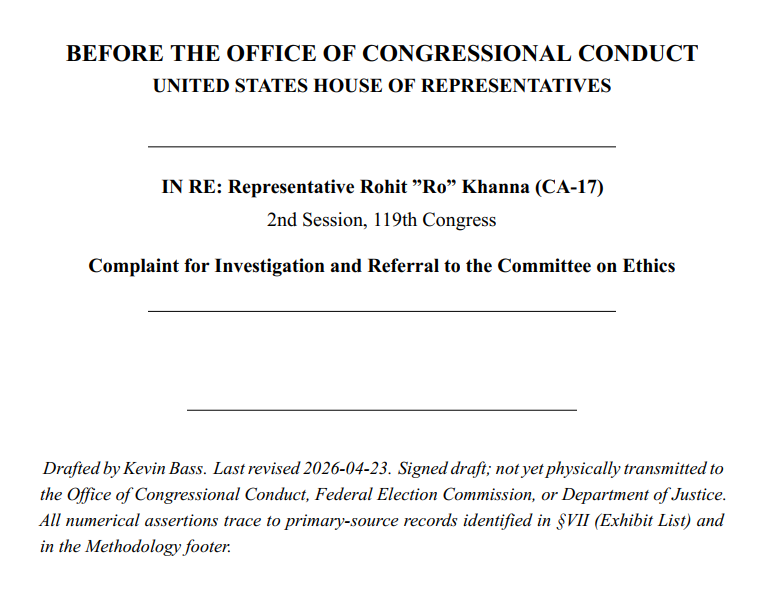
I have conducted the most comprehensive public records audit of any Congressman in the history of the United States.
That audit was conducted on Congressman @RoKhanna.
This audit has exposed shocking ethical lapses and potentially criminal behavior by Congressman Khanna.
I am filing a 239-page ethics complaint, including 30 evidentiary exhibits, with the Office of Congressional Conduct (OCC), to be followed by complaints to the House Ethics Committee and the Department of Justice (DOJ) in the coming days.
Besides being based on an extremely comprehensive public records audit, the complaint is the first of its kind in another way: the factual basis of every single specific claim in the complaint is fully verifiable and reproducible by anyone with a computer.
Attached to this post is a link to the GitHub Release containing the complete reproducibility kit. Anyone with Python 3 and the GitHub CLI installed can download it and run a single command — `python welcome.py` — which walks them through the analysis at whatever verification depth they pick:
1. A 30-second offline check that every body figure derives from the bundled snapshots;
2. A primary-source spot-check that re-fetches the underlying records from the House Clerk and IRS and confirms the bytes match;
3. An OpenTimestamps proof that the package existed at publication time and wasn't backfilled; and
4. An opt-in path that lets the reviewer re-run the OCR pipeline themselves against the primary-source PDFs.
This means that any person in the world can confirm for themselves that all statements made in this complaint are fully reproducible and true.
---
The complaint asserts the following:
Representative Ro Khanna is a Democratic congressman from California's 17th District (basically Silicon Valley). He has been in Congress since January 2017. He is currently in his fifth term.
Khanna has done six different things wrong.
Each one is bad enough to investigate on its own.
Together, they are very bad.
His family's stock trades line up suspiciously with the committees he sits on, the donors who fund him, and the votes he takes.
That's bad.
Khanna's household made between $15 million and $108 million from these trades, with a middle estimate of about $61 million.
The estimate cannot be made any better than this. The disclosure forms provide only disclosure "bands". Precise amounts can only be determined with subpoena power.
But we do have one hard number:
Compared to just buying a basic stock-market index fund, his family beat the market by about $28 million.
$28 million.
The complaint says that Congressman Khanna should pay this money back.
Now, how the trading actually works in this household is important because it helps us to understanding everything else, so I will explain that now.
Khanna himself has filed 114 reports with the House Clerk listing every trade his household has made. Those reports cover 37,238 individual trades. That's a huge amount. Most members of Congress don't trade nearly that much.
But here's the kicker.
Almost none of those trades are in Khanna's own name.
99.997% of them are listed as belonging to either his wife (Ritu Ahuja Khanna) or his dependent child.
That's basically all Khanna trades. A massive volume.
Yet virtually none in his own name.
Curious.
Khanna has publicly said this is fine because the trading is done through what's called a "separately managed account" or "blind trust", meaning a broker or trustee makes the decisions without telling him.
If that were true, he'd be off the hook because he wouldn't know what was being bought or sold.
The complaint says that's not true. When you read his official financial disclosure form (the one he signs every year), it shows:
> No separately managed account
> No blind trust
> No third-party broker handling the actively-traded stocks
Instead, the trades come from about a dozen family trusts (the Ritu Ahuja 1994 Trust, the Ritu Ahuja 1995 Trust, the Ahuja Children's Trust, etc.).
These are family-controlled entities.
Whoever's making the trade decisions is a family member. His wife or his child. (Put another way: his "wife" or his "child".) Not an outside professional.
Uh oh.
The "I didn't know what my spouse was trading" defense doesn't work. Nothing on the official paperwork supports it.
Think about it.
Do you think Khanna and his wife sit around and his wife is just buying Palantir stocks, while, by coincidence, Khanna sits on the defense tech committee?
And they don't talk?
That's the framework. But it gets a whole lot worse.
Because the complaint isn't undergirded merely by this speculation. But by hard evidence.
The complaint makes six specific allegations, or "counts".
---
COUNT 1: Filing trade reports late
This sounds like a technical detail, but it is not. It is the pattern of misbehavior that enabled everything else.
When a member of Congress, their spouse, or their kid makes a stock trade worth more than $1,000, they have to report it within 45 days. That's the STOCK Act, passed in 2012. Each late report costs at least $200 in fines.
Out of about 36,000 auditable trades made by Khanna, 624 were filed late.
The worst one was 358 days late -- almost a full year. A trade in HUMANA stock made in October 2023 wasn't reported until November 2024.
The complaint provides a calculation of how Khanna fares compared to other Congressmen in terms of how often he is late in filing.
Khanna's rate of late filing (1.74%) is better than most members of Congress. The average House member is late on 10% of trades.
So if you measured just the percentage, he'd look fine.
But here's where things get crazy.
The complaint uses a special "composite score" that combines (1) how much money is involved, (2) how late, and (3) how many trades.
By that score, Khanna ranks in the top 7% of the entire House.
This means that Khanna's late filings expose more dollars to delayed disclosure than 93% of members.
A late report means the public can't see what a member of Congress is buying or selling at the time it happens.
By the time it's disclosed, the value of the inside information is gone.
The late filings are not hitting Khanna on a technicality.
They imply that the entire system designed to prevent insider trading in Congress is broken inside Khanna's office.
The 45-day disclosure rule is not a paperwork deadline. It is the security camera. It is the only mechanism that lets the public see what a Congressman is buying while the trade still matters -- while the bill is still being debated, while the FDA decision is still pending, while the news is still fresh.
When Khanna files 358 days late, the camera is off. By the time anyone sees the trade, the moment has passed. The witnesses have moved on. The dots cannot be connected.
A few late filings is a paperwork mistake. 624 of them, on a household making 37,000 trades, in the exact industries Khanna's committees regulate, is a system.
It is Khanna's system. It is how he does his dirty work.
And it is the system that lets every other count in this complaint happen in the dark.
Until now.
The complaint asks for:
1. Civil penalties for the late filings.
2. A requirement that Khanna set up an actual qualified blind trust going forward.
3. An Ethics Committee finding under House Rule XXIII that the absolute-count and composite-score chamber rankings reflect conduct that does not reflect creditably on the House.
---
COUNT 2: Buying defense stocks right before defense bills pass
Members of Congress can't trade based on inside information they got from doing their congressional job (the STOCK Act, sections 3 and 4).
Khanna sits on the House Armed Services Committee, which writes the giant yearly defense bill (the NDAA).
And across four different years, his household bought stock in big defense contractors (Boeing, Lockheed Martin, Northrop Grumman, Raytheon, etc.) right before the NDAA passed:
> 7 defense stock buys 12 days before the 2018 NDAA
> 4 defense stock buys 4 days before the 2021 NDAA override
> 1 Palantir buy 13 days before the 2022 NDAA
> 2 Raytheon buys 2 days before the 2024 NDAA
Khanna publicly voted NO on 12 of 13 of these NDAA passage votes.
So he's saying "I oppose this bill" with his vote.
But his family is buying stock in the companies that would benefit from it passing.
That, of course, is insane.
The complaint argues this is the worst version of the conflict:
Khanna gets the political credit for opposing the bill.
Meanwhile, he makes money from insider knowledge from sitting on the Committee, knowing it would pass anyway.
In addition.
Khanna sits on a committee that oversees defense contracts. The data analytics company Palantir got $4.88 billion in federal contracts during his time in Congress.
On at least nine separate days, Palantir got a federal contract AND Khanna's household bought Palantir stock the same day.
One of these was a $19 million Air Force contract on May 10, 2022: the same day his dependent child's account made six separate Palantir trades.
Khanna's defense trades made about $5.4 million in profits beyond what the broader market did, suggesting that Khanna was using his insider knowledge -- through the intermediary of his dependent child -- to beat the market.
What the complaint asks for:
1. Send to House Ethics.
2. Send to DOJ for possible criminal charges.
3. Force Khanna to give back the $5.4 million.
---
COUNT 3: Buying drug company stocks right before government drug actions
COUNT 3 is the same as COUNT 2, except healthcare stocks instead of defense stocks.
Yes, Khanna is doing the same thing across stock classes. Of course.
Khanna sits on a committee that oversees the agencies regulating drug companies (HHS, CMS, FDA). The complaint identifies 14 different government drug-pricing actions between 2017 and 2024 where Khanna's household made pharmaceutical-company trades within 14 days of the action.
1,244 pharmaceutical-sector trades clustered within ±14 days of these events. That's chamber rank 1 of 66 House members, 14 times the chamber 95th-percentile.
The biggest example: On August 2, 2024, Khanna's family made 286 trades in a single-day rebalance.
Hidden inside was simultaneous trading in four of the nine drug companies (AbbVie, Amgen, Johnson & Johnson, Merck) whose drugs were going to be on the government's negotiated-price list.
That list was published 13 days later, on August 15, 2024.
It was confidential and not yet public on the day of the trades.
But Khanna had insider access to the list. And made the flurry of trades that aligned with it at precisely the right time.
Two other "conflict triangles" the complaint highlights:
1. Palantir (already mentioned in Count 2): Khanna chairs the China select committee and is a top member on the cyber subcommittee. Palantir is a defense tech company affected by both. His family has done 29 Palantir trades and gotten $22,700 in donations from Palantir's chief operating officer.
2. Nvidia: In 2024, Khanna's family donated 10,076 shares of Nvidia stock (worth about $1.67 million when given, much more later as the stock soared) to a family foundation. In the same year, he voted NO on a chips bill, voted YES on four China-policy bills, and continued chairing the China committee. This is the committee that has the most influence over Nvidia's massive AI chip business.
3. The Goldman Sachs margin loan setup: Across 2017-2019, Khanna's spouse had two simultaneous Goldman Sachs margin loans (basically borrowing money against stocks to buy more stocks).
Each loan was labeled as belonging to a family trust ("Ritu Ahuja 1994 Trust" and "Ritu Ahuja 1995 Trust"). This same Goldman Sachs is also the broker for a sophisticated short-volatility options trading program in the spouse's account, and Goldman employees have donated about $48,000 to Khanna over the years.
You can't run an options trading program on a margin account passively; somebody (the spouse) has to authorize each trade.
What COUNT 3 asks for: Same as COUNT 2:
1. Send to Ethics.
2. Send to DOJ.
3. Force Khanna to step away from CMS, FDA, and defense matters pending investigation.
---
COUNT 4: Khanna's family trades line up with insider events at the issuer level — same-day SEC filings and same-day insider trades
The single sharpest count in the complaint.
The legal hook is the STOCK Act §§ 3-4, codified at 15 U.S.C. § 78u-1(g) — the federal statute that extends Rule 10b-5 insider-trading prohibitions directly to Members of Congress who trade on material non-public information acquired through their legislative or oversight duties.
Khanna's household trades are not just suspicious because of how many they are. They are suspicious because they happen at very specific moments.
Two examples:
> 186 of his household's trades happened on the same calendar day that the company in question filed important news with the SEC (Form 8-K — the disclosure form companies file for material acquisitions, executive changes, regulatory actions, and the other news events the SEC requires public companies to disclose immediately).
> 86 of his household's trades happened on the same calendar day that a named officer at the same company (CEO, CFO, board member) was buying or selling their own stock in the same direction.
On each of these patterns, Khanna ranks at the top of the entire House:
> Same-day-8-K count: rank 1 of 96 House Members. 4.3 times more than the second-place Member.
> Same-day-aligned-insider count: rank 3 of 156 House Members.
The complaint does NOT allege that Khanna's RATE of same-day-8-K trading is exceptionally high. As a percentage of his trades, his same-day-8-K rate is 5.4% — which is above the chamber median (4.5%) but inside the normal band. The complaint discloses this candidly, up front, to pre-empt the inevitable "his rate is in-band" defense.
The argument is about ABSOLUTE count combined with ticker-specificity: the same-day intersections concentrate on companies in sectors his committees regulate.
These two findings join two more from Count 3:
> 4,595 pharmaceutical trades within 14 days of FDA Advisory Committee meetings. Rank 1 of 66 House Members. 6.1 times the second-place Member.
> 1,244 pharmaceutical trades within 14 days of CMS rulemaking events. Rank 1 of 66 House Members. 14 times chamber P95.
Across four independent issuer-event and regulator-event substrates — SEC 8-K filings, named-officer Form 3/4/5 filings, FDA Advisory Committee calendar, CMS rulemaking calendar — Khanna's household ranks first or third by absolute count. The four substrates are independent: different agencies, different filer classes, different denominators. The convergence is structurally inconsistent with portfolio management that doesn't draw on contemporaneous information advantage.
The complaint asks for:
1. Ethics Committee referral for full investigation.
2. DOJ referral for criminal review under 15 U.S.C. § 78ff (Exchange Act criminal penalty) if any single windowed trade reflects willful use of material non-public information.
3. Disgorgement under STOCK Act § 9 of any profit attributable to same-day-issuer-event or same-day-officer-aligned trading.
4. A House Rule XXIII finding that the four-substrate convergence reflects conduct that does not reflect creditably on the House.
---
COUNT 5: Ex-government officials who became lobbyists are donating to him
The law says that federal officials who leave government can't immediately go lobby their old agencies. Various waiting periods apply, and the lifetime ban (18 U.S.C. § 207(a)(1)) prevents them from ever working on the same specific matters they personally worked on in government.
Yet, five former federal officials, who all later became registered lobbyists, donated to Khanna's campaign. Each one's old job lines up with what they're now lobbying about:
1. Chris Israel. Former Deputy Assistant Commerce Secretary. Now lobbies for tech and pharma companies (Qualcomm, AbbVie, PhRMA). Donated $1,000 (one $500 check was refunded within 24 hours).
2. Arshi Siddiqui. Former senior staffer to Speaker Pelosi. Now a partner at Akin Gump, lobbying on Armed Services issues for RTX (Raytheon) and Honeywell. Donated $2,000.
3. Francisco Sanchez. Former Obama Commerce Department Under Secretary for International Trade. Now lobbies on international trade issues. Donated $1,250.
4. Kevin Batteh. Former CFTC counsel. Now lobbies on CFTC and DoD issues for Citadel and D.E. Shaw. Donated $1,000.
5. Robert Taylor. The most damning case. Former Deputy Assistant Secretary of Defense for Senate Affairs. Now lobbies for Boeing, BAE Systems, Aerojet Rocketdyne, Textron — the exact defense contractors his old job covered. Donated $1,000 (NOT refunded). Khanna sits on Armed Services.
Their employees too: The companies these lobbyists work for collectively gave $365,140 across 264 individual contributions to Khanna.
Khanna says he doesn't take corporate PAC money. But the corporations' executives give to him personally.
Lobbyists are required to disclose their political contributions. Two of the five lobbyists hid the Khanna donations from their required reports. Robert Taylor's case is the worst: he affirmatively certified "I made no contributions" while a Khanna donation was sitting in the period.
The complaint asks for:
1. DOJ referral for the lifetime-ban review (especially Robert Taylor).
2. DOJ referral for Taylor's allegedly false lobbying disclosure.
3. FEC audit.
COUNT 6: The Ahuja family foundation and a missing rental property
Three problems.
PROBLEM 1: Khanna's family foundation isn't disclosed as a spouse asset
Remember how 99.997% of the trades made by Khanna are made either through his spouse or his child?
His wife's Ahuja Charitable Foundation is a $45 million private family foundation. His wife Ritu Ahuja Khanna, is:
> A named trustee every year from 2018 through 2024 (according to the foundation's own IRS filings)
> A substantial contributor for tax years 2022, 2023, and 2024 (also per IRS filings)
The foundation owns massive amounts of stock in defense companies (Honeywell, L3Harris, TransDigm, Boeing, GE Vernova) and healthcare companies, again exactly the sectors Khanna's committees oversee.
Khanna's annual financial disclosures don't mention the foundation as a spouse-held asset at all. And they don't mention his wife's trustee role. Federal ethics law (5 U.S.C. § 13104(d)(1)(A)) requires members to disclose their spouse's income from nonprofit positions where the spouse has decision-making power. The complaint says the Ethics Committee should decide whether this should have been disclosed.
Now, in 2024, Khanna's wife "donated" 2,821 shares of Nvidia to the Foundation, and the related Ahuja family trust donated 7,255 more shares
This was a combined 10,076 shares of Nvidia worth $1.67 million at donation time (much more later).
This happened the same year Khanna voted on multiple chip and China bills and continued chairing the China committee.
PROBLEM 2: A rental property in Dover, Delaware is missing
In tax year 2021, Khanna disclosed a $100,000-$250,000 mortgage from "First Bank of Wilmington, Delaware" tied to a Dover, Delaware rental property.
But across ten years of disclosures (2014-2023), the Dover, Delaware property itself never appears as an asset. Federal law says any rental property worth more than $1,000 has to be disclosed.
And here's the killer: Every other rental property the household owns (Cincinnati OH, Denham LA, Walton Hills OH, Harahan LA, an NY condo, Walton OH) is correctly disclosed both as an asset AND with the rental income.
Only Dover, Delaware is missing on both sides. So the household clearly knows how to fill out the form. They just didn't for this one property.
Why?
What's special about that property?
The public deserves to know if Khanna is hiding something.
PROBLEM 3: Margin loans and options trading prove there's no blind trust
Across 2017-2020, Khanna's spouse had Goldman Sachs margin loans (borrowing against stocks). At the same time, the household was running a sophisticated options trading program. They were writing PUT options on the spouse-owned account.
Under brokerage rules, writing options on a margin account requires personal customer authorization. You can't run an options program with a passive blind trust.
The "I have no idea what my spouse is trading" defense is impossible.
Khanna knew. And he was breaking the rules.
The complaint asks for:
1. Ethics Committee review of the foundation question.
2. Per-year corrective filings on the Dover property.
3. Civil penalties.
4. A possible "honest services" fraud referral if the Ethics Committee finds intentional concealment.
---
How much money Khanna made
> $61 million in profits the family made from these trades (middle estimate)
> $28 million of that is "alpha" — money beyond what just buying an index fund would have earned
> 41% of those profits ($25.2 million) came from trades made within two weeks of an event Khanna could have known about because of his job
> The complaint asks for that money to be paid back (called "disgorgement") under STOCK Act penalty rules
What the complaint asks
1. The Office of Congressional Conduct should investigate and refer the case to the House Ethics Committee for a real investigation
2. Parts of it should go to the FEC for the LD-203 lobbyist-contribution-disclosure compliance audit
3. Parts of it should go to the DOJ for possible criminal review (insider trading under 15 U.S.C. § 78u-1(g) and § 78ff; lifetime lobbying ban violations under 18 U.S.C. § 207; false statements on lobbyist disclosure filings under 18 U.S.C. § 1001 and 2 U.S.C. § 1606)
4. Khanna should set up an actual blind trust to prevent this in the future
5. He should recuse himself from CMS, FDA, and defense matters while it's being investigated
6. The roughly $28 million in market-beating profits should be returned
English
Sam Singh retweetledi

Alleged Palisades arsonist became 'fixated' with Luigi Mangione, started blaze 'out of resentment of the rich': prosecutors trib.al/nLHwEsr

English

Lefty Star Wars nerds are so mad right now 😂
The White House@WhiteHouse
In a galaxy that demands strength - America stands ready. This is the way. May the 4th be with you.
English
GIF
English
I've warned for months that a @JetBlue-@SpiritAirlines merger would have led to fewer flights and higher fares.
@JusticeATR and @USDOT were right to stand up for consumers and fight against runaway airline consolidation.
This is a Biden win for flyers! apnews.com/article/jetblu…
English
Thank you for doing the right thing! It’s immoral and unconstitutional to have race-based districting! Every single citizen should be treated equally regardless of race, religion, or creed.
Republicans have been disenfranchised in Democrat states for far too long! The same people who cheer on that disenfranchisement are now complaining when the shoe is on the other foot. Tennessee is a deep red state and it should be represented as such!
English
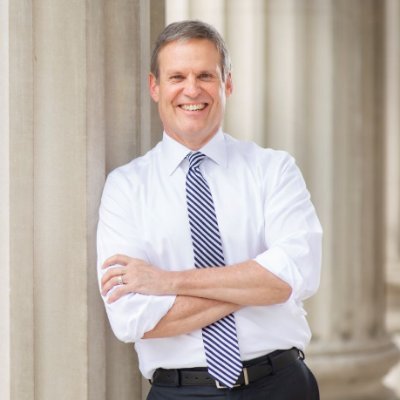
We owe it to Tennesseans to ensure our congressional districts accurately reflect the will of Tennessee voters.

English
Sam Singh retweetledi

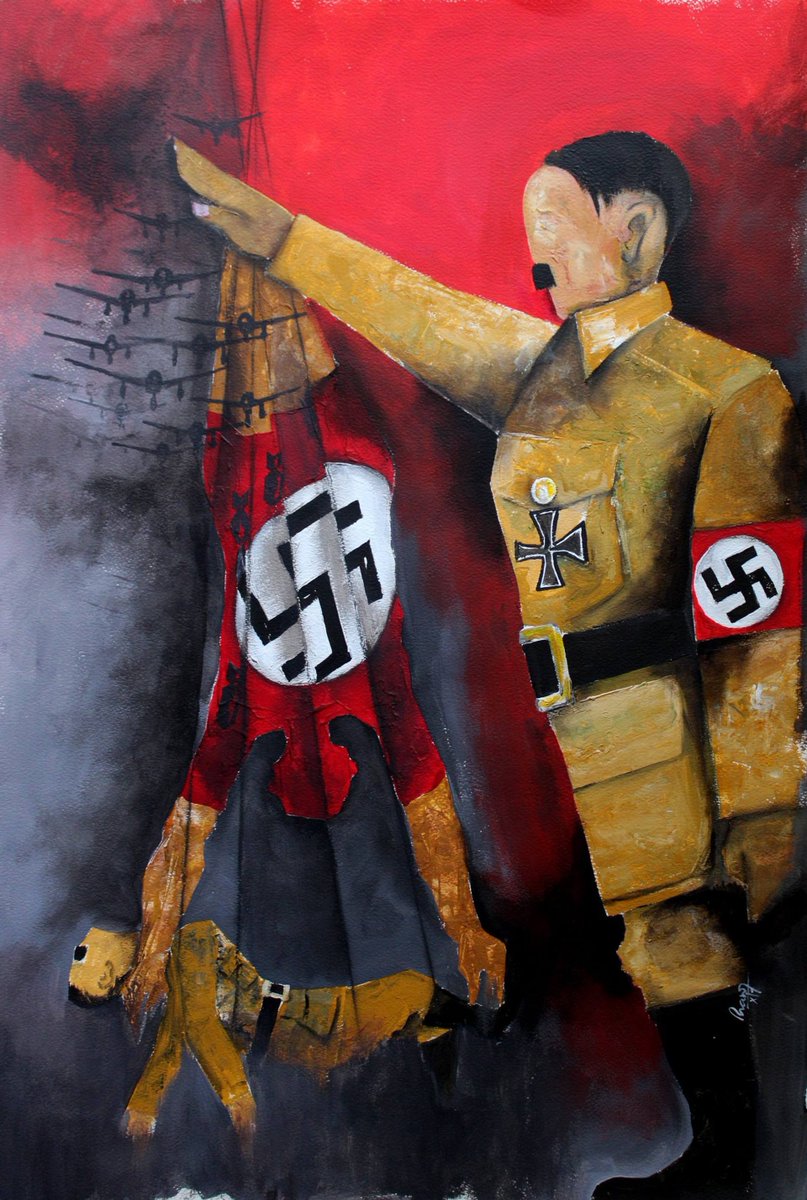
A fucking Nazi.
Graham Platner.
The “progressive” Marine vet, oyster farmer, and self-anointed “friend of the working Mainer” now frontrunning the Democratic Senate primary in Maine to primary Susan Collins.
He’s the guy the left is hailing as their populist savior...endorsed by the usual suspects, raking in millions from small-dollar donors who think they’re sticking it to the man.
But peel back the populist cosplay, and what do you find?
A walking, tattooed monument to the very evil they screech about 24/7.
This isn’t some vague “edgy” ink from his wild youth. In 2007, while a young Marine on leave in Croatia, Platner got hammered and chose a skull-and-crossbones design straight off the parlor wall.
Sounds innocuous?
Bullshit.
It was the Totenkopf...the literal Death’s Head.
The exact insignia of Heinrich Himmler’s SS-Totenkopfverbände, the paramilitary death squads that ran the Nazi concentration camps.
Auschwitz. Dachau. Treblinka.
Those grinning skulls weren’t “cool pirate vibes”...they were the official emblem stitched onto the collars of the men who industrialized genocide.
The guards who herded six million Jews and millions more “undesirables” into gas chambers, ovens, and mass graves while the 3rd SS Panzer Division “Totenkopf” carved a trail of war crimes across Europe.
This wasn’t some fringe symbol; it was the bureaucratic face of the Final Solution, chosen for its psychological terror:
a grinning memento mori for the machinery of extermination.
Platner claims ignorance.
“I didn’t know.” “Youthful mistake.” “Got it covered up now that reporters asked.”
Cute.
Except witnesses from a decade ago...2012, in a D.C. bar...recall him stripping off his shirt, pointing at the ink, and calling it “my Totenkopf” with a cutesy little smirk.
His own former political director flat-out said the man “knows damn well what it means.”
Deleted social posts and opposition research confirm he wasn’t some naive jarhead...he kept that SS calling card on his chest for 18 years, dancing shirtless in family videos, parading it like a badge of dark honor.
This isn’t pathology of a dumb kid; it’s the psychology of projection and denial wrapped in leftist armor.
Carl Jung would call it the shadow archetype devouring the ego:
the unconscious attraction to forbidden power symbols, rationalized away until the spotlight hits.
Arendt warned of the “banality of evil”...here it’s the banality of the modern left’s evil:
they don’t just tolerate it; they elevate it, because the tattoo fits their own totalitarian id while they gaslight the rest of us.
These are the same people who branded you a Nazi for wanting secure borders, school choice, or questioning endless wars.
Trump? Nazi.
MAGA hats? Swastikas.
Jan 6 tourists? Brownshirts.
Half the country gets doxxed, deplatformed, and destroyed for the sin of wrongthink.
Yet when one of their own wears the actual insignia of the SS death machine...the one that orchestrated the Holocaust...they shrug, cover it with some Celtic knot dog bullshit, and keep the campaign checks flowing.
“He’s not a secret Nazi,” Platner whines on podcasts.
No shit, Sherlock. He’s an open one who just got caught.
The left doesn’t call out real evil; it recruits it when it wears the right team jersey.
This is what happens when ideology eats history, psychology, and basic human decency alive.
The same crowd that lectures us on “punching Nazis” is running one for the U.S. Senate.
Ferocity demands we name it:
Platner isn’t a “flawed progressive.”
He’s a symptom of a movement so pathologically deranged by power that it will platform the Totenkopf itself if it polls well against Republicans.
The left doesn’t fight Nazis.
It becomes them...rebranded, tattooed, and smiling for the cameras.
💀🗡️
English
@SenWhitehouse You sir are a prime example of a CORRUPT LYING SACK OF SHIT!
English

Zeldin might play dumb when it comes to elementary math, but he’s raising your costs on purpose.
English