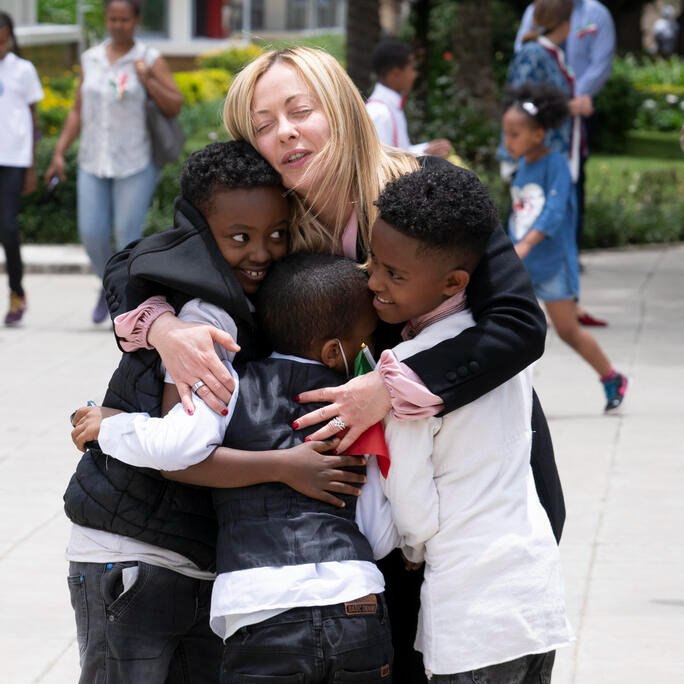
@matteosalvinimi Sei semplicemente un idiota. Un milione di persone pacifiche. Sei tu il primo problema dell'Italia. Vergognati.
Italiano
Martino Andrea Scarpolini
138 posts

@scarpma
Theoretical physicist. PhD student in fluid dynamics, bio-medical engineering and deep learning. I love tech, computer science, climbing and skiing. 🍂



OpenAI's GPT-4 details have apparently been leaked! Looks very detailed and I suspect it's the real deal - given all I know about how these systems work. Here is a summary (extractive+abstractive) I made based on the original thread (see bottom of the post) + some additional pointers from me. (Disclaimer there are probably errors here) ---ARCH--- * GPT-4 is more than 10x the size of GPT-3 (175 B). We believe it has a total of ~1.8 trillion parameters across 120 layers. Mixture Of Experts (16 experts, each ~111B). Not a dense transformer like e.g. PaLM (or GPT-3). They use MQA instead of MHA (classic at this point). * Each forward pass (generation of 1 token) only utilizes ~280B parameters and ~560 TFLOPs. This contrasts with the ~1.8 trillion parameters and ~3,700 TFLOP that would be required per forward pass of a purely dense model. ---DISTRIBUTED--- * To parallelize across all their A100s GPUs They utilized 8-way tensor parallelism. Beyond that, they are using 15-way pipeline parallelism. Also apparently they used DeepSpeed ZeRo Stage 1 or block-level FSDP. (You can check out my video on all of these strategies here: youtube.com/watch?v=hc0u4a… 3D parallelism is what you're looking for & ZeRo) ---VISION--- They have a separate vision encoder from the text encoder, with cross-attention. The architecture is similar to Google DeepMind's Flamingo (I used to work on this project :) ). This adds more parameters on top of the 1.8T of GPT-4. It is fine-tuned with another ~2 trillion tokens, after the text-only pre-training. ---DATA--- * Trained on ~13T tokens (multiple epochs, not unique). Plus millions of rows of instruction fine-tuning data from ScaleAI & internally (I guess acquired through ChatGPT + their API before they changed the policy). * 8k context length for the pre-training phase. The 32k seqlen version of GPT-4 is based on fine-tuning of the 8k after the pre-training. See e.g. MosaicML's blog on how to achieve this: github.com/mosaicml/llm-f…) ---COST--- * OpenAI’s training FLOPS for GPT-4 is ~2.15e25, on ~25,000 A100s for 90 to 100 days at about 32% to 36% MFU. Part of this extremely low utilization is due to an absurd number of failures requiring checkpoints that needed to be restarted from. If their cost in the cloud was about $1 per A100 hour, the training costs for this run alone would be about $63 million. (Today, the pre-training could be done with ~8,192 H100 in ~55 days for $21.5 million at $2 per H100 hour) ---INFERENCE--- OpenAI might be using speculative decoding on GPT-4's inference. See this paper: arxiv.org/abs/2211.17192 The inference runs on a cluster of 128 GPUs. There are multiple of these clusters in multiple datacenters in different locations (it'll be hard for Elizier to nuke these xD). 8-way tensor parallelism and 16-way pipeline parallelism. Original thread: archive.is/2RQ8X (strictly speaking the original one has been removed).








The science of global warming beautifully and simply explained by Dr. Carl Sagan, ca. 1985.