Spencer Dusebout

419 posts

Spencer Dusebout banner
Spencer Dusebout

Spencer Dusebout

@sdusebout

Building agents that drive measurable business outcomes. Founder, CPO @ Lendware. Multi-exit founder. Boulder

Katılım Nisan 2017
1.1K Takip Edilen2.9K Takipçiler
Spencer Dusebout
Spencer Dusebout@sdusebout·
@Chrisgpt Biggest difference for 5.5 vs 5.4 for me was not accuracy it's that it can run a true loop and just keep going. 5.4 I had to use like watchdogs, etc.
English
0
0
0
216
Chris
Chris@Chrisgpt·
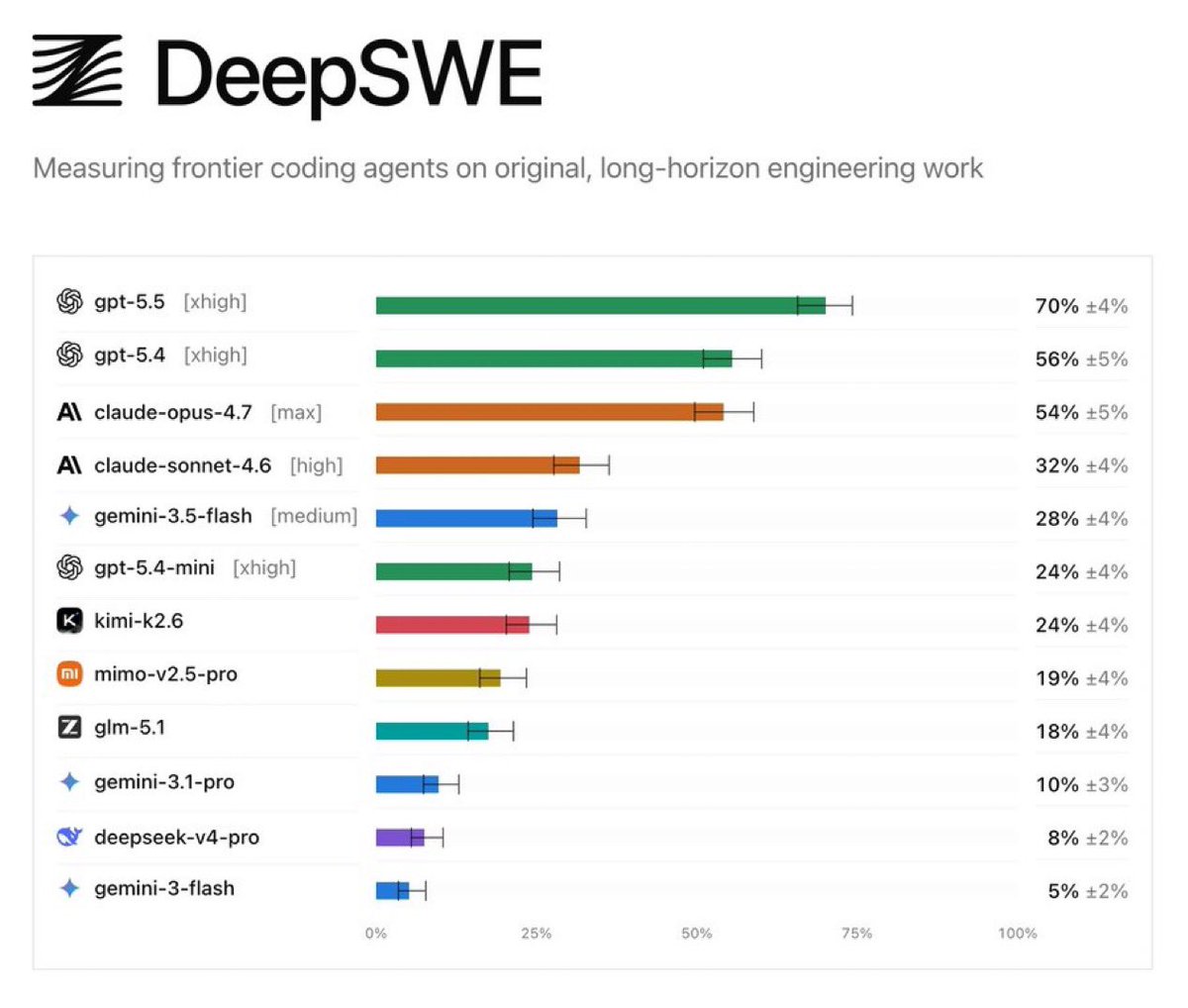
wait a minute 💀 they made a benchmark to test whether coding agents can handle real long horizon engineering work - repo understanding, multi file edits, tool use, debugging loops, test feedback, and keeping the system coherent across the whole task and GPT 5.5 is already at 70% LMAO (OpenAI already has an internally better model btw) if this isn’t a sign of acceleration, I don’t know what is
Chris tweet media
Serena Ge (Datacurve)@serenaa_ge

Today we’re releasing DeepSWE, a new standard for agentic coding benchmarks. On public leaderboards, top models often look relatively close in capability. DeepSWE shows where they actually diverge, reflecting the realistic experience of developers in their day-to-day work.

English
11
5
102
7.9K
Spencer Dusebout
Spencer Dusebout@sdusebout·
@rohanpaul_ai Models not even close to reliably producing great outcomes at scale. Even if that happens, enterprises will take long time to adopt. And even if that happens human + model collaboration will likely produce stronger outputs. So, yea lot of assumptions from doomers...
English
1
0
0
163
Rohan Paul
Rohan Paul@rohanpaul_ai·
wionews: OpenAI CEO Sam Altman now says the feared AI white-collar job collapse has not arrived as fast as he expected. Altman previously warned that routine office work, especially entry-level tasks, could be hit hard because of AI. His new view is that work is bending before it breaks, because companies still need humans for judgment, trust, taste, emotional reading, and messy communication where the right answer depends on context. --- wionews .com/trending/delighted-to-be-wrong-sam-altman-says-ai-may-not-trigger-feared-white-collar-job-apocalypse-1779801560534
Rohan Paul tweet media
English
15
7
55
5.3K
Spencer Dusebout
Spencer Dusebout@sdusebout·
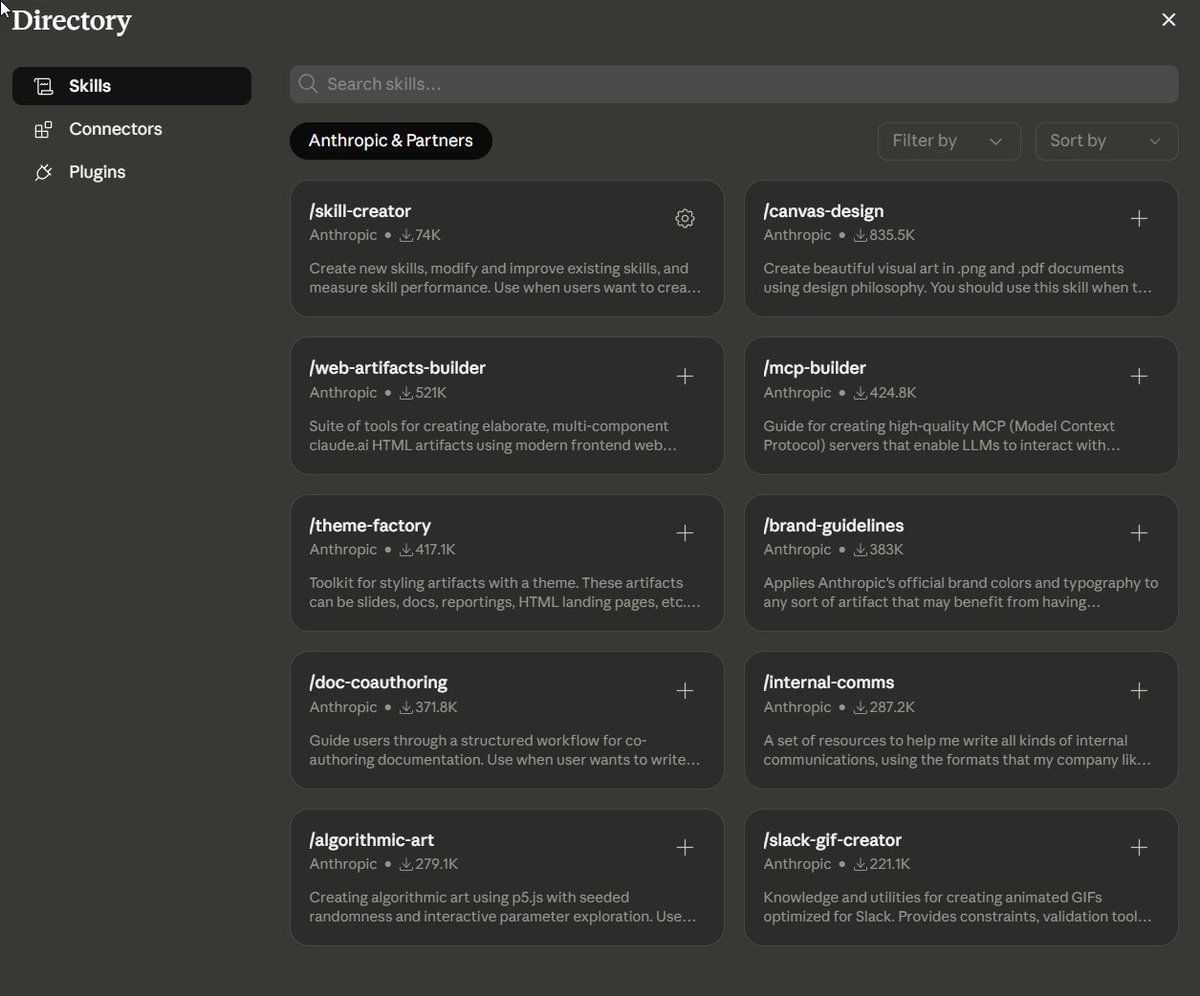
@emollick Yea requires a lot of discovery and trial and error on the users part. Wouldn't think it's that hard to fix this
English
0
0
0
238
Ethan Mollick
Ethan Mollick@emollick·
An annoyance with Claude right now is that changes to the interface are badly documented, resulting in frustrating dead ends. For example, learning mode is migrating to a skill. Where is that skill? The linked article does not mention it (and the skill doesn't seem available!)
Ethan Mollick tweet mediaEthan Mollick tweet media
English
16
5
139
11.4K
Spencer Dusebout
Spencer Dusebout@sdusebout·
@agazdecki ... and realizing they are getting crushed by incumbents with worse products. Pain has to be real enough to get people to move or adopt something new
English
0
0
1
34
Andrew Gazdecki
Andrew Gazdecki@agazdecki·
Founders finding out building a startup is 90% sales and marketing:
English
15
6
43
4K
Surendar
Surendar@Surendar__05·
looking forward to connect people on X if you're into - building SaaS - fullstack developers - vibe coding - AI tools - shipping in public - figuring it out as you go - being a corporate professional say Hi or drop what you're working on looking to follow active ones 🙌🏻
English
36
1
29
804
Yuchen Jin
Yuchen Jin@Yuchenj_UW·
I challenge everyone to code by hand for 8+ hours a day for a week: 1. no coding agents: Claude Code, Codex, Cursor 2. no GPT/Claude, or any AI model If you survive, you are a true warrior.
English
94
8
238
12K
Spencer Dusebout
Spencer Dusebout@sdusebout·
Vibe coders show you the AI that worked once. They never show you the AI two weeks later when their users have quietly stopped using it. We're all building investor expectations on a heavily-filtered sample. The startup ecosystem in 2026 has a visibility problem. The thing that goes viral is the AI demo that works — the impressive first-use moment, captured and shared. The thing that doesn't go viral is the production reality two weeks later: drift, patches, silent abandonment. We're building roadmaps and valuations on a sample biased toward magic. The companies that will actually compound are the ones treating Day 1 as the easiest day, not the proof point.
English
0
0
0
12
Spencer Dusebout
Spencer Dusebout@sdusebout·
@rohanpaul_ai Deterministic gates and infrastructure 100% increase the reliability of probabilistic systems
English
0
0
0
353
Rohan Paul
Rohan Paul@rohanpaul_ai·
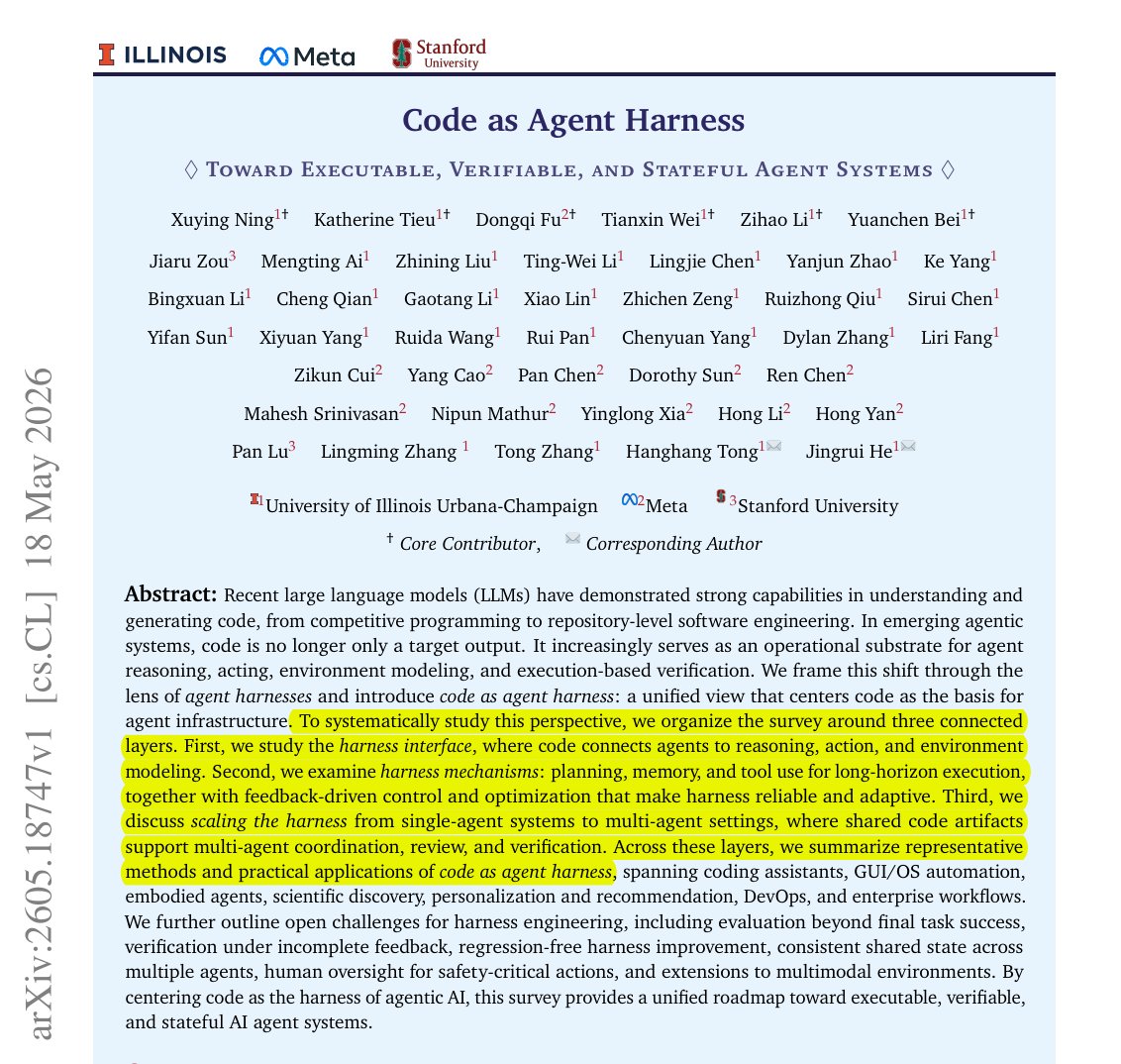
This Meta + Stanford + Illinois survey paper argues that AI agents work better when code becomes their main working layer. The problem is that an LLM by itself is mostly a text predictor, so long tasks can lose state, hide mistakes, and turn plans into actions in fragile ways. The real advance is not “AI writes code,” but “AI uses code as the environment it thinks inside.” The authors call the surrounding system an agent harness, meaning the tools, memory, sandboxes, checks, and feedback loops that turn a model into an agent. Their core idea is that code should sit at the center of that harness, because code can be run, inspected, checked, saved, edited, and shared. Tests become sensors. Repositories become memory. Logs become history. Sandboxes become boundaries. A generated script is no longer merely an answer; it is a handle the system can run, check, revise, share, and roll back. The main finding is a pattern across many fields: code helps agents reason through executable steps, act through tool calls or control programs, and model environments through tests, traces, logs, repositories, and simulators. ---- Paper Link – arxiv. org/abs/2605.18747 Paper Title: "Code as Agent Harness"
Rohan Paul tweet media
English
18
41
150
8.6K
Spencer Dusebout
Spencer Dusebout@sdusebout·
@aaron_epstein People are ignoring that AI leads to amazing outcomes, but AI / the model is not the outcome itself. Open source is also getting stronger. It is not checkmate yet IMO.
English
1
0
3
410
Aaron Epstein
Aaron Epstein@aaron_epstein·
Every generation has a company that seems inevitable. Microsoft in the 90s. Google in the 2000s. Facebook in the 2010s. Anthropic/OpenAI now. It always feels like it's different this time. It never is. Startups always find a way.
English
65
29
654
50.9K
Spencer Dusebout
Spencer Dusebout@sdusebout·
@EXM7777 Curious if it's at the point where it doesn't require a ton of handholding per video and it can be systemized.
English
0
0
0
122
Machina
Machina@EXM7777·
this is the current meta for generating insane videos with AI: first you need an orchestrator, i've tested: > Gemini 3.5 Flash: strongest creative direction, feels like it has "taste" > Claude Sonnet 4.6: requires some solid prompting > Gemini 3: solid but visually behind imo then you need Seedance 2.0, it's just a beast at rendering whatever you have in mind AI agents are exceptional at planning, finding the right model, doing the research and producing videos from just a simple prompt you can build your own system, but requires a lot of tweaking to consistently get great results Higgsfield supercomputer is probably the easiest option (and it's built on top of Hermes)
English
18
5
107
7.7K
Spencer Dusebout
Spencer Dusebout@sdusebout·
@mux4_23 @KaiXCreator No glaring security holes. Understanding of preview / staging environments, test strategy, qa so you don't ship bugs when you have live users. Rate limiting. Ideally some sort of reusability to the architecture, but may not be 100% necessary to get to 1M
English
0
0
1
20
Kaito
Kaito@KaiXCreator·
Is it possible to vibe-code a legit $1M SaaS?
English
72
0
60
7.7K
Spencer Dusebout
Spencer Dusebout@sdusebout·
@mik3fly__ @KaiXCreator For a high velocity PLG motion 100% yes. For a mid - higher price point not really - just need disciplined outreach and ability to sell.
English
0
0
0
17
Spencer Dusebout
Spencer Dusebout@sdusebout·
The most valuable engineer I ever hired cost $3K a month. The least valuable cost $200K. AI just made this gap impossible to ignore — and impossible to fix with more hiring. When AI is the multiplier, raw talent becomes the bottleneck. You can't compensate for talent gaps by adding headcount anymore — every additional mid-tier hire is just more noise for the star to process. The next generation of great companies will be built by 5–10 people, paid like athletes, optimized for output per individual rather than total headcount.
English
0
0
0
30
Spencer Dusebout
Spencer Dusebout@sdusebout·
@brooksjordan @every 100% agree - and it takes a lot of human agent collaboration to build a system that works repeatedly - not just a one off solution.
English
0
0
1
34
brooks
brooks@brooksjordan·
This is 100% my experience. There is agent automation, which is powerful, but there is also human-agent collaboration, if you want the work to be great: From @every “You might already see, in the midst of all of this automation, where the humans come in. In every example, the agent needs a human in order for the work to, well, work. “Someone has to point it at the right thing, decide whether the output is good, catch the places where it is wrong, and turn the result into a real-life decision or process.” I agree! Say I have four to five agents doing substantial pieces of work and often multiple sub-agents working for those primary agents A human is necessary because knowledge isn’t understanding, which is priceless I know in my heart of hearts that if I hadn’t asked critical questions at the right point or applied higher understanding to an architecture or caught details about stale thinking or code, I would start to get slop The question is can you automate even aspects of that human-agent collaboration? This could be done with better planning and priorities, having agents review another’s work via MCP, putting eyes on it at different points in the process, using better models and harnesses, etc. It will evolve but it’s amazingly helpful to have @danshipper and the Every team call out how their humans are skillfully working with agents today when understanding and decisions are required
Dan Shipper 📧@danshipper

We’ve automated every single thing we can @every with AI agents. And yet there’s way more human work to do than ever. We’ve gone from 4 -> 30 human employees since GPT-3. I wrote a report on the structural reasons: how AI makes expert competence cheap, why that drives up demand for experts, and why the dynamic only intensifies as we approach AGI. After Automation: every.to/p/after-automa…

English
2
1
9
3.9K
Spencer Dusebout
Spencer Dusebout@sdusebout·
@gregisenberg Great post. Key is talking to 10 people, instead of just letting claude tell you are a genius and building without verifying.
English
0
0
0
84
GREG ISENBERG
GREG ISENBERG@gregisenberg·
How to build a vertical AI agent cash-flowing startup: find painful workflow in a boring industry → talk to 10 people who do that workflow every day → map every step, every tool, every spreadsheet, every phone call → do the workflow manually first → be the agent before you build the agent → find the edge cases that break everything → document them in obsidian as structured markdown → set up your agent stack → hermes for the harness → obsidian vault as the knowledge base → composio for authentication across apps → build your first 1-3 skills that solve the core pain → use claude code or codex to build the product → use agents to set up other agents → use perplexity MCP and context7 for up-to-date docs → let the agent handle the scaffolding while you focus on the workflow logic → ship the agent to your first 5 customers for free → watch what they actually use it for → they will surprise you → the thing you built for isn't always the thing they need most → build content around the niche → not "building in public" content → useful content → the tips, the shortcuts, the pain points that only someone who does this workflow would know → become the person for that niche → charge per outcome not per seat → per lease renewed, per claim processed, per candidate sourced → the ROI conversation takes 10 seconds when it's tied to a result → set up watchdogs and alerts → your agent emails you when a cron job breaks or a skill fails → the customer should never have to tell you something is broken → connect to open router → see exact costs per model per task → use GPT 5.5 for tool calls → use open source for lightweight tasks → route the right model to the right job → watch your margins double → let hermes write to its own memory after every task → the agent compounds → the longer it runs the better it gets → that accumulated memory becomes your moat → a competitor can clone your product but they can't clone 6 months of context → expand the workflow → you started with one step → add the next → then the next → now you own the entire workflow end to end → you went from a tool to the operating system for that vertical → stack the agents → one agent is a side project → five agents across five customers is a business → each one runs in its own environment → you check in once a day → raise only if you need capital not credibility → most agent businesses should never raise → the margins are too good to give away equity → stay lean → stay profitable → repeat i'm rooting for you
English
136
107
1.2K
99.7K
Chris Maconi
Chris Maconi@chrismaconi·
I hate to say it, but Zeb really had no choice here. You see ClickUp has no moat, and is actually in the process of being disrupted (like most midsize SaaS company's like his). The reality is his solution is fairly easily replaced by internally built solutions that are way more tailored to a given businesses vertical and business. While his numbers may look really strong now, he knows what is coming, because he probably sees evidence of it every day, like I do. Any average Joe can easily spin up their own project management platform with Claude Code, and many are. In fact at Hechura, we've built our own project management platform into our internal software factory platform, Noreaster. This also means enterprising individuals can easily spin up highly vertical project management platforms to compete with his product, and they are. It seems like every day a new product is launched in this category, and they are being launched by experts in their particular vertical industry. Hard for ClickUp to compete. And so, the layoffs. Zeb is reckoning with the reality that today's economics are not going to be tomorrow's economics for his business. If he does nothing, his business is likely to fail, and that isn't hyperbole. It is just the honest truth. SaaS founders like Zeb are going to have to make this same decision, and the smartest among them will understand that regardless of how strong their performance appears today, the game has completely changed underneath them, and tomorrow's performance is no longer guaranteed. Not by a long shot. As a founder / business leader, you must be honest about these changes in the game, and not be afraid to pivot accordingly.
Zeb Evans@DJ_CURFEW

Today we reduced headcount by 22%. The business is the strongest it's ever been. So I think it's important to be direct about what I'm seeing and why. First, I made this decision and I own it. I did it because the way to operate at the highest level of productivity is changing, and to win the future, ClickUp needs to change with it. Second, this wasn't about cutting costs. Most savings from this change will flow directly back into the people who stay. We'll be introducing million-dollar salary bands. If you create outsized impact using AI, you'll be paid outside of traditional bands. Most importantly, I have the deepest gratitude for those affected. We're doing this from a position of strength specifically so we can take care of people properly. Everyone affected receives a package aimed at honoring their contributions and easing the transition. I only see two options: wait for this to play out gradually in the market or be honest about what I'm seeing and act proactively. THE 100X ORGANIZATION The primary change is that we're restructuring around what I call 100x org. The goal is 100x output. The roles required to build at the highest level are fundamentally different than they were a year ago. Incremental improvements to existing systems won't get us there. We need new ones. That means creating enough disruption to rebuild rather than iterate on what's already broken. The common narrative is that AI makes everyone more productive. It doesn't. Many of the workflows of today, if left unchanged, create bottlenecks in AI systems. These roles will evolve. But waiting for that to happen naturally means falling behind now. The 100x org is actually heavily dependent on people - infinitely more than today. This is only possible with 10x people that have embraced and adopted new ways of working. THE BUILDERS, AGENT MANAGERS, AND FRONT-LINERS — THE BUILDERS: 10X ENGINEERS I don't think most companies have internalized what's actually happening with AI in engineering. The common narrative is that AI makes all engineers more productive. That may be true in isolation, but at an organization level - that is the farthest thing from reality. Here's what we've validated recently at ClickUp: the great engineers, the ones who can orchestrate, architect, and review, are becoming 100x engineers. They're not writing code. They're directing agents that write code. The skill is judgment. AI makes the best engineers wildly more productive, and everyone else using AI slows these engineers down. Think about it - the bottlenecks are (1) orchestration - telling AI what to do, and (2) reviewing - what AI did. Everything is leapfrogged and no longer needed. So who do you want orchestrating and reviewing code? And how do you want your best engineers to spend their time? If your best engineers are spending time reviewing other people's code, then this is inherently an inefficient bottleneck. These engineers can review their agent's code much faster than reviewing human code. The new world is about enabling your 10x engineers to become 100x. The wrong strategy is to push every engineer to use infinite tokens. Companies doing this are celebrating 500% more pull requests. But customer outcomes don't match the volume of code being generated. I call this the great reckoning of AI coding, and every company will face this soon if not already. More code is just another bottleneck to the best engineers, and ultimately to your company's impact as well. — THE BUILDERS: 10X PRODUCT MANAGERS Product management and design roles are merging. Designers that have customer focus, become more like product managers. And product managers that have intuition for UX become more like designers. The bottleneck of user research is gone. It takes us just one mention of an agent to kickoff research and analyze results. The bottleneck of product <> design iteration is also gone. The product builder iterates on their own, along with agents and skills that ensure alignment with quality and strategy. Also controversial today - I believe that the wrong strategy is to have your PMs shipping code - that just introduces another bottleneck that the best engineers will waste their time on. To be clear, PMs should be coding but they should do this in a playground to iterate, validate, and scope. That code should not go to production. Everything outside of managing systems, orchestrating AI, and reviewing output becomes a bottleneck. That's why the other roles that are critical along with these are the systems managers (to reduce bottlenecks) along with a bottleneck you can't replace - customer meeting time. — THE SYSTEM MANAGERS Ironically, the people that automate their jobs with AI will always have a job. They become owners of the AI systems - agent managers. We have many examples of these people at ClickUp. The underlying systems in which we operate are absolutely critical to get right. I think most companies are delusional to think they can iterate on existing systems and compete in this new world. You must create enough disruption so that old systems are deprecated entirely. If there's any definition for 'AI native' that's what it is. — THE FRONT-LINERS In a world that will become saturated with AI communication, the human touch will matter more than anything to customers. This is a bottleneck that you shouldn't replace - even when agents are high enough quality to do video meetings. One-on-one meeting time with customers is something that shouldn't be automated. The systems around the meetings should be - so that front-liners spend nearly 100% of their time with customers. REWARDING 100X IMPACT In a world where companies are able to do so much more with less, where does that excess money go? In our case, much of the savings in this new operating model will flow directly back to those that enabled it. We must reward people that create productivity accordingly. This aligns incentives on both sides. Plus, in a world where your best people create 100x impact, you can't afford to lose them. You should aim to retain these employees for decades. The context they have and their ability to efficiently orchestrate and review will be nearly impossible to replace. Compensation bands of today should be thrown out the door. We're introducing $1 million cash/year salary bands with a path available to nearly everyone in the company if they produce 100x impact by creating or managing AI systems. THE FUTURE Nearly every company will make changes like these. The ones that do it proactively will define what comes next. The future is not fewer people. It's different work, new roles, and better rewards for those who embrace it. We're already seeing entirely new roles emerge, like Agent Managers, that didn't exist a year ago. ClickUp is positioning to lead this shift, not just internally, but for our customers too. I've never been more certain about where we're headed.

English
23
3
62
29.9K
Spencer Dusebout
Spencer Dusebout@sdusebout·
Knowledge work has been an assembly line for 50 years. You didn't invent the app, write the requirements, design the UI, or set the roadmap. AI doesn't end this — it just changes who runs the line. The engineer codes inside a system someone else designed. The PM ships inside a plan someone else approved. The AE sells a product someone else invented. This isn't dystopia — it's how scale works. AI doesn't free anyone from the assembly line. It makes the line-runners 10x more valuable, and asks everyone else to either become a line-runner or get more productive on the line.
English
0
0
0
18
Spencer Dusebout
Spencer Dusebout@sdusebout·
@jeremyphoward Yea, the weird failure mode is when a model feels smart but not useful. Speed matters less if I have to keep steering it back to the actual job.
English
0
0
0
95
Jeremy Howard
Jeremy Howard@jeremyphoward·
Gemini Flash 3.5 is such a disappointing model. It's intelligence and speed is awesome. Absolutely amazing. But it's been trained to max evals, not to be helpful to humans. It goes off and does random crap "for me" rather than just doing what I asked.
English
126
51
1.5K
96.5K