brooks

11.9K posts

brooks banner
brooks

brooks

@brooksjordan

I architect, the agents build

37.7989° N, 122.4662° W Katılım Mayıs 2007
439 Takip Edilen834 Takipçiler
brooks
brooks@brooksjordan·
“The frontier model companies are hungry for usage data from the field. They can see API calls and token counts. They can't see the actual workflows. “If you're deep in a niche using these models in ways the model companies haven't seen, that understanding is incredibly valuable.”
GREG ISENBERG@gregisenberg

I just got back from SF and I FEEL INSPIRED. I spent 5 days with frontier AI model teams, AI startup founders, and 3 billionaires. My takeaways: 1. I had lunch with 3 billionaires. All of them are buying SaaS companies and rebuilding them agent-first. They were deeply inspired by Bending Spoons and Ryan Cohen's eBay deal. Buy the company, cut the headcount, rebuild the tech, add agents, add features, make more valuable experience, raise prices. 2. The frontier model companies are hungry for usage data from the field. They can see API calls and token counts. They can't see the actual workflows. If you're deep in a niche using these models in ways the model companies haven't seen, that understanding is incredibly valuable. Usage intelligence is the new alpha. 3. Consumer AI is massively underbuilt. Every billboard in SF is either B2B inference infrastructure or vertical agent companies. The entire city is optimized for enterprise. Meanwhile you have companies like Cal AI doing $50M ARR in 18 months as a consumer app. I met with a cool few teams doing consumer AI (@paulscherer / @ekuyda) 4. MCP came up in literally every conversation. The companies exposing their product as MCP endpoints are getting pulled into deals they never pitched for. The ones that aren't are becoming invisible to agents. This is the new SEO. If agents can't find you, you don't exist. Building products for agents is the new zeitgeist in general. 5. Not uncommon for hot seed rounds to be $25-50 million valuations. I saw a Series A at $450 million 6. If I had a dollar every time someone mentioned "forward-deployed engineer" this trip I could have funded a seed round. It's the hottest role in SF right now. The person who sits between the agent and the customer, making sure everything actually works. 7. The mood around open source shifted. A year ago it felt like open source was chasing the frontier models. Now founders are telling me Gemma and DeepSeek are good enough for 80% of what they need at a fraction of the cost. The "which model do you use" conversation is being replaced by "which model for which task." Model loyalty kinda feels dead. 8. Voice agents came up more than I expected. Multiple founders told me voice is the interface for the next billion users. The billion people who will never type a prompt will absolutely talk to one. 9. The Obsidian community in SF is weirdly intense. Multiple founders showed me their vaults unprompted. Like showing someone your home gym. It's a flex now. The quality of your knowledge base (second brain?) is becoming a status symbol among builders. 10. Maybe it was just the people I met but the age of the founders is shifting. I met more founders over 40 this trip than any trip before and more founders under age 21 than ever before. Founders getting older and younger at the same time. 11. I spoke to a lot of fast-growing startups, VCs and frontier models who are hiring content creators right now. 12. The restaurant scene in SF is actually better than it's been in years. Founders are going out more. Alcohol is out, not surprisingly. 13. SF doesn't feel like the only place anymore. We all have access to the same frontier models. We all read the same X feed. A founder in NYC or Lagos is calling the same APIs as a founder in SoMa. So in the past it felt like SF was always lightyears ahead, doesn't feel that way anymore. It's okay not to live in SF and have BIG DREAMS. 14. The coworking spaces in SF are half empty but the coffee shops are packed. People want to be around people. I had a few startup ideas here.... 15. Walking around the Mission I noticed something: the street-level businesses, the taquerias, the barbershops, the laundromats, none of them use any AI at all. 16. I heard the phrase "agent debt" for the first time. Like technical debt but for agents. When you hack together an agent workflow fast and never clean it up, the system prompts conflict, the memory gets polluted, the tools overlap. 6 months later the agent is doing weird things and nobody knows why lol. 17. Met a few people who carry two phones now. One for personal. One that's basically an agent terminal running Telegram or iMessage connections to their agent fleet. It's always amazing to get that dose of inspiration in SF. I FEEL INSPIRED. But I'm so happy to be back home, locked in and building. We're 12-18 months into a shift that will take 15 years to play out. The urgency in every conversation was real. What an incredible time to be building.

English
0
0
1
35
brooks retweetledi
Naval
Naval@naval·
The new competition isn’t Humans vs AI. It’s Humans with AI vs everyone else.
English
911
1.6K
12.7K
406.8K
brooks
brooks@brooksjordan·
I’m the guy who needed to read Jason’s post today: “It’s hard to live with something that isn’t quite right yet – especially when it’s your job to get it right.”
Jason Fried@jasonfried

Faith in eventually. Making something new takes patience. But it also takes faith. Faith that everything will work out in the end. During the development of most any product, there are always times when things aren’t quite right. Times when you feel like you may be going backwards a bit. Times where it’s almost there, but you can’t yet figure out why it isn’t. Times when you hate the thing today that you loved yesterday. Times when what you had in your head isn’t quite what you’re seeing in front of you. Yet. That’s when you need to have faith. There are designs that are close, but not there yet. There are obvious conflicts that will need to be resolved. There are lingering things that confound you, confuse you, or upset you, but you know that eventually they’ll work themselves out. Eventually you’ll find the right way to do something you’ve been struggling with. It’s hard to live with something that isn’t quite right yet – especially when it’s your job to get it right. It’s important to know when to say “it’s fine for now, but it won’t be fine for later.” Because moving forward is critical to getting somewhere. And, eventually, you’ll figure it all out. It’ll all work out in the end. This is what I’ve always believed, and have always tried to practice. A dedicated faith in the eventual resolution of a problem, the eventual execution of a concept, and the eventual realization of the right design. Even when something’s poking out you don’t like, or something isn’t aligning quite right, or the words aren’t as elegant as you’d hoped, or something just isn’t easy enough yet, you need to have confidence it’ll all come together eventually. Remember that what you’re making is in a perpetual state of almost right up until the end. And it's never right even after. In the meantime, you just press on and keep making things, trying things, and getting closer and closer to the time when you can tie the loose ends into a perfect bow and present it to the world. What fun it is!

English
0
0
0
73
brooks
brooks@brooksjordan·
This is 100% my experience. There is agent automation, which is powerful, but there is also human-agent collaboration, if you want the work to be great: From @every “You might already see, in the midst of all of this automation, where the humans come in. In every example, the agent needs a human in order for the work to, well, work. “Someone has to point it at the right thing, decide whether the output is good, catch the places where it is wrong, and turn the result into a real-life decision or process.” I agree! Say I have four to five agents doing substantial pieces of work and often multiple sub-agents working for those primary agents A human is necessary because knowledge isn’t understanding, which is priceless I know in my heart of hearts that if I hadn’t asked critical questions at the right point or applied higher understanding to an architecture or caught details about stale thinking or code, I would start to get slop The question is can you automate even aspects of that human-agent collaboration? This could be done with better planning and priorities, having agents review another’s work via MCP, putting eyes on it at different points in the process, using better models and harnesses, etc. It will evolve but it’s amazingly helpful to have @danshipper and the Every team call out how their humans are skillfully working with agents today when understanding and decisions are required
Dan Shipper 📧@danshipper

We’ve automated every single thing we can @every with AI agents. And yet there’s way more human work to do than ever. We’ve gone from 4 -> 30 human employees since GPT-3. I wrote a report on the structural reasons: how AI makes expert competence cheap, why that drives up demand for experts, and why the dynamic only intensifies as we approach AGI. After Automation: every.to/p/after-automa…

English
2
1
9
4K
Dan Shipper 📧
Dan Shipper 📧@danshipper·
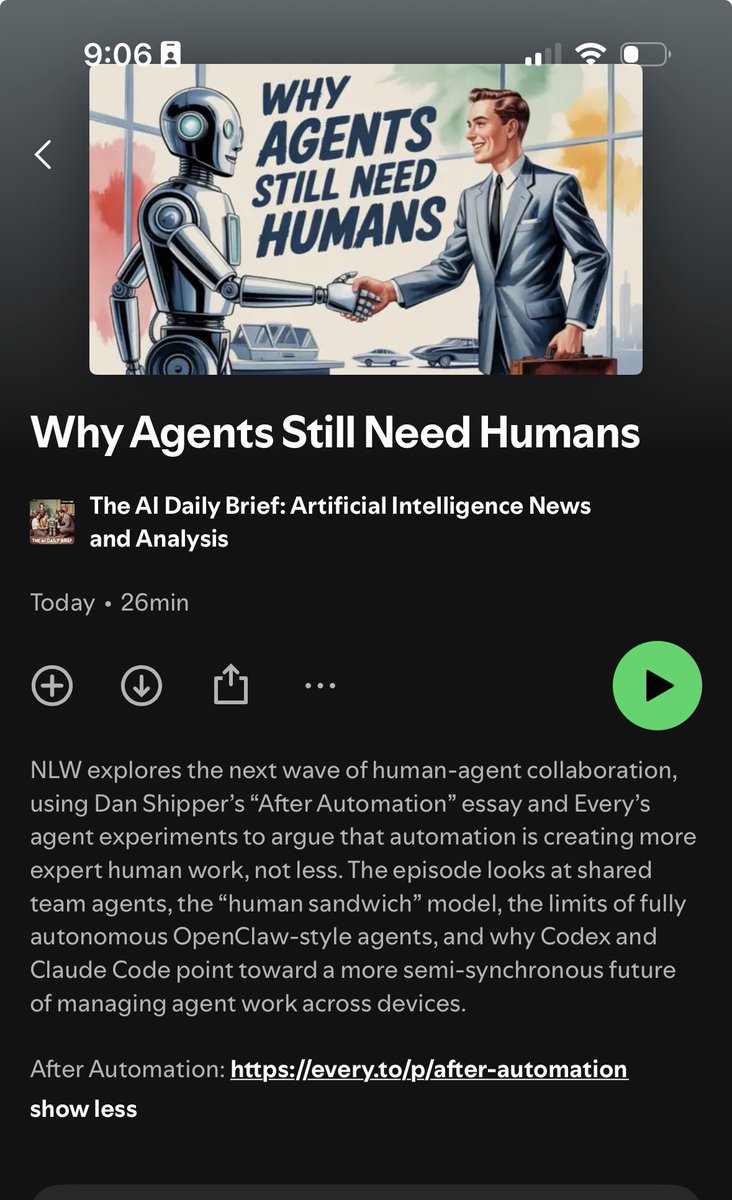
Fantastic breakdown of After Automation in today’s AI Daily Brief Thanks for such a thoughtful episode @nlw!
Dan Shipper 📧 tweet media
English
5
5
59
5.7K
Josh Wolfe
Josh Wolfe@wolfejosh·
2/ and reality...😂
Josh Wolfe tweet media
English
6
2
40
15.6K
Josh Wolfe
Josh Wolfe@wolfejosh·
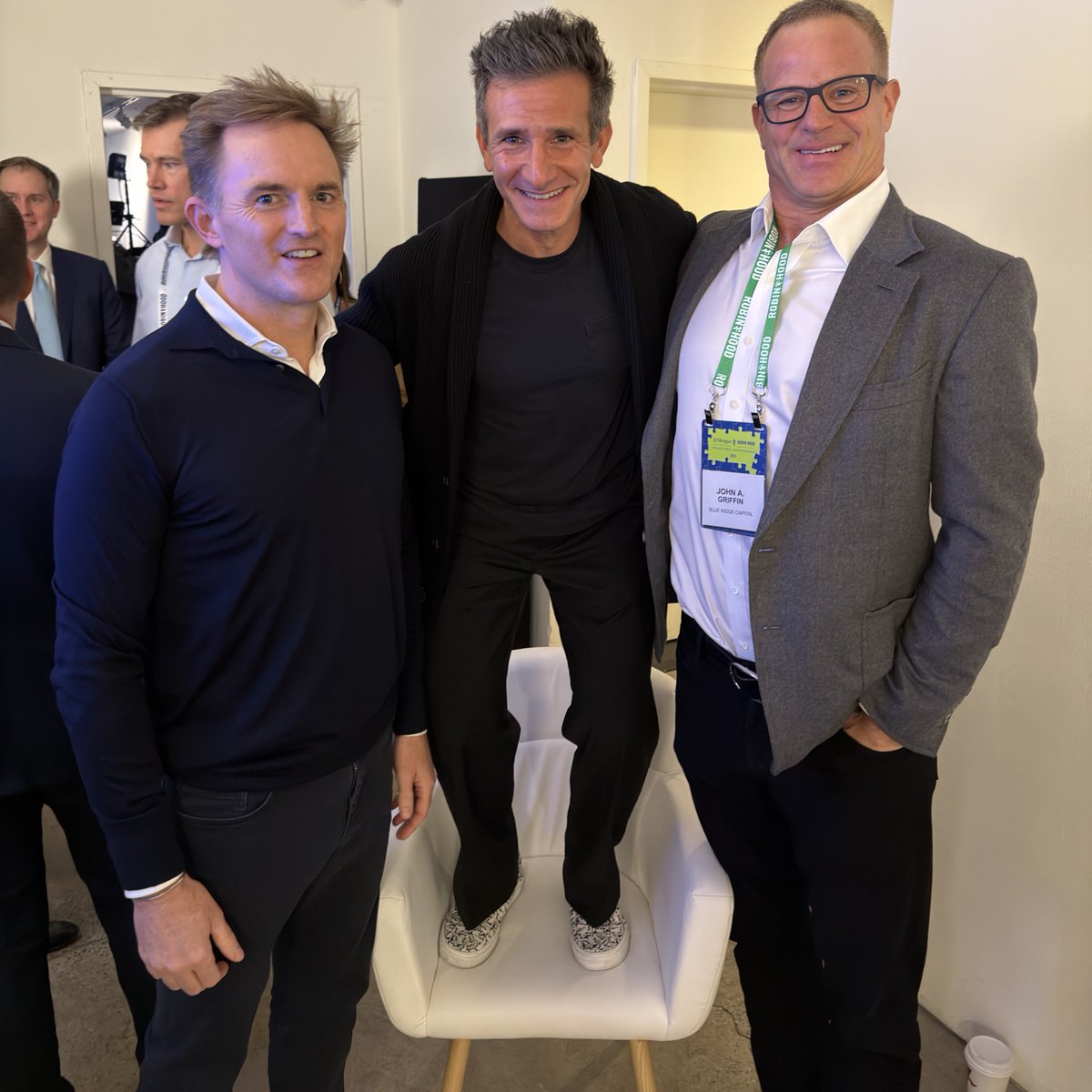
1/ Continuing my series of commanding heights of capital... Chase Coleman (Tiger Global)+ Josh Wolfe (Lux) + John Griffin (Blue Ridge)
Josh Wolfe tweet media
English
3
1
96
92.3K
brooks retweetledi
François Chollet
François Chollet@fchollet·
If you can learn one thing that's genuinely novel to you, you can learn anything.
English
80
84
1.2K
55.5K
brooks retweetledi
Dean W. Ball
Dean W. Ball@deanwball·
“We are standing in the foothills of the singularity,” says Demis at I/O. A beautiful turn of phrase.
English
18
35
577
22.5K
brooks retweetledi
Azeem Azhar
Azeem Azhar@azeem·
Met a dozen AI labs in China ten days ago. The vibe is much less nihilist and aggressive than the US one
Ejaaz@cryptopunk7213

anthropic just publicly committed to a deadline for transformative AI (AGI): 2028 and this matters in the race against china in AI (for good reason): > if AGI is built in <24 months then its essential adversaries don't get access to it (first). we're seeing a mini version of this play out with the government restriction on mythos (no public release). > china themselves admit USA is #1 for now: "China is still sharpening our swords while the other side has suddenly mounted a fully automatic Gatling gun." -chinese cybersecurity analyst on mythos. you might call bullshit on this but yesterday's security test report from Logan suggests they're right. > anthropic dismisses deepseek's claim they've found a workaround to building frontier models with less compute: everything about ai advancement (model intelligence, research, algorithms) sit DOWNSTREAM of compute the models are now building themselves. the winners are whoever has more compute (gpus in this case) and thats the USA. huawei's entire compute capacity this year is only 4% of nvidia's entire compute. good food for thought imo

English
3
3
17
3.7K
brooks
brooks@brooksjordan·
@Teknium Yess, using this codex runtime agent under a Hermes agent that’s using 5.5
English
0
0
1
49
brooks
brooks@brooksjordan·
@Saboo_Shubham_ I've set this up, works great, thanks for the guide Shubham
English
1
0
1
132
Shubham Saboo
Shubham Saboo@Saboo_Shubham_·
Codex /goal builds it. Claude Code /goal review and refines it. Hermes /goal manages the orchestration and handoff. All tracked on a single Kanban Board and agents keep running in the loop.
English
59
49
853
90.2K
brooks retweetledi
Ethan Mollick
Ethan Mollick@emollick·
Everyone has seen the @waitbutwhy cartoon of AI capability growth with a "you are here" indicator just before the exponential really starts, but the independent assessments of both METR and the UK's AISA do seem to show that we are past that point now (until we hit a slowdown?)
Ethan Mollick tweet mediaEthan Mollick tweet mediaEthan Mollick tweet media
English
49
44
544
47.7K