Sean O'Brien

22 posts

Sean O'Brien

Sean O'Brien

@seano_research

UCSD PhD student studying LLMs Ex-Meta AI, Berkeley AI Research

Katılım Ağustos 2023
126 Takip Edilen110 Takipçiler
Sean O'Brien retweetledi
Juliette Decugis @ ICML🇰🇷
Juliette Decugis @ ICML🇰🇷@DecugisJuliette·
What advantage to use, and when? Everyone's proposing new advantage functions for RL with LLMs but nobody knows why they work or fail. We break this down and build FADE a self-adapting advantage to get +14% on LiveCodeBench v6 in 40% less steps. Paper: arxiv.org/pdf/2607.01490
GIF
English
4
29
99
9.5K
Sean O'Brien
Sean O'Brien@seano_research·
@jiqizhixin This looks quite similar to the off-policy setup of Any-Reward Generation Optimization (AGRO), just with a drifting reference policy. Might be worth referencing. arxiv.org/abs/2503.19612
English
0
0
3
328
机器之心 JIQIZHIXIN
机器之心 JIQIZHIXIN@jiqizhixin·
Say goodbye to GRPO—GVPO is here! GVPO (Group Variance Policy Optimization), proposed by a NeurIPS 2025 paper from HKUST(GZ) and Zuoyebang, is a new algorithm that tackles the instability plaguing advanced post-training methods like GRPO. GVPO introduces an analytical solu tion to the KL-constrained reward maximization problem and bakes it directly into its gradient weights, aligning every update with the true optimal policy. Why it matters: - Stable by design – guarantees a unique optimal solution - Flexible sampling – no on-policy or importance sampling constraints - Physically intuitive – the gradient acts like an MSE between expected and actual reward distances By uniting theory and practicality, GVPO sets a new standard for reliable, efficient LLM post-training.
机器之心 JIQIZHIXIN tweet media
English
5
28
192
12.6K
Sean O'Brien retweetledi
ISMIR Conference
ISMIR Conference@ISMIRConf·
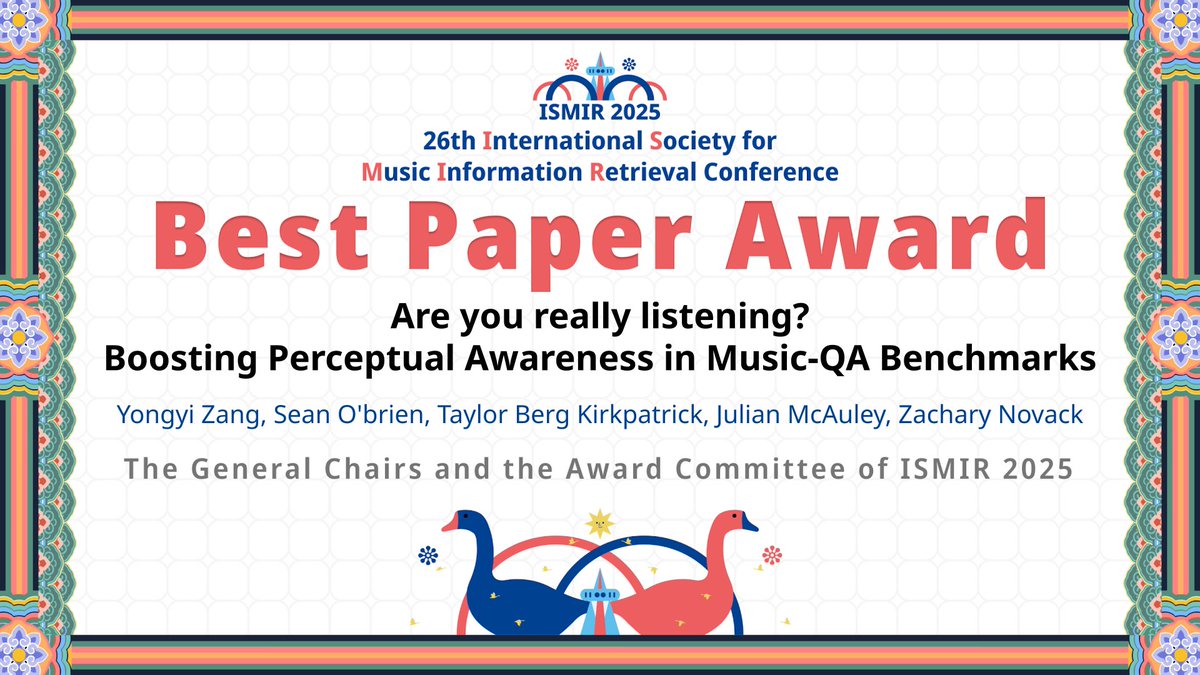
Are AI models for music truly listening, or just good at guessing? This critical question is at the heart of the latest Best Paper Award winner at #ISMIR2025! Huge congratulations to Yongyi Zang, Sean O'brien, Taylor Berg Kirkpatrick, Julian McAuley, and Zachary Novack for their paper, "Are you really listening? Boosting Perceptual Awareness in Music-QA Benchmarks." They expose how current benchmarks can be solved without genuine audio perception—even by text-only models! Their new framework, RUListening, creates evaluations that force models to prove they're actually hearing the music. A vital step forward for robust AI evaluation.
ISMIR Conference tweet media
English
0
9
23
9.9K
Sean O'Brien
Sean O'Brien@seano_research·
@LinkBechtel That's a good way of putting it -- another is to say we're giving extra encouragement to behaviors that the amateur hasn't learned (because it's too small to learn them).
English
0
0
1
28
luke
luke@LinkBechtel·
@seano_research So the main idea is, essentially, "remove amateur knowledge, and the expert will shine through"?
English
1
0
1
43
Sean O'Brien
Sean O'Brien@seano_research·
Excited to announce my new paper! Check it out: arxiv.org/abs/2309.09117 TL;DR: we improve LM reasoning with only 3-5 lines of code and 3% extra compute. The method requires no training, scales well, and earlier work shows that humans prefer its longer generations. (1/8)
Sean O'Brien tweet media
AK@_akhaliq

Contrastive Decoding Improves Reasoning in Large Language Models paper page: huggingface.co/papers/2309.09… demonstrate that Contrastive Decoding -- a simple, computationally light, and training-free text generation method proposed by Li et al 2022 -- achieves large out-of-the-box improvements over greedy decoding on a variety of reasoning tasks. Originally shown to improve the perceived quality of long-form text generation, Contrastive Decoding searches for strings that maximize a weighted difference in likelihood between strong and weak models. We show that Contrastive Decoding leads LLaMA-65B to outperform LLaMA 2, GPT-3.5 and PaLM 2-L on the HellaSwag commonsense reasoning benchmark, and to outperform LLaMA 2, GPT-3.5 and PaLM-540B on the GSM8K math word reasoning benchmark, in addition to improvements on a collection of other tasks. Analysis suggests that Contrastive Decoding improves over existing methods by preventing some abstract reasoning errors, as well as by avoiding simpler modes such as copying sections of the input during chain-of-thought. Overall, Contrastive Decoding outperforms nucleus sampling for long-form generation and greedy decoding for reasoning tasks, making it a powerful general purpose method for generating text from language models.


English
8
31
176
52.4K
Sean O'Brien
Sean O'Brien@seano_research·
@Vannaweh @_akhaliq This paper is more intended to show that contrastive decoding is more versatile than we previously thought, but there's lots of important research to be done in the future to make it stronger and robust across more domains.
English
1
0
1
25
Sean O'Brien
Sean O'Brien@seano_research·
@Vannaweh @_akhaliq That's a fair concern, which is why we downweight the amateur penalty by a factor beta < 1 which we see alleviates the problem in most domains (truthfulness being the exception). Plus, we find gains in standard math reasoning datasets like GSM8K, which aren't trick questions.
English
1
0
1
57
Sean O'Brien
Sean O'Brien@seano_research·
@imran__ds Wish I could! Unfortunately the amateur model used in this study is an unreleased version of LLaMA that I'm not authorized to open-source. The 7B-amateur and Flan-T5 experiments, as well as the negative prompting results, are all built on open-source models.
English
0
0
0
88
Sean O'Brien
Sean O'Brien@seano_research·
@TheNr24 @benjiwheeler So it might look like Small model: 90/10 A/B Large model: 55/45 A/B [ here we extrapolate! ] Even larger model (projected): 45/55 A/B You may notice this extrapolation is rough. You could in theory add more models to get a better estimate :^)
English
1
0
1
13
Sean O'Brien
Sean O'Brien@seano_research·
@TheNr24 @benjiwheeler Here's another way of thinking about it: we're extrapolating to roughly guess what an even larger model would pick. Imagine the guesses changing continuously as a function of how many parameters our LM has; we're just giving a little boost to the existing trend.
English
1
0
1
12
Sean O'Brien retweetledi
Mike Lewis
Mike Lewis@ml_perception·
New paper showing that Contrastive Decoding (CD) works really well for reasoning tasks, e.g. +6 on GSM8K and +4 on HellaSwag compared to greedy. CD searches for strings that are more likely under a good model than a weak model, emphasizing the improvement from the better model.
AK@_akhaliq

Contrastive Decoding Improves Reasoning in Large Language Models paper page: huggingface.co/papers/2309.09… demonstrate that Contrastive Decoding -- a simple, computationally light, and training-free text generation method proposed by Li et al 2022 -- achieves large out-of-the-box improvements over greedy decoding on a variety of reasoning tasks. Originally shown to improve the perceived quality of long-form text generation, Contrastive Decoding searches for strings that maximize a weighted difference in likelihood between strong and weak models. We show that Contrastive Decoding leads LLaMA-65B to outperform LLaMA 2, GPT-3.5 and PaLM 2-L on the HellaSwag commonsense reasoning benchmark, and to outperform LLaMA 2, GPT-3.5 and PaLM-540B on the GSM8K math word reasoning benchmark, in addition to improvements on a collection of other tasks. Analysis suggests that Contrastive Decoding improves over existing methods by preventing some abstract reasoning errors, as well as by avoiding simpler modes such as copying sections of the input during chain-of-thought. Overall, Contrastive Decoding outperforms nucleus sampling for long-form generation and greedy decoding for reasoning tasks, making it a powerful general purpose method for generating text from language models.

English
3
17
111
28.9K
Sean O'Brien
Sean O'Brien@seano_research·
@BillBainbridge5 @BillBainbridge5 Great question! The small amateur is a 1.5B (unreleased) LLaMA model; the large amateur is a 7B LLaMA model. That figure's showing that your amateur model shouldn't be too large/powerful, or else you'll be penalizing good behavior and performance drops.
English
0
0
0
69
Sean O'Brien
Sean O'Brien@seano_research·
@sivil_taram @PY_Z001 This makes sense, because speculative decoding is trying to maintain the same distribution while getting performance gains; contrastive decoding is trying to modify the distribution to get better behavior. So you could definitely stack the two!
English
1
0
4
648
Sean O'Brien
Sean O'Brien@seano_research·
@sivil_taram @PY_Z001 Author of the new CD paper here! Speculative decoding does also exploit an expert-amateur difference, but when combined with the rejection sampling step, the distribution of x reduces back to p(x), the expert distribution. (See Appendix A.1 of arxiv.org/abs/2211.17192)
English
1
0
2
178
Qian Liu
Qian Liu@sivil_taram·
💡Free idea: We have speculative decoding - which leverages a small and a large LM, and contrastive decoding - which also uses a small and a large LM. So, is it possible to combine them both?
AK@_akhaliq

Contrastive Decoding Improves Reasoning in Large Language Models paper page: huggingface.co/papers/2309.09… demonstrate that Contrastive Decoding -- a simple, computationally light, and training-free text generation method proposed by Li et al 2022 -- achieves large out-of-the-box improvements over greedy decoding on a variety of reasoning tasks. Originally shown to improve the perceived quality of long-form text generation, Contrastive Decoding searches for strings that maximize a weighted difference in likelihood between strong and weak models. We show that Contrastive Decoding leads LLaMA-65B to outperform LLaMA 2, GPT-3.5 and PaLM 2-L on the HellaSwag commonsense reasoning benchmark, and to outperform LLaMA 2, GPT-3.5 and PaLM-540B on the GSM8K math word reasoning benchmark, in addition to improvements on a collection of other tasks. Analysis suggests that Contrastive Decoding improves over existing methods by preventing some abstract reasoning errors, as well as by avoiding simpler modes such as copying sections of the input during chain-of-thought. Overall, Contrastive Decoding outperforms nucleus sampling for long-form generation and greedy decoding for reasoning tasks, making it a powerful general purpose method for generating text from language models.
English
2
3
29
6.5K
Sean O'Brien
Sean O'Brien@seano_research·
There’s plenty more research to be done: in many ways our formulation is naive, and on some tasks (especially truthfulness) contrastive decoding can harm performance. I’ll be looking into overcoming these shortfalls; excited to see where the research leads! (7/8)
English
1
0
5
755