Shefaly Yogendra, PhD

65K posts

Shefaly Yogendra, PhD banner
Shefaly Yogendra, PhD

Shefaly Yogendra, PhD

@shefaly

Board Director | Author (#UnchartedSpaces) | Keynote speaker | curious and patient human

London Katılım Haziran 2008
1.3K Takip Edilen3.7K Takipçiler
Sabitlenmiş Tweet
Shefaly Yogendra, PhD
Shefaly Yogendra, PhD@shefaly·
Delighted to be among the "100 Women To Watch" in the annual Female FTSE Board Report goo.gl/hRvx6M Fabulous, stellar company too!
English
8
14
112
0
Shefaly Yogendra, PhD
This wasn’t and isn’t unforeseeable as a long tail risk and impact. And it is not just about State capacity and the global economy, but wider social stability. This excerpt from my book #UnchartedSpaces that came out April 2026 (written over 2024-25).
Shefaly Yogendra, PhD tweet media
Hedgie@HedgieMarkets

🦔The IMF quietly war-gamed how AI could destabilize the global economy last December. The biggest threat they identified was income tax erosion. 66% of US federal revenue comes from individual income and payroll taxes. Every job AI eliminates is a paycheck that stops funding the government. My Take Every AI earnings call celebrates headcount reduction. Dimon cut 30-40% of jobs in some departments. Oracle cut 21,000 to fund data centers. Meta used AI to rank employees for layoffs. The entire pitch to investors is fewer workers, higher margins. But who replaces the tax revenue those workers generated? Corporate tax is a fraction of what individuals pay in income tax, payroll tax, and Social Security. The companies eliminating the jobs aren't picking up the tab. So you end up in a cycle where companies fire workers to boost margins, the government loses revenue, and then the same government is expected to fund the safety net for the people who got fired. At some point a politician is going to look at the numbers and realize that the AI companies celebrating record efficiency are also quietly draining the tax base that keeps everything else running. CEOs don't bring this up on earnings calls, and analysts haven't started asking yet. Hedgie🤗

English
0
0
1
81
Diva Jain
Diva Jain@DivaJain2·
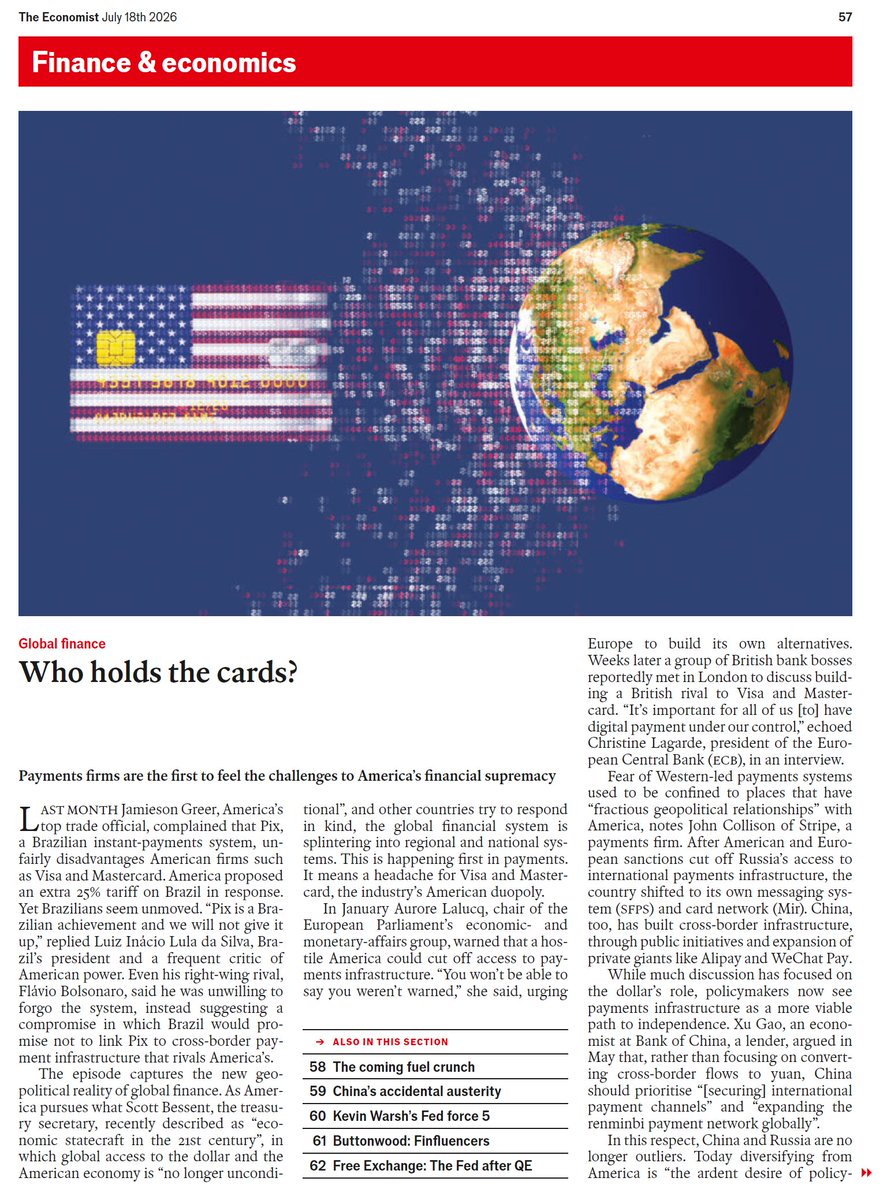
India was ahead of the curve in derisking itself from American payment networks with UPI. It needs to do something similar in AI.
Diva Jain tweet mediaDiva Jain tweet media
English
10
117
530
15.8K
Nikesh Arora
Nikesh Arora@nikesharora·
In the presence of legends! This is not an AI post :). But for those who know, they know.
Nikesh Arora tweet media
English
153
93
3.3K
219.2K
Shefaly Yogendra, PhD retweetledi
Tren Griffin
Tren Griffin@trengriffin·
Wrong! Teledesic never went bankrupt. Teledesic created the regulatory structure that enabled Starlink, which nearly exactly matched our business plan. Before the dot-com/telecom crash in 2000/2001, Teledesic raised hundreds of millions of dollars and had already launch our first test satellite. We had also spent years persuading the 188 members of the International Telecommunications Union to create a new category of radio frequency spectrum regulation called “Non-geostationary Fixed Satellite Service” (NGSO FSS). That is the regulatory structure relied upon by Starlink.  After the 2000/2001 crash, we concluded that for the indefinite future the financial markets were closed to a satellite venture that would require $10 billion to deploy before first revenue. At the time, we still had hundreds of millions of dollars in cash in the bank and no debt. We returned that money to our shareholders through a share repurchase offer.  (Indeed, Starlink’s original VP responsible for regulatory affairs came from Teledesic.) Starlink benefited from more favorable capital markets, government support, significantly lower launch costs, and a big drop in the cost of electronically-steered, phased- array antennae essential to their user terminals.  This is not meant to detract from the impressive success of Starlink. Among other things, it was SpaceX that brought down the cost of launch by more than an order of magnitude. StarLink is an amazing service and a remarkable achievement. The Teledesic co-founders are thrilled to see that vision realized.
David Senra@davidsenra

Marc Andreessen on why Starlink may be the most misunderstood success story in tech right now: “Elon’s not the first guy who said we’re going to do satellite-based internet access. There was Bill Gates, Craig McCaw. Complete catastrophe, total bankruptcy, complete disaster. Elon’s like, ‘I know, I’m going to do another three of those. We’re starting as a side project at the rocket ship company.’ If the rockets are reusable, we’re going to be launching them all the time. What’s going to go in the rockets? I could wait for the customers to come to me, or I could just put up my own satellites. Anybody who knew anything about the history of satellites knew that was the craziest idea in the world. And of course it’s like this giant success. It’s the side project. It’s clearly the least studied and understood thing I know of in the world right now.” @pmarca @elonmusk
English
9
20
149
20.3K
Shefaly Yogendra, PhD retweetledi
McGee Young
McGee Young@fiercemcgee·
A few months ago, I started working on the question of what DERs were actually worth to the grid. This question led me down a deep rabbit hole of grid data, most of which couldn't actually answer the questions that I had. I started building my own data layers. A grid digital twin
McGee Young tweet media
English
6
18
105
26.4K
Shefaly Yogendra, PhD
@vboykis This also extends to those who have outsourced core parts of their work that involve thinking and creativity to LLM-driven tools. Seeing it from board directors to students to all sorts of functional specialists. Trajectories from here will be fun to watch.
English
0
0
1
5
vicki
vicki@vboykis·
Had a realization as I was reading an interview with someone who loves programming recently: some of the hype over LLMs is because many programmers don’t enjoy programming and are relieved not to have to do it anymore
English
72
38
718
48.7K
Shefaly Yogendra, PhD retweetledi
Nick Gray
Nick Gray@nickgraynews·
I miss blogrolls on personal websites so I made a side quest to bring them back slashfriends.org/about
English
14
13
123
50.1K
Visakan Veerasamy
Visakan Veerasamy@visakanv·
"visa, do you have a favorite bible verse?" i'm glad you asked
Visakan Veerasamy tweet media
English
9
22
465
22.3K
Shefaly Yogendra, PhD retweetledi
丂卄ㄖᗪ卂几 - 👋 crack fingers
For my American friends UK is similar in latitude to Alaska UK gets 2.5hrs more daylight than Texas Las Vegas humidity is 30%, UK is 81% Imagine Alaska having the same weather as Florida, that’s what’s going on here
English
77
657
17.5K
518.6K
Shefaly Yogendra, PhD
Shefaly Yogendra, PhD@shefaly·
@tomfgoodwin It’s technically not that hot I agree. Laptops however might melt down with Teams calls that seem to heat things up weirdly.
English
0
0
2
384
Tom Goodwin
Tom Goodwin@tomfgoodwin·
It’s really not that hot in the uk. It’s just that everyone goes up to everyone and says “wow it’s hot” and then we all convince each other it is. At a conference in London this week it’s all people could talk about. Wear natural fibers, walk a bit more slowly, enjoy feeling warm. It’s dry heat , it’s wonderful . It’s humidity that sucks
English
56
1
56
23.6K
Shefaly Yogendra, PhD
Shefaly Yogendra, PhD@shefaly·
@ramit Very interesting thread. The U.K. is explained wholly through a class lens and language, intonation, particular references are the ever-present if sometimes subtle signals.
English
0
0
0
40
Ramit Sethi
Ramit Sethi@ramit·
Follow me, @ramit, to learn more about money psychology
English
2
0
9
17.9K
Ramit Sethi
Ramit Sethi@ramit·
I’m obsessed with this comment thread about “all inclusives” that’s really a critique of social class 🧵
Ramit Sethi tweet media
English
61
26
4.2K
1M
Shefaly Yogendra, PhD
Shefaly Yogendra, PhD@shefaly·
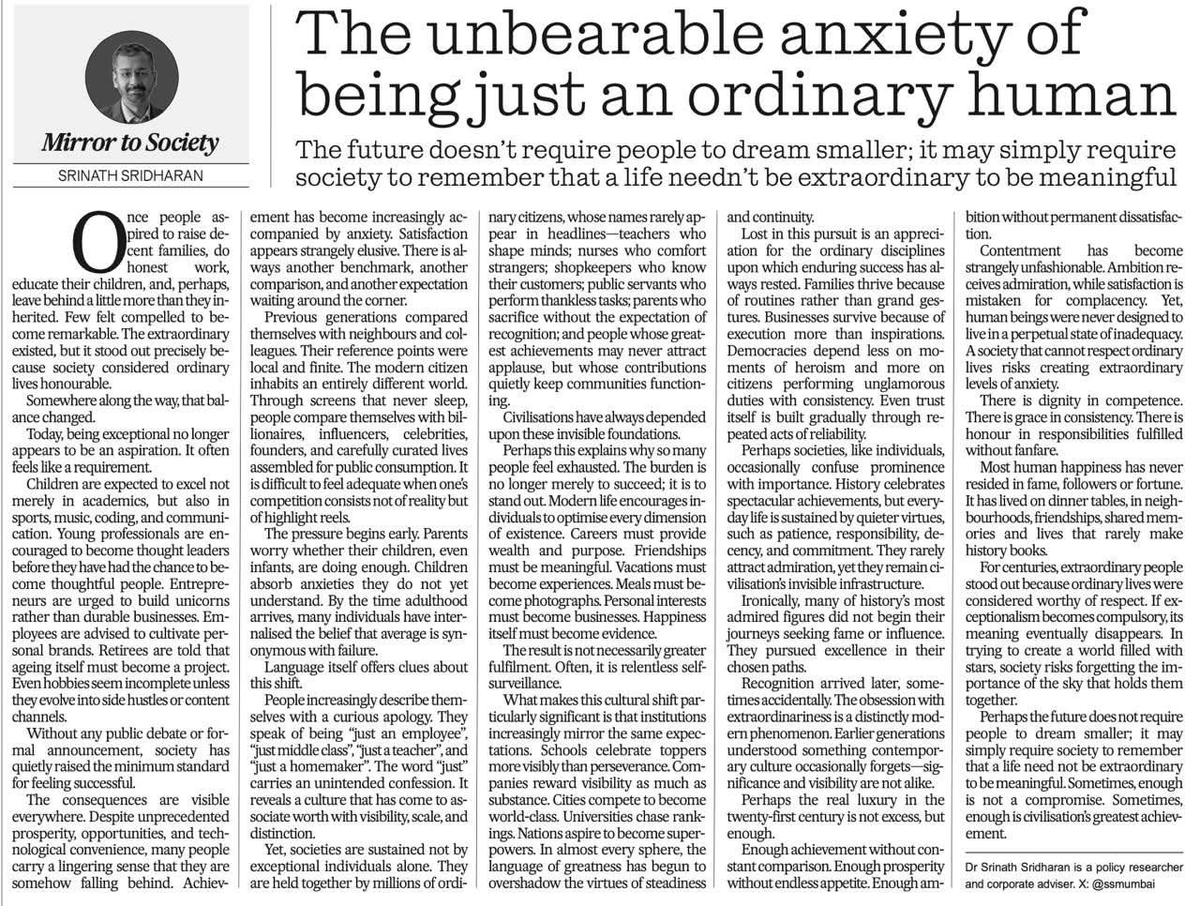
@Makarand_S @ssmumbai In other words - critical thinking. This past weekend in an exchange, I said to a young person I know well: it is nothing more than placing a pause between coming across something and taking action based on it.
English
0
0
1
74
Makarand (मकरंद) (مکرند)
Read. In this thought provoking piece, @ssmumbai writes about the mad scramble for prominence mistaking it for importance. There is, he says, need to reevaluate what makes for a meaningful life. Hint, it does not need life to be extraordinary.
Makarand (मकरंद) (مکرند) tweet media
English
4
7
31
1.5K
Shefaly Yogendra, PhD
Shefaly Yogendra, PhD@shefaly·
@tomfgoodwin This problem pervades medicine, boards of companies etc too. Building a generalist has to be intentional. The first 3 of 8 semesters in my Engg degree were courses from all other disciplines before we could stream to our chosen one. It built a foundation to understand others.
English
0
0
2
119
Tom Goodwin
Tom Goodwin@tomfgoodwin·
It's exhausting working with specialists not generalists. The architect designed a house, it turns out with little knowledge of costs. The structural engineer designed foundations with no consideration of the trees ( on the survey they wanted) The landscape architect ignored the house blocking the light for plants The MEP engineer ignored the louvres and utility locations By FAR the most useful people are the Builders who build the thing, they actually understand how things relate. Is it that hard to know a little bit about everything?
English
11
2
39
3.2K
Jay Cummings
Jay Cummings@LongFormMath·
I just read that Charles Darwin made Pros-and-Cons list when deciding whether or not he should get married (to his first cousin). One of the 9 benefits to staying single: “more money for books”
Jay Cummings tweet media
English
22
57
509
41.3K