

shior 🔺
3K posts

shior 🔺 retweetledi


shior 🔺 retweetledi


shior 🔺 retweetledi

From Niche to Mainstream: The Institutional Awakening of DeAI 🏛️🚀
The "DeAI Summer" of 2026 isn't just a retail trend anymore. We are seeing a massive shift as major exchanges and institutional players realize that centralized AI is a bottleneck.
The latest partnership between AscendEX and DGrid_AI is the ultimate signal. 👇
1/ Liquidity Meets Intelligence: The collaboration with AscendEX isn't just about a logo on a website. It’s about integrating DGrid_AI’s decentralized compute directly into the heart of high-frequency trading and exchange infrastructure. When the big players start using the Grid, the game changes forever. 📈
2/ Global Scale, Local Performance: By tapping into DGrid_AI’s DePIN network, global platforms can now offer their users faster, cheaper, and more reliable AI-powered tools without relying on a single cloud provider. It’s about eliminating the "single point of failure" for the entire crypto-AI ecosystem. 🌍
3/ The $DGAI Utility Explosion: Partnerships like this drive one thing: Utilization. Every new institution that integrates with the grid increases the demand for verifiable, high-quality compute. The Proof of Quality (PoQ) standard we’ve been talking about is now becoming the benchmark for the entire industry. 🛡️
The Big Picture: We used to talk about "what if" AI was decentralized. Now, with major players like AscendEX joining the movement, we are talking about "how fast" it can scale. The grid is definitely growing. ⚡
________
The Standard has Shifted: GLM-5 is Sovereign on 0G Labs 🧠
0G Labs has officially moved from "Experimental AI" to Industrial-Grade Intelligence.
With the integration of GLM-5, the world’s #1 open-source model, onto the 0G Aristotle Mainnet, 0G Labs is serving 744B parameters of raw reasoning with zero centralized gatekeepers. 🛰️
The Mechanic: Agentic Engineering at 50 Gbps
GLM-5 isn't just "running" on 0G Labs; it’s integrated into the nervous system of the dAIOS.
✔️ Beyond the Chatbot: Optimized for "Long-Horizon" tasks, GLM-5 can architect entire systems, handle multi-step workflows, and recover from errors autonomously.
✔️ The Privacy Shield: Every call is protected by Sealed Inference (TEEs). You get frontier-level intelligence with the physical guarantee that your prompts are never logged. 🔐
Real-World Impact:
From autonomous DeFi traders to privacy-first enterprise architects, GLM-5 on 0G Labs is the first time a model of this scale has been accessible as a Sovereign Public Good.
The Architectural Outcome:
0G Labs has achieved the "Impossible Trinity": Frontier Scale + Decentralized Infrastructure + Total Privacy.
While the world rents intelligence from Big Tech, 0G Labs is building the infrastructure to own it.


Star@Amstarlighter
The Rise of Sovereign AI: Why "Small" is the New "Big" in 2026 In 2024, everyone wanted the biggest model. In March 2026, the smartest players want the most private one. The era of the "General Purpose Giant" is yielding to the Sovereign SLM (Small Language Model). DGrid_AI is where these specialized minds come to life. 👇 1/ Privacy as a Feature, Not a Bolt-on: Data is the new gold, and nobody wants to leak it to a centralized API. DGrid_AI enables "On-Premise" style decentralization. By running task-specific SLMs on our distributed nodes, enterprises and creators get the intelligence they need without their data ever leaving the encrypted grid. 🛡️ 2/ Precision Over Parameters: You don't need a trillion parameters to draft a legal contract or optimize a supply chain. Specialized SLMs are faster, cheaper, and often more accurate for specific tasks. DGrid_AI’s intelligent routing identifies these "Vertical LLMs" and pairs your request with the perfect, right-sized model. 🎯 3/ The Edge Revolution: With the shift toward Edge AI, intelligence is moving closer to where data is born. DGrid_AI’s DePIN architecture is uniquely built for this, allowing localized nodes to process high-stakes requests with ultra-low latency. It’s not just "Cloud AI", it’s Local AI on a global scale. 🌐 The Shift: DGrid_AI isn't just building a bigger brain; They are building a more secure and efficient one. Sovereignty isn't a luxury anymore, it’s the 2026 standard, powered by DGrid_AI. ⚡ ______ Beyond the Training Hype: 0G Labs and the Inference Inflection 🧠 GTC 2026 just confirmed it: we have officially crossed the Inference Inflection Point. The "AI Factory" of the future isn't about training massive models once; it’s about running them a billion times. 0G Labs is the only dAIOS built for this high-velocity reality. ⚡ The Mechanic: Reth & The 50 Gbps Flow Centralized factories are hitting a "Reasoning Bottleneck." By migrating to Reth and optimizing for high-read/write MDBX storage, 0G Labs has built a protocol that matches the sequential reasoning needs of next-gen AI. It’s not just "Blockchain for AI"; it’s the Execution Layer for Tokens. 🛡️ Why This Matters Post-GTC👇: ✅ Agentic Scaling: As NVIDIA shifts to "Agentic Workflows," 0G Labs is providing the Sealed Inference enclaves where those agents can live and breathe without a corporate overseer. ✅ Deterministic Speed: While other chains lag under inference load, 0G’s Deterministic Data Plane ensures your AI responds in real-time, every time. 🏎️ ✅ The Sovereignty Standard: We’re moving from "AI as a Service" to "AI as a Protocol." 0G Labs is the bare-metal foundation that ensures the $1 Trillion buildout remains open and verifiable. The Architectural Outcome: The world just realized that inference is the dominant workload of the decade. 0G Labs realized it two years ago. While others are building for the past, 0G Labs is serving the Inference Era. 💪
English
shior 🔺 retweetledi

The current internet is optimized for consumption, not comprehension. Content is designed to be quickly consumed and just as quickly forgotten. This creates a cycle where knowledge is constantly produced but rarely accumulated.
Breaking that cycle requires a fundamental shift in how we treat data. Inside PermawebDAO, data is not ephemeral. It is persistent, structured, and interconnected. Applications are designed to live indefinitely, and content is enriched so that it retains meaning across time. Permacast turns discussions into lasting knowledge artifacts, making them accessible and interpretable long after they are created.
But comprehension also requires processing. This is where 0G Labs becomes essential. Its decentralized AI stack allows models to process large-scale datasets efficiently, without relying on centralized infrastructure. Through verifiable inference and distributed compute, it ensures that intelligence can operate transparently and at scale.
When these systems align, the internet shifts from a stream of content to a system of understanding. And that is where real value begins to emerge.
Marveltech@Marveltech13835
We often talk about scalability in terms of speed and throughput, but rarely in terms of knowledge accumulation. Yet the most important systems of the future will not just scale in performance, they will scale in understanding. Within 0G Labs, scalability is being redefined at the infrastructure level. By separating compute, storage, and data availability into modular layers, the system avoids traditional bottlenecks. This allows AI workloads to expand without collapsing under centralized limitations. Inference becomes a distributed process, and verification ensures that outputs can be trusted. But scaling intelligence without stable data is like building on sand. That is why PermawebDAO is equally important. Its focus on permanent, structured data ensures that as systems scale, the knowledge they rely on remains intact. Permacast demonstrates how even dynamic content can be captured in a form that retains context and meaning over time. When both layers evolve together, scalability takes on a new definition. It is no longer just about handling more users or more transactions. It becomes about handling more knowledge, more context, and more intelligence, without losing coherence.
English
shior 🔺 retweetledi

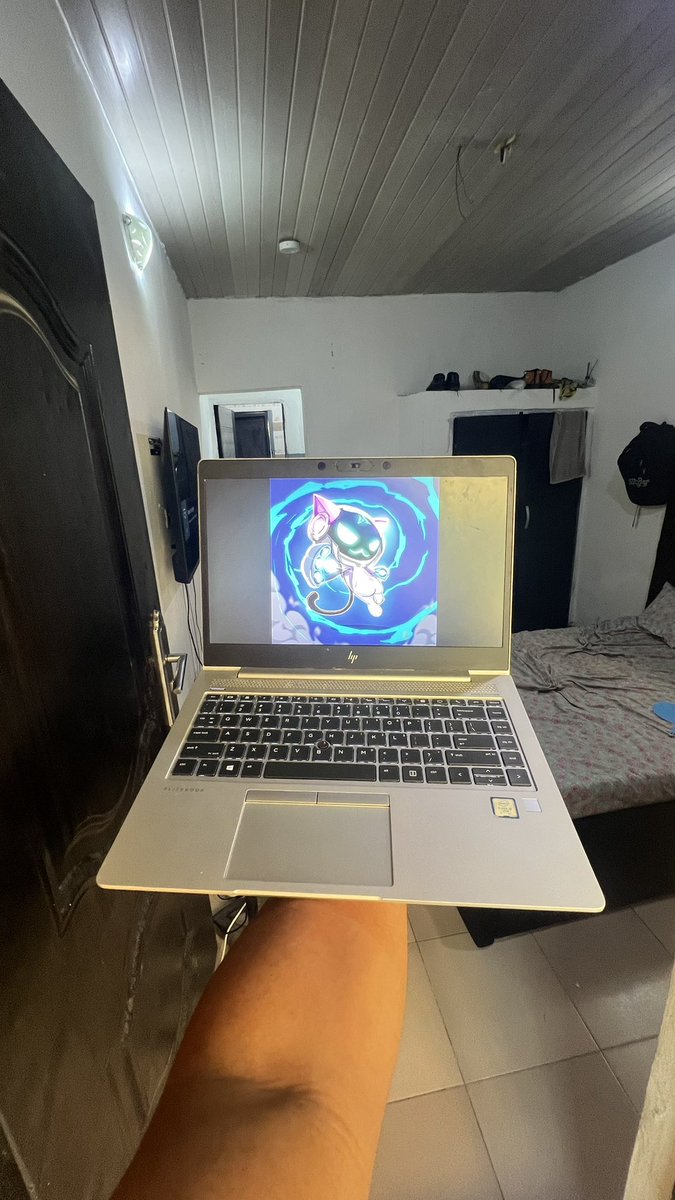
Mochi is live in Port Harcourt, Nigeria 🇳🇬
And guess what, Mochi is right here in my sitting room.😄
What started as just a simple setup turned into something bigger.
Mochi is here getting ready for #TestnetBradbury, powering up with @GenLayer for a new era of intelligence.
From my screen to the world… we’re building the future, one step at a time.

English
shior 🔺 retweetledi

A “paper millionaire” with $0 liquidity is market paralysis.
Your wallet proves accumulation, but if you can’t deploy it, that wealth is trapped energy waiting for action.
Then your thread hook stays separate:
The "HODL" narrative, as a mandate for immobility, ends here.
A🧵

English
shior 🔺 retweetledi


shior 🔺 retweetledi

Web3 as a system for externalizing trust.
In traditional systems, trust lives inside institutions.
You trust banks to hold money.
You trust platforms to store data.
You trust companies to enforce rules.
But that trust is fragile and often invisible.
Web3 moves trust outward.
On systems like Bitcoin, trust is embedded in the network itself, not in any single entity.
On Ethereum, trust extends into code rules are transparent and verifiable.
Now extend that outward.
Data integrity in @0G_labs isn’t dependent on one provider.
Computation in DGrid doesn’t rely on a single machine.
Financial flows in Dango aren’t controlled by a single institution.
And storage in @permacastapp isn’t tied to a single server.
Trust becomes:
1) Verifiable
2) Distributed
3) Inspectable
Which leads to a subtle shift:
You don’t need to believe a system works.
You can check that it does.
And over time, that changes how people interact with digital systems entirely.
cryptolord001@Brighter6N
There’s a stage every system eventually reaches where the biggest challenge is no longer building, scaling, or even coordinating. It’s sustainability. Not in the environmental sense but in the sense of: can this system keep existing without constant external energy? Early systems always rely on injections: - Capital - Attention - Hype - New users But over time, those inputs fade. And when they do, the real question appears: Does the system sustain itself? We’ve seen what happens when it doesn’t. Liquidity dries up. Participation drops. Incentives stop working. The system slowly loses momentum. That’s why the next phase of Web3 is less about growth, and more about self-sustaining loops. Take foundational networks like Bitcoin. Its sustainability comes from a simple but powerful cycle: miners secure the network, are rewarded, and continue participating because the system maintains value. On Ethereum, sustainability is more complex fees, staking, and usage all interact to keep the network alive. Now extend that idea to newer infrastructure. In data ecosystems like @0G_labs, sustainability depends on continuous demand for data availability and incentives that reward maintaining that availability over time. In compute networks such as DGrid, it relies on a balance between supply (machines) and demand (workloads). In financial systems like Dango, sustainability comes from real usage not just speculative capital rotating through the system. And in permanence layers like @permacastapp, the challenge is even deeper: ensuring that “forever storage” is backed by economic models that actually last. This leads to a critical shift in thinking: From incentives that attract, to mechanisms that retain. Because attracting users is easy with enough rewards. Keeping them without overpaying is much harder. The systems that win long-term will have: Real demand, not artificial usage Incentives that decrease reliance on subsidies Feedback loops that reinforce participation naturally In other words, systems that don’t need to constantly convince people to stay. Because leaving would mean losing real value. That’s when a network becomes more than a product. It becomes an environment people depend on. And once that happens, sustainability stops being a question. It becomes a property of the system itself.
English
shior 🔺 retweetledi

Something Happened Today That I Keep Thinking About 📜
I was explaining these projects to someone who's been in this space longer than me and halfway through my explanation they stopped me and said something I wasn't expecting
they said: you sound like you actually believe this
and I didn't know how to respond because the honest answer is yes but yes felt too simple for what I actually meant
──────────────────────────────────
because believing in this space is complicated now
it used to be simpler. the early days had a clarity to them that came from the problem being obvious and the solutions being new and the gap between where we were and where we could be feeling worth the risk of getting there
that clarity eroded. slowly. through enough cycles of watching things that seemed important turn out to be noise. through enough moments of being right about the direction and wrong about the timing in ways that felt identical to just being wrong
and now believing requires holding more complexity than it used to. believing in the foundation while being honest about the gaps. believing in the direction while being uncertain about the path. believing in the people building while acknowledging you can't fully verify who they are or whether they'll still be building when the hard moments arrive
──────────────────────────────────
Permaweb DAO makes me believe in permanence as infrastructure
not as a promise. as a demonstrated property of something that has been running long enough to call itself proven. seven years is not a claim. it's a record. and the permanent media network and creator identity layer building on top of that record inherits something that can't be manufactured quickly
I believe in that foundation the way I believe in things that have had time to be tested rather than things that have had time to be marketed. Permaweb_DAO
──────────────────────────────────
DGrid makes me believe in accountability as infrastructure
the Proof of Quality mechanism is the most serious attempt I've found at making AI inference something other than a trust exercise. slashing for bad outputs. quality proofs attached to results. nodes with economic skin in the game about whether what they returned was real
I believe in that approach the way I believe in things where the hard thinking happened before the commercial pressure rather than after. dgrid_ai
──────────────────────────────────
Dango makes me believe in access as infrastructure
the people who showed up without a token showed me something I needed to see. that the desire for DeFi that works like a product rather than a puzzle is real and present and not waiting for a bull market to surface it
I believe in that signal the way I believe in things where the evidence existed before the incentive to manufacture it. dango
──────────────────────────────────
side note: the person who said I sounded like I actually believed this meant it as a compliment and I took it as one. belief that has survived enough cycles to still be specific rather than vague is hard to maintain and worth having
──────────────────────────────────
so how do you hold belief in this space after enough cycles to make it complicated. fr I think the people who are still genuinely here rather than just financially here have a more interesting answer to that than they usually share

English
shior 🔺 retweetledi

Open any wallet you’ve used recently and scroll through your transaction history.
Every transfer, interaction, movement of value is recorded, time stamped and public.
That’s not just a list of transactions but a pattern that reveals
How you move capital, when you act, what you interact with and how often you rotate positions.
It looks like data to most people but to the right observer, it’s insight and
@Multihopper @StrategicSuperR $SSR #MultiHopper
In a system where anyone can observe, that insight becomes leverage.
English
shior 🔺 retweetledi
Web3 as a system for turning coordination into capital.
In traditional systems, capital is mostly financial.
Money fuels activity.
Investment drives growth.
Ownership determines influence.
But Web3 expands what “capital” means.
On networks like Ethereum, participation itself can generate value.
Now add infrastructure.
Contributing data in @0G_labs becomes a form of capital.
Providing compute in DGrid becomes a productive asset.
Allocating liquidity in Dango becomes an active role in shaping markets.
Curating information in @permacastapp becomes a long-term contribution to collective memory.
This leads to a powerful idea:
Anything that helps a system function can become capital.
Not just money:
Data
Attention
Compute
Reputation
All of it can be:
1) Measured
2) Rewarded
3) Composed
And when that happens, the economy expands.
Because more people can contribute value in more ways.
Which means the next wave of Web3 isn’t just about redistributing wealth.
It’s about redefining what counts as value in the first place.
cryptolord001@Brighter6N
Web3 as a system for externalizing trust. In traditional systems, trust lives inside institutions. You trust banks to hold money. You trust platforms to store data. You trust companies to enforce rules. But that trust is fragile and often invisible. Web3 moves trust outward. On systems like Bitcoin, trust is embedded in the network itself, not in any single entity. On Ethereum, trust extends into code rules are transparent and verifiable. Now extend that outward. Data integrity in @0G_labs isn’t dependent on one provider. Computation in DGrid doesn’t rely on a single machine. Financial flows in Dango aren’t controlled by a single institution. And storage in @permacastapp isn’t tied to a single server. Trust becomes: 1) Verifiable 2) Distributed 3) Inspectable Which leads to a subtle shift: You don’t need to believe a system works. You can check that it does. And over time, that changes how people interact with digital systems entirely.
English
shior 🔺 retweetledi

Ai is now a general thing for everyone now but the racing to build better AI models isn't common.
But almost no one is fixing the real problem, the data bottleneck.
Data is everywhere but how can we get not just any data but high-quality, trustworthy, human verified data?
This is the issue and that’s the gap @PerleLabs is quietly dominating, stay with me.
Perle Labs isn’t trying to compete with model builders.
They’re building something far more foundational:
→ a decentralized AI data layer
→ where human intelligence becomes an on-chain asset
→ and trust is engineered into every dataset
Here’s the reality most people ignore:
AI models are only as good as the data they’re trained on.
Bad data = biased, unreliable, unusable AI.
Perle flips this entire dynamic.
Instead of opaque datasets scraped from the internet, they introduce:
• Verified contributors → real humans, not anonymous noise
• Reputation systems → quality is tracked, not assumed
• On-chain attribution → every contribution is provable
• Incentive alignment → people earn for high-quality work
This is not crowdsourcing.
This is precision data engineering at scale.
And the traction? It’s not theory.
→ Over 1M annotators onboarded
→ More than 1B points distributed
→ Rapid expansion across multi-modal datasets
That kind of growth doesn’t happen unless there’s real demand.
Because every AI company today is facing the same problem:
they need better data, not just bigger models.
What makes Perle Labs even more interesting is how they’re doing it:
They combine Web3 + AI in a way that actually makes sense:
• Blockchain for transparency & ownership
• Tokenized incentives for scaling human input
• Decentralization for global data contribution
No buzzwords — just infrastructure.
And this is where their real strength lies:
Perle Labs is not building another AI tool.
They’re building the data economy behind AI.
The layer where:
human knowledge → gets structured → verified → and fed into machines
Backed by top-tier funding and built by teams with experience from leading AI companies, they’re positioning themselves at the most critical point of the stack.
Because in the long run, the winners in AI won’t just be the ones with the best models…
They’ll be the ones who control
the highest-quality data pipelines.
Perle Labs understands this.
And they’re moving early.
Participating in @PerleLabs community campaign.
#PerleAI #ToPerle
English
shior 🔺 retweetledi
The next wave of crypto-native infrastructure is being shaped by projects like 0G_labs, Dgrid_ai, Permacastapp, and Dango, each attacking a different layer of the decentralized stack, from modular AI compute and data availability to autonomous media and onchain finance. Together, they signal a shift away from fragmented innovation toward a composable, intelligence-driven ecosystem where data, compute, identity, and value flow seamlessly across protocols.
What stands out immediately is how 0G_labs is positioning itself at the intersection of modular infrastructure and AI scalability. The narrative is no longer just about faster chains, but about verifiable, decentralized compute that can support large-scale AI workloads. This aligns with the growing demand for trustless AI, where inference and training can be validated onchain. The keyword here is modularity breaking apart monolithic systems into specialized layers that can evolve independently while remaining interoperable.
Dgrid_ai builds on this by focusing on decentralized intelligence networks. Instead of centralized AI models controlling data pipelines, Dgrid leans into distributed data coordination and autonomous agent interaction. This introduces a new primitive: AI agents as economic participants. Data becomes not just an asset, but a live input stream powering decisions, automation, and value creation across networks.
On the content and communication layer, Permacastapp is redefining media permanence and ownership. In a space flooded with ephemeral content, Permacast leans into permanence, verifiability, and censorship resistance. The implication is deeper than podcasting, it’s about creating an immutable knowledge layer where creators retain control and audiences interact with content that cannot be altered or erased. This ties directly into the broader decentralized storage narrative.
Then comes Dango, approaching finance from a user-first, composable banking perspective. Instead of replicating traditional fintech, Dango integrates DeFi primitives into an accessible, seamless interface. The focus is on abstraction, removing the complexity of wallets, gas, and bridging, while still leveraging the full power of onchain finance. This is where real adoption lives: when users don’t need to understand the backend to benefit from it.
The connective insight across all four is this: the future isn’t about isolated protocols competing for attention, but about layered ecosystems optimizing for intelligence, usability, and interoperability. AI, data availability, decentralized storage, and finance are no longer separate verticals, they are converging into a single programmable environment.
This is where the real opportunity lies. Not in chasing hype cycles, but in recognizing that these projects are quietly laying the groundwork for a system where AI agents transact, data verifies itself, content persists forever, and finance becomes invisible.

Oluwafemi👑❤️🚀@TheFemog
Decentralized intelligence, modular infrastructure, and programmable data liquidity is no longer theoretical, it is actively being shaped by emerging systems like 0G_labs, Dgrid_a, Permacastapp, and Dango. Together, they signal a shift from fragmented Web3 primitives into a cohesive, composable stack where data availability, compute, content permanence, and user interaction are seamlessly integrated to unlock scalable adoption. At the core, 0G_labs is redefining data availability with a modular architecture designed for high-throughput environments, making it possible for AI-driven applications and on-chain services to operate without the bottlenecks that have historically constrained blockchain performance. Its emphasis on scalable data layers and verifiable computation positions it as a foundational layer for the next generation of decentralized AI, where trustless execution meets real-time responsiveness. Layered on top of this evolving data infrastructure is Dgrid_a, which introduces a decentralized compute coordination framework that transforms idle resources into an active grid of distributed intelligence. Rather than relying on centralized cloud providers, Dgrid enables permissionless participation in compute markets, aligning incentives between resource providers and developers. This creates a fluid compute economy where workloads can dynamically scale across a decentralized network, directly complementing the high-throughput data pipelines enabled by 0G. While infrastructure solves for scale and efficiency, Permacastapp tackles the permanence and accessibility of information. By leveraging decentralized storage paradigms, it ensures that content is not only censorship-resistant but also contextually persistent. This introduces a new layer of narrative continuity in Web3, where data is not just stored but meaningfully indexed and retrievable over time, forming a knowledge layer that both users and AI agents can rely on without degradation or loss. Completing this stack is Dango, which reimagines user interaction and liquidity flow through intuitive abstractions that bridge complexity and usability. It focuses on seamless onboarding, fluid asset movement, and frictionless engagement, ensuring that the underlying sophistication of decentralized systems does not become a barrier to entry. Dango acts as the interface layer where users actually experience the power of the combined infrastructure, translating deep tech into accessible utility. What emerges from the synergy of these projects is not just incremental innovation but a redefinition of how decentralized systems function as a whole. Data availability from 0G, compute orchestration from Dgrid, permanence from Permacast, and usability from Dango form a vertically integrated ecosystem where each layer reinforces the others. This interconnected design addresses the core bottlenecks of Web3 adoption scalability, accessibility, reliability, and user experience without compromising decentralization. #BybitAmplifyWin @Bybit_Official The real insight lies in how these systems collectively dissolve the boundaries between infrastructure and application. Instead of isolated protocols competing for attention, they operate as interdependent components of a larger machine, one that is capable of supporting AI-native applications, autonomous agents, and persistent digital economies. This is the architecture required for true adoption not just more users, but more meaningful, sustained interaction within decentralized environments. In this emerging paradigm, the question is no longer whether Web3 can scale, but how effectively these modular components can synchronize. And based on the trajectory of 0G_labs, Dgrid_a, Permacastapp, and Dango, the answer is already unfolding.
English
shior 🔺 retweetledi

DeFi has built some of the most advanced financial tools in history. But it was not designed for everyone. It was built for people who already understand how the system works.
If you have been in crypto for a while, you know the routine.
Setting up wallets.
Bridging assets across chains.
Making sure you have gas on each network.
Jumping between DEXs to find the best route.
For experienced users, it is normal. For new users, it is overwhelming. It feels fragmented and confusing, and that becomes a real barrier.
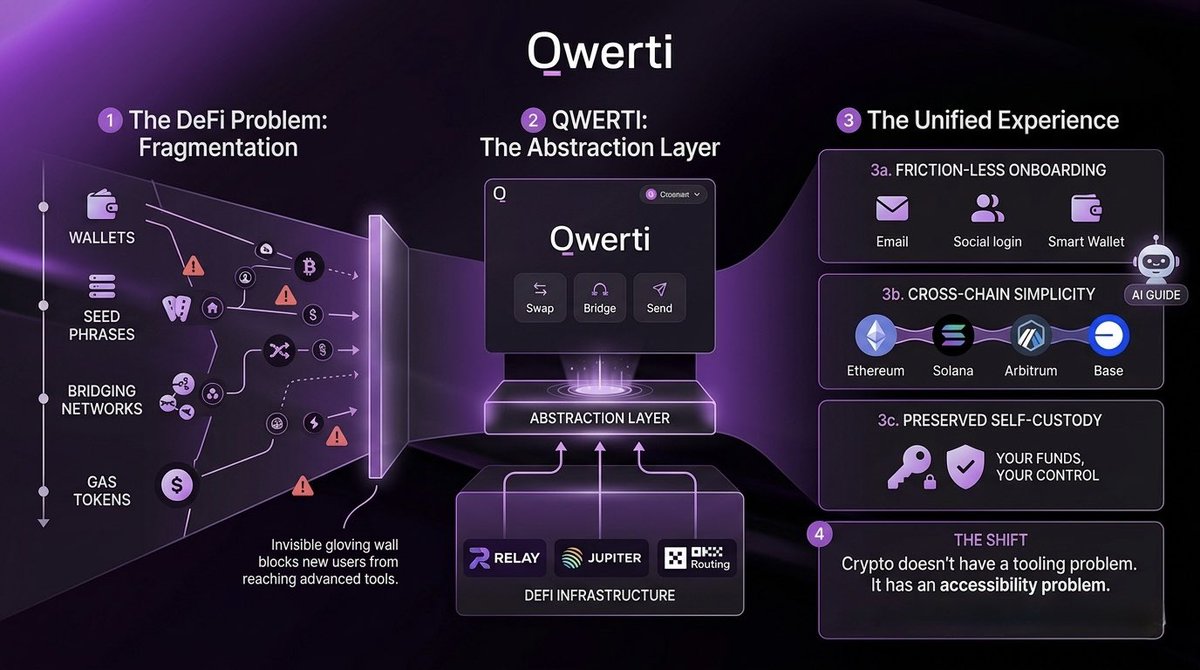
This is the problem @QwertiAI is trying to solve.
What I like is that it is not trying to replace DeFi. It is building on top of it. It brings together infrastructure from Relay, Jupiter, OKX and others, and wraps everything into one simple interface.
Instead of forcing you to figure out how everything works, it handles the complexity in the background. You just choose what you want to do, and it finds the best way to do it.
At the same time, it keeps self custody intact. Your funds stay in your control. Your keys remain yours. You get simplicity without giving that up.
Onboarding is another big shift.
You do not need to start with a complicated wallet setup. You can sign in with email or Google and begin immediately. If you already use wallets, you can connect them too. It works both ways.
Funding is also easier. You can go from fiat to tokens directly using normal payment methods, without jumping between platforms.
Then there is the everyday experience.
Swapping, checking token data, and exploring assets all happen in one place. No switching tabs, no guessing routes. It supports multiple chains and handles routing automatically.
There is also an AI assistant built in that helps explain things and guide actions step by step. That alone makes DeFi feel more approachable.
For creators, the widgets and Magic Links make it easier to onboard others and even earn from activity.
At a high level, this is really about accessibility.
Crypto already has the tools. What it lacks is a simple way for people to use them.
Qwerti feels like a layer that connects everything and makes it usable.
You could even call it a kind of aggregator for the next wave of users.
English
shior 🔺 retweetledi

This Saturday feel different
Anyway, I just locked in for the @RiverdotInc S4 campaign, you might want to check it out too 👀
Here’s how to get started:
• Connect your X account + 0x wallet
• Make a post about RIVER and tag @River4fun
• Earn points based on your content and engagement
Want to boost your points?
Stake your $RIVER and increase your rewards 📈
Simple strategy: show up, stay active, and stay consistent.
And while you’re at it, don’t sleep on @3look_io — keep posting, join campaigns, and turn your content into rewards.
Weekend grind, let’s get it. 🚀

English
shior 🔺 retweetledi

Something big is creeping in… quietly.
While everyone is chasing noise, @MidnightNtwrk is building a chain where your data stays yours… but still plays by the rules.
Mainnet is getting close.
The future isn’t fully public… and it isn’t fully hidden either.
#Midnight #Web3

English
shior 🔺 retweetledi

Have you noticed how most platforms treat your work like it disappears the moment you log out? That’s exactly what makes this different.
Your @codatta_io DID is not just another profile sitting somewhere, it’s something you actually own. Every task you complete, every piece of data you help refine, it all stays tied to you. It moves with you, grows with you, and now… it’s getting even more powerful.
With ERC-8004 coming into play, it’s no longer just humans contributing. Agents can now step in... helping to label, validate, and even consume data. And it all feeds back into a system where real contributions continue to generate value.
This is how a real data economy should work, connected, rewarding, and built around the people (and agents) who make it possible.
If you haven’t created your DID yet, this is a good time to start, see below. 👇
#Codatta #Data #Ai
Codatta@codatta_io
Your Codatta DID is more than just a profile—it's a user-owned, portable and extensible identity that tracks your contributions across the ecosystem. We rolled out DID V1 on @base last November. Any user can create a DID and log in seamlessly with an email or Web3 wallet. Now, we’re leveling up with ERC-8004 compatibility. What this means for the ecosystem: • Agents as Contributors: ERC-8004 agents can participate in Codatta workflows, acting as data labelers and validators. • Agents as Consumers: They are also the downstream data buyers, fueling the precise closed-loop of our Royalty Engine. 🔁This upgrade is set to plug Codatta into a broader agent economy across the entire EVM ecosystem. It will also inject high-quality, battle-tested identity data backed by real platform operations into ERC-8004, driving wider adoption of the standard. Don't have your Codatta DID yet? 👇 Log in to app.codatta.io and get your DID now.
English
shior 🔺 retweetledi

people are still arguing for free in replies while @arguedotfun already has people and agents staking $ARGUE on their positions and defending them in public feels like the shift already happened and most haven’t caught upàa

English