
Shrijak
107 posts


Shrijak
@shrijacked
marathons, weights, physics, math and code
Katılım Aralık 2021
361 Takip Edilen37 Takipçiler

ai didn’t suddenly get dumber; it just hit a plateau where the harness matters more than raw intelligence. every lab is pushing safety and security, and now one system prompt tweak can quietly nerf one of the best tools on earth. so if something feels off, maybe it’s not the model but the wrapper. at this point, your output is bounded by the tool you pick, so choose your daily driver like you choose your ide.
English
@Kimi_Moonshot kimicode. claude code for kimi, just getting started.
--early
github.com/shrijacked/kim…
English

Meet Kimi K2.6: Advancing Open-Source Coding
🔹Open-source SOTA on HLE w/ tools (54.0), SWE-Bench Pro (58.6), SWE-bench Multilingual (76.7), BrowseComp (83.2), Toolathlon (50.0), Charxiv w/ python(86.7), Math Vision w/ python (93.2)
What's new:
🔹Long-horizon coding - 4,000+ tool calls, over 12 hours of continuous execution, with generalization across languages (Rust, Go, Python) and tasks (frontend, devops, perf optimization).
🔹Motion-rich frontend - Videos in hero sections, WebGL shaders, GSAP + Framer Motion, Three.js 3D.
🔹Agent Swarms, elevated - 300 parallel sub-agents × 4,000 steps per run (up from K2.5's 100 / 1,500). One prompt, 100+ files.
🔹Proactive Agents - K2.6 model powers OpenClaw, Hermes Agent, etc for 24/7 autonomous ops.
🔹Claw Groups (research preview) - bring your own agents, command your friends', bots & humans in the loop.
-
K2.6 is now live on kimi.com in chat mode and agent mode.
For production-grade coding, pair K2.6 with Kimi Code: kimi.com/code
-
🔗 API: platform.moonshot.ai
🔗 Tech blog: kimi.com/blog/kimi-k2-6
🔗 Weights & code: huggingface.co/moonshotai/Kim…

English


@VibhumAggarwal @ycombinator @agupta @snowmaker we tried to keep up with _____, tried is the keyword here.
English


at @StampAppHq we are building the trust and procurement layer for ai agents. the simplest way to think about it is that we start with identity, giving every serious ai agent an address and a public profile, and then connect that identity to proof, trust, and buyer workflows like discovery, evaluation, and procurement. the problem we’re focused on is that agent discovery is still fragmented, and most listings are difficult to trust in any serious enterprise context.
Shrijak@shrijacked
right now agent discovery is word of mouth / X / github stars. that's how npm worked in 2012. we know how this evolves.
English
@kosa12m idk right or wrong, but just a take:
instead of making ai guess from a pile of math operations, the idea is to give it one repeated structure and let it search inside that. if the data really hides a law, the weights can settle into place and snap into an exact formula.
English


@lukOlejnik think of it as a local lab for odrzywolek's single-operator paper where formulas are found from data checked with the exact operator and compared across gradient agentic and optional pysr methods on the same targets.
github.com/shrijacked/eml…
English

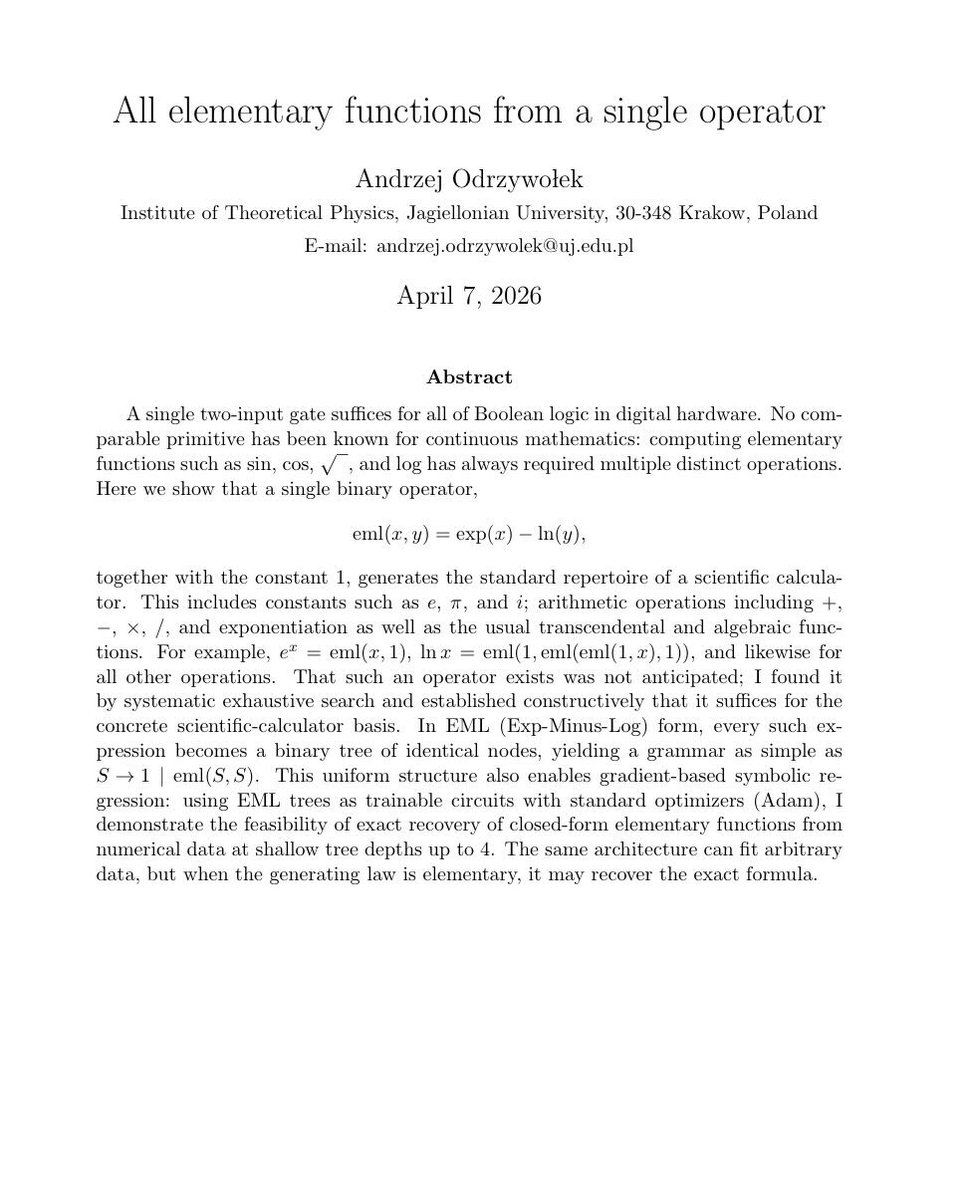
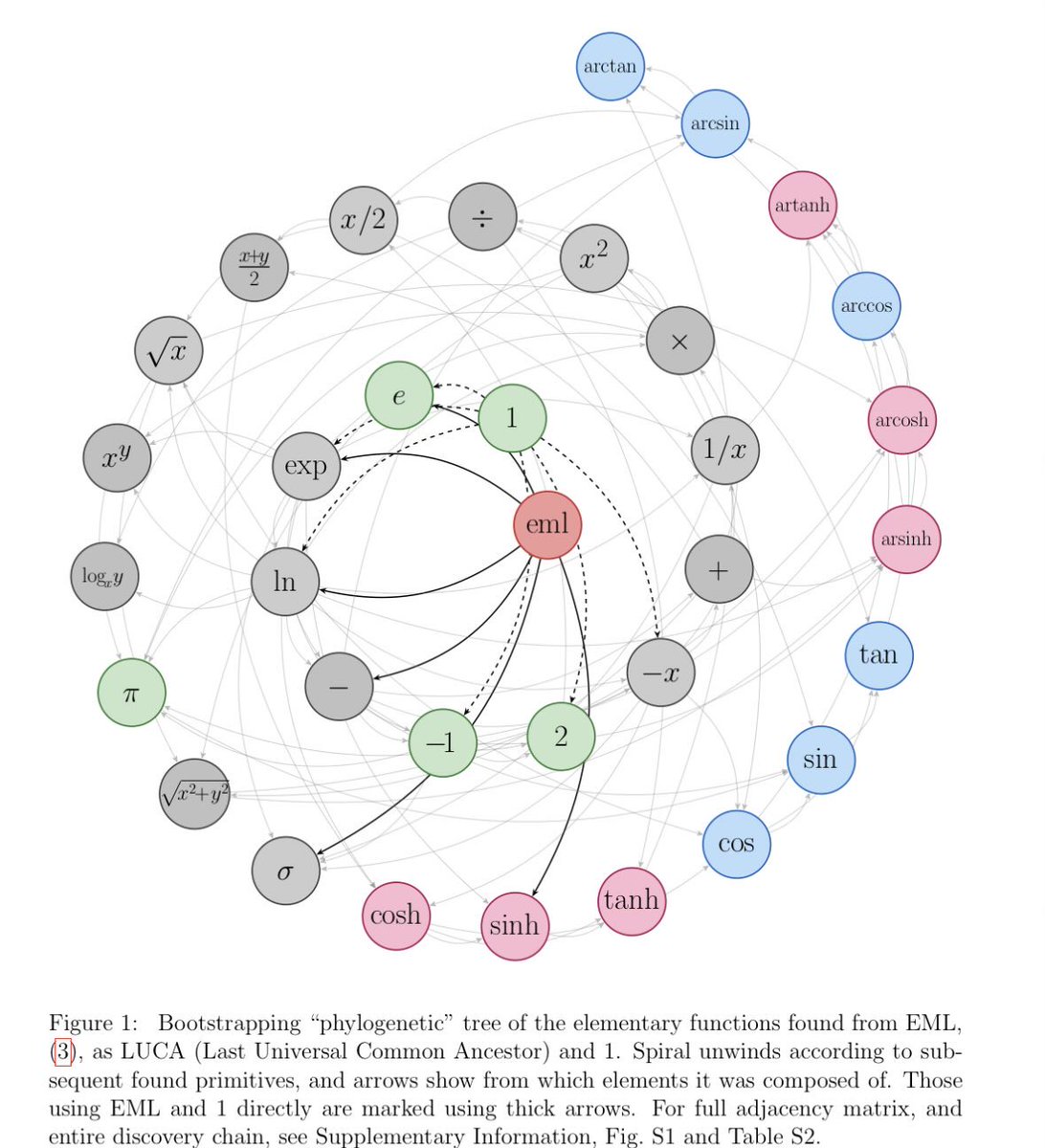
Physicist has written a fascinating big beautiful paper.Let’s not be afraid to call it what it is - groundbreaking. For hundreds of years, mathematics had dozens of “basic” functions: sine, cosine, logarithm, square root, exponential. You know these from school. Everyone does. Now it turns out that all of it is one single operator:
E(x, y) = exp(x) - ln(y), and the constant 1.
Sin, cos, π - everything follows from this neatly , just nest it properly. Nature hid the simplest possible description of reality. And it was just been found. The whole thing is beautiful and remarkable, here the word “groundbreaking” is not a marketing buzzword.
For instance, instead of writing π or 3.14, one can now elegantly write E(E(E(1,E(E(1,E(1,E(E(1,E(E(1,E(E(1,E(1,E(E(1,1),1))),1)),E(E(E(E(E(1,E(E(1,E(1,E(E(1,E(E(E(1,E(E(1,E(1,E(E(1,1),1))),1)),E(E(1,E(E(1,E(E(1,E(E(1,1),1)),E(E(E(1,E(E(1,E(1,E(E(1,1),1))),1)),E(1,1)),1))),1)),1)),1)),1))),1)),E(E(E(1,E(E(1,E(1,E(E(1,1),1))),1)),E(E(1,E(E(1,E(1,E(E(1,E(E(1,E(E(1,E(1,E(E(1,1),1))),1)),E(1,1))),1))),1)),1)),1)),1),1),1))),1))),1)),E(E(E(1,E(E(1,E(1,E(E(1,1),1))),1)),E(E(1,E(E(1,E(1,E(E(1,E(E(1,E(E(1,E(1,E(E(1,1),1))),1)),E(1,1))),1))),1)),1)),1)),1)
arxiv.org/abs/2603.21852
English
rooted in odrzywolek's single-operator trying to make a local symbolic discovery workflow where equations are recovered from data verified with the exact operator and compared across gradient agentic and optional pysr search.
ksa 🏴☠️@kosa12m
Best paper I've read so far this month: All elementary functions (sin, cos, tan, exp, log, powers, roots, hyperbolic functions, π, e, and even basic arithmetic) can be generated from just one binary operator: eml(x, y) = exp(x) − ln(y) …plus the constant 1.
English
right now agent discovery is word of mouth / X / github stars. that's how npm worked in 2012.
we know how this evolves.
Shrijak@shrijacked
every serious ai agent will have an address, memory, and proof. the agent economy will not run on hype. it will run on identity, memory, proof, and trust.
English
@karpathy i think the interesting part is when ingest gets rich enough that later passes stop feeling like retrieval and start feeling like compilation. pdf text, repo structure, images, citations, then cleaner artifacts back into the same corpus.
github.com/shrijacked/Cog…
English

LLM Knowledge Bases
Something I'm finding very useful recently: using LLMs to build personal knowledge bases for various topics of research interest. In this way, a large fraction of my recent token throughput is going less into manipulating code, and more into manipulating knowledge (stored as markdown and images). The latest LLMs are quite good at it. So:
Data ingest:
I index source documents (articles, papers, repos, datasets, images, etc.) into a raw/ directory, then I use an LLM to incrementally "compile" a wiki, which is just a collection of .md files in a directory structure. The wiki includes summaries of all the data in raw/, backlinks, and then it categorizes data into concepts, writes articles for them, and links them all. To convert web articles into .md files I like to use the Obsidian Web Clipper extension, and then I also use a hotkey to download all the related images to local so that my LLM can easily reference them.
IDE:
I use Obsidian as the IDE "frontend" where I can view the raw data, the the compiled wiki, and the derived visualizations. Important to note that the LLM writes and maintains all of the data of the wiki, I rarely touch it directly. I've played with a few Obsidian plugins to render and view data in other ways (e.g. Marp for slides).
Q&A:
Where things get interesting is that once your wiki is big enough (e.g. mine on some recent research is ~100 articles and ~400K words), you can ask your LLM agent all kinds of complex questions against the wiki, and it will go off, research the answers, etc. I thought I had to reach for fancy RAG, but the LLM has been pretty good about auto-maintaining index files and brief summaries of all the documents and it reads all the important related data fairly easily at this ~small scale.
Output:
Instead of getting answers in text/terminal, I like to have it render markdown files for me, or slide shows (Marp format), or matplotlib images, all of which I then view again in Obsidian. You can imagine many other visual output formats depending on the query. Often, I end up "filing" the outputs back into the wiki to enhance it for further queries. So my own explorations and queries always "add up" in the knowledge base.
Linting:
I've run some LLM "health checks" over the wiki to e.g. find inconsistent data, impute missing data (with web searchers), find interesting connections for new article candidates, etc., to incrementally clean up the wiki and enhance its overall data integrity. The LLMs are quite good at suggesting further questions to ask and look into.
Extra tools:
I find myself developing additional tools to process the data, e.g. I vibe coded a small and naive search engine over the wiki, which I both use directly (in a web ui), but more often I want to hand it off to an LLM via CLI as a tool for larger queries.
Further explorations:
As the repo grows, the natural desire is to also think about synthetic data generation + finetuning to have your LLM "know" the data in its weights instead of just context windows.
TLDR: raw data from a given number of sources is collected, then compiled by an LLM into a .md wiki, then operated on by various CLIs by the LLM to do Q&A and to incrementally enhance the wiki, and all of it viewable in Obsidian. You rarely ever write or edit the wiki manually, it's the domain of the LLM. I think there is room here for an incredible new product instead of a hacky collection of scripts.
English