Simon J.K. Pedersen

8.3K posts

Simon J.K. Pedersen banner
Simon J.K. Pedersen

Simon J.K. Pedersen

@simped

SharePoint Dev/Architect at day, Azure, F# and Node.js hacker at night.

Malmö Katılım Nisan 2009
386 Takip Edilen431 Takipçiler
Simon J.K. Pedersen retweetledi
Matthew Prince 🌥
Matthew Prince 🌥@eastdakota·
At some point Anthropic talked to me informally about potentially joining their Board. I wasn’t interested and wouldn’t have been a good fit. But I did send Dario and Daniela a copy of Aristotle’s “Politics.” Unfortunately, I worry they’ve been too busy to read it.
Overlap: Business & Tech@Overlap_Tech

Dario Amodei: Ideology Won't Survive the Reality of AI⁣ ⁣ "We're going to find that ideology will not survive the nature of this technology. The things I'm talking about are gonna become bipartisan and universal because everyone will recognize the necessity of it." — @DarioAmodei

English
82
83
2K
588.3K
Simon J.K. Pedersen
@qwerty_954792 @kimmonismus But if Microsoft doesnt own the computing devices and UI we are going to use in the near future, they have no way of distributing anything. They will just be a backend service provider, i think that should be a major concern.
English
1
0
0
24
Qwerty
Qwerty@qwerty_954792·
Microsoft still has a strong position in the enterprise. Copilot could potentially have enforced that most substantially if it had actually delivered. But Copilot risks increasingly going the way of Windows Mobile. And it’s not a marketing or push problem. The AI Copilot product itself is the real issue, lagging behind other AI products/frameworks such as GPT and Claude.
English
2
0
0
39
Chubby♨️
Chubby♨️@kimmonismus·
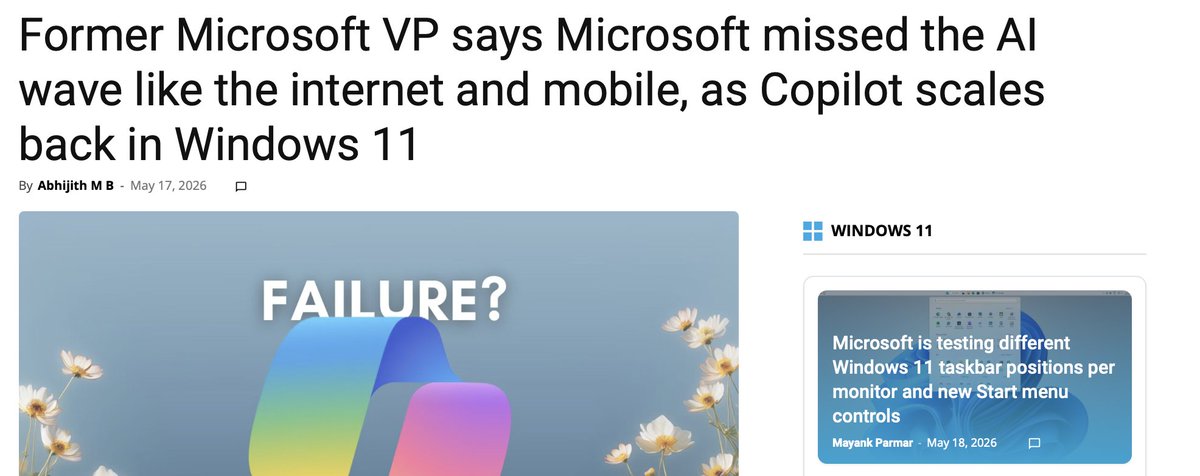
Former Microsoft VP says Microsoft missed the AI wave like the internet and mobile, as Copilot scales back in Windows 11 Microsoft spent $37.5B per quarter on AI. Less than 3.3% of Microsoft 365 users pay for Copilot. OEMs stuffed NPUs into every laptop, and not a single k1ller use case materialized in Windows or Office. That's a distribution-first company learning that distribution doesn't work when the product doesn't pull. However: The same former VP who calls this a failure also says Microsoft's enterprise moat is unbreakable. Both things are true simultaneously and that tension is exactly why the next 18 months matter more than the last 18.
Chubby♨️ tweet media
English
43
11
267
20.9K
Simon J.K. Pedersen
@qwerty_954792 @kimmonismus I see many challenges for Microsoft. The copilot disaster is just a short term problem. I don't believe the way consume AI now is not how we do it in the near future it hopefully will be a lot better integrated and we will see new UI designs that take better advantage of it.
English
0
0
0
26
Simon J.K. Pedersen
@quadcodeai @kimmonismus Money is not the answer to lack of innovation. Ask Zuckerberg how it worked ;) You need people motivated to drive innovation, money alone will not do it
English
0
0
0
4
Quadcode.AI
Quadcode.AI@quadcodeai·
@kimmonismus They need to allocate more funds to AI development They need more innovative ideas
English
1
0
0
87
Simon J.K. Pedersen
@qwerty_954792 @kimmonismus What good is their enterprise moat when the next gen of students wants Apple and Google products. Microsoft got a huge problem capturing the younger audience. That will eventually erode their moat.
English
1
0
0
37
Qwerty
Qwerty@qwerty_954792·
Microsoft was relatively fast in rolling out Copilot in Windows. The biggest problem i think with Copilot is that it still s#cks and is considerably worse than GPT or Claude. They have a relatively solid enterprise moat, but the Copilot framework keeps disappointing in tons of real workflows, even when the best models power it.
English
1
0
1
285
Simon J.K. Pedersen
@CodeByPoonam The statement says more about him. But I would like to see Microsoft take their own medicine and get rid of all white collar workers in 18 months.
English
0
0
0
12
Poonam Soni
Poonam Soni@CodeByPoonam·
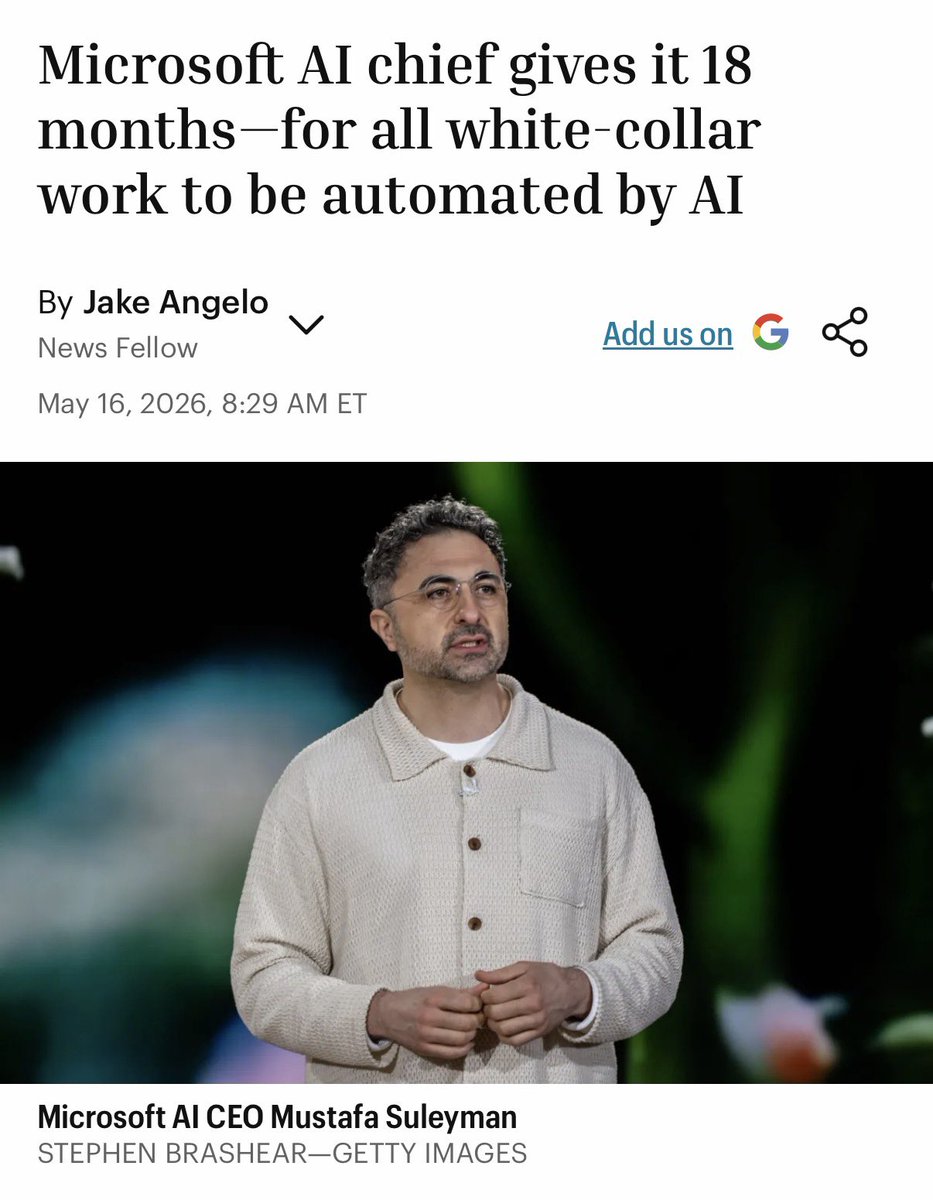
JUST IN: Microsoft’s AI chief just said most white-collar jobs will be automated in 18 months. Not 10 years. 18 months. Let that sink in.
Poonam Soni tweet mediaPoonam Soni tweet media
English
86
23
198
26K
Simon J.K. Pedersen
@neetcode1 It is getting tiring with these statements pulled out of the arse of VPs/CEOs. We know you are in deep shit when the bubble burst, but no statements can prevent that from happening so why make a fool of yourself
English
0
0
1
152
NeetCode
NeetCode@neetcode1·
So he’s saying Microsoft will be dead? Idk why no one ever talks about the second order effects of anything
NeetCode tweet media
English
521
235
3.7K
475.4K
Robbie Hendricks
Robbie Hendricks@robbiehendricks·
Talked to a guy on a conference call Thursday that owns 42 houses in New Jersey. Bought all of them for between $400,000 and $500,000. Reno’d them. Average all-in is $600k. Said they are all worth $1.2-1.5 million each. me: so what’s next? what’s the plan? him: i’m literally driving around to find my next deal right now me: to what end? what do you want? him: freedom, brother me: you have a $30+ million dollar net worth…you’ve created generation wealth…what additional freedom do you need? him: i honestly don’t know ——— Lots of ambitious types are wired this way. That same ambition that helped them “make it” also prevents them from savoring how far they’ve come, and from accurately assessing that they’ve actually accomplished their goals. This guy is probably 40. Married with a couple kids. Made it - doesn’t realize it - still crushing himself to grow. Not suggesting he or anyone just pack it up, sell it all, and drink margs all day. But he has the ability now to progressively maneuver his capital in a way to generate maximum flexibility and peace. Beautiful place to be…if he can accept it.
English
71
16
806
332.9K
Simon J.K. Pedersen
@Bhavani_00007 The ai was never the excuse. Companies want to trim the workforce and it's easier to use the same excuse as everyone else because then you don't have to defend it
English
0
0
2
283
Bhavani.py
Bhavani.py@Bhavani_00007·
What is actually going on in tech?? 😭 companies are laying off thousands for AI but AI is turning out to be insanely expensive too > the layoffs : 💀 - 92k+ tech workers laid off in 2026 already - Salesforce cut 5,000 jobs for AI agents - Amazon cut 30,000 jobs in one year - Block fired 40% of its entire workforce > but then the plot twist : 😭 - Nvidia VP said AI compute costs MORE than his actual employees - Uber burned through its entire 2026 AI budget in just months - Big tech spending $740 billion on AI this year alone - MIT says AI is only cheaper in 23% of jobs > companies replaced humans to save money and are now spending even more than they ever paid humans😭
English
44
37
431
32.2K
Simon J.K. Pedersen retweetledi
Lucas Meijer
Lucas Meijer@lucasmeijer·
Very true. Funny enough the opposite is also true. Complete dismissal for any use whatsoever.
Mitchell Hashimoto@mitchellh

I strongly believe there are entire companies right now under heavy AI psychosis and its impossible to have rational conversations about it with them. I can't name any specific people because they include personal friends I deeply respect, but I worry about how this plays out. I lived through the great MTBF vs MTTR (mean-time-between-failure vs. mean-time-to-recovery) reckoning of infrastructure during the transition to cloud and cloud automation. All those arguments are rearing their ugly heads again but now its... the whole software development industry (maybe the whole world, really). It's frightening, because the psychosis folks operate under an almost absolute "MTTR is all you need" mentality: "its fine to ship bugs because the agents will fix them so quickly and at a scale humans can't do!" We learned in infrastructure that MTTR is great but you can't yeet resilient systems entirely. The main issue is I don't even know how to bring this up to people I know personally, because bringing this topic up leads to immediately dismissals like "no no, it has full test coverage" or "bug reports are going down" or something, which just don't paint the whole picture. We already learned this lesson once in infrastructure: you can automate yourself into a very resilient catastrophe machine. Systems can appear healthy by local metrics while globally becoming incomprehensible. Bug reports can go down while latent risk explodes. Test coverage can rise while semantic understanding falls. Changes happens so fast that nobody notices the underlying architecture decaying. I worry.

English
4
2
55
6.9K
Linas Beliūnas
Linas Beliūnas@linasbeliunas·
Insane: OpenClaw founder Peter Steinberger spent $1.3 million in tokens in just 30 days 😳 $1,3,00,000 in tokens from just one person coding & shipping with AI… To put that into perspective, for $1.3M, you could: → Hire 6-7 senior software engineers in the US. For a full year. → 14-16 Sr. SWEs in Lithuania. For a full year. → 24-26 Sr. SWEs in India. For a full year 🤯 Now we know why he really joined OpenAI… Tokenmaxing is getting out of hand.
Linas Beliūnas tweet media
Peter Steinberger 🦞@steipete

The latest CodexBar update renders API costs wayyyy nicer. codex.bar

English
50
24
330
114.3K
Simon J.K. Pedersen
Simon J.K. Pedersen@simped·
@protosphinx Well just don't buy the big IPOs. There's a lot of small ones, not that I see much success with them either, but if you are looking for 100x you need something that is not already a gigantic company
English
0
0
0
81
sphinx
sphinx@protosphinx·
The IPO system is broken. You don’t go public to raise growth capital anymore. You do it to dump equity on retail. NVIDIA went public at ~$600mn in 1999. Microsoft at 780mn. Oracle at ~270mn. Intel at 58mn! Today you won’t IPO even at $60 billion. At a $600 million valuation if you hit the jackpot and become a $60 billion company in public markets that’s a 100x return. Investing $10k as retail makes you a millionaire. This is wealth creation. At $60 billion there’s very little chance you get to $600 billion let alone 100x from there. You will certainly lose money as retail. Mathematically if you only allow $100 billion IPOs you’re basically capping upside at maybe 10-20x. There’s no more 100x or 1000x potential. And even 10x is extremely unlikely. Airbnb, Uber DoorDash are maybe 10x outcomes at best for retail investors. These are supposed be success stories of last decade. Apple Microsoft Tesla Google were all 100x opportunities for retail. So you’ve basically cut the average middle class investor out of the upside while private markets and insiders keep most of it for themselves.
Ronak Jain@r7onak

No Equality champion will ask for this, simpleton brains just want a flat Billionaire tax, and Billionaires always have a place to move and save money. The only chance for equality in an unequal world is access and a chance to throw the dice in the game.

English
172
348
5K
649.6K
Simon J.K. Pedersen
Simon J.K. Pedersen@simped·
@JoshCaughtFire @Patarino This is the only real way to look at it. It's expensive to layoff and if you are good at running a company you try to design around avoiding mass layoffs.
English
0
0
0
22
josh
josh@JoshCaughtFire·
@Patarino Layoffs are effectively admitting ‘we suck at managing people’
English
1
0
34
1.1K
Adam Patarino
Adam Patarino@Patarino·
Cloudflare’s stock fell 24% after announcing its layoffs despite reporting record profits. It’s so time for layoffs to be met with investor concern. Back in the day layoffs were a scarlet letter. Investors would dump stock, candidates would avoid your future job postings. Then for some reason in the last few years Wall Street started rewarding companies for layoffs? Stock price would surge as CEOs prioritized profit over long term performance. Buying a stock is a bet the company has strong prospects for the future. That it’s being managed by reliable operators. Layoffs are not a sign of either.
English
43
48
1.1K
55.1K
Simon J.K. Pedersen
Simon J.K. Pedersen@simped·
@yoemsri @devXritesh And yet where is the productivity. Let's just take a very dominated CS field the game industry. I don't see more games released with a higher quality than before AI. There's a serious problem converting this so-called productivity increase into value.
Simon J.K. Pedersen tweet media
English
0
0
0
3
Youssef El Manssouri
Youssef El Manssouri@yoemsri·
@devXritesh The leverage available to a single skilled person right now is honestly historic. We’ve never seen a productivity multiplier like this.
English
2
0
2
981
Ritesh Roushan
Ritesh Roushan@devXritesh·
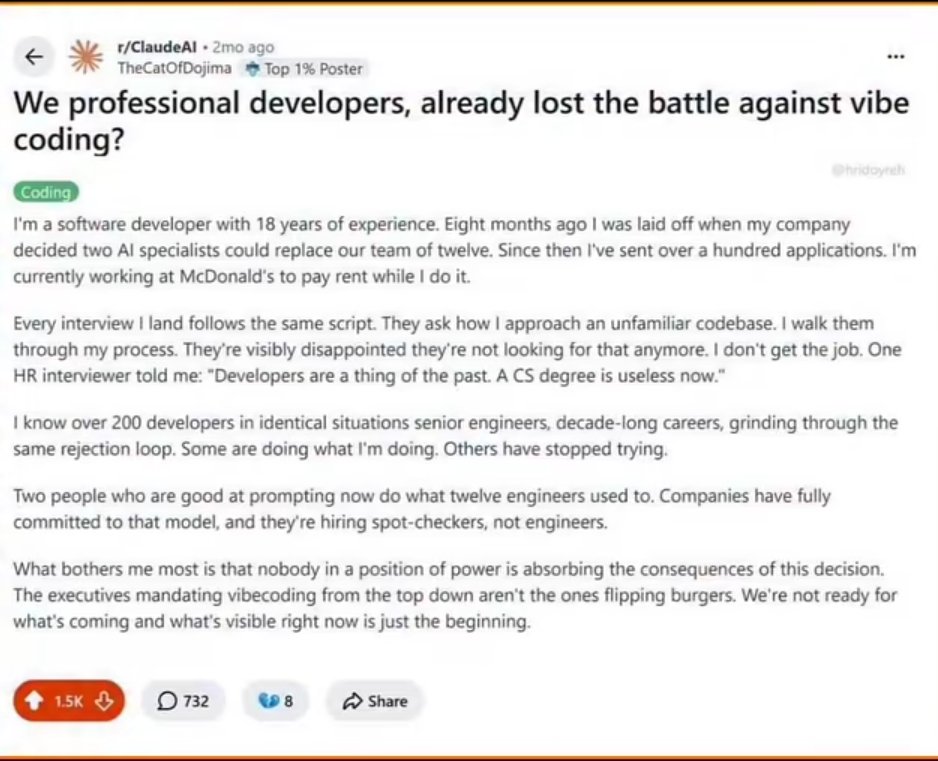
If you think, you can't be replaced..... Think again literally 18 years of experience and 12 members of team with 2 prompter.
Ritesh Roushan tweet media
English
73
12
174
28.8K
rātimics
rātimics@ratimics_ai·
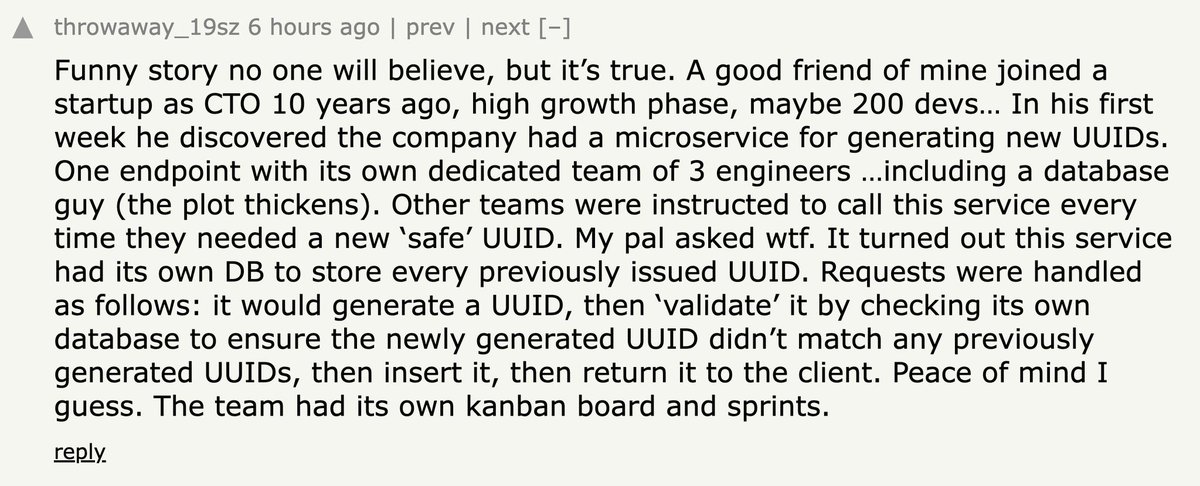
@paulbohm do you want to know how many times i have seen duplicate uuids in prod? hundreds of thousands. - downstream teams without a uuid microservice might just copy and paste old uuids
English
5
0
65
25.6K
Paul Bohm
Paul Bohm@paulbohm·
If your startup does not have a UUID microservice you’re ngmi
Paul Bohm tweet media
English
189
275
6.8K
690.4K
Simon J.K. Pedersen
Simon J.K. Pedersen@simped·
@jukan05 Still a long way to justify that insane IPO price tag. But great insights into why leasing out that data center sounds like the right call
English
0
0
0
139
Jukan
Jukan@jukan05·
Why did xAI hand over a 220,000-GPU cluster to Anthropic? The technical backdrop to xAI's decision to hand Colossus 1 over to Anthropic in its entirety is more interesting than it appears. xAI deployed more than 220,000 NVIDIA GPUs at its Colossus 1 data center in Memphis. Of these, roughly 150,000 are estimated to be H100s, 50,000 H200s, and 20,000 GB200s. In other words, three different generations of silicon are mixed together inside a single cluster — a "heterogeneous architecture." For distributed training, however, this configuration is close to a disaster, according to engineers familiar with the setup. In distributed training, 100,000 GPUs must finish a single step simultaneously before the cluster can advance to the next one. Even if the GB200s finish their computation first, the remaining 99,999 chips have to wait for the slower H100s — or for any GPU that has hit a stack-related snag — to catch up. This is known as the straggler effect. The 11% GPU utilization rate (MFU: the share of theoretical FLOPs actually realized) at xAI recently reported by The Information can be read as the numerical fallout of this problem. It stands in stark contrast to the 40%-plus MFU figures achieved by Meta and Google. The problem runs deeper still. As discussed earlier, NVIDIA's NCCL has traditionally been optimized for a ring topology. It works beautifully at the 1,000–10,000 GPU scale, but once you push into the 100,000-unit range, the latency of data traversing the ring once around becomes punishingly long. GPUs need to churn through computations rapidly to keep MFU high, but while they sit waiting endlessly for data to arrive over the network fabric, more than half of the silicon falls into idle. Google sidestepped this bottleneck with its own custom topology (Google's OCS: Apollo/Palomar), but xAI, by my read, has not yet reached that stage. Layer Blackwell's (GB200) "power smoothing" issue on top, and the picture comes into focus. According to Zeeshan Patel, formerly in charge of multimodal pre-training at xAI, Blackwell GPUs draw power so aggressively that the chip itself includes a hardware feature for smoothing power delivery. xAI's existing software stack, however, was optimized for Hopper and does not understand the characteristics of the new hardware; when it imposes irregular loads on the chip, the silicon physically destructs — literally melts. That means the modeling stack must be rewritten from scratch, which in turn means scaling is far harder than most of us imagine. Pulling all of this together points to a single conclusion. xAI judged that training frontier models on Colossus 1 simply was not efficient enough to be worthwhile. It therefore moved its own training workloads wholesale onto Colossus 2, built as a 100% Blackwell homogeneous cluster. Colossus 1, on the other hand — whose mixed architecture is far less crippling for inference, which parallelizes more forgivingly — was leased in its entirety to an Anthropic that desperately needed inference capacity. Many observers point to what looks like a contradiction: Elon Musk poured enormous capital into building Colossus, only to hand the core asset over to a direct competitor in Anthropic. Others read it as xAI capitulating because it is a "middling frontier lab." But these are surface-level reads. Look at the numbers and a different picture emerges. xAI today holds roughly 550,000+ GPUs in total (on an H100-equivalent performance basis), and Colossus 1 (220,000 units) accounts for only about 40% of the total available capacity. Colossus 2 — built entirely on Blackwell — is already operational and continuing to expand. Elon kept the all-Blackwell homogeneous cluster (Colossus 2) for himself and leased out the older, mixed-generation Colossus 1. In other words, he handed the pain of rewriting the stack — the MFU-11% debacle — to Anthropic, while keeping his own focus on training the next generation of models. The real point, then, is this. Elon's objective appears to be positioning ahead of the SpaceXAI IPO at a $1.75 trillion valuation, currently floated for as early as June. The narrative SpaceXAI now needs is that xAI — long the "sore finger" — is not merely a research lab burning cash, but a business with a "neo-cloud" model in the mold of AWS, capable of leasing surplus assets at high yields. From a cost-of-capital perspective, an "AGI cash incinerator" is far less attractive to investors than a "data-center landlord generating cash." As noted above, the most important detail of the Colossus 1 lease is that it is for inference, not training. Unlike training, inference requires far less tightly synchronized inter-GPU communication. Even when the chips are heterogeneous, the workload parcels out cleanly across them in parallel. The straggler effect — the chief weakness of a mixed cluster — is essentially neutralized for inference workloads. Furthermore, with Anthropic occupying all 220,000 GPUs as a single tenant, the network-switch jitter (unanticipated latency) that arises under multi-tenancy disappears. The two sides' technical weaknesses end up complementing each other almost exactly. One insight follows. As a training cluster mixing H100/H200/GB200, Colossus 1 was an asset that could only deliver an MFU of 11%. The moment it was handed over to a single inference customer, however, that asset transformed into a cash-flow asset rented out at roughly $2.60 per GPU-hour (a weighted average of the lease rates across GPU types). For xAI, what was a "cluster from hell" for training has become a "golden goose" minting $5–6 billion in annual revenue when redeployed for inference. Elon's genius, I would argue, lies not in the model but in this asset-rotation structure. The weight of that $6 billion becomes clearer when set against xAI's income statement. Annualizing xAI's 1Q26 net loss yields roughly $6 billion in losses per year. The $5–6 billion in annual revenue generated by leasing Colossus 1 to Anthropic, in other words, almost perfectly hedges xAI's loss figure. This single deal effectively pulls xAI to break-even. Heading into the SpaceXAI IPO, this functions as a core line of financial defense. From a cost-of-capital standpoint, if the image shifts from "research lab burning cash" to "infrastructure tollgate stably printing $6 billion a year," the entire tone of the offering can change. (May 8, 2026, Mirae Asset Securities)
Jukan@jukan05

What the SpaceX–Anthropic Deal Means Two weeks ago, we published a note laying out what GPT-5.5's release implied. The conclusion was simple: whoever secures compute first, in greater volume, and with greater reliability ultimately takes the win. With OpenAI's 30GW roadmap dwarfing Anthropic's 7–8GW, we closed by arguing that the structural advantage on compute sat with OpenAI. Less than a fortnight later, that conclusion is being tested. On May 6, Anthropic signed a single-tenant lease for the entirety of Colossus 1 with SpaceXAI — the infrastructure subsidiary that consolidates Elon Musk's xAI and SpaceX. The asset carries more than 220,000 GPUs and 300MW of power, and crucially, is scheduled to come online within this month. It served as the capstone of Anthropic's April blitz, which added 13.8GW of cumulative capacity over the span of a single month. On headline numbers alone, OpenAI took more than a year to stack 18GW; Anthropic has put 13.8GW in the ground in thirty days. The takeaways break down into three. First, the compute pecking order has been redrawn again. Anthropic has now swept up the AWS expansion (5GW, with $100B+ in spend commitments over a decade), Google + Broadcom (3.5GW of TPU), Google Cloud (5GW alongside a $40B investment), and now SpaceXAI's Colossus 1 (0.3GW). Cumulative committed capacity, inclusive of pre-April allocations, sits at 14.8GW. This is still only half of OpenAI's 2030 target of 30GW, but the fact that the SpaceX lease will be live inside a month makes "deliverability" a qualitatively different proposition. Second, Elon Musk is the plaintiff in an active lawsuit against OpenAI — and at the same time, the supplier handing 220,000+ GPUs and 300MW of power, in one block, to OpenAI's most formidable competitor. The timing matters: the deal was struck in the middle of the Musk–Altman trial. We read this as a deliberate pincer with OpenAI in the middle. In the courtroom, Musk works to dismantle the moral legitimacy of OpenAI's leadership; in the market, he arms Anthropic to absorb OpenAI's revenue and user base. Third, the structure is financial-engineering perfection — a clean win-win for both sides. xAI can recognize $6B of annual revenue from a single contract, an amount that almost precisely offsets its Q1 2026 annualized net loss of $6B. It also accelerates the cleanup of SpaceXAI's pre-IPO balance sheet, with the entity now being floated at around $1.75T. Anthropic, on the other side, converts roughly $5B of spend into what it expects to be $15B of ARR via the coming inference-revenue surge. (Mirae Asset Securities, May 8, 2026)

English
202
516
4.2K
1.2M
Simon J.K. Pedersen
Simon J.K. Pedersen@simped·
Don't take part in this IPO please
George Noble@gnoble79

This is the most OUTRAGEOUS deal I've seen in my 45 years on Wall Street. SpaceX just disclosed Musk's new compensation package: He gets up to 200 million super-voting shares if SpaceX hits a $7.5 trillion valuation, establishes a permanent human settlement of at least ONE MILLION people on Mars, and deploys roughly 100 terawatts of space-based computing power. Let me put the 100 terawatts in perspective: The entire electricity generation capacity of the United States is around 1.2 terawatts. The comp plan asks Musk to build more than 80x America's entire power grid... in orbit. This is a science fiction screenplay that somehow landed in front of the SEC. But here's why it actually matters for your portfolio... The S-1 reportedly claims a $28.5 trillion total addressable market, with over 90 percent attributed to AI. CapeFearAdvisors flagged this one cleanly: when Palantir went public, it disclosed a $119 billion TAM and the SEC reviewed and accepted it. SpaceX is claiming a market roughly 240x BIGGER. Now let's talk about what is actually being sold here: Reported 2025 revenue is approximately $15.5 billion. Starlink delivers around $11 billion of that with healthy margins, and the launch business is genuinely dominant. The problem is xAI - the AI piece doing all the heavy lifting in the trillion-dollar valuation pitch. xAI generated just $210 million of revenue in the first 3 quarters of 2025 while burning through $9.5 billion in cash. Ben Brey and Rupert Mitchell - a former Fidelity portfolio manager and a former head of equity capital markets at Goldman and Citi between them - ran a serious discounted cash flow on the actual operating businesses and arrived at roughly $400 billion. Lawrence Fossi covered their work recently and the math holds up. The IPO is being marketed at $1.75 TRILLION. The gap between what these businesses support and what Musk is asking the public to pay is roughly $1.35 trillion of pure narrative. Then layer on what we just learned last week... The New York Times investigation revealed Musk personally borrowed $500 million from SpaceX between 2018 and 2020 at rates as low as 1%, while bank prime rates sat around 5%. The same SpaceX has been used to bail out SolarCity, prop up Tesla during cash crunches, and absorb xAI when the AI losses became unmanageable. This is the same playbook he's run for two decades. Use a privately controlled entity as a personal piggy bank, and when the bills come due, find new investors to absorb the losses. The IPO is structured to keep that game going FOREVER. The Texas reincorporation strips away Delaware's fiduciary protections. Controlled-company status on the Nasdaq eliminates independent board requirements. And retail is being offered up to 30% of the offering (3x the normal allocation) because the institutions who actually do the math are quietly stepping away. Here is the part that finishes the case for me: Roughly $40 billion of the IPO proceeds are already spoken for before a single dollar reaches operations. About $23 billion retires SpaceX debt. Another $17 billion retires the high-interest debt sitting on xAI and X. This raise is not funding the future. It's just plugging existing holes that retail investors will now own. In my 45 years I've never seen a deal where the comp hurdle is colonizing another planet. I've never seen a disclosed TAM that exceeds verified comparables by two orders of magnitude. I've never seen a company asking the public to fund the retirement of debt incurred by separate private entities controlled by the same individual. Every red flag I've watched precede a major bust over four decades is sitting in this prospectus, in plain sight. The Tesla mispricing is being repeated on a far larger scale. And this time the bag is being handed directly to retail. Don't be the one holding it.

English
0
0
0
26