

Hamin Jeon
211 posts


$OPEN this is up now on OPENDOOR.ARMY website, hope you all like it, lmk if there's any problems or q's!
Qubicle | Based Dept. Treasury 🏦@cubeqube
$OPEN I am polishing up a BIG update coming soon to OPENDOOR.ARMY - adding app-wide SCOPING and DRILLDOWNS and overall making everything easier to understand and view Scope all stats easily by date range, quarter, etc. as well as 2 distinct views - Inventory and Activity. Inventory is a point in time snapshot of entire inventory while activity will easily show what happened between date ranges across the stats. You will also be able to easily filter all stats by State and Region instead of just a loose definition of Markets. Drilldown will let you quickly drill down into each home that makes up a stat or number displayed on a widget so you can easily verify for yourself against the available public sources provided in case the tracker is messed up, etc. Also fixing up an issue I saw with some homes incorrectly being marked as a fallen through/withdrawn contract. Also adding the Opendoor link onto homes that are pending as the Opendoor page seems to be kept alive now for a majority pending homes
English

No, imo macro won't matter as Kaz mentioned.
If opendoor truly succeeds which I think it will, it will be the default platform the majority of people use to transact real estate, meaning they take the whole pie.
People will want to use it, just like how people use Ubereats to order food/groceries, much of the market share will flock to opendoor to buy/sell homes because of it's speed and efficiency.
Obviously a lot needs to be done. But that's the bet. The potential upside is incredible.
English

$OPEN
How will Kevin Warsh cut interest rates for home buyers?
His real plan is to cut short-term rates while shrinking the Fed’s balance sheet — selling off mortgage bonds instead of buying more.
He does it at the FOMC meetings, usually eight times a year. The committee votes on a new target range for the federal funds rate — that’s the overnight rate banks charge each other.
To actually push that rate lower, the Fed mainly tweaks two numbers:
• They lower the interest they pay on reserve balances that banks keep at the Fed.
• They adjust the rate on their overnight reverse repo facility.
Those two administered rates act like a floor and ceiling, so the market rate follows them down. No bond-buying needed.
Warsh has been clear he wants to do this while still shrinking the balance sheet, which is the part that makes mortgage traders nervous.
English
@urbnsteezus @ijustinvest4fun do not be complacent with sleeping giant. Aim high brothers
English
@ijustinvest4fun @skysync6652 exactly lol. ill never understand people on here
English
You guys want to a magic trick?
Bookmark this post
$open 🪄
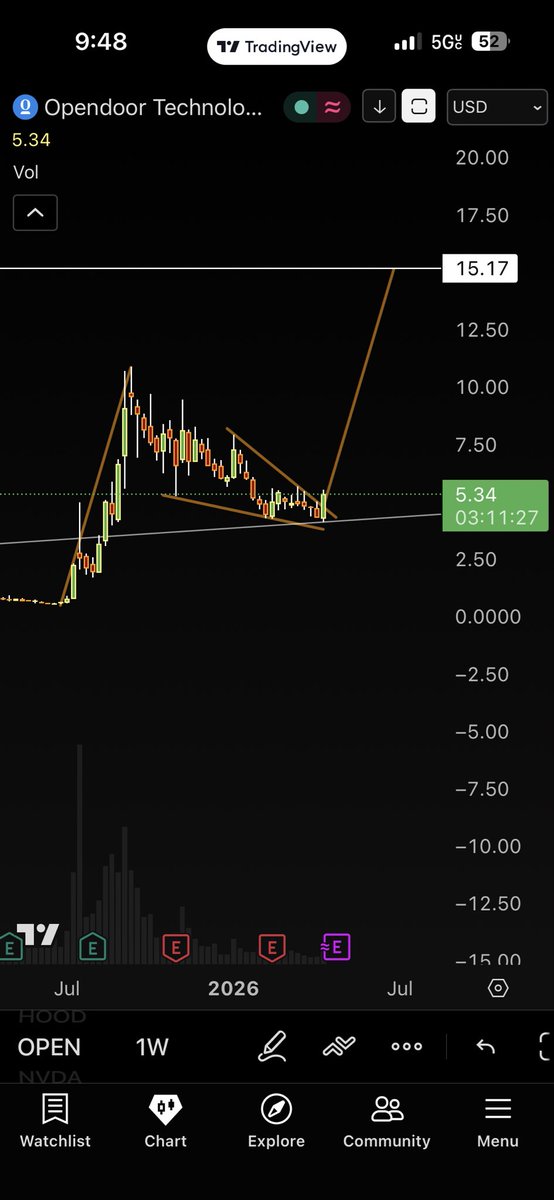
My end of year target is now $15.17
Yes $15.17
English
@skysync6652 This is all based off the measured move of the breakout.
English
@ssj2abid @pappygist @nejatian Do you think we might run after q1 earnings if they give a great guidance for q2? Or do you think we'll need to wait until q2 earnings
English
@pappygist @nejatian Ding ding ding ding.
That is when $OPEN rips,
So most likely Q2 earnings 🙏🏻
English

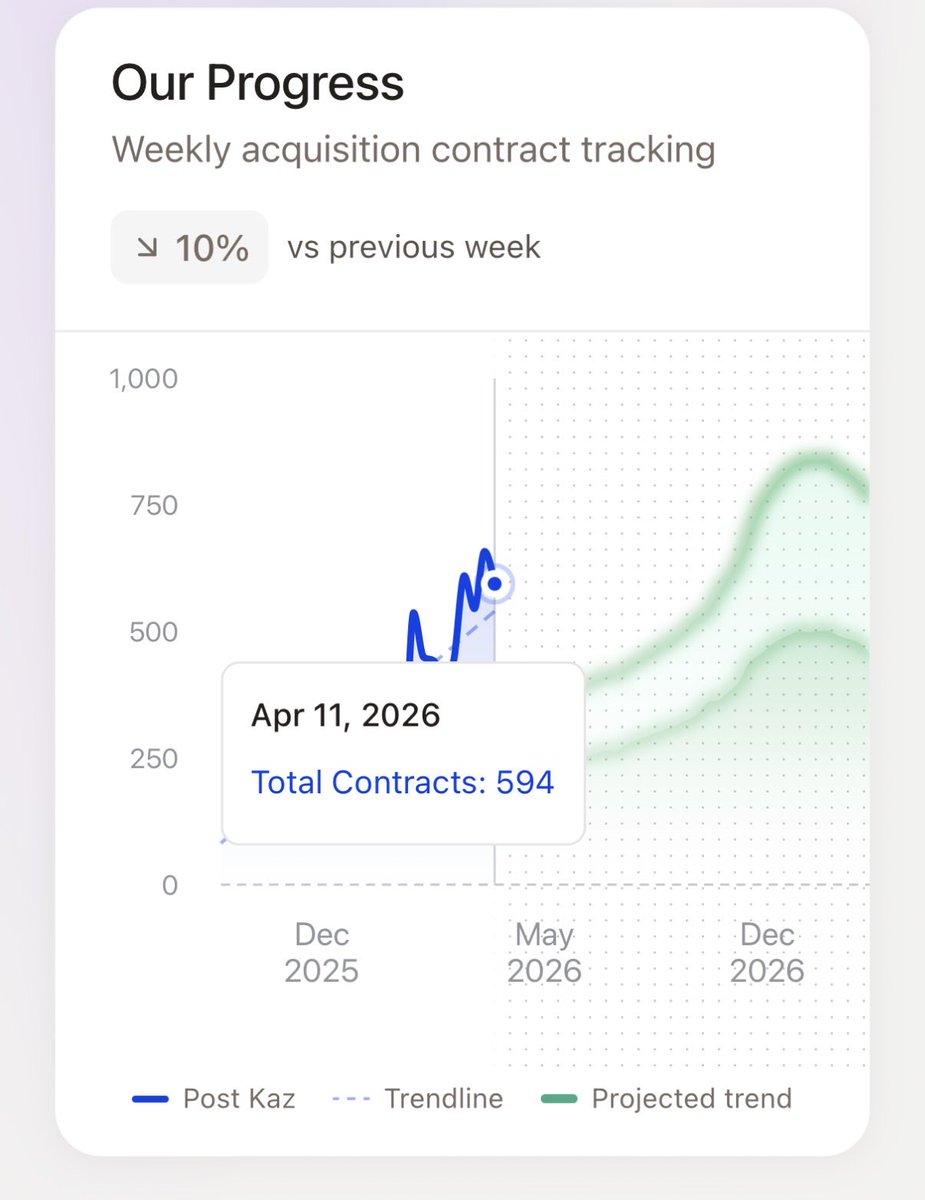
$OPEN holding strong above the trend line.
600 houses/week
31,200/year
$400,000 median home price
7% contribution margin
$873 MM in gross profit
$300 MM costs
$573 MM earnings
35x tech multiple
$20 BB MC
$22 SP
THAT’S RIGHT NOW
EBITA POSITIVE here we come!
@nejatian
English

$ONDS Ignore the noise.
ONDS will hit $20+
Like if you agree

English
@ssj2abid Keep this coming! Let's have a daily/weekly math party until we achieve $80+
English
Who wants to see some more $OPEN math? 👀
This time we're going over the new products built into Opendoor 2.0:
→ The Doma acquisition (title + escrow, now owned in-house)
→ The Opendoor Mortgage product (AI-native, no lender fees, lower rates)
I'm going to break down what a single home transaction looks like under the old Opendoor vs the new full stack.
Then scale the math.
It's very tasty 👀
GIF
English

The rebound predicted for the first half of April has reached my target level, just as I forecasted when the market was still below 6500 $SPX and most people were calling for a bear market.
In the Sunday weekly post below, I examine the critical levels for market structure, their significance, and how traders are positioning themselves around these areas in light of the April OpEx.
Additionally, in an attached free post, I place all these events into a geopolitical and economic context.
Unfortunately, there is a lot of guesswork, confusion, and trend-chasing behavior out there.
Me, I have been consistently moving forward, and in the macro space, I have been accurate over 73% of the time, staying ahead of the news and the analysts. I have also been 60% accurate on a micro-structural level since the inception of my Substack. (...according to backtests)
#stockmarket #trump #oil
$SPX $SPY $ES $ES_F $NDX $NQ $NQ_F $VIX $VVIX
#spx500 #optionstrading #riskmanagement

Alma.Trk@alma271828
When the $SPX was below 6500, I forecasted that a rebound would come in early April, and gave you the structurally really important levels to monitor. When $FNMA was still under $5, I signaled that I was long, because — as I’ve been explaining since last November, and even more so since August — Trump will need the GSEs in the near future, and they will have to be recapitalized. This is a longer-term position. Regarding the Iranian conflict, I wrote that the temporal peak of aggression would occur during the March OpEx week, and that I expect the next wave in the second half of April. That’s why I flagged a short backwardation trade in oil, as front-end volatility was strongly bid. (These were free signals. I update the levels in my blog. Link in bio.) I continue to draw your attention to the three major risks: ▫️Japanese yen carry trade unwind risk, as Japan will be forced to raise rates. This is already clearly visible. ▫️AI bubble burst risk, since $NVDA is significantly over-leveraged, infrastructure has been massively overbuilt relative to end-user demand, current capacity, and future regulations. Additionally, TSMC’s latest earnings report already showed slowing expectations starting from Q2. ▫️Geopolitical risk, because the East holds inflation as a weapon, and China will not let this go. There is currently a diplomatic breather, but a new wave is coming soon. It will quiet down by summer, but in November China itself will directly threaten America along the First Island Chain, with strong propaganda attacks aimed at inciting unrest, dissatisfaction, and uncertainty inside the US. This has been well prepared, and apart from me, almost no one is talking about it. There is enormous information noise right now. Most people are either pretending to be smart or simply chasing the news and sentiment. I, however, already predicted these events and their timing last year — roughly since February — as they gradually unfolded. Read my previous posts (and stop asking grok everything. You have your own brain...) I will give one more signal when I see it… and after that, I’m done being active on Twitter😘
English
English

@theelkingtonway Approximately every 10 minutes I track Opendoor entire current listing set and compare it with snapshots to detect new listings, delistings, price changes, etc. You can verify it yourself by comparing Opendoor’s map with the Map Explorer.
All here: aubermark.github.io/open-tracker/
English
@ssj2abid wow. I didn't realize that they already reported 10% margin. Good stuff!
English
@skysync6652 They hit like 10% contribution margins with their October cohort, best margins ever.
We should expect this happening more often as the AI gets better.
English
Let's talk more $OPEN math.
Let's talk $OPEN warrants.
And this time it's about why I keep talking about Q2.
$OPEN warrants expire November 20, 2026.
→ Series K: $9 strike
→ Series A: $13 strike
→ Series Z: $17 strike
Kaz issued these to shareholders as a special dividend. His exact words:
"If management gets performance-based upside, shareholders should too."
Now think about the timeline.
→ Q1 earnings: May 2026
→ Q2 earnings: ~August 2026
→ Warrants expire: November 20, 2026
I believe Q2 is the inflection point.
Here's what I expect:
→ 700-800 homes acquired per week
→ 650+ homes sold per week (sales lag acquisitions by 8-11 weeks)
→ 5-7% contribution margin
→ EBITDA positive
Let's run the math.
650 homes/week sold at 5% margin:
→ 8,450 homes/quarter
→ $3.4B revenue
→ $169M contribution profit
→ EBITDA: +$119M (positive)
→ Net income: +$35M/quarter
→ Annualised: $141M/year
→ $6.3 (45x P/E) | $10.6 (75x P/E)
650 homes/week sold at 7% margin:
→ 8,450 homes/quarter
→ $3.4B revenue
→ $237M contribution profit
→ EBITDA: +$187M (positive)
→ Net income: +$103M/quarter
→ Annualised: $411M/year
→ $18.5 (45x P/E) | $30.8 (75x P/E)
Now look at the warrants again.
At 7% margin:
→ Series K ($9): in the money at both 45x and 75x ✓
→ Series A ($13): in the money at both 45x and 75x ✓
→ Series Z ($17): in the money at 45x, deep in the money at 75x ✓
All three series hit if Kaz delivers 7% margin at current volume.
The stock doesn't need to go to $80 for these warrants to print.
It just needs Q2 to show the business is working.
Now here's where it gets spicy for the stinky bears.
When warrants are exercised, shareholders pay cash to buy new shares at the strike price. That means:
→ Millions of warrants get exercised
→ Cash flows into Opendoor's balance sheet
→ Shorts need to cover as the stock moves up
→ More buying pressure from warrant holders exercising
→ More covering from shorts
Kaz designed this.
The November expiry isn't random. He has Q1 and Q2 earnings to prove the model, then the warrants create a wave of buying pressure right as the thesis is confirmed.
658 contracts last week.
Consistent uptrend.
New all time high.
Margins improving.
This man thought this through deeply.
The stock is $4.40 today.
nfa, long $OPEN.
English
The April rebound has likely begun...(?)
I didn't get the 99% signal on my reversion model that I wanted to see in this vol environment, but the probability stayed above 97.36% the entire time. I pointed this out in the chat recently, just as I brought to your attention that $DJI has already broken through the structural levels marked earlier.
For the rebound to be sustained, the spot needs to hold the following levels:
$SPX: 6537.38
$ES / $ES_F: 6569.91
However, sentiment will only become optimistic again—signaling a belief that policy can manage the economic risks—if price action does not reject these levels:
$SPX: 6728.15
$ES $ES_F: 6758.38
(These are the next structural levels that inform us about market sentiment).
As I have been writing since last year, BlackRock and the UAE are establishing $100 billion funds to turn the Middle East into the world's AI data center hub, and to build the blockchain infrastructure that the stock market will be migrated to after the crisis. However, this requires a controlled Iran☝️
The markets are hoping that the war will end in a few days with a quick tit-for-tat exchange (the levels will tell us this). The truth, however, is that starting today, the US-Israeli air force is embarking on a prolonged, systematic, and grinding campaign🚩 Their goal is the methodical destruction of Iranian missile silos, drone factories, and nuclear facilities hidden deep underground, which will take weeks. The UAE and SA have provided the necessary support for this.
As I said, there is a high chance of a new wave coming from the second half of April, which will cause a further inflationary push. Trump needs the GSEs (explanation in my previous posts). That is why I wrote on Friday that I'm long $FNMA, which has since rallied 80%+
...you can find all the explanations, context, and dynamic info via the link in my bio...
Alma.Trk@alma271828
Let me explain the reality of a short-term rebound, as well as why I believe the upside bands I have marked are highly unlikely to be broken... The volume of systematic selling is decreasing, and the market is underpricing the chances of a relief rally. As I wrote on Sunday, Trump will do everything to shift the narrative and sentiment in a positive direction; moreover, the spring tax refund season is approaching in the US, and equity selling by pension funds will also quiet down by April. This narrative management is also evident in 0DTE positioning. I constantly see ratio put spread selling, which creates short speed exposure in the dealer profile; this essentially absorbs downside realized volatility and thus curbs momentum. Thus, if the put hedges cannot outperform theta decay, traders will close them out, which generates further buying pressure. Alongside this, I see continuous downside zomma and vomma supply in the weekly positioning, which functions as a synthetic circuit breaker and prevents downside hedges from properly capitalizing on downside momentum. This will result in a relief. At the same time, stagflation risk has deepened, and these effects have only just begun. The market is trying to reprice the hard-landing narrative and is preparing for a higher interest rate environment in the future. Also, systematic funds will remain net sellers because the volatility environment will stay high for a while longer; since they use trailing calculations, the current higher-volatility days will remain in the calculation for a few more weeks, which keeps risk metrics high and induces a net cautious positioning. This will keep the markets under pressure. We can see that the structural $SPX levels I previously marked and are continuously defended by the market are acting as strong support, particularly the August levels right now. This means the market still believes the administration can manage the risks. However, as I've been saying, I expect another wave of geopolitical risk by May, specifically spiced up with domestic political issues and a slowdown around the AI sector (see my free post on $NVDA and $TSMC). Furthermore, let's add the hidden left-tail and kurtosis risk of the yen carry trade, which I have also written extensively about since last December. And I cannot stress enough that this Iranian conflict is not over either, while China is slowly building the first island chain blockade, and due to the information war, the market cannot properly assess the risk. These factors will produce enough extra sentiment pressure for the top to start forming. So, I expect a short-term relief into the first half of April and another leg down, then a quick rebound and top into summer. This is how it looks to me right now. It is also important to emphasize that meanwhile, Trump is continuously losing his credibility and support, which jeopardizes the entire Trumponomics system and the April rebound. Where is the money flowing? Nobody wants to invest in the hundredth AI chatbot. The money is going into what physically keeps this alive: electrical grids, server farms, cooling systems, and the stable power generation required for them (a mix of natural gas, nuclear, and green energy). A massive competition is underway for the ownership of copper, lithium, and rare-earth metal mines in the developing world. Meanwhile, investors are increasingly exiting the tech bubble, earning interest on their cash in short-term government bonds, buying defensive stocks (oil, healthcare), and waiting out the storm so they can buy up physical assets cheaply afterward.
English
@Nbusiness1990 Are they though? I tried to get an answer from the earnings call, but no clear guidance on this. It would be great to get some sort of timeline instead of a surprise announcement
English

Also let's be clear, $OPEN has talked about tokenization, hired the experts (serious experts) and we have not heard anything about it. They are working on it and perfecting it and im sure are waiting for the right moment when to release any information about it.
Dont forget about it!
English
@SingularityRes Parcl says that OPEN Q1 performance doesn't look so good, so it's probably very different from your projection
English

Does anyone have Parcl lab subscription?
I think my see the $OPEN numbers and compare it with my model.
I think my new model should be accurate and want to make double check before i make it free
English