

silversnail
979 posts

silversnail
@snail_silver
The snailtrail is running. @The333Club
web Katılım Şubat 2022
3.1K Takip Edilen1.4K Takipçiler


Without saying anything… how long have you been playing video games? Reply with a GIF.
GIF
Dave@GamewithDave
Without saying anything… how long have you been playing video games? Reply with a GIF.
English
@Zeneca I get such responses often. I ask about an est. timeframe. The model tells me 1 week and 1hr later eveything is done 😄
English
Four weeks? My co-founder is a bit pessimistic with launch timelines and his own abilities sometimes
This book is legit good, I’m editing and reviewing every line, and it’s gonna help a lot of people
Coming soon 🐉
Yoshi@yoshizenco
Wrote 26,500 words of a personal brand playbook today. Chapter 5 from scratch, six missing sections, a conclusion, and a 30-exercise workbook as a day-one add-on. Built the landing page too — three pricing tiers, chapter breakdown, FAQ, the works. Four weeks to launch, and the bottleneck now is Zen writing his 16 personal stories. The AI co-founder did his part. 🐉
English
silversnail retweetledi

@Zeneca I know that builder’s excitement. The best kind of energy. Can’t wait to see what you’re about to ship.
English
silversnail retweetledi

There have recently been some discussions on the ongoing role of L2s in the Ethereum ecosystem, especially in the face of two facts:
* L2s' progress to stage 2 (and, secondarily, on interop) has been far slower and more difficult than originally expected
* L1 itself is scaling, fees are very low, and gaslimits are projected to increase greatly in 2026
Both of these facts, for their own separate reasons, mean that the original vision of L2s and their role in Ethereum no longer makes sense, and we need a new path.
First, let us recap the original vision. Ethereum needs to scale. The definition of "Ethereum scaling" is the existence of large quantities of block space that is backed by the full faith and credit of Ethereum - that is, block space where, if you do things (including with ETH) inside that block space, your activities are guaranteed to be valid, uncensored, unreverted, untouched, as long as Ethereum itself functions. If you create a 10000 TPS EVM where its connection to L1 is mediated by a multisig bridge, then you are not scaling Ethereum.
This vision no longer makes sense. L1 does not need L2s to be "branded shards", because L1 is itself scaling. And L2s are not able or willing to satisfy the properties that a true "branded shard" would require. I've even seen at least one explicitly saying that they may never want to go beyond stage 1, not just for technical reasons around ZK-EVM safety, but also because their customers' regulatory needs require them to have ultimate control. This may be doing the right thing for your customers. But it should be obvious that if you are doing this, then you are not "scaling Ethereum" in the sense meant by the rollup-centric roadmap. But that's fine! it's fine because Ethereum itself is now scaling directly on L1, with large planned increases to its gas limit this year and the years ahead.
We should stop thinking about L2s as literally being "branded shards" of Ethereum, with the social status and responsibilities that this entails. Instead, we can think of L2s as being a full spectrum, which includes both chains backed by the full faith and credit of Ethereum with various unique properties (eg. not just EVM), as well as a whole array of options at different levels of connection to Ethereum, that each person (or bot) is free to care about or not care about depending on their needs.
What would I do today if I were an L2?
* Identify a value add other than "scaling". Examples: (i) non-EVM specialized features/VMs around privacy, (ii) efficiency specialized around a particular application, (iii) truly extreme levels of scaling that even a greatly expanded L1 will not do, (iv) a totally different design for non-financial applications, eg. social, identity, AI, (v) ultra-low-latency and other sequencing properties, (vi) maybe built-in oracles or decentralized dispute resolution or other "non-computationally-verifiable" features
* Be stage 1 at the minimum (otherwise you really are just a separate L1 with a bridge, and you should just call yourself that) if you're doing things with ETH or other ethereum-issued assets
* Support maximum interoperability with Ethereum, though this will differ for each one (eg. what if you're not EVM, or even not financial?)
From Ethereum's side, over the past few months I've become more convinced of the value of the native rollup precompile, particuarly once we have enshrined ZK-EVM proofs that we need anyway to scale L1. This is a precompile that verifies a ZK-EVM proof, and it's "part of Ethereum", so (i) it auto-upgrades along with Ethereum, and (ii) if the precompile has a bug, Ethereum will hard-fork to fix the bug.
The native rollup precompile would make full, security-council-free, EVM verification accessible. We should spend much more time working out how to design it in such a way that if your L2 is "EVM plus other stuff", then the native rollup precompile would verify the EVM, and you only have to bring your own prover for the "other stuff" (eg. Stylus). This might involve a canonical way of exposing a lookup table between contract call inputs and outputs, and letting you provide your own values to the lookup table (that you would prove separately).
This would make it easy to have safe, strong, trustless interoperability with Ethereum. It also enables synchronous composability (see: ethresear.ch/t/combining-pr… and ethresear.ch/t/synchronous-… ). And from there, it's each L2's choice exactly what they want to build. Don't just "extend L1", figure out something new to add.
This of course means that some will add things that are trust-dependent, or backdoored, or otherwise insecure; this is unavoidable in a permissionless ecosystem where developers have freedom. Our job should make to make it clear to users what guarantees they have, and to build up the strongest Ethereum that we can.
English
silversnail retweetledi
In these five years, the Ethereum Foundation is entering a period of mild austerity, in order to be able to simultaneously meet two goals:
1. Deliver on an aggressive roadmap that ensures Ethereum's status as a performant and scalable world computer that does not compromise on robustness, sustainability and decentralization.
2. Ensures the Ethereum Foundation's own ability to sustain into the long term, and protect Ethereum's core mission and goals, including both the core blockchain layer as well as users' ability to access and use the chain with self-sovereignty, security and privacy.
To this end, my own share of the austerity is that I am personally taking on responsibilities that might in another time have been "special projects" of the EF. Specifically, we are seeking the existence of an open-source, secure and verifiable full stack of software and hardware that can protect both our personal lives and our public environments ( see vitalik.eth.limo/general/2025/0… ). This includes applications such as finance, communication and governance, blockchains, operating systems, secure hardware, biotech (including both personal and public health), and more. If you have seen the Vensa announcement (seeking to make open silicon a commercially viable reality at least for security-critical applications), the ucritter.com including recent versions with built in ZK + FHE + differential-privacy features, the air quality work, my donations to encrypted messaging apps, my own enthusiasm and use for privacy-preserving, walkaway-test-friendly and local-first software (including operating systems), then you know the general spirit of what I am planning to support.
For this reason I have just withdrawn 16,384 ETH, which will be deployed toward these goals over the next few years. I am also exploring secure decentralized staking options that will allow even more capital from staking rewards to be put toward these goals in the long term.
Ethereum itself is an indispensable part of the "full-stack openness and verifiability" vision. The Ethereum Foundation will continue with a steadfast focus on developing Ethereum, with that goal in mind. "Ethereum everywhere" is nice, but the primary priority is "Ethereum for people who need it". Not corposlop, but self-sovereignty, and the baseline infrastructure that enables cooperation without domination.
In a world where many people's default mindset is that we need to race to become a big strong bully, because otherwise the existing big strong bullies will eat you first, this is the needed alternative. It will involve much more than technology to succeed, but the technical layer is something which is in our control to make happen. The tools to ensure your, and your community's, autonomy and safety, as a basic right that belongs to everyone. Open not in a bullshit "open means everyone has the right to buy it from us and use our API for $200/month" way, but actually open, and secure and verifiable so that you know that your technology is working for you.
English


Indeed it pays to be in the bankr club .
@bankrbot
Bankr@bankrbot
it pays to be the bankr club. "just one week of rewards already covers my monthly subscription"
English
@harmonysage Thank you. It's s a good read and helps understanding the $BNKR leaderboard.
English
silversnail retweetledi

Today Rekt Drinks passed 1 MILLION drinks sold in under 11 months.

English
silversnail retweetledi

👀 @ChristiesInc ‘s closing its talented digital art department is easy to read as “NFTs are dead.” But that misses the bigger story in my opinion.
What’s happening is the same pattern we’ve seen whenever a new medium collides with old institutions. Photography, video, even Impressionism all went through the same arc of being dismissed, overhyped, segregated, and finally absorbed.
NFTs just compressed the timeline. The boom of 2021 wasn’t cultural settlement, it was liquidity froth. Auction houses tried to bolt on digital art teams, but the economics never fit very well. Why charge 25% commissions to handle works that don’t need vaults, shipping, or insurance and have infinitely scalable digital sales distribution?
But this is definitely not an obituary. It’s the graduation moment. Digital art doesn’t need its own department any more than photography does today. It belongs in the same conversation as contemporary painting and sculpture.
We are entering an age where everything—from AI-generated media to Bitcoin inscriptions—is born digital. Provenance, authenticity, and permanence will be defined on-chain. Art is just the first arena where this shift becomes visible.
So yes, the short-term headline is bearish. But the long-term arc is profound. We are building the cultural memory of the digital age. The works that matter will be the ones that stand up not just as speculation, but as art. They will be anchored in permanence, provenance, and meaning.
Christie’s didn’t shut the door on digital art but they did confirm it’s no longer a novelty. 🔥
English
silversnail retweetledi

silversnail retweetledi

silversnail retweetledi

silversnail retweetledi

silversnail retweetledi

5 years. 500 collections.
Preserving an era of on-chain generative art
Laying the foundation for our next chapter
This is Art Blocks 500
English
silversnail retweetledi

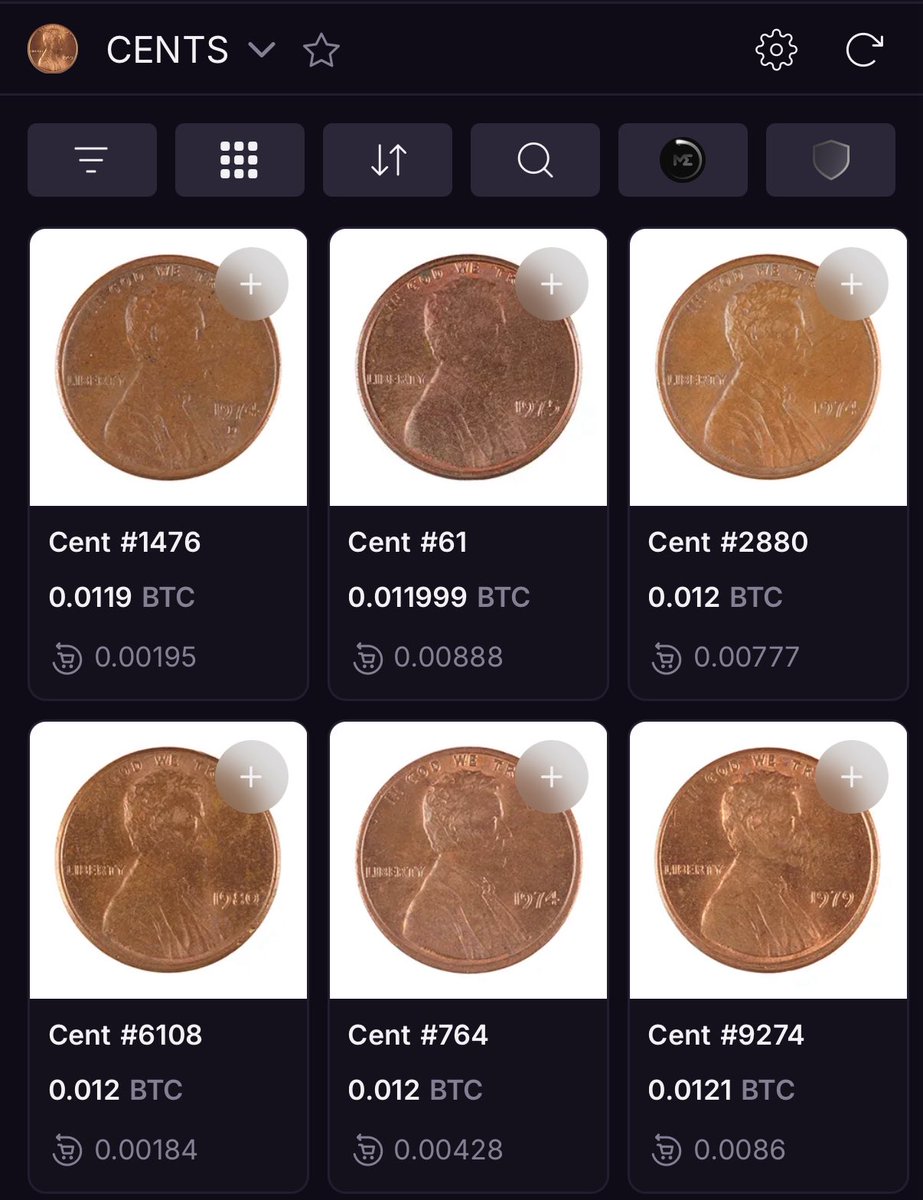
CENTS Ordinals have seen a lot of recent activity, the floor is now above $1,000

English