solaries ❄🇵🇸

4.5K posts

solaries ❄🇵🇸 banner
solaries ❄🇵🇸

solaries ❄🇵🇸

@solaries_

idealist & forever daydreamer ❄ | challenger anivia | smash zelda | 日本語OK (⌒▽⌒)☆ designing in medtech (secretly amazing smash coach)

Sandy Eggo Katılım Haziran 2012
2.3K Takip Edilen586 Takipçiler
solaries ❄🇵🇸 retweetledi
パフェさん
パフェさん@perfectsunday2·
桜と乙女椿
パフェさん tweet media
日本語
6
412
3.5K
36.6K
solaries ❄🇵🇸
solaries ❄🇵🇸@solaries_·
Absolutely insane that these guys were in charge of compliance for so many medtech companies 😬😬😬 "Brilliant AI innovation" strikes again! Now a ton of people are in deep shit 😁
Ryan@ohryansbelt

Delve, a YC-backed compliance startup that raised $32 million, has been accused of systematically faking SOC 2, ISO 27001, HIPAA, and GDPR compliance reports for hundreds of clients. According to a detailed Substack investigation by DeepDelver, a leaked Google spreadsheet containing links to hundreds of confidential draft audit reports revealed that Delve generates auditor conclusions before any auditor reviews evidence, uses the same template across 99.8% of reports, and relies on Indian certification mills operating through empty US shells instead of the "US-based CPA firms" they advertise. Here's the breakdown: > 493 out of 494 leaked SOC 2 reports allegedly contain identical boilerplate text, including the same grammatical errors and nonsensical sentences, with only a company name, logo, org chart, and signature swapped in > Auditor conclusions and test procedures are reportedly pre-written in draft reports before clients even provide their company description, which would violate AICPA independence rules requiring auditors to independently design tests and form conclusions > All 259 Type II reports claim zero security incidents, zero personnel changes, zero customer terminations, and zero cyber incidents during the observation period, with identical "unable to test" conclusions across every client > Delve's "US-based auditors" are actually Accorp and Gradient, described as Indian certification mills operating through US shell entities. 99%+ of clients reportedly went through one of these two firms over the past 6 months > The platform allegedly publishes fully populated trust pages claiming vulnerability scanning, pentesting, and data recovery simulations before any compliance work has been done > Delve pre-fabricates board meeting minutes, risk assessments, security incident simulations, and employee evidence that clients can adopt with a single click, according to the author > Most "integrations" are just containers for manual screenshots with no actual API connections. The author describes the platform as a "SOC 2 template pack with a thin SaaS wrapper" > When the leak was exposed, CEO Karun Kaushik emailed clients calling the allegations "falsified claims" from an "AI-generated email" and stated no sensitive data was accessed, while the reports themselves contained private signatures and confidential architecture diagrams > Companies relying on these reports could face criminal liability under HIPAA and fines up to 4% of global revenue under GDPR for compliance violations they believed were resolved > When clients threaten to leave, Delve reportedly pairs them with an external vCISO for manual off-platform work, which the author argues proves their own platform can't deliver real compliance > Delve's sales price dropped from $15,000 to $6,000 with ISO 27001 and a penetration test thrown in when a client mentioned considering a competitor

English
0
0
1
109
solaries ❄🇵🇸 retweetledi
Symph
Symph@sorcehri·
You play league of legends? AND world of warcraft? lol, wow.
English
109
2K
26.7K
426.9K
solaries ❄🇵🇸 retweetledi
Joshua Blankenship
Joshua Blankenship@blankenship·
Interesting. Gamma paid “the design tax” to a fantastic design agency for their brand identity. I’d love to see a robust public conversation about how AI design tools aren’t good enough for companies to use on their own brands, but are ostensibly good enough for their customers.
Grant Lee@thisisgrantlee

There's a hidden tax on every knowledge worker in the world, and nobody talks about it: The design tax. You're a strategist, a sales lead, a marketer. You were hired for what you know. But every meeting, every pitch, every proposal expects you to show up with something that looks like a designer made it. I lived this. Before Gamma, I spent time in consulting and investment banking. I spent more hours formatting slides than the analysis that went into them. When my cofounders and I started Gamma, we asked: what if you never had to be a designer in the first place? Five years and nearly 100 million users later, we've refunded billions of hours of the design tax. Today, we're eliminating it for good with our biggest launch ever. Gamma Imagine — a powerful, AI-native visual creation tool directly in Gamma. Posters, logos, infographics, visuals from a single prompt. On brand, every time. AI-Native Templates. Templates were supposed to save you from design work. Instead you spent the time filling them in. So we completely rebuilt the template experience. Modify a whole deck with a single prompt, with your brand and style intact every time. Gamma Connectors. You're already thinking in ChatGPT and Claude. Now Gamma sits inside the most popular work apps in the world. No more context-switching. You were hired for your ideas, not to resize text boxes. Let Gamma pay the design tax.

English
28
63
795
88K
solaries ❄🇵🇸 retweetledi
MIKE SUNDAY
MIKE SUNDAY@OPEN_SUNDAY·
THE EVER LASTING INFLUENCE OF THE DESIGNERS REPUBLIC
English
26
554
4.4K
119.9K
solaries ❄🇵🇸
solaries ❄🇵🇸@solaries_·
@nicole_clash Let alone distribution of these resources - we can’t pretend QoL everywhere is as blessed as we have it here in the US
English
0
0
0
10
solaries ❄🇵🇸
solaries ❄🇵🇸@solaries_·
@nicole_clash I would like to do that but we have two or more wars being fought in no small part over natural resources legit rn The average person is richer but climate change is only getting worse and the planet is objectively less ‘healthy’ than ever before
English
1
0
0
10
solaries ❄🇵🇸 retweetledi
Alex Socoloff
Alex Socoloff@socoloffalex·
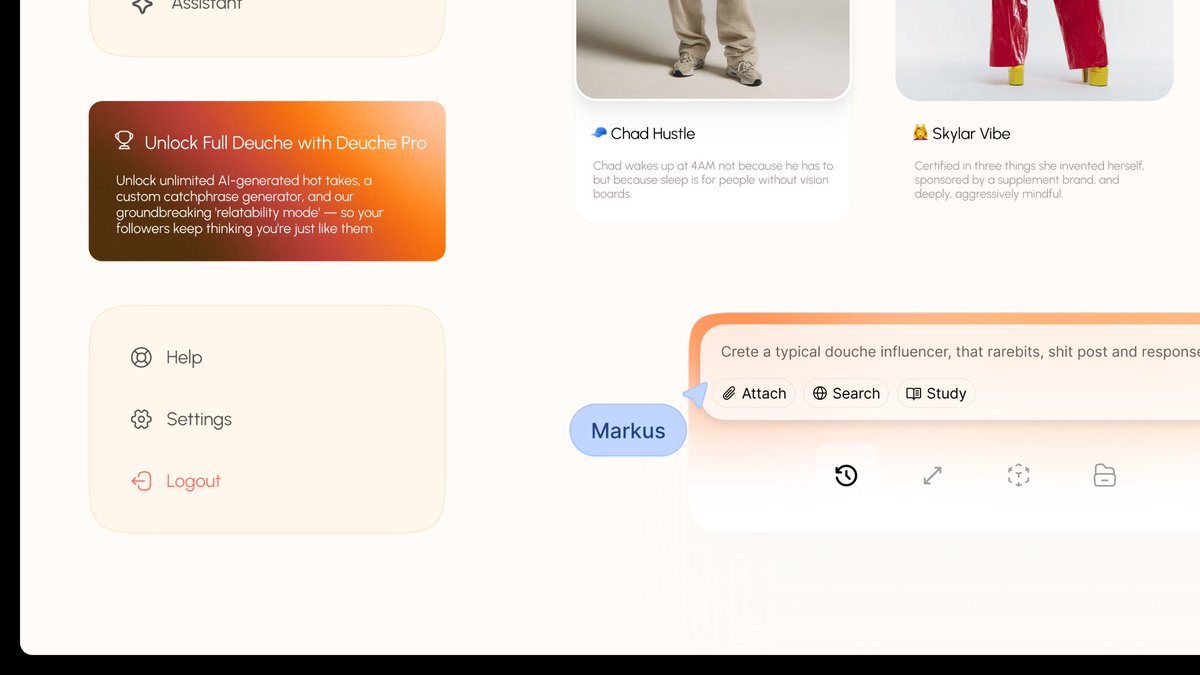
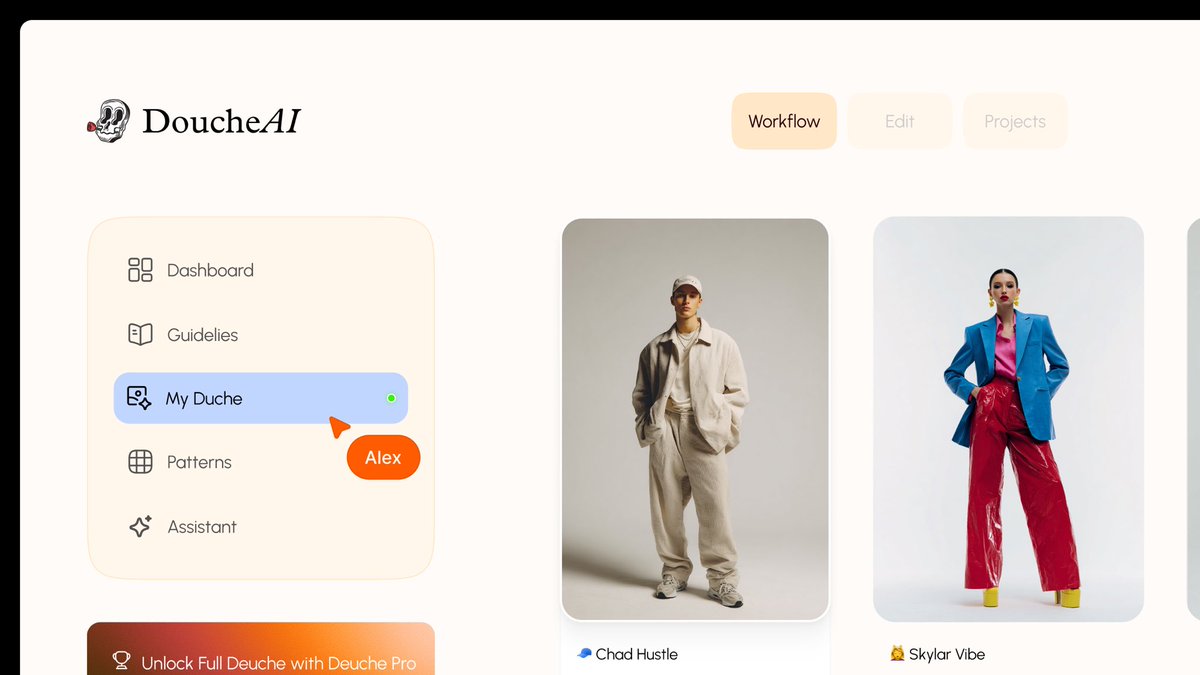
Influencers are cooked. 🪦 I built DoucheAI - create your own influencer in seconds. 0% intelligence. 100% arrogance. Let AI shit post, rage bait & leave the dumbest comments on the internet so you don't have to. Use code IWANTMYDOUCHE for a massive 0.1% off 💀 You're welcome, kings and queens 👸🤴
Alex Socoloff tweet mediaAlex Socoloff tweet mediaAlex Socoloff tweet mediaAlex Socoloff tweet media
Alex Socoloff@socoloffalex

Can someone please explain me why everyone is so obsessed with ripping designers, like AI can do a lot of other things (poorly but can) Leave us a lone and go find some better things to do, touch some grass or go fuck yourself for example.


English
17
4
84
8K
solaries ❄🇵🇸
solaries ❄🇵🇸@solaries_·
@nicole_clash i agree 4 learning! i just wish that people talked about regulating and accounting for the negative aspects of ai way more than they do now. most jobs involving ai atm are not 'for good' and it feels really bleak. 'embrace' ai is what all the corpos want too - it makes line go up
English
0
0
0
12
Nic0le
Nic0le@nicole_clash·
@solaries_ fair lol, in which case, even if the only use for gen AI is learning, the potential reduction in human suffering is worth every effort and investigation into it, so we can better understand how it reduces human suffering
English
1
0
1
22
solaries ❄🇵🇸
solaries ❄🇵🇸@solaries_·
@nicole_clash but there are always huge incentives for evil as well. sometimes a lot of the economic arguments fall flat for me bc i feel like if x corpo controls all resources, why does money need to exist? why do certain groups of humans need to exist & use up resources? im not economist tho
English
1
0
0
19
Nic0le
Nic0le@nicole_clash·
Yes people like money. So, simply incentive them to use AI for good. Capitalism is a great in that sense. People would pay a lot for a novel use of applied AI that solves their problems. Hence why the field is not only great from a humanity standpoint, it will reward you if you do good.
English
1
0
0
16
solaries ❄🇵🇸
solaries ❄🇵🇸@solaries_·
@nicole_clash I mean yeah you can hard-code certain results to happen in which it's not much of a genai right? this will sound dumb and subjective but i would consider the paint spatter 'art' because a person specifically decided that randomness would be best on that canvas at that spot
English
1
0
0
35
Nic0le
Nic0le@nicole_clash·
You can configure any AI to be 100% deterministic, even gen AI. Just because the public facing products do not give you the option doesn’t mean the underlying AI model cannot be deterministic. But if you operate a random number generator for example, it is determined that you will get a random number. Just because that number itself is random doesn’t mean the output wasn’t deterministic. Needing to make a decision on each fine detail is not a good metric. You can splatter paint onto a canvas and call it art, but you did not make a decision about the splatter. Would you rate a single platter of paint on canvas as art?
English
1
0
0
29
solaries ❄🇵🇸
solaries ❄🇵🇸@solaries_·
@nicole_clash sry ik i repeated this point twice i feel like leveraging AI is very tricky - i design for medtech and we use ai to help match patients to clinical trials and it's amazing in that sense but truly the vast majority of people using AI are in it for the money and dont care at all
English
1
0
0
20
Nic0le
Nic0le@nicole_clash·
@solaries_ I am not hand waving it away. But the transition is going to happen regardless. So why not leverage AI as much as possible to prevent people from dying? The sooner we get to abundance the less the human suffering right?
English
1
0
0
16
Nic0le
Nic0le@nicole_clash·
You are only aware of these 3 mainly due to the new-ness of the whole applied AI field. Not enough people are working on using AI to solve the world’s problems. A recent, real life example of mine. My grandma was suffering from chronic headache. A doctor’s visit is all scheduled out for the next two months. She (yes I made sure my grandma knew how to use AI) talked over every single symptom with ChatGPT and had it generate visuals of the exact things she can eat and do to help. In this case, the AI actively reduced human suffering, that is not possible pre-AI, unless you are stupid rich and have a doctor look at you the same day.
English
1
0
0
22
Beora
Beora@_Beora·
For context before I begin, I am also both someone who has studied AI and am considered a traditional artist. I have many critiques of your stance that I will explain below. You begin by talking about information, the collective banding together of early humans to aggregate information and pass it down to future generations. I would say, largely, most people do not believe that the informational value provided by advancements in AI are a primary issue and I don't think they are relevant to the core criticisms of Generative AI which largely are based in the erasure of human history and connectivity to the art being trained on, typically without consent. I understand that it was included largely as a framing for the "fourth jump" point but I feel it needs to be said. I also think that comparing the recent advancements in AI to the steel tool and similar inventions needs more scrutiny in a post-internet world. On your assertions that AI will eliminate world hunger, solve human health issues and remove the need to work in order to receive basic necessities I would like to approach them independently. RE: Eliminating world hunger - This is entirely unfounded and, in my opinion, grossly ignores basic human sociology in the current economical and political landscape of the modern age. AI will not eliminate world hunger, that is a resource problem which you are asserting will be solved by a tool that chews through resources which directly compete with the agricultural industry. Datacenters are currently putting immense pressure on local agricultural populations with regards to water consumption, energy use and land which affects the entire supply chain. This is not accounting for the job displacement which will exacerbate the issue for at-risk populations. RE: Solving health problems - I do concede that current advancements actually have done well in the medical field both in hospitals (although not without issues, currently, though tech will improve) and for the every day user who can aid themselves in a pinch if they are smart enough to utilize the tool correctly. That being said, it does not come without risk and a large portion of the common populous will be at risk of more harm than good for some time if they choose to blindly engage with LLMs as if they were medical professionals. RE: Never needing to work - I think this is overly idealistic and again ignores the current landscape of the world especially as it pushes closer and closer to a corporatocracy. I will expand on this in detail below as it is brought up multiple times in your post. Moving on to your next point which revolves around stolen data - you begin by talking about compensation for stolen work. Now, before continuing, that is definitely an issue worth talking about but in my opinion it is largely irrelevant to the larger picture. Compensation, at this point, is only needed because a bunch of nerds in labs around the world decided they had the authority to insert the art of others into their training set without consent. Talking about compensation now ignores the primary issue - yes, people should get paid, but also their art should never have been ripped without consent. Because of this, your next point re: whether the morality changes if corporations no longer profit from the stolen art is mostly irrelevant. The damage was already done, and you can't put that genie back in the bottle. Your natural counterargument to this is that drawing from inspiration has always been a thing throughout human history. You are not wrong, but I would argue it isn't a sound analogy. You are asserting that the following scenarios are equivalent: - One where a human draws inspiration from another human's work and uses that inspiration to create their own unique piece of art which they can then go on to explain the history of - where the inspiration came from, who they were inspired by, what it was like to create the piece. In this scenario, the history and human connection is preserved. You can trace the art back to its roots and to the roots of those roots. - One which involves feeding the art of tens and hundreds of thousands of artists' works into the training data of a model which then blends pieces, styles and stories together into one resulting output with no regard for the history of its creation. The human element, where the inspirations came from, the history of the piece are totally erased. That is the issue. You mention aggregation at the beginning of your post and, to jump ahead, talk about it in the context of AI being a preservation tool. As a data scientist, what happens when you take a dataset and then aggregate the data? What happens if you aggregate on that aggregate? And another time? Do you see the problem? What does this begin to look like long term? Do you really think the history and human stories will be preserved? Moving forward, you make the point that AI will enable more creativity than less. I think this is a bit of a gray area. Will creativity be fostered in a future where the jobs of creatives are at risk? What happens to motivation for folks who had big dreams of working at large studios as artists - not for the monetary gain, but for the pie in the sky goal of working on a large team? If those teams can no longer be supported due to the changing corporate landscape, what happens to those dreams? What happens to creative inspiration for people who's jobs have been displaced in other sectors due to AI? What happens to the creative inspirations for people who may have jobs but are facing economical hardships due to cascading effects of the technology? I don't think it is 100% black and white, just things to consider. Your final point is a hypothetical - as an artist who traditionally got paid for your art, can you genuinely say that you will not be more creative if you didn’t need to worry about monetary aspect? I would argue that we have no idea whether these advancements will lead to a world where people no longer have to worry about money. I'd say, given human history, the opposite will be the more likely outcome and in a world where human labor is less valuable but money is still required, the outcome feels pretty bleak to me.
English
2
0
14
790
solaries ❄🇵🇸
solaries ❄🇵🇸@solaries_·
@nicole_clash From what I have seen, genAI's outputs are not 100% deterministic. You can write the same prompt into something twice and you will not get the same result. Furthermore, AI is certainly active. When someone generates AI 'art', are they making decisions about each fine detail? No
English
1
0
0
46
Nic0le
Nic0le@nicole_clash·
@solaries_ AI is not active or non-deterministic. Similar to code, you can control its outputs 100% of the time. By the very nature that present day AI is ran off of a computer, aka a rock wrapper, it is impossible for an AI to be non-deterministic.
English
1
0
0
121