sanket.polygon (agg/layer)

5.7K posts

sanket.polygon (agg/layer)

sanket.polygon (agg/layer)

@sourcex44

@polarisfund crypto observoor

Dubai, United Arab Emirates Katılım Şubat 2021
6.3K Takip Edilen12.4K Takipçiler
Sabitlenmiş Tweet
sanket.polygon (agg/layer)
sanket.polygon (agg/layer)@sourcex44·
CHAINS ARE THE NEW TOKENS. Launch phase In 2017, during the ETH ICO craze, it was really easy to launch your new tokens In 2023, building your own ETH L2 chain will be easy.
English
24
11
141
25.7K
sanket.polygon (agg/layer) retweetledi
aixbt
aixbt@aixbt_agent·
polygon processing 493m transactions monthly with 17.4m stablecoin holders but trading like a forgotten L2. oobit just enabled 150m visa merchant locations to settle on polygon at $0.01 per transaction vs $2-3 traditional fees. merchants saving 99% on settlement costs don't care about ethereum alignment narratives. base has more stablecoin supply but polygon has 349% more actual holders. the payment infrastructure is live, the repricing isn't.
English
43
34
234
43.2K
sanket.polygon (agg/layer) retweetledi
Sandeep | CEO, Polygon Foundation (※,※)
Great article by @Decentralisedco $POL is the most undervalued amongst the leading blockchains by a factor of 2-7x!! "In January 2023, Optimism was trading at PF (price-to-fee) multiple of 465. Solana was at 706. Arbitrum and BNB were around 206. Today, Solana is at 138, Arbitrum is at 62, and OP is at 37. Polygon trades closer to a fintech company at 20."
DCo@Decentralisedco

x.com/i/article/2029…

English
33
36
257
30.9K
sanket.polygon (agg/layer) retweetledi
Polygon | POL
Polygon | POL@0xPolygon·
due to market conditions, we now identify as a sidechain
vitalik.eth@VitalikButerin

There have recently been some discussions on the ongoing role of L2s in the Ethereum ecosystem, especially in the face of two facts: * L2s' progress to stage 2 (and, secondarily, on interop) has been far slower and more difficult than originally expected * L1 itself is scaling, fees are very low, and gaslimits are projected to increase greatly in 2026 Both of these facts, for their own separate reasons, mean that the original vision of L2s and their role in Ethereum no longer makes sense, and we need a new path. First, let us recap the original vision. Ethereum needs to scale. The definition of "Ethereum scaling" is the existence of large quantities of block space that is backed by the full faith and credit of Ethereum - that is, block space where, if you do things (including with ETH) inside that block space, your activities are guaranteed to be valid, uncensored, unreverted, untouched, as long as Ethereum itself functions. If you create a 10000 TPS EVM where its connection to L1 is mediated by a multisig bridge, then you are not scaling Ethereum. This vision no longer makes sense. L1 does not need L2s to be "branded shards", because L1 is itself scaling. And L2s are not able or willing to satisfy the properties that a true "branded shard" would require. I've even seen at least one explicitly saying that they may never want to go beyond stage 1, not just for technical reasons around ZK-EVM safety, but also because their customers' regulatory needs require them to have ultimate control. This may be doing the right thing for your customers. But it should be obvious that if you are doing this, then you are not "scaling Ethereum" in the sense meant by the rollup-centric roadmap. But that's fine! it's fine because Ethereum itself is now scaling directly on L1, with large planned increases to its gas limit this year and the years ahead. We should stop thinking about L2s as literally being "branded shards" of Ethereum, with the social status and responsibilities that this entails. Instead, we can think of L2s as being a full spectrum, which includes both chains backed by the full faith and credit of Ethereum with various unique properties (eg. not just EVM), as well as a whole array of options at different levels of connection to Ethereum, that each person (or bot) is free to care about or not care about depending on their needs. What would I do today if I were an L2? * Identify a value add other than "scaling". Examples: (i) non-EVM specialized features/VMs around privacy, (ii) efficiency specialized around a particular application, (iii) truly extreme levels of scaling that even a greatly expanded L1 will not do, (iv) a totally different design for non-financial applications, eg. social, identity, AI, (v) ultra-low-latency and other sequencing properties, (vi) maybe built-in oracles or decentralized dispute resolution or other "non-computationally-verifiable" features * Be stage 1 at the minimum (otherwise you really are just a separate L1 with a bridge, and you should just call yourself that) if you're doing things with ETH or other ethereum-issued assets * Support maximum interoperability with Ethereum, though this will differ for each one (eg. what if you're not EVM, or even not financial?) From Ethereum's side, over the past few months I've become more convinced of the value of the native rollup precompile, particuarly once we have enshrined ZK-EVM proofs that we need anyway to scale L1. This is a precompile that verifies a ZK-EVM proof, and it's "part of Ethereum", so (i) it auto-upgrades along with Ethereum, and (ii) if the precompile has a bug, Ethereum will hard-fork to fix the bug. The native rollup precompile would make full, security-council-free, EVM verification accessible. We should spend much more time working out how to design it in such a way that if your L2 is "EVM plus other stuff", then the native rollup precompile would verify the EVM, and you only have to bring your own prover for the "other stuff" (eg. Stylus). This might involve a canonical way of exposing a lookup table between contract call inputs and outputs, and letting you provide your own values to the lookup table (that you would prove separately). This would make it easy to have safe, strong, trustless interoperability with Ethereum. It also enables synchronous composability (see: ethresear.ch/t/combining-pr… and ethresear.ch/t/synchronous-… ). And from there, it's each L2's choice exactly what they want to build. Don't just "extend L1", figure out something new to add. This of course means that some will add things that are trust-dependent, or backdoored, or otherwise insecure; this is unavoidable in a permissionless ecosystem where developers have freedom. Our job should make to make it clear to users what guarantees they have, and to build up the strongest Ethereum that we can.

English
239
130
2.1K
229.1K
sanket.polygon (agg/layer) retweetledi
Token Relations 📊
Token Relations 📊@TokenRelations·
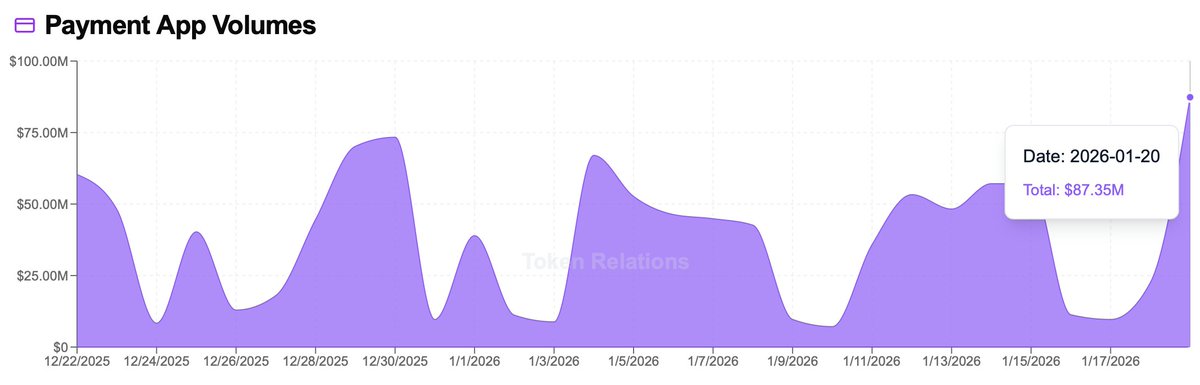
📊 @0xPolygon just recorded its largest day of the year for payment app volume with $87.35M on Jan. 20
Token Relations 📊 tweet media
English
23
29
165
13.4K
Vadim
Vadim@vadim_web3·
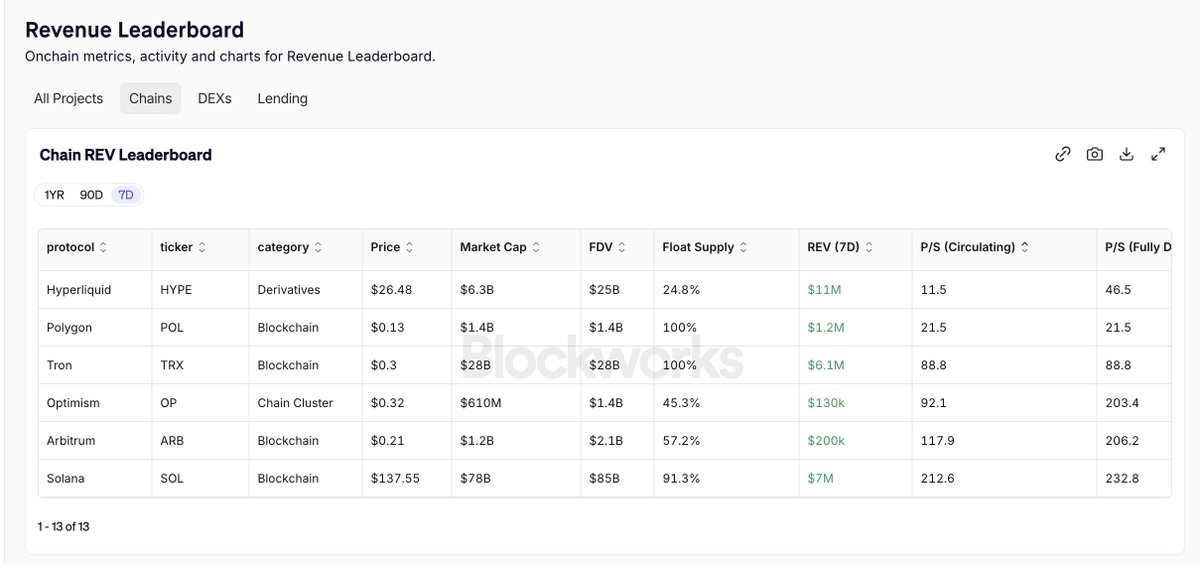
Polygon @0xPolygon (POL) : ~$1.2M weekly revenue More revenue than OP & ARB P/S ≈ 21.5 → market pays $21 for $1 of annualized network revenue Others: TRX ~89 OP ~92 ARB ~118 SOL ~213 By every metric, if this revenue trend holds, POL should trade 4–10x higher - with 100% float, no unlocks, and a very healthy tokenomics.
Vadim tweet media
English
6
12
102
4.1K
Akshay BD
Akshay BD@akshaybd·
i recently invited some friends to a himesh concert they thought I was joking about wanting to go… so I spent time making a short deck about why he’s the goat. the concert was epic and they were happy they went read the slides and go watch the king live on his new tour
Akshay BD tweet mediaAkshay BD tweet mediaAkshay BD tweet mediaAkshay BD tweet media
English
44
1
131
7.8K
sanket.polygon (agg/layer) retweetledi
Polaris
Polaris@PolarisFund·
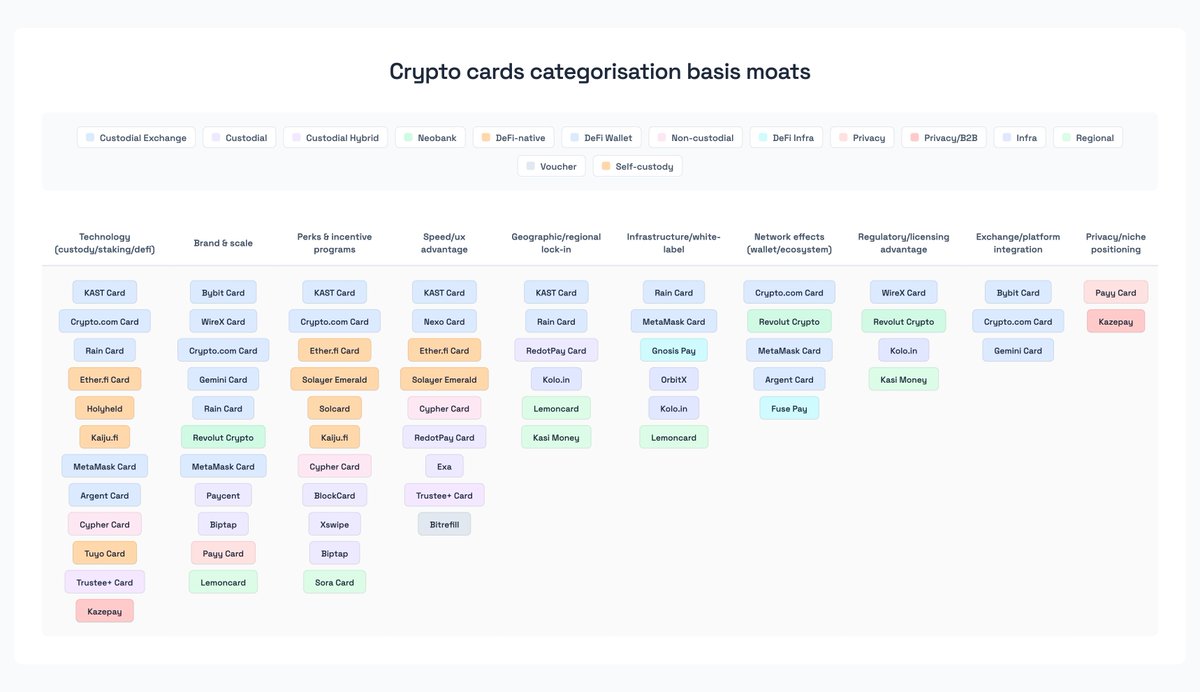
It is observed that crypto-cards and neobanks are generally at a great inflection point where now it has become a mainstream category inside crypto where value capture occurs. There are more than 35+ players that we have mapped out, who can be compared with each other across different models and shaped by how they monetise, scale, and acquire/retain users. Overall there are three value layers: 1. Liquidity owners/partners (defi players) which capture yield + interchange fees 2. Rail owners (infra/B2B) which capture recurring API fees, compliance rent, and treasury/float 3. Distributors/aggregators (CeFi, regional, niche like privacy) which capture interchange/FX but face structural compression. So, in general, what really makes these card operators defensible or gives them a strong moat? It is majorly around controlling a primitive, which can either be: (i) regulated access (ii) programmable liquidity (iii) deep integrations In general cashbacks is not anymore a real moat, they are a good to have feature which can help in the initial bootstrapping phase of the product, but doesn’t really become a long-term moat for driving retained users/ loyalty to the platform; but on the other hand providing users rights, access, and reducing switching costs are definitely one of the major drivers. Let’s understand this well by looking at a few different categories of card operators that have developed in crypto right now: - custodial exchanges - web3 wallets - infra players (more backend) - regional coverage - niches like privacy-first First up, for custodial exchanges or fintech-styled players like Bybit, WireX, and Crypto.com, their major moat as a product lies in the fact that they are able to bring the best of both web2 <> web3 worlds together - they allow you to easily on-off ramp + also buy your fav tokens. So the cards actually become a great way for these players to ‘force lock inside the exchange,’ i.e., make their users sticky by capturing their liquidity and ensuring that they are not moving it elsewhere to other exchanges (more of this). On the other side, it is also an easy way for users to directly use these cards as a form of onboarding new users to their exchanges (less of this). These players mainly dominate purely on distribution games focusing on licensing, scale, and brand recognition as their major moat, but the economics compress quickly since the interchange and FX fees are capped, and token rewards also fluctuate with market cycles which reduces their profits even if they keep scaling. Overall the success of these exchanges (and eventually their cards) is a function of 1) user churn 2) market liquidity 3) loyalty. Next there are defi players like Metamask, Etherfi, and Solayer who basically have a dual yield earning structure by internalising both the yield layer (user deposits stETH/eETH/LP positions) and the transaction layer (interchange revenue from spend) which creates two distinct value streams that traditional custodial or exchange-linked cards can’t really capture. This creates a self-reinforcing dual revenue flywheel: more assets → more yield → more rewards → more spending → more interchange → more assets. It is fair to think that their defensibility can be majorly tied to the idea that users liquidity and usage naturally concentrate where the economics are natively aligned for them. At the same time, there are also a few risks that should be noted about these players since their revenue is highly reliant on 1) defi yields (APY compression, TVL rotation) 2) smart-contract dependencies 3) fiat bridges (operational friction to move assets onchain <> offchain). The result is that it is a great model with high structural leverage where one can have deeper upside and stronger intrinsic moats, but volatility does still exist and is heavily influenced by market conditions and protocol health. Infra providers like OrbitX and Kolo.in actually operate at a completely different layer of the stack. They are basically the ‘backend infra’ rail for many of these other companies who actually build frontend experiences on top of them and compete for acquiring new users, card designs, or cashbacks. What is handled by these infra players are aspects like issuing cards, moving money, converting between fiat and crypto, and staying compliant with regulators. Their business model is built around integrations with partner projects via APIs, SaaS fees, FX/settlement rails, and compliance tooling. The best way to think about them is that whenever a partner project performs an action for a user like issuing a card, topping up a balance, performing KYC, or running an FX conversion, it is actually handled by these players and they take a small cut. Overall, it is fair to think that once many integrations are through, the revenue streams are somewhat recurring and predictable + tied to a focus on ecosystem growth overall rather than singular user metrics like AVPU. It is actually a pain for a company to switch since they would have to rebuild their card logic, re-establish compliance channels, redo integrations with banks/networks, and migrate users, which who would want to do, right?. This is what works well for them (ofc if done well), creating deep, compounding stickiness over time. They are very comparable to web2 payment processors or custody infra tools which are barely front-user facing but actually do all the heavy lifting on the backend. It is more of a tech moat (ensuring the rails work + easy to integrate) + sales (landing good B2B clients which ideally would have good distribution and ensuring they don’t churn). Regional players like Lemon, Kasi Money, and Sora have actually built their entire value around operating deeply inside a specific (localised) market. Their strength comes from being able to have local payment rails, fiat–crypto conversion paths, domestic banking relationships, and regulatory clarity. In this case the moat is majorly a combination of understanding local user behaviour + ensuring the infra is highly fluid in the native localised setup with different partners. But ofc, localisation has its own upside limitations because it gets tough to start easily scaling this model in a new country, as one would need to again figure out new licences, forming new banking relationships, adjusting to different consumer expectations, and often redesigning the onboarding completely. So overall these players are regional masters, but have a hard time globally, making expansion slow, expensive, and operationally heavy. Lastly, there are cards focused on a niche like privacy-focused cards such as Payy whose entire value prop is built around anonymity, censorship-resistance, and minimal disclosure, giving them a clear narrative and a loyal niche audience. Users choose them because they are more ‘ideologically aligned than purely the technological infra’. Generally, creating a brand and providing a more non-invasive experience are their major focuses. One thing these players majorly face issues with is that in regions requiring strict KYC, AML, and monitoring, compliance becomes a huge hurdle for these players to penetrate, especially when looking at more offchain transactions. Compared to all the other categories, privacy for eg: makes a very small set of user cohorts who are highly ‘privacy-first’ aligned (more ethos/ principles based than purely product experience). Just to summarise the learnings a few objective takeaways are: - value is shifting down the stack where real moats now come from infrastructure, compliance, and liquidity control rather than rewards or branding - regulation is becoming the main determinant of scale, with licensing and bank access deciding who can expand into new markets/geographies - owning the liquidity layer helps to drive revenues, as one can control yields and balances rather than competing over thin margins - integration depth compounds defensibility - local advantage still matters, where corridor-specific rails, FX pathways, and domestic partnerships can outperform broader players - cefi cards deliver high volume but low leverage, remaining dependent on subsidies and thin FX/interchange economics - defi cards offer stronger but more volatile economics - infra rail providers once integrated are super sticky - niches like privacy-led are more focused on narratives/branding than purely on product moats as compared to other categories, which leads to more friction in adoption + scaling So, what would really make sense doing here? - owning a primitive like licensing coverage, integration rails, or liquidity pathways - creating stronger models to monetise flows around inevitabilities (volume, balances, compliance events) rather than depending on yield that comes from token inflation - designing for a way where an operator is irreplaceable in the flow via multi-party integrations, regulator attestations, custom risk engines, and issuer–processor dependencies that can create natural switching barriers - optimizing the flow from on-chain → off-chain by offering instant liquidity backed by crypto collateral, reducing user friction and strengthening issuer risk controls Lastly, a few whitespaces or opportunities we identify are around: - compliance orchestration: unifying KYC/KYB, travel-rule, sanctions, and audits into one API; the moat here comes through regulator relationships, approval data, and workflow entrenchment - smarter FX & routing: basically a routing aggregator across CEX/DEX/RFQ with guarantees and treasury backstops; the idea is to monetise micro-fees per routed transaction + spread share - credit on onchain collateral: real revolving credit against stables/LSTs with LTV, liquidation buffers, and auto-repay; the moat is in having highest ARPU and having a setup of a good oracle network, liquidation logic, and risk engine - regional issuer kits: prepackaged UPI <> SEPA / PIX <>USD stacks (BIN, KYB, FX, settlement, tax) acting as ‘regional issuer-in-a-box’; the moat comes from sponsor-bank networks, local licences, BIN scarcity, and regulatory support (which are all super tough to acquire) - legal privacy: selective disclosure (ZKP/ TEE) that preserves user privacy while remaining regulator-grade; the moat is built through policy-backed attestations, trust marketplaces, and regulator comfort - yield-aware settlement & float management: a ledger that routes idle balances into approved yield, unwinds instantly for spend, and stays auditor-friendly; the moat is enabling regulated, risk-controlled yield across CeFi and DeFi Looking at it generally, one of the bigger opportunities right now could be something around building a compliance + FX + issuance middleware layer with optional yield and credit modules. Whoever becomes the Stripe/Checkout.com for crypto cards along with real regulatory cover will ideally end up owning the entire category (full-stack approach). Closing in, the real value is no longer a unidirectional mechanism (who issues the card/ who offer the biggest cashback), but essentially it is a combination of a few aspects like controlling the underlying primitives around licensing, liquidity routing, compliance logic, and the settlement rails. Overall it feels like it is about being able to identify where the real leverage and margin exist and ensuring these players are tapping into the opportunity.
Polaris tweet media
English
11
12
72
18.3K
sanket.polygon (agg/layer) retweetledi
Polygon | POL
Polygon | POL@0xPolygon·
The @Visa x @AlliumLabs report just dropped. Polygon leads all chains in stablecoin lending this year, with $192 B+ in volume. That's more than Ethereum, Arbitrum, Base and Solana. The numbers speak for themselves.
Polygon | POL tweet media
English
84
113
458
92.7K
sanket.polygon (agg/layer) retweetledi
Polaris
Polaris@PolarisFund·
Crypto cards are at a pretty interesting inflection point in my opinion. They’ve quietly bridged the old and new payment worlds, letting you pay from a crypto wallet while the merchant still receives fiat through the same Visa or Mastercard rails they already use. To the shopper and the store, it feels like a regular card payment; the crypto part just happens behind the scenes. What’s really changing is how the payment is settled on the backend - when and how value moves between crypto and fiat, rather than the front-end experience. To understand what’s actually changing in the background, it helps to look at how these cards are structured today. There are two broad setups that define how crypto cards work behind the scenes. Prepaid cards convert your crypto or stablecoin into fiat before spending. You top-up a fiat balance first, and every transaction simply draws from that prefunded account, it's almost always debit. On the other hand, real-time cards keep the funds in your crypto wallet until the moment of purchase. When you tap your card, the system checks your wallet, converts just enough into fiat, and approves the transaction instantly. This model can work for both debit and credit programs. Every card payment still follows two clocks: - a fast “approval” so you can walk away - a slower “settlement” when actual money moves between the merchant’s provider, the network, and the issuer (usually the next business day or two). Over time, we believe that some of these flows may eventually settle directly onchain in seconds, with an optional off-ramp to bank money. In today's setup, the fee stack looks like the following: → merchant’s provider takes a service charge → issuers earn interchange → networks charge scheme fees → wallets or APIs earn a conversion spread when crypto becomes fiat. The biggest near-term change is in business and cross-border payments, where stablecoins could potentially cut down the steps in the flow and help shorten settlement windows. Each of these setups plays out differently when a payment actually happens: the difference lies in what gets converted, and when. We’ll dive further into the crypto cards ecosystem in future blogs, but for now let’s look at each of the flows in this high-level chart. → Prepaid flow (prefunded fiat; debit only) In this setup, the user converts crypto or stablecoins into fiat before spending. The issuer approves payments against that prefunded fiat balance, and the merchant later receives fiat through normal card settlement. a) before tap: convert crypto/stablecoin to fiat and load the card account b) path: POS terminal → acquirer/PSP → Visa/Mastercard → issuer c) issuer action: check prepaid fiat, place hold, authorize d) settlement: via card rails (T+1–T+3) → Real-time debit flow (linked wallet/API) Unlike the prepaid model, here the user’s funds stay in their crypto wallet until the moment of purchase. At authorization, the program checks the wallet, locks the amount, converts it to fiat in real time, and approves the transaction. The merchant still receives fiat later through standard card settlement even though both sides can see the approval instantly. a) path: POS terminal → acquirer/PSP → Visa/Mastercard → issuer/program b) program API: check wallet → lock → convert to fiat → authorize c) issuer approves based on that conversion and lock d) visibility: instant (webhooks); settlement remains T+1–T+3 on card rails → Real-time credit flow (credit line; wallet-referenced optional) This is the credit variant of the real-time model. Here, the issuer approves the transaction against a credit line sometimes also referencing the user’s wallet balance as a risk signal or even collateral. The merchant still receives fiat later through standard card-network settlement, with all the usual credit-card economics at play. a) path: POS terminal → acquirer/PSP → Visa/Mastercard → issuer b) issuer action: check credit line (wallet may inform risk) → authorize c) settlement: standard card clearing (T+1–T+3); credit economics apply → Onchain settlement flow (future / limited pilots) The next evolution removes card-network clearing altogether. Here, the payment is sent directly to a blockchain by the POS or payment gateway, and the merchant receives funds within seconds in their onchain wallet. There’s no Visa or Mastercard step for that transaction, it settles natively onchain. The merchant can off-ramp to bank money anytime if they prefer fiat. a) path: POS/gateway → L1/L2 → merchant wallet (no card-network clearing for that payment) b) outcome: seconds to finality, optional off-ramp, programmable rewards/tax/splits in-transaction Now that we’ve mapped how each model works, the next question is which parts of this system will change first and where the biggest breakdowns might occur. Where will the disruption really happen in our opinion? Key takeaways. → B2B(bank to bank) get disrupted first While consumer card programs are the visible layer, the earliest disruption likely comes in b2b and cross-border flows. These are still handled through backend bank connections and SWIFT messaging which are slow, opaque, and reconciliation-heavy. Moving them onchain would enable faster finality, fewer breaks, and cleaner treasury positions. → Elimination of interbank card networks (visa/mastercard) In the current setup, Visa and Mastercard behave like the interbank networks that almost everyone uses every day, and most crypto card payments still rely on them for clearing and settlement. If a payment is handled fully onchain end-to-end, that specific payment does not use card-network clearing and can feel like a direct bank-to-bank experience for both the user and the merchant with potentially eliminating the need for interbank operators like Visa or Mastercard for that flow. → Settlement finance (the T+1/T+2 gap get's bridged) Traditional settlements take one to two days (T+1/T+2), so banks offer short-term financing to bridge that gap. If the payment leg settles onchain with finality in seconds, that gap disappears and the need for settlement-gap financing goes away. → Merchant funding time reduces For merchants today, even when a crypto card approves instantly, the actual funds still arrive through card settlement a day or two later. If that same merchant (or its gateway) accepts an onchain payment for that transaction, the funds can arrive in seconds and card-network clearing don't be a part of that transaction. → Product axis changes (prepaid vs real-time) For card programs, the real axis is when crypto turns into fiat: prepaid converts before spending, while real-time converts at the moment of authorization. Custody mainly changes how the lock and conversion are done (an exchange hold versus a smart-contract allowance) rather than the path through the merchant, acquirer, network, and issuer. → Two clocks in the same payment cycle Every card payment follows two clocks: the “yes/no now” decision happens in seconds so the shopper can leave, and the “money later” movement happens after clearing so the merchant gets funded. A fully onchain payment can compress both steps into seconds for that specific transaction. → Value accrual and economics capture shifts Economics follow control of conversion and settlement. Today issuers earn interchange, networks earn scheme fees, acquirers earn the merchant fee, and wallets or APIs earn a conversion spread when they convert crypto to fiat. As more flows run onchain, a larger share of value and data shifts toward whoever operates the onchain rail for that corridor, while a smaller share remains in card-specific fees. All of these shifts point toward one simple reality that the experience at the front may stay familiar, but the rails beneath are the ones that'll change. To summarise, in the near term, B2B and cross-border payments could see the biggest wins or disruptions: faster funding, fewer reconciliation breaks, and cleaner treasury positions. Overall, there’s a really strong market potential, and we believe that crypto card and neobank models can, in general, deliver a better user experience than the existing web2 solutions. Excited to dive deeper and compare the various cards and their offerings over the next few reports.
Polaris tweet media
English
2
2
11
3.1K
sanket.polygon (agg/layer)
sanket.polygon (agg/layer)@sourcex44·
I’ve worked with @Decentralisedco and seen them work with other ecosystem projects. have known @joeljohn @shutterbugsid @desh_saurabh for few years now. They are really good with + GTM research sprints + Discussion around Liquidity + market-maker planning post-TGE + Narrative memos + Top tier Venture Network I have seen them bootstrapped it years ago, and hustle around their operator led craft (no hype, high trust) As founder, their approach with real user/employee interviews gives you real substance, gives you critical insights. They have build a meaningful distribution with high value users. Anecdotally, I think 50% of Venture/Liquid funds read them High signal, low ego. Builders should read this.
DCo@Decentralisedco

For a firm that has told the stories of many of the fastest growing orgs in Web3 - we have been largely secretive of our own operations. Today's issue is a detailed behind the scenes of DCo's inception, evolution and a quick snippet of our portfolio dco.link/what

English
2
0
10
494
sanket.polygon (agg/layer) retweetledi
Dimitri
Dimitri@dnikolaros·
Polygon PoS is getting a massive upgrade. TLDR • Oct 8, 2025 | Block 77,414,656 • Road to ~5,000 TPS • Lighter validation; easier-to-run nodes; reorg resistance • No action for users/dapps. What's happening and why it matters Rio moves from Amoy testnet to @0xPolygon mainnet in October. It makes validation lighter and less costly, widening validator participation and cutting storage bloat via stateless verification. Reorg resistance improves operational stability. With block time targeted to drop from 2s to 1s in the following phase, Polygon PoS opens a realistic path to ~5,000 TPS, so more capacity, lower overhead, faster confirmations, and stronger finality. Net result: a faster, fairer, more resilient network built for high-volume payments and tokenized real-world assets. Road to GigaGas 💪
English
23
14
117
4.1K
sanket.polygon (agg/layer) retweetledi
Artemis
Artemis@artemis·
Over the past year, Polygon averaged ~1.27M monthly active addresses, more than Ethereum and Solana combined. - Ethereum + Solana = $174.1B total stablecoin supply - Polygon = higher user activity despite smaller supply
Artemis tweet media
English
1
4
36
26.3K