Radek Stefanski

1.1K posts

Radek Stefanski

Radek Stefanski

@stefanski_radek

Economist

Katılım Kasım 2015
419 Takip Edilen168 Takipçiler
Radek Stefanski
Radek Stefanski@stefanski_radek·
@thsottiaux This makes no sense. I was supposed to get a reset tomorrow and I had 60% left. My intention was to run all night at fast rate. Now you reset it and I've lost the 60% I had left and the rest only comes in a week. You've essentially taken away a day and a half of usage.
English
1
0
3
163
Luis Garicano 🇪🇺🇺🇦
We stopped everything to write an answer (link below) to Paul Krugman's two posts of today (one informal, one with a simple model) arguing that Europe is broadly not falling behind the United States. The change measured by the Draghi report, he argues, is mostly due to growth in the technology industry, which has distorted GDP numbers without actually leading to higher standards of living. We should believe our eyes when we walk around France and walk around Mississippi. Krugman is wrong. The measures he uses understate European stagnation. This matters enormously. Divergence with the United States is the strongest evidence for reform in Europe. 1. The growth numbers Krugman compares the United States, France, and Germany at purchasing power parity in current prices. On that measure, France's and Germany's position relative to America has been roughly constant since 2000. But current price comparisons miss productivity gains in sectors where prices fall. If America produces twice as much software while the price of each unit halves, the value of American software output looks unchanged even though the volume has doubled. Most economists therefore use constant prices, which fix the base-year PPP level and apply each country's real output growth on top of it. American output growth has concentrated in tech, where prices have fallen tremendously as productivity rises. In terms of the volume of things produced, America has pulled away from Europe. 2. Is it all the tech industry? Krugman concedes this tech divergence but says it is not welfare-relevant. The American growth lead is an accounting artefact of measuring more iPhones at base-year prices, not a sign that Americans are actually richer, because Europeans buy the same iPhones at the same world prices. This is not the right way to think about the world today, as an earlier Paul Krugman would have argued. His model assumes tradable goods, interchangeable workers, marginal-cost pricing, and no profits. Each assumption fails. Most of what households buy is non-tradable: housing, healthcare, childcare, education. When American tech firms bid workers from haircutting to coding, American haircut wages rise. Germany has no growing tech sector to do the bidding, so German wages stay flat. Technology is not priced at marginal cost. Apple's margins are around 40 percent. Anthropic's inference margins are at 70 percent. The major platforms enjoy network effects, switching costs, and lock-in that hold prices well above what a competitive market would deliver. A large share of the productivity gains in technology stays as profit. A lot of the value of American technology dominance shows up in equity, not in wages. Apple, Microsoft, Nvidia, Alphabet, Meta, and Amazon together are worth $21 trillion, more than the entire combined stock market value of all European stock markets. Around 60 percent of US equity is held by American households. The median French or Spanish household holds almost no equity. The median employee at Meta, a company with almost 80,000 employees, earned $388,000 in 2025. This advantage is not going to go away. Krugman's own 1991 paper, cited in his Nobel prize, showed that comparative advantage in modern industries is produced by increasing returns to scale, specialized labor markets, supplier networks and the agglomeration of suppliers, workers, and ideas in particular places. Once an industry concentrates somewhere, the concentration is self-reinforcing. Europe is being pushed away from the next round of technology industries (AI!). 3. What about inequality? Another retort is that GDP per capita hides substantial inequality, and so even if America is rich on average, this is mostly due to the super wealthy. But despite the US's high pre-tax income inequality, it also achieves higher median incomes than Europe, in part because of such a high base, and in part because it actually redistributes more than many European countries. The cleanest comparison is median equivalised disposable household income: income after cash taxes and transfers, adjusted for household size and purchasing power. According to the OECD's 2021 numbers, the median American earns 30 percent more than the median Dutchman, about 31 percent more than the median German, and about 52 percent more than the median Frenchman. 4. What about hours worked? Krugman points out that while American GDP per person is higher, most of this is because Americans work more. For this divergence to be an hours worked story, Americans must work more relative to Europeans now than they did in 2000. The opposite has happened. Birinci, Karabarbounis, and See in a 2026 NBER paper show that about half of the American-European hours gap that existed in the 1990s has reversed by the end of the 2010s. Americans work fewer hours per person than they did in 2000, while most Europeans work more. 5. Is America not a bad place to live? Walk around Alabama and France: surely the former cannot be substantially richer than the latter? American cities often have poorer centres and richer suburbs or exurbs. European cities preserve richer and more attractive historic cores. A visit to a city as a tourist in America compared with a city in France will leave one having seen different spots on the income distribution. Americans in Europe go to the nicest and richest European cities. Rather than a walking around test, do a driving around test. Go to the periphery of any modern American city and see a level of new-built material wealth that is extremely uncommon in Europe, with thousands of enormous four- or five-bedroom homes. In the South, in places like Nashville and Austin, drive around the downtowns to see hundreds of luxury apartment buildings springing from the ground. This construction boom is replicated virtually nowhere in Europe today. The other question is generational. Housing often costs more in Europe than in the United States, despite the quality of the housing stock generally being much better. Europe has nice city cores but these are inaccessible to young Europeans. Consider the salaries available to entry-level workers. The starting pay for a London police officer is $57,000. In Washington, DC, $75,000. The entry-level Deloitte consultant job in Madrid pays around €28,000, roughly $33,000 per year. In Charlotte, the entry-level Deloitte job pays $63,000. There are many things to dislike about life in America. But relative to 25 years ago, the gap in material wealth has shifted dramatically in America's favor. siliconcontinent.com/p/european-sta…
English
96
509
2.2K
1M
Radek Stefanski retweetledi
Jesús Fernández-Villaverde
Jesús Fernández-Villaverde@JesusFerna7026·
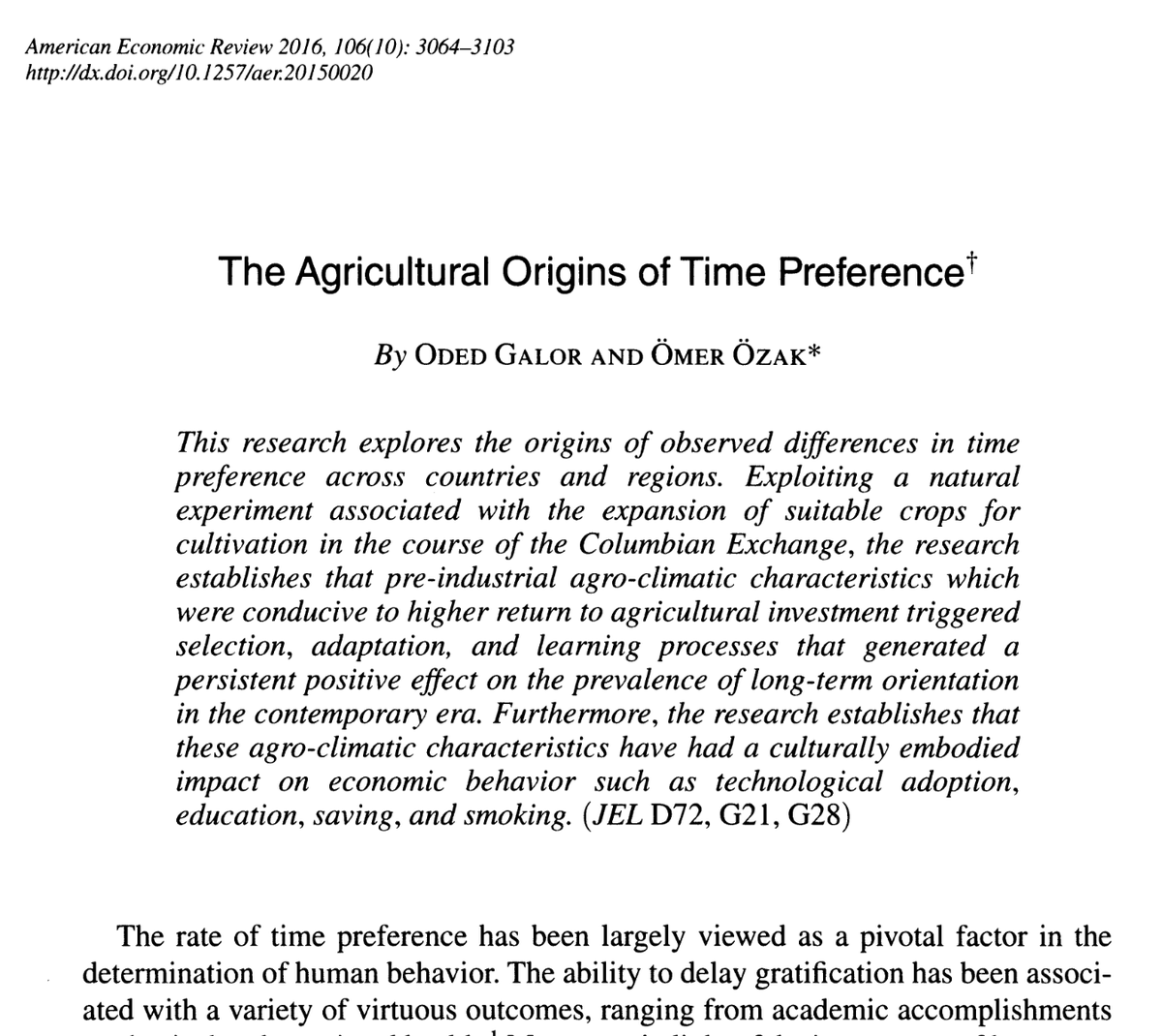
Many of you sent me messages or left comments with more papers linking economic growth and directional selection. Thanks very much! Oded Galor, @GalorOded, reminds me, in particular, of his paper with Ömer Özak, @OmerOzakEcon, in the AER, “The Agricultural Origins of Time Preference,” which links pre-industrial agro-climatic conditions favorable to higher returns to agricultural investment with a persistent positive effect on long-term orientation today. This is at the core of yesterday’s discussion. Omer Moav, @Omer_Moav, posts a short review of recent findings: warwick.ac.uk/fac/soc/econom… and a discussion of the relation with Gregory Clark’s (@GregoryClarkUCD) “A Farewell to Alms.” I apologize to Gregory for not mentioning his book (which I use when teaching undergrads!). There was no deeper motivation than wanting to keep the post short. Unfortunately, X is not the best platform to acknowledge everyone’s contributions. Radoslaw Stefanski (@stefanski_radek) and Alex Trew follow a similar line of argument in “Selection, Patience, and the Interest Rate” in JPE: Macro, arguing that endogenous selection on patience helps explain falling interest rates. It also predicts a long transitional rise in savings rates, generating transitional growth. After all, selection is the ultimate driver of economic growth. We do not see much increase in the income per capita of squirrels. Without evolution, there would be no technological improvement or sophisticated division of labor (yes, among some animals, there are degrees of cultural improvement or division of labor, but nothing that sustains long-run growth). The discussion is only whether directional selection made a difference over the last few thousand years. Paul Novosad, @paulnovosad, draws my attention to “Cognitive Endurance as Human Capital” in the QJE by Christina Brown, @christinalbrown, Supreet Kaur, Geeta Kingdon, and Heather Schofield, who show that schooling may build human capital by expanding the capacity for cognition. In particular, they document that the experience of effortful thinking itself, even when devoid of any subject content, improves general cognitive capacity. So, yes, practicing the five declensions of Latin and the three voices of Ancient Greek is probably a much more useful allocation of time than “At Lincoln Elementary, we inspire every child to become a confident, curious, lifelong learner ready to thrive in an ever-changing global community.” There are many more papers and books, but I do not want to overextend myself. I only want to point out to young students and researchers what a vibrant field economics is. Check the webpages of Oded, Ömer, Omer, Gregory, Radoslaw, Alex, and everyone I cited here, and you will find dozens of fascinating papers. Also, on a personal level, I have had the good fortune to interact a bit with Oded and Omer. Both are true scholars in the best sense of the word, curious about the world and seeking to get things “right,” not just another publication. I do not always agree with their readings of the evidence, but even when I do not, I learn an immense amount from them. And guess what? It seems that time is vindicating their views.
Jesús Fernández-Villaverde tweet media
English
4
70
381
27.8K
Jesús Fernández-Villaverde
Jesús Fernández-Villaverde@JesusFerna7026·
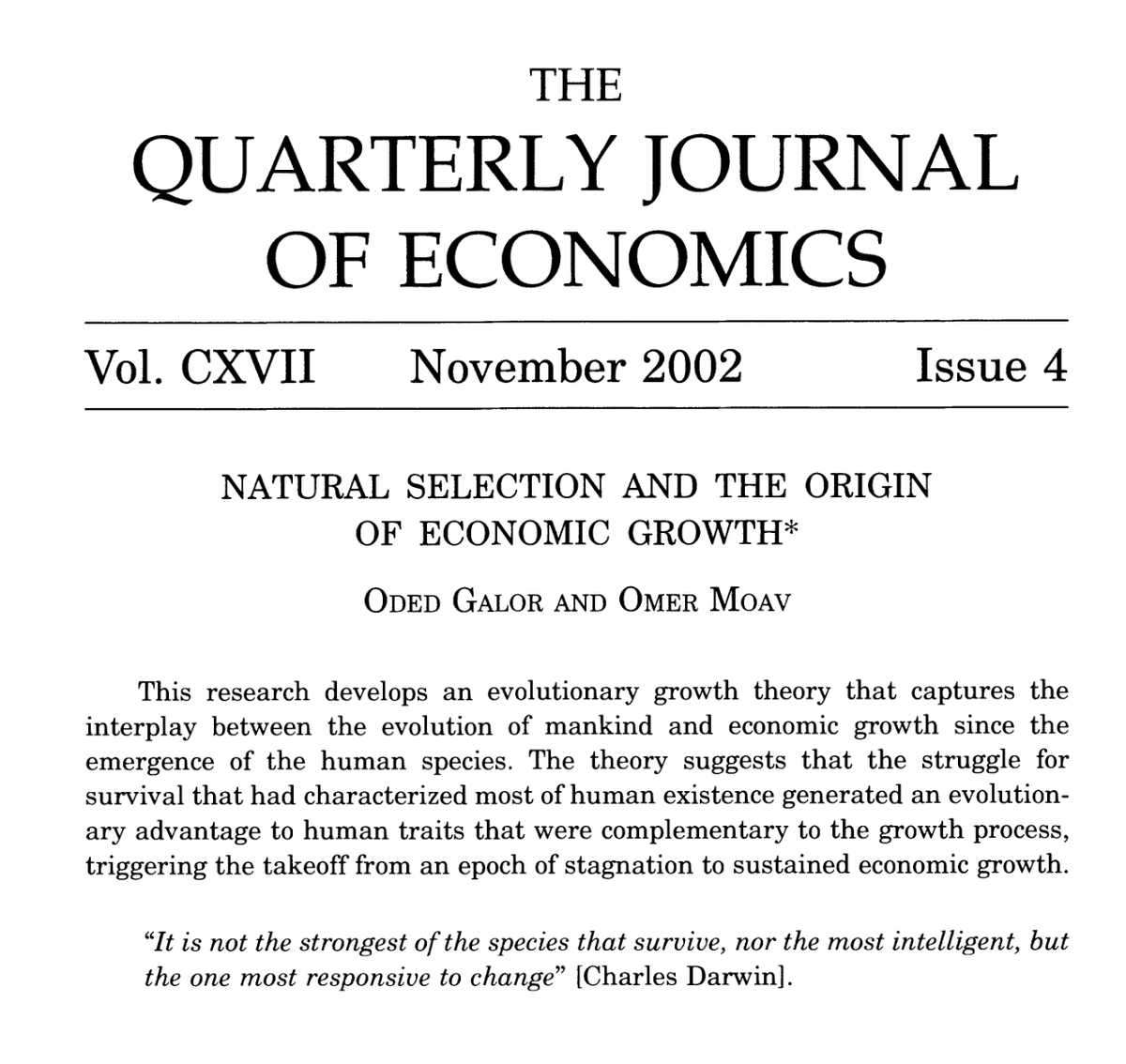
Last night I listened to David Reich’s interview with @dwarkesh_sp on his new Nature paper, “Ancient DNA reveals pervasive directional selection across West Eurasia.” dwarkesh.com/p/david-reich-2 Reich and his team present a method for detecting directional selection in ancient DNA time series, testing for consistent trends in allele frequency over time. They find that hundreds of alleles have been under strong directional selection, including alleles correlated with measures of cognitive performance. I have followed David Reich’s work for over a decade now and cite him in my economic history courses all the time. Nothing has changed my view of ancient history as much as his research, and the research his methods have triggered. His findings also bear directly on another line of work, “Natural Selection and the Origin of Economic Growth” by @GalorOded and @Omer_Moav at the Quarterly Journal of Economics, which proposes a similar mechanism. Reich’s results give a serious empirical boost to Galor and Moav's research agenda. Reich returns several times in the interview to behavior related to what economists call the discount rate (without using such a term). The evidence suggests that humans began discounting the future less with the advent of agriculture, because directional selection favored patience. I’ve long thought modern schooling serves this same function, training people to defer immediate rewards for long-term gains, and that such training is the most valuable trait one can have in daily life. Contrary to the Foucaults and Freires of the world, that schools are boring is a feature, not a bug. I don’t expect anyone at the schools of education to get this.
Jesús Fernández-Villaverde tweet media
English
24
150
718
78.6K
Radek Stefanski
Radek Stefanski@stefanski_radek·
@AndreasShrugged I think we understand misallocation and its causes a lot better today than we did 30 years ago. And misallocation is a big part (the biggest?) in explaining income differences.
English
0
0
1
63
PantheManII
PantheManII@panthemanii·
@laplacian28 Doubt that. The Eastern Bloc always lagged behind Central and Western Europe (CWE). Nothing to do with Russians.
English
16
0
23
4.5K
Radek Stefanski
Radek Stefanski@stefanski_radek·
@antoniomele101 Because I can get essentially unlimited codex for 4o quid a month. And with Claude I run out after 10 minutes ;)
English
0
0
0
63
Radek Stefanski
Radek Stefanski@stefanski_radek·
@andrewzacker @RilRil Weather sucks for 5 months late November to early April. The rest of the year it is heaven on earth. Awesome spring, best summer and amazing autumn. But yes, February in Warsaw is grim.
English
0
0
2
12
Andrew Zacker
Andrew Zacker@andrewzacker·
@RilRil Every city has its cons and pros, and everyone decides what cons you are ready to accept. Yeah, weather sucks
English
1
0
1
1.2K
Andrew Zacker
Andrew Zacker@andrewzacker·
I moved to Warsaw 5 years ago 🇵🇱 Here's what I didn't expect: > it’s safe > it’s clean > fast internet > great startup community > a lot of amazing cafes > everything is new > bike lanes everywhere > cheaper than western world (€2k/m enough for COMFY life) > culture of working with laptops in coffee shops Cons? > weather is sh*t > people aren’t that friendly as in Asia (but it’s still much better than a fake US smile) I just spent 2 months in Asia building my startup from there. I was missing my routines in Warsaw. But honestly, you can build from anywhere. Just choose any city, build routines and lock in. The city matters less than you think 🌍.
Andrew Zacker tweet mediaAndrew Zacker tweet mediaAndrew Zacker tweet mediaAndrew Zacker tweet media
English
69
25
495
46K
Stats Globe
Stats Globe@statsglobe·
🇵🇱 Poland Passport Power Ranking Since 2000: 2000 ➜ 🇵🇱 Passport Rank: 45th 2001 ➜ 🇵🇱 Passport Rank: 40th 2002 ➜ 🇵🇱 Passport Rank: 40th 2003 ➜ 🇵🇱 Passport Rank: 35th 2004 ➜ 🇵🇱 Passport Rank: 25th 2005 ➜ 🇵🇱 Passport Rank: 20th 2006 ➜ 🇵🇱 Passport Rank: 16th 2007 ➜ 🇵🇱 Passport Rank: 15th 2008 ➜ 🇵🇱 Passport Rank: 15th 2009 ➜ 🇵🇱 Passport Rank: 15th 2010 ➜ 🇵🇱 Passport Rank: 13th 2011 ➜ 🇵🇱 Passport Rank: 14th 2012 ➜ 🇵🇱 Passport Rank: 13th 2013 ➜ 🇵🇱 Passport Rank: 12th 2014 ➜ 🇵🇱 Passport Rank: 11th 2015 ➜ 🇵🇱 Passport Rank: 10th 2016 ➜ 🇵🇱 Passport Rank: 9th 2017 ➜ 🇵🇱 Passport Rank: 8th 2018 ➜ 🇵🇱 Passport Rank: 7th 2019 ➜ 🇵🇱 Passport Rank: 7th 2020 ➜ 🇵🇱 Passport Rank: 8th 2021 ➜ 🇵🇱 Passport Rank: 10th 2022 ➜ 🇵🇱 Passport Rank: 8th 2023 ➜ 🇵🇱 Passport Rank: 9th 2024 ➜ 🇵🇱 Passport Rank: 6th 2025 ➜ 🇵🇱 Passport Rank: 6th 2026 ➜ 🇵🇱 Passport Rank: 6th
Stats Globe tweet mediaStats Globe tweet media
English
90
191
4.6K
644.6K
Veronica, Collagen Scientist
Veronica, Collagen Scientist@celestialbe1ng·
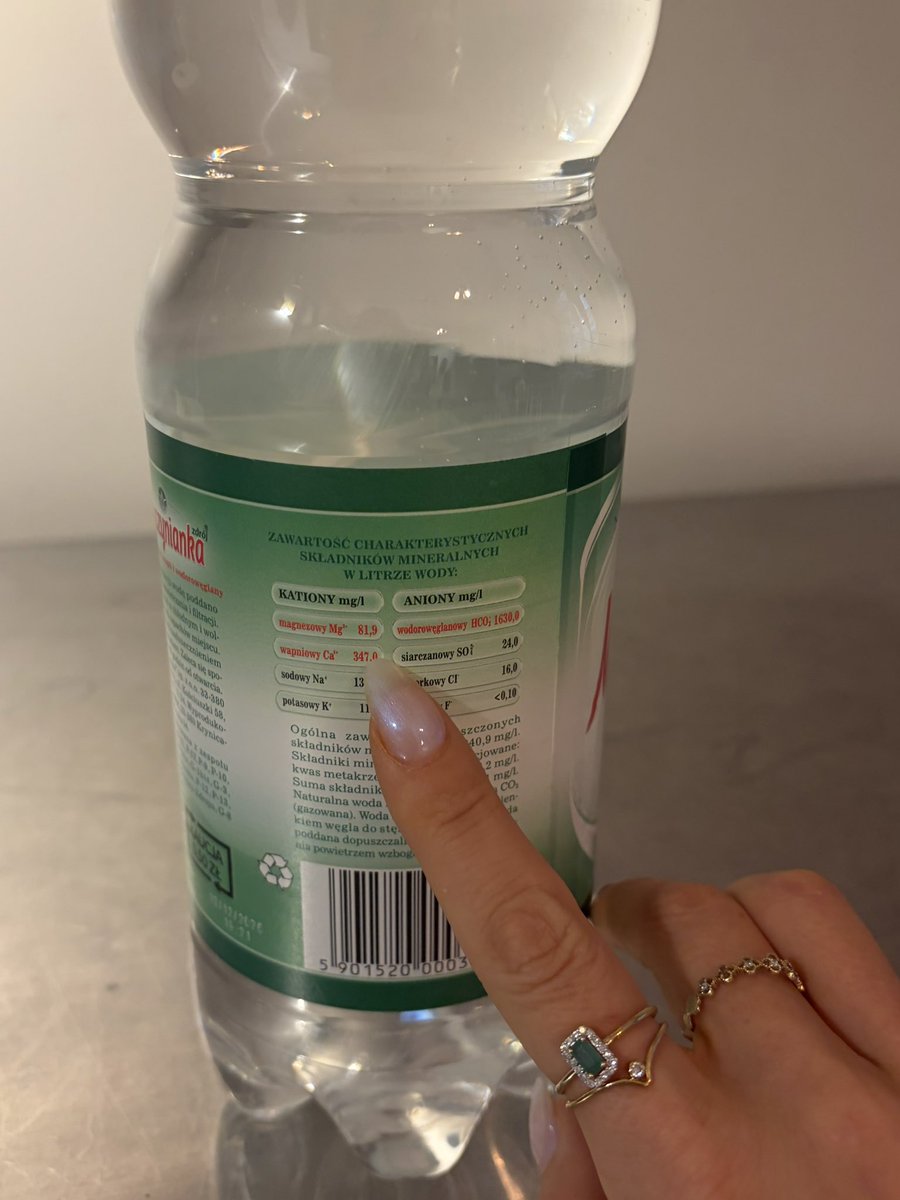
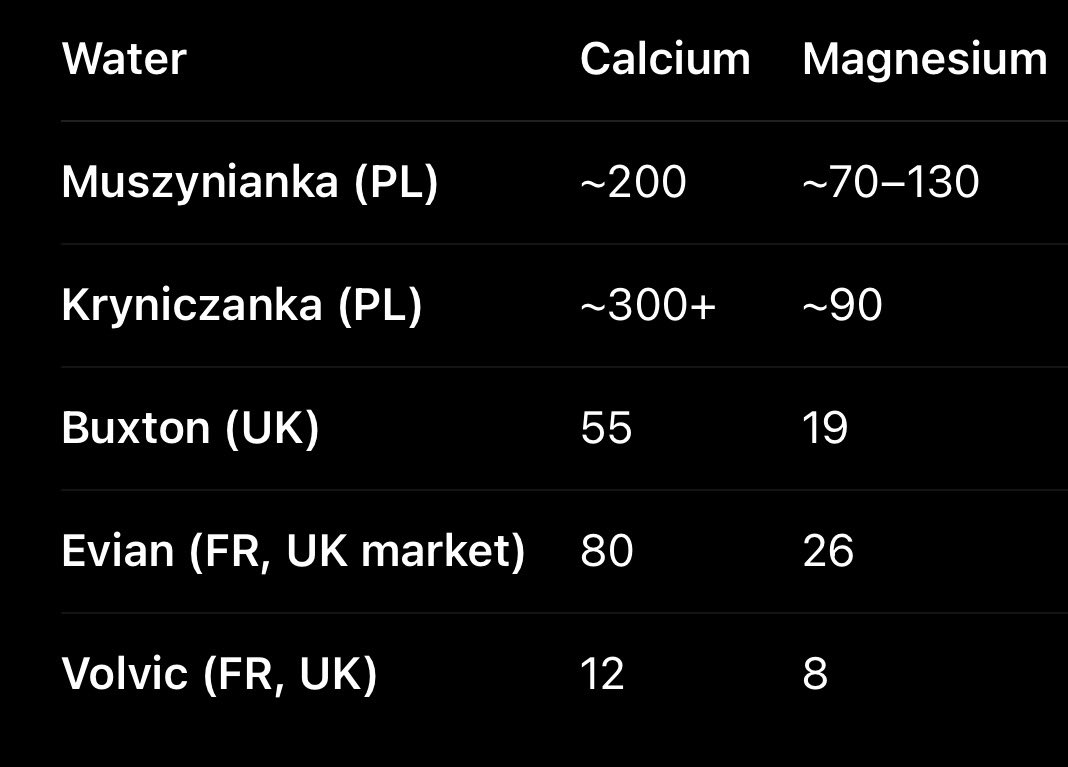
Polish mineral water is so mineralised it’s basically a calcium + magnesium supplement in a bottle. Poland can’t stop catching Ws <3🫧🇵🇱
Veronica, Collagen Scientist tweet mediaVeronica, Collagen Scientist tweet media
English
334
278
7.6K
1.8M
Milo MacBooth
Milo MacBooth@MiloMacBooth·
@FitFusion__ Make your own… 6 ingredients, including whole roasted garlic cloves.
Milo MacBooth tweet media
English
2
1
98
9.4K
Fit_Fusion
Fit_Fusion@FitFusion__·
Grandma's best hack for homemade bread
English
369
242
2.6K
575.5K
Tuki
Tuki@TukiFromKL·
🚨 Cursor just dropped Composer 2.. their own AI model.. not Claude.. not GPT.. their own.. and it beats Claude Opus on coding benchmarks.. at a fraction of the cost.. a code editor with 50 people just outperformed a $30 billion AI lab.. at coding.. which is supposed to be their whole thing.. the vibe coding era just got an upgrade..
Cursor@cursor_ai

Composer 2 is now available in Cursor.

English
305
258
4.6K
1.1M