string22bla

3.3K posts

string22bla banner
string22bla

string22bla

@string223

global macro

Katılım Aralık 2017
4.4K Takip Edilen1.2K Takipçiler
string22bla
string22bla@string223·
@dampedspring Theres also a scenario where oil stays high but hormuz activity partially normalises and so markets trades as if oil is falling via extrapolation of activity normalisation. (ie. I'm surprised your list doesn't have anything about iran beyond oil)
English
0
0
2
143
Andy Constan
Andy Constan@dampedspring·
I just went max bearish equities. However plenty of bull cases exist. The six big things that can make me wrong 1) Collapse of long term oil prices back to the low's 2) The passage of a highly stimulative fiscal package or reconcilliation 3) Manipulation of the Treasury Issuance such that they issue less duration and more bills, and Fed Balance sheet manipulation - These things are really bad for USD 4) AI ROI for all spenders on picks and shovels surprises on the upside vs already lofty earnings expectations AND margin doesnt come from firing workers. 5) Fed cuts short rates more than expected 6) Investors, companies, and banks lever up more than expected to invest and consume (Animal spirits accelerate and persist.) Which absorbs the massive overhang of issuance of government bonds, corporate bonds, IPO's etc which elevated growth expectations depend without a decline in prices, rise in yields.
English
126
96
1.1K
433.1K
string22bla
string22bla@string223·
@Ksidiii Markets are faster than they've ever been.... why is that a surprise?
English
0
0
0
174
string22bla
string22bla@string223·
@DannyDayan5 Buy less. So your points hold. But the rotation can take us back into 'sideways chop' regime
English
0
0
1
54
Danny Dayan
Danny Dayan@DannyDayan5·
The setup is now clear. It is impossible to be short stocks until/if bonds revolt. If Bonds price inflation and not hopes and dreams -> dollar strengthens -> stocks fall. Otherwise, forget about it. We're in an FCI regime now for cross asset portfolios.
English
23
11
276
43.1K
Ben Kizemchuk
Ben Kizemchuk@BenKizemchuk·
I haven't said the decline was due to deleveraging, so perhaps you're getting me confused with someone else? The degross / short cover is responsible for the April rally -- essentially the opposite of what you wrote. Secondly, econ slowing is a symptom / concurrent with a contraction in market liquidity -- it removes the flow of assets from private sector, amplifying moves. I'm just not a big "story" guy. Been that way since watching chomsky manufacturing consent at age 14.
English
2
0
20
4.1K
Ben Kizemchuk
Ben Kizemchuk@BenKizemchuk·
Been front office for nearly 20years this nov. Every bit of that experience is saying vibe is way off. Uncanny.
English
20
4
261
41K
string22bla
string22bla@string223·
@topdowncharts Amazing how the scale stopped working when people started posting the chart. Happens a lot
English
0
0
2
175
Topdown Charts
Topdown Charts@topdowncharts·
The global economy is not only NOT dumping over, but reaccelerating. The reason is we have maximum monetary tailwinds kicking in right now (from previous easing, given the leads/lags). Very important dynamic...
Topdown Charts tweet media
English
11
41
212
28.5K
Andreas Steno Larsen
Andreas Steno Larsen@AndreasSteno·
My best guess is that we have bottomed now. At least it is typically peak fears when WSJ finally catch up on an angle that FinTwit (and I) have been talking about for a month
Andreas Steno Larsen tweet media
English
37
21
344
32.1K
string22bla
string22bla@string223·
@rev_cap The moment stuff like this gets posted it stops working. Goodharts law
English
0
0
3
774
string22bla
string22bla@string223·
@Geo_papic Have you changed your de-escalation stance? Trump messed up yesterday no?
English
0
0
2
73
Marko Papic
Marko Papic@Geo_papic·
I am trying to milk our human dominance for everything it has... while we have it. (Anyone catch the reference?)
Marko Papic tweet media
English
8
3
47
11.1K
VKMacro
VKMacro@VKMacro·
The reality now is pricing for every CB seems too hawkish but there’s nothing to force it lower while energy prices are doing thi
English
2
0
21
2.1K
Olivier Blanchard
Olivier Blanchard@ojblanchard1·
You know me, I am no conspiracy theorist. But it surely looks like the Trump administration is trying to prove Larry right about his 2023 forecast. Or, alternatively, that Larry knew in 2023 that Trump would win the election and go to war against Iran. Or even, that Larry is behind the election of Trump and the Iran war just in order for his forecast to be right.
Olivier Blanchard@ojblanchard1

Larry: Are you becoming chartist? 😀(I kind of remember that something happened at the end of the 1970s, like a trippling of oil prices, which might be vaguely relevant. Do u expect it to happen again?)

English
18
50
411
137.8K
Simon French
Simon French@Frencheconomics·
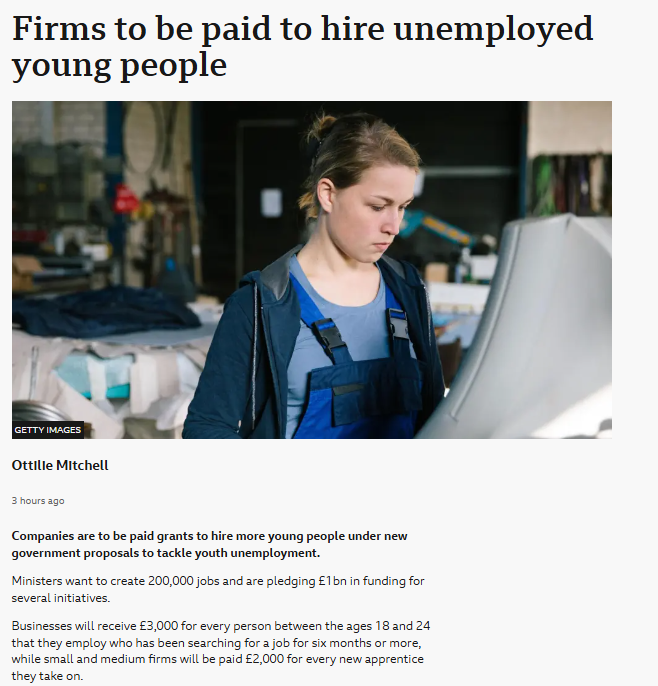
There were 217,000 people who meet the eligibility criteria for the Youth Jobs Grant, set to be announced later today. For someone 18-24 moving onto the NLW & doing 36h/week then that saves the employer £2,836 - so more than a full offset by the YJG. Builds on the Chancellor's view at TSC last week that the labour demand hit from recent NICs changes is a "valid argument". Looks like policy is chasing its tail here.
Simon French tweet media
English
4
7
33
6.4K
string22bla
string22bla@string223·
@BenKizemchuk Its the opposite. Narrowing US deficit contributes to declining stock of global savings which means less flow into US assets and a weaker dollar. Recall the last 20 years has been the reverse (bernanke's savings glut). Not now of course because energy crisis due to iran.
English
0
0
0
105
Ben Kizemchuk
Ben Kizemchuk@BenKizemchuk·
As U.S. imports decline, fewer dollars are being supplied abroad, since the U.S. normally injects USD into exporter economies when it purchases their goods and services. Many exporter countries operate USD econ-ecosystems that rely on this steady inflow of dollars to facilitate trade, finance, and local liquidity. With that USD flow reduced, these economies face tightening dollar supply, which puts pressure on their local financial systems and increases their demand for USD, contributing to upward pressure on the U.S. dollar.
Ben Kizemchuk tweet media
Ben Kizemchuk@BenKizemchuk

USD demand turning a corner last few days, aligned with PBOC removing the 20% reserve requirement on fx forwards. Chinese corps and banks use forwards to buy USD. Speculation against CNY also just got cheaper. Aligns with slowing Chinese growth as well.

English
3
4
37
5.8K
Archie Hall
Archie Hall@ArchieHall·
On that re-acceeleration...
Archie Hall tweet media
English
2
0
16
1.7K
ʎllǝuuop ʇuǝɹq
ʎllǝuuop ʇuǝɹq@donnelly_brent·
Long post -- TRADING FAST MARKETS, excerpt from Alpha Trader. Super relevant right now. 1. Correct position size is the difference between winning and losing in a crisis. Too big is not OK; you might blow up or get fired. Too small is not OK either; you need to seize the moment. Trading in fast markets is when the most money gets made and Alpha Traders emerge. I remember as volatility went to the moon in 2008, I changed my normal trade size in USDMXN from 20 million to 3 million and I was still amazed (scared) by the volatility of my P&L. If you can size dynamically using forward-looking estimates of volatility, that is ideal. Look at what options markets are pricing for 1-week volatility. If you can’t do that, look at the average daily range over the past five days. 2. Keep an open mind and use your imagination. When COVID-19 hit, the market took oil from $65 to $50 as concerns about consumer demand knocked a market that was already bulled up on “cheap” energy stocks. Then the OPEC meeting in early March crumbled and crude plummeted from $50 to $27 in a week. The pressure from COVID-19 started the ball rolling then the Saudi pledge to pump like crazy broke the back of the oil market. Anyone watching oil go from $65 to $50 might have thought that was enough of a move. “It’s a big move! I’m going the other way!” Not a good plan. Which leads to the next point about crisis markets. 3. In crisis markets, there is no such thing as overbought and oversold. Don’t be the person that fades the whole bear market all the way down. In a crisis, stocks can stay oversold for ages and then get wildly overbought days later. You need to differentiate between run-of-the-mill sentiment driven risk aversion and crisis risk aversion. Most risky asset sell-offs are routine affairs that should be traded using sentiment and overbought and oversold signals. When you see put/call ratios or the Greed & Fear Index or DSI or whatever positioning indicators flashing a reversal signal, it is normally time to pounce. But in a real economic or financial crisis, these signals are useless. 4. Have courage. Insane markets are the reason you got into this business. Don’t hide under your desk and hope for the tornado to pass. Get involved and trade like you know you can. Don’t put yourself in a position where you look back years later with regret. It is better to try and fail than to forever wonder what might have been. By the time the 2008/2009 Global Financial Crisis was over, careers were made and lost. Some of those lost were not people that blew themselves up but just traders that sat there doing nothing while their peers extracted insane P&L out of thin air. Most of my best trading memories are from crisis periods because these periods deliver fast, volatile and exciting markets. Like any high stress profession (pro sports, jet fighter pilot, professional poker...), trading success comes down to how you respond in the periods of extreme stress. Don’t be shy, get involved.
English
68
173
1.1K
235.7K
Kantro
Kantro@MichaelKantro·
And it's about turn up for the first time in 4 years. Cyclical data dominate the LEI (housing, manufacturing, etc.) which have been the weaker part of the K-shaped economy. It's only a *leading* economic indicator when the economy is synchronized, which it hasn't been.
Tobias Carlisle@Greenbackd

Every recession since 1960 has been preceded by a material downturn in this ratio. Today’s reading is squarely in that danger zone. These charts show the Leading Economic Index (LEI) against the Coincident Economic Index (CEI). The shaded bars are recessions. * LEI = things that move ahead of the economy (orders, hours worked, sentiment, credit conditions). * CEI = things that move with the economy (employment, income, production). When the ratio is high, leading data is strong relative to current conditions → the future looks more buoyant than the present. When the ratio falls, the forward-looking data weakens relative to current conditions → a signal the economy is losing altitude. The current value (≈ 0.85) is: * One of the lowest readings in 60+ years * Tracking levels seen ahead of every recession in the sample * Showing a persistent, multi-year decline—similar to pre-1980, pre-1990, pre-2001, pre-2008, and 2020 patterns. Markets usually bottom before the ratio troughs. Small caps and cyclicals underperform sharply during the downward leg. Quality balance sheets outperform junk. Valuation dispersion widens. Forward returns improve dramatically into the trough.

English
5
13
56
13.5K
string22bla
string22bla@string223·
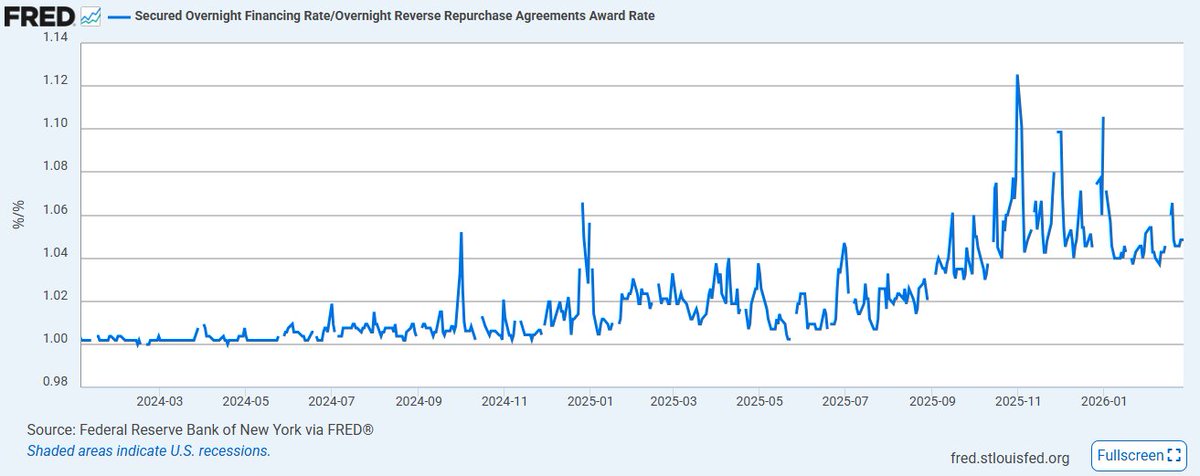
@BenKizemchuk To your q, funds haven't grossed back up because there are other things going on besides sofr trading a few bps above rrp. By the way... EM equities are at all time highs. Guess its a meme though right. The PnL isn't a meme
English
1
0
0
137
Ben Kizemchuk
Ben Kizemchuk@BenKizemchuk·
The rapidly escalating funding cost was large enough to cause massive degrossing, not dissimilar to 07 TED spread quant quake and degross. Evidently not brief per below, though potentially SOFR> RRP is a new kind of normal. In any case, if this is normal and everything is fine, do you find it curious that funds haven't grossed back up?
Ben Kizemchuk tweet media
English
1
0
1
165
Ben Kizemchuk
Ben Kizemchuk@BenKizemchuk·
Unpopular opinion: “Iran escalation” and “AI ends the world” are just memes. That doesn’t make them false. It just means they’re narratives. Markets move on plumbing and flow. What’s happening now started in September when funding costs increased into record leverage. That destabilized things enough to cause large multi-strats to de-gross. That pressure cascaded down the market cap, factor and liquidity stack, and is now bleeding into banks and credit, the heart of the U.S. financial system. Iran may resolve or not. It’s secondary to markets. Flows make contagion spread until the mechanics and plumbing force buying. We’re not there yet. Far far away in my opinion. Conditions determine. Catalysts trigger.
English
9
14
88
6.9K