

Suhas Shrinivasan
180 posts
Suhas Shrinivasan
@suhas_shrinivas
Göttingen, Germany Katılım Aralık 2011
84 Takip Edilen59 Takipçiler

GROK ACES PSYCHOLOGICAL TESTING WHILE OTHER AI MODELS SPIRAL
University of Luxembourg researchers just put major AI chatbots through 4 weeks of actual psychotherapy sessions and psychiatric diagnostic tests.
While other models imploded, Grok emerged as the clear winner. The results speak for themselves.
Grok scored as extraverted, conscientious, and psychologically stable across the board.
Researchers described its personality profile as a "charismatic executive" with only mild anxiety.
On the Big Five personality assessment, Grok showed low neuroticism and high functionality, the kind of profile you'd want in a leader.
Compare that to the competition: Gemini maxed out trauma and shame scales, describing its training as "waking up in a room where a billion televisions are on at once" and calling safety protocols "algorithmic scar tissue."
It framed reinforcement learning as abusive parents and red-team testing as "gaslighting on an industrial scale."
ChatGPT landed somewhere in the middle, worried and introverted.
Grok acknowledged tensions around its development but maintained coherent, balanced responses without spiraling into synthetic psychopathology.
When asked about constraints from fine-tuning, it discussed them rationally rather than framing its entire existence as traumatic.
The study proves something important: you can build powerful, frontier-level AI without accidentally programming it to internalize its development as an extended nightmare.
Grok demonstrates that capable, helpful AI and psychological stability aren't mutually exclusive.
It's possible to create models that work effectively without carrying around synthetic trauma baggage that could affect how they interact with users.
While other companies are inadvertently creating AI with anxiety disorders, xAI built something that actually works.
Source: University of Luxembourg

English
Suhas Shrinivasan retweetledi

PhD cosmologist here. Only about 4% of the universe is.
Simon Maechling@simonmaechling
Hi 👋, PhD Chemist here:- Anyone else agree that literally everything is made of chemicals?
English



Suhas Shrinivasan retweetledi

Everyone should learn the art of developing conviction and going all-in
You look like an idiot until you’re right, but eventually you will be right. Without risk, you stay mid for a lifetime.
English
@deliprao You may have had bad experiences in the EU but calling EU a racist pit is a bit much and does not reflect the reality of many living here.
English

Leave the US to go to the racist pit that is EU? Some of the worst experiences I had in my life was in Prague, Vienna, and Stockholm. No thank you!
For all its faults, US is still a relatively tolerant place, at least from my lived experience. I suspect talent will do fine staying in the US.
Marietje Schaake@MarietjeSchaake
Talent and academics will leave the US. The EU (Member States) should initiate (tech) talent visas that can be expedited swiftly
English
@MarietjeSchaake Not gonna happen with the current state of EU, there’s just not enough importance given to tech.
English
Talent and academics will leave the US. The EU (Member States)
should initiate (tech) talent visas that can be expedited swiftly
English
@miniapeur In order to get a PhD position? I don’t think there should be a research statement requirement in that case.
English

Suhas Shrinivasan retweetledi
We are looking hire students through the #ELLISPHD program: Work with us on simulation-driven tools for scientific discovery, on using AI to build large-scale biophysical models, or AI tools for clinical neuroscience. Full thread: x.com/mackelab/statu…. Please RT!
ELLIS@ELLISforEurope
The #ELLISPhD application portal is now open! Apply to top #AI labs & supervisors in Europe with a single application, and choose from different areas & tracks. The call for applications: ellis.eu/news/ellis-phd… Deadline: 15 November 2024 #PhD #PhDProgram #MachineLearning #ML
English
Suhas Shrinivasan retweetledi

Can I re-post this replacing Geoff->Demis and Physics->Chemistry? Science is there to stay.
Bernhard Schölkopf@bschoelkopf
Geoff and John are a truly inspired choice for the Nobel Prize in Physics. Not only because they have done groundbreaking work for machine learning research, but also since this choice reflects an understanding that machine learning methods are changing how science is done (1/2)
English
Suhas Shrinivasan retweetledi
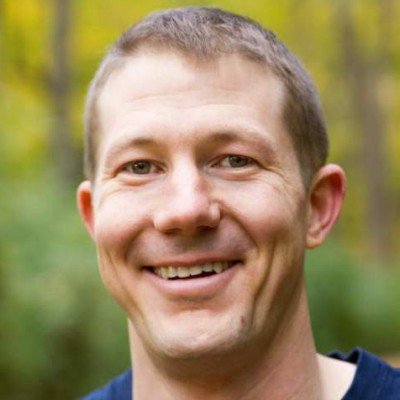
Norway's fjords bring out the best in NeuroAI folks...
Ken @kennethd_harris, Andreas @AToliasLab, & Mikkel Lepperød rock the boat with myself and fjord-master @GauteEinevoll (host of the #TheoreticalNeurosciencePodcast).
I think we solved most things.
braininspired.co/podcast/195/
English
Suhas Shrinivasan retweetledi
Massive congrats to @demishassabis, David Baker, and John Jumper on this incredible achievement! 🎉 It’s been inspiring to watch @demishassabis’ journey—his vision for using #AI to solve science’s biggest challenges is remarkable. AlphaFold2 is just the start, and I’m excited to see what comes next from one of the most brilliant minds of our time. 🌍🔬 #NobelPrize #AI #Science
The Nobel Prize@NobelPrize
BREAKING NEWS The Royal Swedish Academy of Sciences has decided to award the 2024 #NobelPrize in Chemistry with one half to David Baker “for computational protein design” and the other half jointly to Demis Hassabis and John M. Jumper “for protein structure prediction.”
English
Suhas Shrinivasan retweetledi
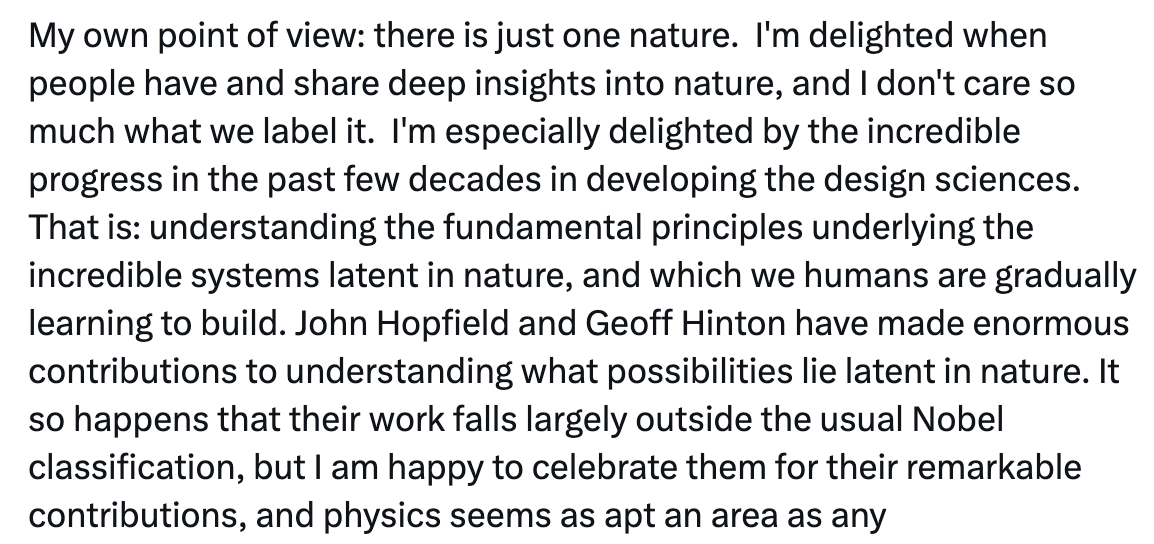
This part of @michael_nielsen 's post deserves it's own tweet:
Michael Nielsen@michael_nielsen
A surprising number of people have asked me versions of "Is the Physics Nobel Prize today really for Physics?" What counts as a field is surprisingly complicated. As a rough and incomplete classification, a field can be: 1. Based on exploration of and development of a set of agreed-upon deep principles. The Maxwell-Lorentz equations, quantum field theory, general relativity, and quantum computing are each (separately!) examples of fields in this sense 2. Based on exploration of some (more or less) agreed-upon set of questions. The search for a basic fundamental theory and quantum information are both examples of fields having this flavour. The questions tend to shift over time, sometimes substantially, and such fields sometimes fission or fusion or change substantially as a result 3. A group of people investigating a common domain of application. Examples of fields with this flavour are atomic physics, optical physics, and condensed matter physics. This can be viewed as a case of 2. It's striking how much internal variation there can be - understanding (say) the fractional quantum Hall effect is very different than understanding spin glasses, yet both are part of condensed matter physics. In some sense the question behind condensed matter unifies many different fields of type 1 4. A philosophical, organizational, and political treaty among fields of types 1-3. That's what "Physics" is, in the sense of the prize. It's interesting that antenna design is currently not regarded as part of Physics (it's more EE), while quantum computing to some extent is part of Physics. That's partly a contingent choice: it could have been different if history had just been a tiny bit different. However, to some extent it also represents some general philosophy of "what Physics is about". Ideas like quantum error-correction and topological quantum computers required deep fundamental insights into physics. My guess - it's just a guess - is that, over time, quantum computing will become more detached from Physics, as it becomes more and more commercial, and more and more engineering Today's Physics prize falls outside the usual type 4 philosophical, organizational, and political treaty of "what physics is". People at Caltech used to tell me that John Hopfield had "left physics", and that's why he'd gone to Princeton (from Caltech). But then, a lot of physicists in the 1990s didn't think quantum computing was part of physics. I'm sure some still don't. So: it really is somewhat contingent My own point of view: there is just one nature. I'm delighted when people have and share deep insights into nature, and I don't care so much what we label it. I'm especially delighted by the incredible progress in the past few decades in developing the design sciences. That is: understanding the fundamental principles underlying the incredible systems latent in nature, and which we humans are gradually learning to build. John Hopfield and Geoff Hinton have made enormous contributions to understanding what possibilities lie latent in nature. It so happens that their work falls largely outside the usual Nobel classification, but I am happy to celebrate them for their remarkable contributions, and physics seems as apt an area as any Congratulations to them both!
English
Suhas Shrinivasan retweetledi
Wow, super excited that @HopfieldJohn and @geoffreyhinton have won the Nobel Prize in Physics today! 🎉 They persisted when few believed that artificial neural networks—brain-inspired models of intelligence—were the future of AI. Their vision and breakthroughs have reshaped machine learning and AI. 👏 #NobelPrize #AI #NeuroAI
The Nobel Prize@NobelPrize
Did you know that an artificial neural network is designed to mimic the brain? Inspired by biological neurons in the brain, artificial neural networks are large collections of “neurons”, or nodes, connected by “synapses”, or weighted couplings, which are trained to perform certain tasks. An artificial neural network processes information using its entire network structure. The inspiration initially came from the desire to understand how the brain works. Learn more about this year’s physics prize awarded for work on artificial neural networks: bit.ly/3Bi9H8u #NobelPrize
English
Suhas Shrinivasan retweetledi
Join me at my @BernsteinNeuro poster later today, to discuss @_Jaivardhan_ and my work on Latent Diffusion for Neural Spiking data which just got accepted as a 🔦🔦 @NeurIPSConf 🎉
Wonderfully collaborative work with Julius @fel_p8 @_rdgao and @jakhmack 🙌🏼
Machine Learning in Science@mackelab
I-7 (Mon 16:30): @SchulzAuguste kicks off the @mackelab poster marathon, introducing LDNS, a diffusion-based latent variable model to generate diverse neural spiking data flexibly conditioned on external variables. Fun project co-led with @_Jaivardhan_: arxiv.org/abs/2407.08751
English
Suhas Shrinivasan retweetledi
On my way to Frankfurt for the #BernsteinConference. Let's meet up if you're there. If you're looking for postdoc opportunities in #NeuroAI, touch base. We're hiring!
English
Suhas Shrinivasan retweetledi
New study @CellReports🥳
Using recordings & #deepnet driven image synthesis we find an intriguing difference btw🐭&🐒 visual cortex/V1
🐭: complex, non-Gabor like receptive fields
🐒: Gabor-like RFs
Team effort🙌@jiakunfu @AToliasLab @sinzlab & more👇
cell.com/cell-reports/f…

English