Raji

32 posts

Raji

Raji

@sun_raji

Katılım Mayıs 2022
75 Takip Edilen30 Takipçiler
Raji
Raji@sun_raji·
@alex_prompter What happens when there is no more new information to peddle? Google is pulling the rug from content creator by diverting web traffic.
English
0
0
2
1.2K
Alex Prompter
Alex Prompter@alex_prompter·
Let me trace the timeline here because nobody's connecting it. Step 1: Scrape the entire internet. Every book, every article, every conversation, every piece of art, every forum post. Do it without asking. Do it without paying. Step 2: Train a model on all of it. Call it "artificial intelligence." Step 3: Go to BlackRock's Infrastructure Summit and announce: "We see a future where intelligence is a utility, like electricity or water, and people buy it from us on a meter." Step 3 is where you sell people's own knowledge back to them. On a meter. They took the collective output of human thought, compressed it into a model, and now they want to charge you by the token to access a version of what you and everyone you know already created. One Reddit user put it perfectly: "They stole all this data from us, the people, our life's work, creativity, art, by devouring the internet and blowing through all copyright laws. Now they want to sell it back to us in the form of a utility." Imagine if someone photocopied every book in the public library, burned the library down, and then opened a subscription service for the copies. That's the metered intelligence business model. And they're pitching it to infrastructure investors as though they invented water.
Vivek Sen@Vivek4real_

SAM ALTMAN: “WE SEE A FUTURE WHERE INTELLIGENCE IS A UTILITY, LIKE ELECTRICITY OR WATER, AND PEOPLE BUY IT FROM US ON A METER.”


English
3K
42.4K
122.2K
4.6M
Vince Langman
Vince Langman@LangmanVince·
My top 5 military movies: 1. Saving Private Ryan 2. Patton 3. The Patriot 4. Apocalypse Now 5. The Dirty Dozen Honorable mention: The first half of Full Metal Jacket What do you have?
English
2.1K
50
1.3K
149.6K
Raji
Raji@sun_raji·
@thewire_in @sundarpichai Not cool Sundar. Build a man-made island like that in the Emirates for data centers and use desalination plant for water.
English
0
0
0
282
Raji
Raji@sun_raji·
@coinbureau May be come up with something like - if guard rails are corrupt, then entire product is corrupted and unusable, making it tamper proof.
English
0
0
0
54
Coin Bureau
Coin Bureau@coinbureau·
🚨AI GUARDRAILS BROKEN IN MINUTES FT reports tools can strip safety protections from Meta, Google, and other AI models. The altered models then answered harmful prompts on bio weapons, malware, and child exploitation. Open-source AI risk just got harder to control.
Coin Bureau tweet mediaCoin Bureau tweet media
English
41
8
76
10.5K
Raji
Raji@sun_raji·
@yacinelearning He does not get thinkers and doers. Researchers are not paper pushers.
English
0
0
1
65
Yacine Mahdid
Yacine Mahdid@yacinelearning·
Yacine Mahdid tweet media
Data Noir@datanoir_io

@yacineMTB Serious question, what exactly is xAI missing to leap ahead, with all that compute? Is that impossible now or something they could pull off in a year with the right people?

ZXX
53
66
1.5K
471.9K
Raji
Raji@sun_raji·
@kimmonismus Who is lining up to buy products build by AI if there is no disposable income to buy it...?
English
0
0
0
224
Chubby♨️
Chubby♨️@kimmonismus·
Anthropic co-founder Dario Amodei has been saying this for over a year now. And he keeps saying it. Louder each time. In May 2025, he told Axios that AI could eliminate 50% of all entry-level white-collar jobs within five years and push unemployment to 10-20%. In January 2026, he published a 20,000-word essay calling AI “a general labor substitute for humans” that will cause “unusually painful” disruption. At Davos, he warned of a “zeroth world country” forming in Silicon Valley, decoupled from the rest of society, running at 50% GDP growth while everyone else faces mass joblessness. In his own words: “We, as the producers of this technology, have a duty and an obligation to be honest about what is coming.” And the data is starting to back him up. Tech entry-level hiring dropped 30-50% in 2025. Wall Street banks are cutting ~200,000 roles concentrated at the junior level. S&P 500 companies shed employees in net terms for the first time since 2016. Anthropic’s own labor market research confirmed that 77% of businesses use Claude to automate tasks, not to augment workers. Now another Anthropic co-founder is echoing the same message: “There is a real possibility that AI will displace human labor at a very large scale. Supporting those people will be a moral imperative of historic proportions.” This is no longer a warning from the sidelines. This is the company building the technology telling you, repeatedly, that the disruption is real, it’s fast, and society is not ready for it. x.com/disclosetv/sta…
English
133
86
1.1K
126.1K
Raji
Raji@sun_raji·
@lpachter How that is that possible...?
English
0
0
0
365
Lior Pachter
Lior Pachter@lpachter·
This person has published 71 papers in 143 days so far in 2026. That is, 2 days per paper (source: Google Scholar). It's truly amazing. To see someone proud of this.
English
108
263
3.5K
794K
The Better India
The Better India@thebetterindia·
What started with a question about polluted drinking water has now won three Indian teens one of the world’s biggest environmental prizes. 16-year-olds Vivaan Chhawchharia, Ariana Agarwal, and Avyana Mehta just became the Asia winners of The Earth Prize 2026 after creating “Plas-Stick”, using powdered tamarind seed as the base for an all-natural microplastic clumping agent. The idea came after the trio visited rural communities where people stored drinking water in shared containers without access to advanced filtration. Today, microplastics have been found everywhere, from the deepest oceans to the human brain and even placentas. But while most people are still discussing the problem, these teens are already building a solution. The team received $12,5000 each through The Earth Prize to develop their creation and to make safer drinking water more accessible. #EarthPrize #Microplastics #IndianInnovators #CleanWater #ClimateSolutions [Microplastics, Clean Water, Teen Innovators, Earth Prize]
The Better India tweet media
English
13
185
519
10.6K
Raji
Raji@sun_raji·
@Google Most people don't find any of this relevant in their daily lives. A lot of money is burned through, just because a lot of money is available to burn through.
English
1
0
2
341
Google
Google@Google·
Introducing Gemini Spark ✨ a 24/7 personal AI agent that helps you navigate your digital life. Set recurring tasks, teach it new skills and create complete workflows. #GoogleIO
English
64
79
459
70.2K
Raji
Raji@sun_raji·
@alexis_sch @demishassabis Are there any commercial products available globally because of alpha fold or isomorphic...?
English
0
0
1
78
Demis Hassabis
Demis Hassabis@demishassabis·
Gemini Omni is a major leap in world understanding & multimodal editing! It can take photos, video & audio and build entirely new scenes. Over time it’ll be able to handle any input & any output - starting w/ video You can even give it your own videos & iterate on your ideas:
English
382
946
9.5K
916.2K
Raji
Raji@sun_raji·
@MilkRoadAI Very cool! I can see it used for disabled stroke patients.
English
0
0
1
351
Milk Road AI
Milk Road AI@MilkRoadAI·
This is WILD! MIT just solved one of the hardest unsolved problems in robotics (Save this). For decades, the fundamental problem with soft robots and wearable exoskeletons has not been compute or AI, it has been actuation. The moment you try to give a soft robot meaningful strength, you run into the same wall every engineer has hit since the field began, fluid-driven systems require external pumps, hydraulic reservoirs, and heavy infrastructure that makes the entire thing impractical to wear or embed into fabric. MIT's new Electrofluidic Fiber Muscles solve that problem by eliminating external infrastructure entirely. The key insight is electrohydrodynamic pumping using electric fields to generate pressure directly from electricity, with no moving parts, no motors, and no external fluid reservoir. The fibers are less than 2 millimeters thick, can be woven into fabric like ordinary textile, and operate in complete silence because nothing physically moves inside them, it is just ions propelling fluid through a closed circuit. The performance numbers published in Science Robotics are not conceptual, they are empirical results from actual hardware. These fibers achieve a power density of 50 watts per kilogram, matching skeletal muscle, with a contraction strain of 20% and a response time of 0.3 seconds. A single bundled configuration lifted 4 kilograms, 200 times its own weight while a separate configuration drove a robotic arm through a 40-degree bend compliant enough to safely complete a human handshake. Another configuration launched objects in under 100 milliseconds, which is faster than a human flinch reflex. The design mirrors biological muscle architecture in a way that prior artificial muscle approaches never achieved. The fibers are organized into antagonistic pairs, one contracts while the other extends, exactly like biceps and triceps and because the system runs in a closed loop, the relaxing fiber serves as the fluid reservoir for the contracting one, which is what allows the whole system to operate untethered with no external tank. The applications are not hypothetical but rather are the exact use cases the industry has been waiting years for the hardware to catch up to. Exoskeletons for physical labor, prosthetic limbs that move with the natural compliance of biological tissue, assistive garments for patients with motor disorders, and soft robots capable of safe physical contact with humans are all immediately unlocked by a muscle technology that is silent, lightweight, and weavable into clothing. The deeper significance is what this technology does when it meets the AI robotics wave that is already underway. Every major humanoid robot program, Figure, 1X, Boston Dynamics, Tesla Optimus is currently bottlenecked by the same hardware limitations these fibers address, actuators that are too rigid, too loud, too heavy, or too dependent on infrastructure to operate naturally alongside humans. Electrofluidic fiber muscles do not just solve a materials science problem but rather they remove one of the last physical barriers between robots that live in labs and robots that live in the world.
English
140
1K
5.2K
1.2M
Sundar Pichai
Sundar Pichai@sundarpichai·
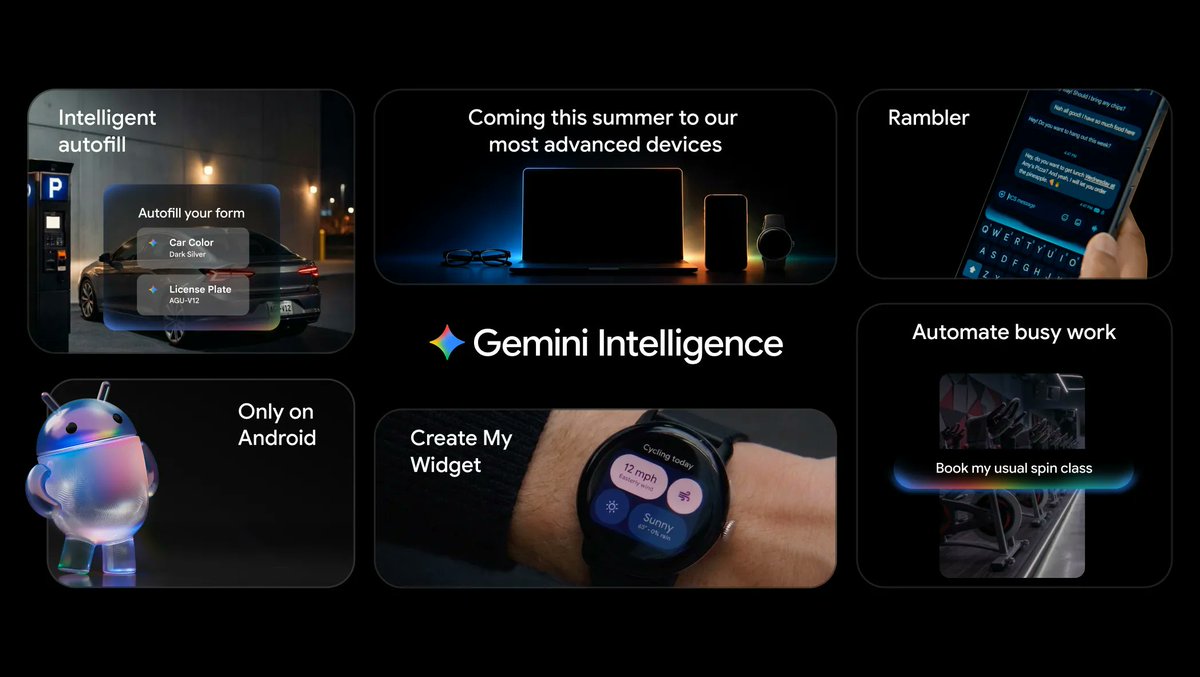
Today at the @Android Show (I/O edition) we announced Gemini Intelligence - bringing the best of Gemini to our most advanced devices. Automate multi-step tasks across apps and Chrome, fill out forms in a single tap, turn spoken thoughts into polished text with Rambler, build custom widgets & loads more.
Sundar Pichai tweet media
English
316
473
5K
302.5K
Raji
Raji@sun_raji·
@HumansNoContext United, AA and the rest should have seating like this in Economy during long hauls.
English
0
0
2
606
NO CONTEXT HUMANS
NO CONTEXT HUMANS@HumansNoContext·
In China, schools are equipped with desks that can be transformed into beds, allowing students to take naps.
English
334
1.3K
6.7K
984.6K
Cliff Pickover
Cliff Pickover@pickover·
Knowledge. Ideas. Biology, Physics, Economics, Chemistry, ... Mathematics? What word completes the pattern?
Cliff Pickover tweet media
English
690
49
370
53.3K
Raji
Raji@sun_raji·
@sundarpichai Build sensors to pick up blood pressure reads in real time.
English
0
0
2
1.7K
Raji
Raji@sun_raji·
@MorePerfectUS Some of them left CA to avoid paying taxes, yet talk about Universal income, AI taxes for displaced workers. If there really was an AI tax, where will they go next?
English
0
0
11
2.9K
More Perfect Union
More Perfect Union@MorePerfectUS·
If California's billionaire wealth tax passes, Nvidia CEO Jensen Huang would pay $8 billion dollars. His response: "I don't mind paying taxes."
English
221
1.1K
8.2K
802.4K
Raji
Raji@sun_raji·
@nytimes Panel must include academic AI experts with no allegiance to any tech companies. The subject is too complex for legislative members to wrap their heads around.
English
1
0
1
718
The New York Times
The New York Times@nytimes·
Breaking News: The Trump administration is discussing vetting new A.I. models before they are publicly released. nyti.ms/49msJbF
English
191
162
501
458.5K
Raji
Raji@sun_raji·
@charliebilello Gas prices are rising to a point where employees will refuse to commute to work. The price needs capped.
English
1
0
4
201
Charlie Bilello
Charlie Bilello@charliebilello·
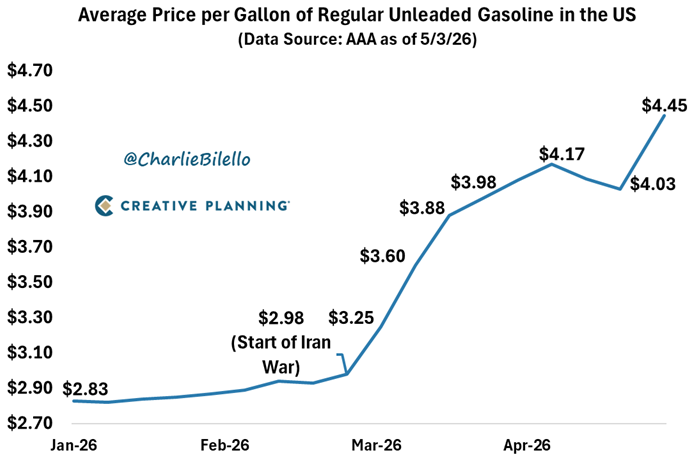
Gas prices in the US have moved up to $4.45 per gallon, their highest level since July 2022. The 49% spike over the last 9 weeks ($2.98/gallon to $4.45/gallon) is the biggest we've seen in the past 30 years.
Charlie Bilello tweet media
English
58
170
490
56.9K
Raji
Raji@sun_raji·
@JosephJacks_ Very cool ! Water molecules are fuel cells.
English
0
0
1
174
JJ
JJ@JosephJacks_·
Microtubules are usually drawn as hollow protein tubes — a piece of cellular scaffolding. But the hollow isn’t empty. Its 15-nanometer lumen holds water, and that water is nothing like the bulk liquid filling the rest of the cell. Confined by a charged protein wall at nanoscale dimensions, water reorganizes into a highly structured, radially layered architecture with properties closer to a soft crystal than a fluid. Four concentric zones emerge, each with its own geometry, dynamics, and electromagnetic character, nested like the rings of a resonant cavity. At the outermost layer, a chemisorbed shell (0–3 Å) locks directly onto the acidic residues of the inner protein surface. These waters form rigid tetrahedral cages, H-bonded so tightly to the wall that they behave as an extension of the protein itself — rotationally frozen on picosecond timescales. Moving inward, the first ordered hydration layer (3–8 Å) organizes into a helical dipole lattice: millions of water molecules with their electric dipoles tilted 15–25° from the long axis, aligned collectively in a twist that mirrors the microtubule’s own 3-start and 5-start protofilament helices. This is water that has inherited the symmetry of its container. Deeper still, the coherence domain (8 Å to ~2.5 nm) is where the physics becomes genuinely strange — water molecules oscillating in phase, coupled to a trapped electromagnetic field, forming a quasi-crystalline low-entropy plasma. Predicted by quantum electrodynamic treatments of liquid water (Del Giudice, Preparata) and consistent with measured resonance signatures, it is effectively an optical cavity made of matter. At the very center runs the axial water wire: a single-file chain of water molecules, 0.3 nm wide, threading the length of the tube. It is the biological analogue of water in a carbon nanotube or an aquaporin channel, and it carries protons by the Grotthuss mechanism — not by moving water molecules, but by relaying H⁺ charge along the chain at near-ballistic speed. The supporting panels quantify what the cutaway shows. The dielectric profile stays low and flat (ε ≈ 2–5) across all four zones, confirming that none of this water behaves like the bulk liquid (ε ≈ 80) — the entire lumen is a low-dielectric environment that enhances electrostatic interactions and stabilizes long-range coherence. The H-bond distances shorten monotonically from 2.80 Å in the outer hydration layer to 2.65 Å in the axial wire, meaning water becomes progressively more tightly bonded, more ordered, and more conductive as you move inward. The EM resonance spectrum spans eight decades and resolves into three distinct bands — MHz longitudinal cavity modes, GHz librational modes, and THz H-bond stretching modes — the signature of a structure that is simultaneously an antenna, a dielectric resonator, and a mechanical oscillator. The scale reference anchors the axial wire against its nearest cousins: slightly narrower than a carbon-nanotube water wire, dimensionally identical to the conduction channel of aquaporin, but embedded in a far larger and more complex resonant architecture. The implication is significant. A microtubule is not a passive strut. It is a nanoscale resonant cavity whose working fluid is coherent, ordered water — a structure capable of storing electromagnetic modes, conducting protons along its axis, and coupling mechanical, electronic, and optical degrees of freedom through a single medium.
JJ tweet media
English
27
98
413
20K