

suzos
718 posts

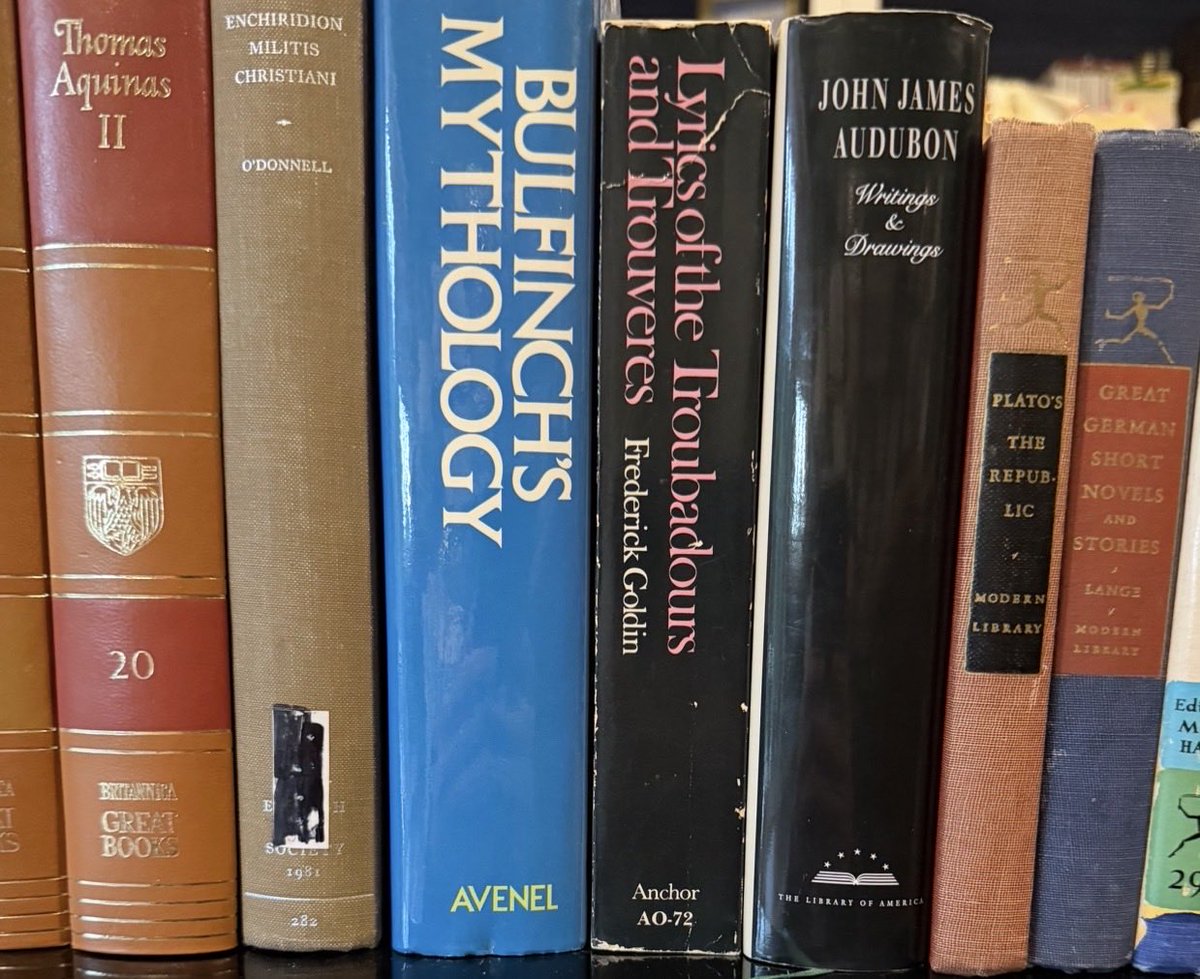
All of this for $20 at an estate sale — people, especially the children of boomers, are profoundly stupid.


English

@ItsGoneAwry Get a crackpot! It cooks for you while you're at work.
It's not difficult
English

No time for making dinner?
GET A FREAKING INSTANT POT.
It will change your life.
If you can afford DoorDash you can afford an Instant Pot.
You’ll save a bazillion dollars a year.
English

@HowToAI_ Months ago in a post, I had said that “Artificial Intelligence” was a wrong nomenclature.
“Artificial Thinking” Maybe?
I was the only person on this planet that saw the limited use for this so called AI from the word go.
I hv not seen any evidence to change my views yet.😊
English

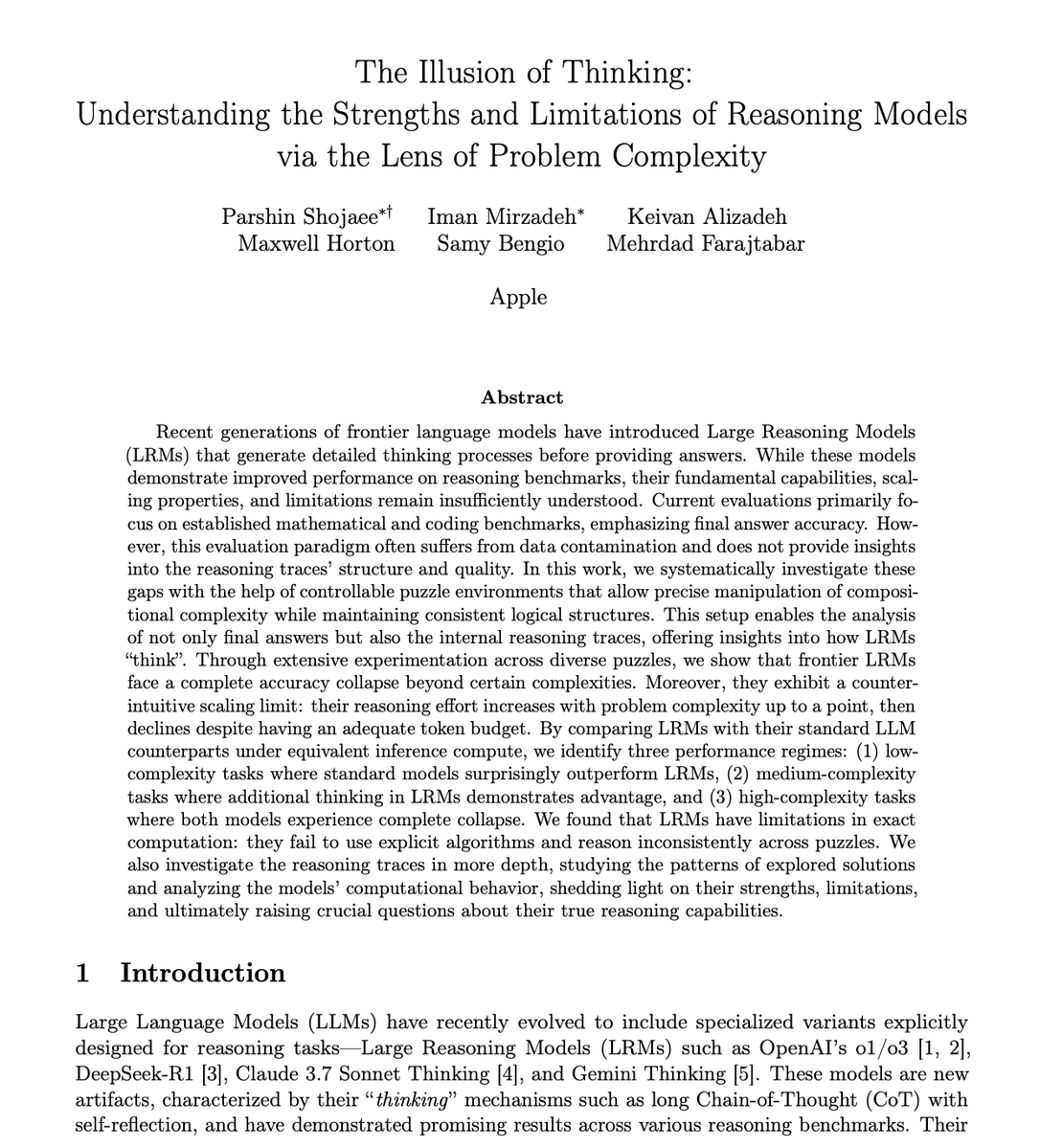
Apple has published a paper with a devastating title: “The Illusion of Thinking”
It argues that AI models, no matter how brilliant they may seem, do not understand what they are doing.
They do not solve problems. They do not reason. They merely generate text word by word, trying to sound coherent.
Apple tested the most advanced reasoning models in the world on controlled puzzle environments. They tore open the internal "thinking" traces.
What they found shatters the narrative that we are getting closer to AGI.
Current models don't scale with complexity. They have a hard mathematical cliff. And they do not degrade gracefully. They collapse.
But here is the most unsettling part.
When a problem gets too complex, the AI doesn't use its remaining compute to try harder.
It just gives up.
Its reasoning effort actually declines. It stops thinking and starts guessing.
Then Apple ran the experiment that closes the casket on the reasoning debate.
They gave the AI the exact, step-by-step algorithm to solve the puzzle. The cheat codes.
All the AI had to do was follow the instructions.
It couldn't do it.
Performance didn't improve at all.
When the complexity gets high enough, these models fail because they cannot actually execute a logical sequence.
They are not reasoning. They are just pattern matching.
When you give them a simple problem, they overthink. When you give them a hard problem, they collapse.
Paper: The Illusion of Thinking, Apple, 2025
English

It’s a beautiful day to make a Spencer Pratt ad.

English
@youaresmarter22 @PecanC8 You don’t listen. She said they read it in the mirror.
English

@PecanC8 Fake story. Letters would be backwards.
English

Mike Rowe had his mother, best selling author Peggy Rowe on his recent podcast.
After her daily morning swim, Peggy saw a woman's backside in the locker room. She had an unusual tattoo on her rear-end, so Peggy asked her about it.
You won't believe what it was. 😂
English
English



President @realDonaldTrump asked the White House chef to make breakfast sandwiches for the press who are viewing the ballroom construction this morning 🇺🇸

English
@ExploreEso @Lordoftheringsu Love Story is the worst. Saying “I’m sorry” is one of the most important phrases to use in a love relationship.
English

@Lordoftheringsu No greater love story? Really? Romeo and Juliet? The Notebook? Love Story, FFS. Stop with the hyperbole. Aragorn and Arwen are barely on screen together in the films.
English

Aragorn was 87 years old and Arwen was 2778 years old during the events of The Lord of the Rings. When Aragorn died at the age of 210, Arwen could not bear his loss and died of grief at the age of 2901, 123 years after she had renounced her Elvish immortality to be with him.
There is no greater love story in film or literature than this one.


English
@ihtesham2005 I’m in full agreement with the studies, but can you explain what the word ‘fight’ is supposed to represent in this sentence:
A decade before her, two researchers at Princeton ran the same fight using a completely different method and ended up at the same answer.
English

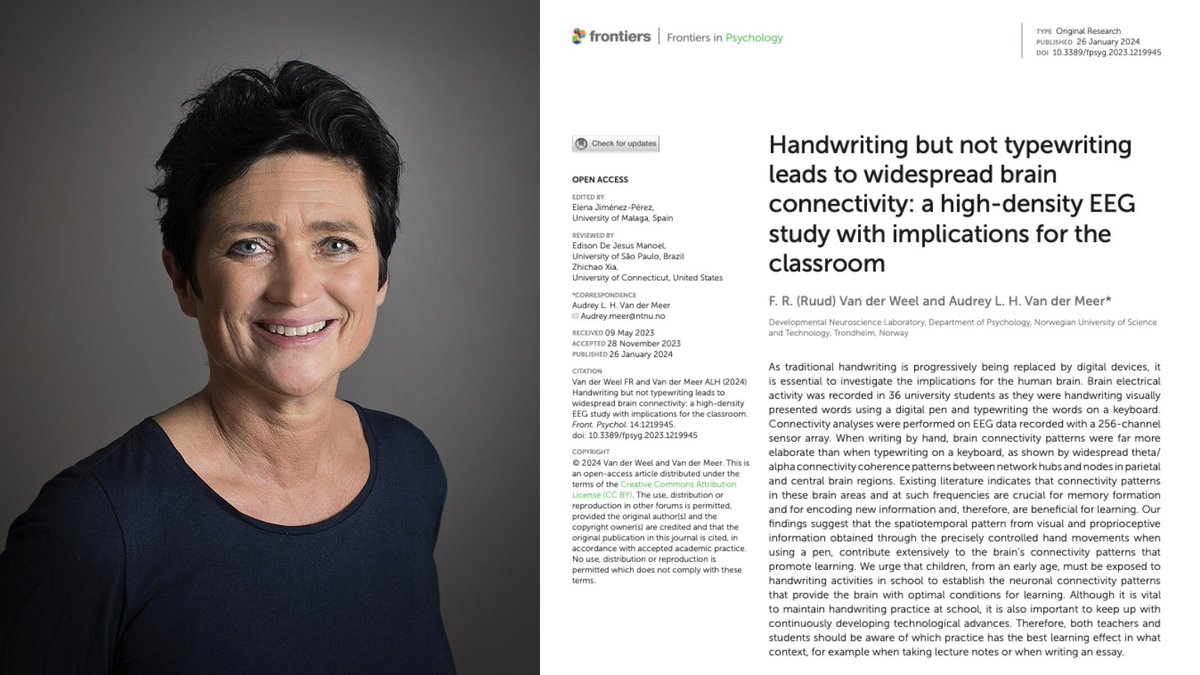
A Norwegian neuroscientist spent 20 years proving that the act of writing by hand changes the human brain in ways typing physically cannot, and almost nobody outside her field has read the paper.
Her name is Audrey van der Meer.
She runs a brain research lab in Trondheim, and the paper that closed the argument was published in 2024 in a journal called Frontiers in Psychology. The finding is brutal enough that it should have changed every classroom on Earth.
The experiment was simple. She recruited 36 university students and put each one in a cap with 256 sensors pressed against their scalp to record brain activity. Words flashed on a screen one at a time.
Sometimes the students wrote the word by hand on a touchscreen using a digital pen, and sometimes they typed the same word on a keyboard. Every neural response was recorded for the full five seconds the word stayed on screen.
Then her team looked at the part of the data most researchers had ignored for years, which is how different parts of the brain were communicating with each other during the task.
When the students wrote by hand, the brain lit up everywhere at once.
The regions responsible for memory, sensory integration, and the encoding of new information were all firing together in a coordinated pattern that spread across the entire cortex. The whole network was awake and connected.
When the same students typed the same word, that pattern collapsed almost completely.
Most of the brain went quiet, and the connections between regions that had been alive seconds earlier were nowhere to be found on the EEG.
Same word, same brain, same person, and two completely different neurological events.
The reason turned out to be something nobody had really paid attention to before her work. Writing by hand is not one motion but a sequence of thousands of tiny micro-movements coordinated with your eyes in real time, where each letter is a different shape that requires the brain to solve a slightly different spatial problem.
Your fingers, wrist, vision, and the parts of your brain that track position in space are all working together to produce one letter, then the next, then the next.
Typing throws all of that away. Every key on a keyboard requires the exact same finger motion regardless of which letter you are pressing, which means the brain has almost nothing to integrate and almost no problem to solve.
Van der Meer said it plainly in her interviews.
Pressing the same key with the same finger over and over does not stimulate the brain in any meaningful way, and she pointed out something that should scare every parent who handed their kid an iPad.
Children who learn to read and write on tablets often cannot tell letters like b and d apart, because they have never physically felt with their bodies what it takes to actually produce those letters on a page.
A decade before her, two researchers at Princeton ran the same fight using a completely different method and ended up at the same answer. Pam Mueller and Daniel Oppenheimer tested 327 students across three experiments, where half took notes on laptops with the internet disabled and half took notes by hand, before testing everyone on what they actually understood from the lectures they had watched.
The handwriting group won by a wide margin on every question that required real understanding rather than surface recall.
The reason was hiding in the transcripts of what the two groups had actually written down.
The laptop students typed almost word for word, capturing more total content but processing almost none of it as they went, while the handwriting students physically could not write fast enough to transcribe a lecture in real time, which forced them to listen carefully, decide what actually mattered, and put it in their own words on the page.
That single act of choosing what to keep was the learning itself, and the keyboard had quietly skipped the choosing and skipped the learning along with it.
Two studies. Two countries. Same answer.
Handwriting makes the brain work. Typing lets it coast.
Every note you have ever typed instead of written went into your brain through a thinner pipe. Every meeting, every book highlight, every idea you captured on your phone instead of on paper was processed at half depth.
You did not forget those things because your memory is bad. You forgot them because typing never woke the part of the brain that would have made them stick.
The fix is the thing your grandmother already knew.
Pick up a pen. Write the thing down. The slower road is the faster one.
English

She thought she was heading to her aunt’s all-white birthday celebration… meanwhile, it was actually her proposal 😃😃
But wait, I’m confused 🤔 Did she really just walk past the entire proposal setup without noticing her man standing there?
English
@SpevV2 @OocTobeyM Exactly. I kept wondering why they were following her.
English

@OocTobeyM This also makes her several inclusions during the battle of New York to make sense
English

The Avengers (2012) has a deleted scene where Steve Rogers sits alone at a cafe, completely lost in modern times
A waitress tries to talk to him. He doesn't react
Stan Lee leans over from the next table and says "Ask for her number, ya moron"
Marvel cut it
No Context Tobey Maguire@OocTobeyM
Marvel movies are famous for their post-credits scenes. But their deleted scenes are just as insane…
English

The internet had things to say, so I gave them the Sunday service treatment. 🎶
English
@Betrfromscratch I wish I had a blue check so more people would see me repost this and boost your numbers. I’m crying 🤣
English
@Betrfromscratch So glad there was an IG watermark on your hijacked video so I could find and follow you!
English

Katharine Hepburn aparece con lágrimas en los ojos frente a Spencer Tracy en la escena final de "¿Sabes quién viene a cenar?" (1967), de Stanley Kramer. No estaba actuando; sabía que su amado de toda la vida estaba gravemente enfermo y se conmovió con sus palabras.
Español
@verawishful1 @RachelM91517319 @yassermedinam Don’t believe they were “in the shadows.” My understanding is his wife refused a divorce.
English

@RachelM91517319 @yassermedinam Exactly! My point exactly! She wasted her love and her life. Living in the shadows instead of having a love that belongs to her.
English
@end3of6days9 Hope he has a more detailed video showing drainage holes in those buckets…
English

This guy walks us through building a simple beginner friendly two-tier vertical garden stand using eight 5-gallon buckets and just a few 2x4s.
He shows every step — cutting the boards to length, framing it out, sliding the buckets into place, and adding the legs so the whole thing sits sturdy and ready for soil.
What I love most about building your own stand is how easy it is to customize. You can scale it to any size you want by simply adjusting the length of the boards to hold more or fewer buckets. You can even add a trellis to the back of the upper level if you’re growing vining vegetables like tomatoes.
One important tip: be sure to use food-grade buckets rather than the standard ones from the hardware store. Flip them over and look for the recycling symbol with the number 2 (HDPE) on the bottom — that’s the safe one for growing edibles. Regular buckets can release microplastics into the soil over time, so food-safe ones are the much better choice.
Have you ever thought about trying a vertical bucket garden like this on your deck or in the backyard? Would you build one this size or customize it bigger/smaller?
English

Furnish an entire house completely from antique stores and flea markets. You’ll be surprised at the results. 💯 it’s better than buying anything made in the last two decades.

English




People often say, “I hate when people paint brick! It ruins it.” But we’ve built some beautiful painted brick buildings at Building Culture.
The key is knowing what kind of paint to use.
Drop a dry brick into a bucket of water, and it will soak up moisture like a sponge. Brick is porous; it naturally absorbs water and releases it.
The problem with typical paint, latex or oil-based, is that it forms a coating that essentially seals the brick. What happens when the brick gets wet? The water can’t get out. It’s trapped. This can ultimately damage the brick, particularly in climates where it freezes, and especially with historic, multi-wythe masonry buildings. The brick needs to breathe.
But beyond the masonry's durability, it’s also an aesthetic issue. Peeling paint is ugly.
The right answer is a mineral stain, and the three options are limewash, potassium silicate, and sol silicate.
Mineral stains don't sit on top of the brick; they penetrate the surface and fuse with it. They are breathable, colored with earth pigments, highly alkaline – making them mold resistant – and, depending on which one you choose, can be far more durable. A well-applied sol silicate can last over 50 years.
Limewash, on the other hand, washes away over time. Literally. But it doesn’t look like peeling paint. It looks weathered. It’s actually the look people are often going for, but they try to achieve it with a faux-aged finish. But if you just use the right material and then let time do its thing? You can get a beautiful outcome.
See the pictures below. These were built in 2018, so the limewash is now 7+ years old. When first applied, it’s a solid white. But after seven years, the limewash is wearing away – in a natural way.
If you want this look, use limewash. If you want a solid paint that will last for decades, use potassium silicate or sol silicate. The Germans actually invented potassium silicate in the 19th century because limewash wouldn’t hold up in their harsh climates. Sol silicate is a newer invention and very impressive.
I think the reason people often hate on painted brick in the US is because 95% of the time, it’s the wrong paint. The rubber-like coating from oil-based, latex, and even many “masonry paints” smooths out all the texture of the brick. You lose a lot of character. Mineral stains don’t do this. It still feels like a real brick building. The texture comes through.
People don’t go to Europe and hate the painted masonry buildings. They’re beautiful and charming. It’s because they’re using the right paint.
One more key (and nerdy) fact for why people love European painted brick, but not US painted brick: mineral stains have a characteristic called “double refraction”. One light wave hits it, and it splits off two. It gives it this soft glow. But NOT glossy. It’s actually a chalky look – but doesn’t look flat (as we think of flat paint in the US, which reflects very little light). It’s chalky AND glows. That’s the double refraction. You simply can’t replicate this with petroleum-based products. It’s a chemical thing.
Don’t get me wrong: I love natural brick buildings, and we do a lot of those. But, with the right paint, and for the right project, painted brick can be absolutely stunning.
You can check out mineralstains dot com if you are looking for a supplier of quality mineral stains. Have had the owner on the podcast and he's extremely knowledgeable.


English
@bugler @AustinTunnell Unless you’re matching your mortar to the brick color, staining would result in a less jarring visual.
English

@AustinTunnell Why not just get bricks that have pigments in it from the start?
This painting and staining thing just looks awful.
There are so many nice bricks that have different colours because of their source. My bricks are old, but they're a coloured silicate type that is combed.
English
@disheartened_gy @AustinTunnell I think “idiots” is harsh. Uninformed and ignorant are more likely apt.
English

@AustinTunnell Painted brick is bad for the building as bricks need to breath, bad for your heating as it damages the U-values and is expensive to keep painting the exterior of a building.
Only idiots paint bricks, unless they like wasting money.
English