Shailesh Vickram Singh

10.8K posts

Shailesh Vickram Singh banner
Shailesh Vickram Singh

Shailesh Vickram Singh

@svickram

VC/Entrepreneur since 99. Building Climateh Tech ecosystem thru GoMassive Investing in Climate: https://t.co/HfrwZbox53 Operating : https://t.co/IeYShkdQlY

Around Katılım Nisan 2011
699 Takip Edilen3K Takipçiler
Shailesh Vickram Singh retweetledi
Nikhil Mehra
Nikhil Mehra@TweetinderKaul·
Mataji you literally know nothing about anything so stay out. What you frame as the burden that Punjab carried has its roots in Punjab's undying loyalty to the British in 1857 and thereafter for which it received the most significant canal systems, agrarian reforms and even tracts of lands in Awadh. While Awadh was systematically decimated. As an example Raja Randhir Singh of Kapurthala (Punjab) received the rich estates of Baundi and Bhitauli which were in Awadh. The whole pretence of "martial race" also began after 1857. So post-independence the Punjabi demand for the same preferential treatment continued. And in order to corner the MSP system from the mid-60s Punjabi farmers were growing paddy which simply doesn't suit the conditions for most of Punjab. Paddy could easily have been grown in other states. But why would they do this? Because that's how you perpetuate wealth and power. I don't blame folks for benefiting but I blame them for not recognising what has been at play. The Punjab Land Alienation Act 1900 played a significant role in creating the Jatt Sikh dominance of Punjabi society that we see today. So bestowed by loyalty to the British in 1857, enhanced by killing their own cropping preferences from the 1960s onwards and perpetuated by the support received from useful idiots like you during the Farm Laws Protest. This isn't as much a tale of sacrifice - it certainly exists in part - as it has been of self ingratiation.
Kewrious@Kewrious

Punjab was forced to do this to feed a hungry nation incapable of growing food themselves. But now time to change. Forget rice or wheat for the masses - sow only heritage crops for Punjab. Fix the farm economy. Rest of India is growing enough for itself. Punjab must pivot

English
16
184
572
32.9K
Shailesh Vickram Singh
Shailesh Vickram Singh@svickram·
Like roads create more traffic, AI will create more work / more productivity and in turn more jobs
Nav Toor@heynavtoor

🚨BREAKING: Berkeley researchers spent 8 months inside a tech company watching how employees actually use AI. The promise was simple: AI will save you time. Do less. Work smarter. The opposite happened. Workers didn't use AI to finish early and go home. They used it to take on more. More tasks. More projects. More hours. Nobody asked them to. They did it to themselves. The researchers sat inside the company two days a week for 8 months. They watched 200 employees in real time. They tracked work channels. They conducted 40+ interviews across engineering, product, design, and operations. Here's what they found. AI made everything feel faster, so people filled every gap. They sent prompts during lunch. Before meetings. Late at night. The natural stopping points in the workday disappeared. People ran multiple AI agents in the background while writing code, drafting documents, and sitting in meetings simultaneously. It felt like momentum. It felt productive. But when they stepped back, they described feeling stretched, busier, and completely unable to disconnect. 83% said AI increased their workload. Not decreased. Increased. 62% of associates and 61% of entry-level workers reported burnout. Only 38% of executives felt the same strain. The people doing the actual work absorbed the damage while leadership celebrated the productivity numbers. Then came the trap nobody saw coming. When one person uses AI to take on extra work, everyone else feels like they're falling behind. So the whole team speeds up. Nobody formally raises expectations. But the new pace quietly becomes the default. What AI made possible became what was expected. The researchers gave it a name: workload creep. It looks like productivity at first. Then it becomes the new baseline. Then it becomes burnout. AI was supposed to give you your time back. Instead it's eating more of it. And the worst part? You're doing it to yourself. Voluntarily.

English
0
0
1
108
Shailesh Vickram Singh
Shailesh Vickram Singh@svickram·
So havans are good and helpful in aqi
Science girl@sciencegirl

Smoke can clean the air better than some chemicals. A study published in the Journal of Ethnopharmacology analyzed the effects of "medicinal smoke" - specifically the combustion of wood and a mixture of odoriferous and medicinal herbs - on airborne pathogens. The goal was to see if natural smoke could function as an atmospheric sterilizer. The findings were significant. The researchers treated a closed room with this medicinal smoke for one hour. They found that it didn't just mask odors; it decimated the bacteria. Within 60 minutes, there was a 94 percent reduction in bacterial counts. Even more surprising was the longevity of the effect. While chemical sprays often evaporate or dissipate quickly, the smoke treatment maintained a cleaner environment for 24 hours in a closed room. In an open room, specific pathogenic bacteria - including Staphylococcus lentus and Enterobacter aerogenes were completely absent even 30 days after the initial treatment. This indicates that the smoke possesses strong bactericidal properties, capable of eliminating diverse plant and human pathogens within a confined space. It challenges the modern assumption that air quality is only improved by filtration, This modern data validates a practice that dates back thousands of years. Indigenous cultures worldwide have long used smoke for purification. In India, the havan ritual involves burning specific herbs to purify the environment, while Aboriginal Australians have performed "smoking ceremonies" for roughly 60,000 years to ward off bad spirits and cleanse the land. Read the study: "Medicinal smoke reduces airborne bacteria." Journal of Ethnopharmacology, 2007

English
0
0
1
99
Shailesh Vickram Singh
Shailesh Vickram Singh@svickram·
India needs massive infusion of capital in Health Care from phillontrophy side and not the PE/VC side Hospitals with no revenue pressures, doctors who are there for calling and not to build generational wealth Treatment as per ailment and not to meet quarterly quota
Mohandas Pai@TVMohandasPai

Please set up 1 tertiary hospital in 100 poor districts of India. Save lives @AnilAgarwal_Ved @narendramodi @PMOIndia consider and announce this before March 31, 2026. At Rs 500 cr this will be a mere Rs 50000 cr, a very small amount for a big big billionaire. In the name of your dear late son. You will be remembered for ever. @AmitShah Less than 75% of your known wealth!
English
0
0
2
233
Shailesh Vickram Singh retweetledi
Mohandas Pai
Mohandas Pai@TVMohandasPai·
Please set up 1 tertiary hospital in 100 poor districts of India. Save lives @AnilAgarwal_Ved @narendramodi @PMOIndia consider and announce this before March 31, 2026. At Rs 500 cr this will be a mere Rs 50000 cr, a very small amount for a big big billionaire. In the name of your dear late son. You will be remembered for ever. @AmitShah Less than 75% of your known wealth!
Anil Agarwal@AnilAgarwal_Ved

Last week, I was invited to attend and speak at the ‘PM’s Roundtable with Global Energy Leaders’ on the sidelines of the India Energy Week. This was the first official meeting I attended after the tragedy in our family. I am very grateful to Pradhan Mantri ji who expressed his condolences and deep sympathy for my loss. His advice that my wife and I stay strong and continue to do our work which is important for the country, provided great solace. I took the opportunity to inform him that I have already announced that 75% of my wealth will go back to society. I will cease to be a promoter and will work as a trustee. Very humbly, in keeping with the wishes of my late son, I put forward a request to do something big in education or healthcare or anything else that can benefit society. I would like to put in Rs10,000 crore-Rs 15,000 crore in such an effort. I am thankful to the PM for appreciating the sentiment. We are lucky to have a PM who not only has eyes and ears on the ground but also possesses great empathy towards all Indians. His words are a massive support to our family as we try and pick up our lives after tragedy and grief.

English
13
286
1.8K
371.1K
Jaidev Jamwal
Jaidev Jamwal@JaidevJamwal·
Once you can sort out mosquitoes, other biting insects, leeches, random landslides, heat, humidity and rain, hikes like this can be pretty fun during monsoons. Worth it all for me as there are no Indian tourists around.
English
7
4
111
7.4K
Shailesh Vickram Singh
Shailesh Vickram Singh@svickram·
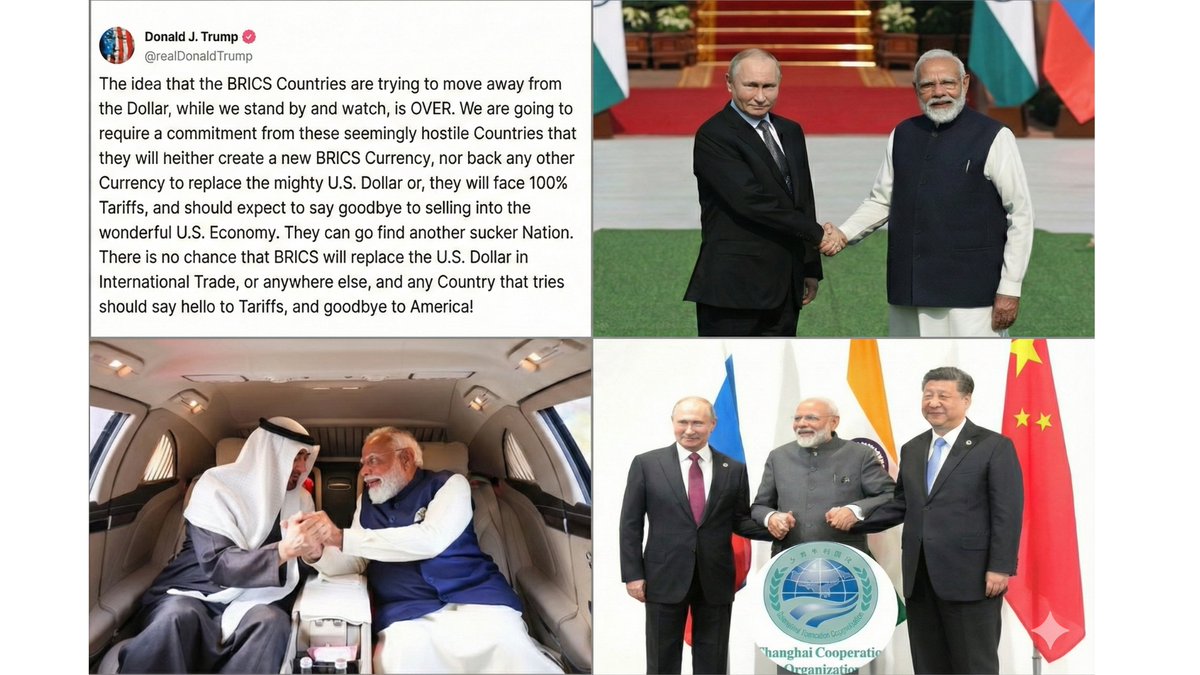
There are fundamental issues with the statements and logic used - Can Russia buy and invest in indian assets freely - answer is no Is there any country in brics which will happily run current deficit to support cirrency trade Is there any country or by is with deep enough bond markets Answer to all these questions is No - all these assumptions about USD being replaced by BRICS or anyother currency are just pipe dreams and will remain so
English
0
0
6
1.4K
Manish Bhandari
Manish Bhandari@TweetManishbh·
In the high-stakes theatre of international diplomacy, silence is rarely just silence. When U.S. Commerce Secretary Howard Lutnick announced this January that a landmark trade deal with India had stalled because Prime Minister Narendra Modi "did not call" President Trump to finalize the terms, the explanation was as convenient as it was implausible. To the casual observer, it painted a picture of bureaucratic hesitation. But to those watching the flow of global capital, the silence on the phone line masked a thunderous shift in the global economic order. While Washington focused on tariffs and trade deficits, New Delhi quietly engineered a financial mechanism that the United States has historically treated as a red line: the ability to buy oil without the dollar. A rigorous analysis of regulatory filings, central bank data, and geopolitical signalling reveals that the trade impasse of early 2026 is not about almonds or steel. It is the first major casualty of the "Petro-Rupee," a strategy that has placed the world’s oldest democracy and its largest democracy on a collision course over the future of financial sovereignty. The "Red Line" and the Greenback To understand the gravity of the rift, one must look past the current headlines to the foundation of American power. Since 1974, when the Nixon administration struck a pact with Saudi Arabia, the global oil trade has been denominated effectively exclusively in U.S. dollars. This "Petrodollar" system forces nations to hold vast dollar reserves, which are recycled back into U.S. Treasury bonds, financing American deficits and cementing the dollar's global supremacy.   History has been unkind to those who challenge this arrangement. When Saddam Hussein switched Iraqi oil sales to the Euro in 2000, or when Muammar Gaddafi proposed a gold-backed African currency in 2011, the geopolitical consequences were severe. As former Federal Reserve Chairman Alan Greenspan candidly noted in his memoirs, the Iraq war was "largely about oil"—a resource inseparable from the currency used to buy it.  So is the case with Venenzula and Iran today, which are pricing their oil outside the US dollar system. For decades, this was a line no ally would cross. But in the shifting landscape of 2026, India has done just that. The Smoking Gun: August 2025 Picture tells thousand words. The deterioration of economic relations can be traced precisely to mid-2025. While public attention was fixed on diplomatic pleasantries, the Reserve Bank of India (RBI) was dismantling the "Rupee Trap" that had hindered its trade with Russia in Rupee. For months, Moscow had been accumulating billions in Indian Rupees from oil sales that it couldn't spend. Then, on August 12, 2025, the RBI issued a quiet but revolutionary circular. It authorized foreign holders of "Special Rupee Vostro Accounts" (SRVAs) to invest their surplus balances into Indian Government Securities and Treasury Bills.   In a move that alarmed U.S. strategists even more, India and the UAE—two key American partners—began operationalizing a Local Currency Settlement system. The Indian Oil Corporation paid for a million barrels of Abu Dhabi crude in rupees, proving the concept worked. By 2025, this corridor had deepened, with the UAE pumping $22.84 billion in foreign direct investment into India to balance the currency flows, and the Abu Dhabi Investment Authority setting up shop in Gujarat's GIFT City. This was the smoking gun. By allowing Russia to recycle its oil revenue directly into Indian sovereign debt, New Delhi created a closed-loop financial system. Russian oil profits were no longer chasing U.S. Treasuries; they were funding Indian infrastructure. The reaction from Washington was swift. Within weeks, the U.S. imposed tariffs of up to 50 percent on select Indian goods—a punitive strike that signal the partnership was in jeopardy. By late 2025, this alternative financial architecture had expanded far beyond a wartime necessity for Russian oil. The RBI had permitted 123 correspondent banks from 30 countries—including the United Kingdom, Germany, Israel, and Singapore—to open 156 Special Rupee accounts. The Last Straw: India Takes the Wheel at BRICS While the "Petro-Rupee" laid the kindling, the spark that finally burned the bridge was India’s bold assumption of leadership within the BRICS currency project. As the host of the 2026 BRICS Summit, New Delhi has moved beyond passive participation to active architecture. The Reserve Bank of India has formally proposed linking the Central Bank Digital Currencies (CBDCs) of member nations—a project dubbed the "BRICS Bridge." Building on the 2025 Rio de Janeiro declaration, India is pushing for a proprietary, interoperable payment rail that would allow Russia, China, India, other BRICS members to settle trade instantly in digital local currencies, completely bypassing the U.S. banking system. This is not merely a theoretical exercise; with the RBI actively pilot-testing the e-Rupee’s cross-border capabilities, India is effectively building a "digital SWIFT" immune to Western sanctions. For the Trump administration, this was the final provocation. It wasn't just evasion; it was replacement. Conclusion: A Monetary Mutiny This aggressive push for a parallel financial system became the veritable last straw on the camel's back for the stalled trade deal. In December 2024, President-elect Trump issued a blunt ultimatum: any move by BRICS nations to create a new currency or back an alternative to the dollar would be met with 100 percent tariffs. Washington views India’s 2026 agenda not as economic modernization, but as a "monetary mutiny." The sages who studied the rise and fall of kingdoms would chuckle today, for the lesson is ancient: money is the hard-earned fruit of labor, while currency is merely the paper promise that it still tastes good. Money—like gold and silver—is the crystallized effort of real work. Currency, however, is its excitable younger cousin: useful for trade, but spoiled the moment rulers discover the printing press. India has chosen to bear the cost of tariffs rather than surrender the sovereignty of its "crystallized effort." The trade deal may be officially "stalled" due to a missed phone call, but in reality, it lies buried under the foundation of the new BRICS financial architecture—a foundation India is now actively pouring concrete for better future. Manish Bhandari, CIIA, founder of Vallum Capital Advisors, a Portfolio Management firm managing equity investments Based in Mumbai. Full Article & Research Document Available Below economictimes.indiatimes.com/markets/us-sto… #Geopolitics #Macroeconomics #USIndiaTrade #BRICS2026 #GlobalEconomy #ForeignPolicy #TradeWar #DeDollarization #InternationalRelations
Manish Bhandari tweet media
English
117
591
1.9K
277.1K
Shailesh Vickram Singh retweetledi
Sridhar Vembu
Sridhar Vembu@svembu·
My single point agenda in life is to make Bharat a technologically strong and self reliant nation, which I see as critical to our economic prosperity as well as our rural and civilisational revival. Our civilisation has to show the world through living example how to combine prosperity with humility and contentment, and show the sustainable path to harmonize humanity and the natural world. Our past 1000 year history has left us deep civilisational wounds and the defeatist, colonial mindset is one of them. Being world-class in technology is the key to restoring true pride in ourselves as a nation, and building that technology with rural talent spreads the wealth across society. We need people to do deep work in R&D. I have some skill in this area and that is the best use of my life for our nation. I view politics as public service and as a democratic duty in which citizens must be involved but given my overriding priority in life, I cannot be and will not be in active electoral politics. Bharat Mata ki Jai 🙏
English
692
3.5K
17.1K
278.6K
Neil Borate
Neil Borate@ActusDei·
The abrupt stoppage of flows into the Motilal Oswal Microcap 250 Index Fund raises key questions. 1) Why was approval given to thd fund in the first place if microcap isn't allowed in mutual funds? Microcap = stocks below top 500 2) What is the liquidity situation & how will it deal with a scenario of only outflows? 3) Will the fund get merged?
English
40
36
340
56.1K
Shailesh Vickram Singh
Shailesh Vickram Singh@svickram·
@DrNeilStone Soap and plumbing - it drastically reduced infection and massive deaths by infectious disease like cholera etc
English
0
0
3
101
Neil Stone
Neil Stone@DrNeilStone·
Name one human invention that has saved more lives than vaccines
English
4.7K
274
2.7K
2.1M
Shailesh Vickram Singh retweetledi
Vijay Shekhar Sharma
Vijay Shekhar Sharma@vijayshekhar·
Actually, we entrepreneurs are the market economy’s outcome. Neither capitalism is perfect nor socialism solves the world’s miseries. It is always the market based economy that gives the opportunity to serve and build to everyone equally ! In a market-driven economy, the government can build; any one else who has some POV can build (Make half-hour deliveries or shorter; the market decides the winner.) or entrepreneurs can build. This is the modern India, we see being built in last 10 years. What you can’t pause/kill is the flow of the progress or market. That will stop the economy growth which took so long to start ! When capital decides policies, it is capitalism. When collectivism prevails, it is socialism. When the market decides, it is a market economy. Today, India is the world’s best market economy and is thriving. We have to protect it from any vested interest of the short term (typically commercial/politics) or long-term intents (typically geo-politics). I am for a thriving Indian market, which attracts its own best talent to build world-class companies in India and then expand to rule global markets. ✨
Deepinder Goyal@deepigoyal

Capitalism isn’t perfect, but it’s the only engine we’ve seen that creates value. Create first, and distribute second. Reverse the order, and we distribute scarcity. Helps no one.

English
121
339
2.5K
418.3K
Shailesh Vickram Singh retweetledi
Deepak Abbot
Deepak Abbot@deepakabbot·
🏥 ❌ Max Hospital PAT ₹1392cr, Fortis ₹1588cr, Medanta ₹956cr, Apollo ₹1446 with EBITDA margins of over 20%. They make zero margins on OPD (100% goes to Dr. as fat salaries). Hospitals have hired highly qualified doctors as "sales agents" to sell their beds basically. Sad state of affairs in large private hospitals. Some (most) Doctors are doing disservice to their noble profession. Opinion built over last 5 years of visiting numerous doctors and hospitals. They convert patient's sufferings to fat profits. Rant over.
Deepak Abbot tweet media
English
54
106
498
96.1K
Shailesh Vickram Singh
Shailesh Vickram Singh@svickram·
If the Ganga were the world’s 7th largest plastic polluter, it would be a plastic dump—not a river. Instead, blame is shifted to countries that consume a tiny fraction of global plastic. Repeat a lie often enough, and it becomes “data.
Sandy Petersen 🪔@SandyofCthulhu

English
0
0
1
121