SystemsArchitect.io

2.1K posts

SystemsArchitect.io banner
SystemsArchitect.io

SystemsArchitect.io

@systemsarch

⚡️ Guides: https://t.co/XnyCOz3kgs 🚀 Demo/Features: https://t.co/4WPqWeQZqk 🧠 Cloud Quizzes: https://t.co/IB96Vy7kO3 🧙🏼‍ Founder: @CSJcode

Katılım Ekim 2024
2.9K Takip Edilen1.4K Takipçiler
SystemsArchitect.io
SystemsArchitect.io@systemsarch·
⚖️ Trade-offs aren't a side effect of architecture; they ARE the architecture...deliberate (or default) balancing of competing forces, performance vs. cost, flexibility vs. simplicity, or scalability vs. development speed that defines what the system really is.
English
0
0
3
26
SystemsArchitect.io retweetledi
Lloyd 👨‍💻
Lloyd 👨‍💻@lloydtheophilus·
As a DevOps Engineer, understanding system design is essential. Here are key steps to consider when approaching it: Understand the problem: Gather information about the problem you are trying to solve and the requirements of the system. Identify the users and their needs, as well as any constraints or limitations of the system. Identify the scope of the system: Define the boundaries of the system, including what the system will do and what it will not do. Research and analyze existing systems: Look at similar systems that have been built in the past and identify what worked well and what didn't. Use this information to inform your design decisions. Create a high-level design: Outline the main components of the system and how they will interact with each other. This can include a rough diagram of the system's architecture, or a flowchart outlining the process the system will follow. Refine the design: As you work on the details of the design, iterate and refine it until you have a complete and detailed design that meets all the requirements. Document the design: Create detailed documentation of your design for future reference and maintenance. Continuously monitor and improve the system: The system design is not a one-time process, it needs to be continuously monitored and improved to meet the changing requirements.
English
3
6
33
929
SystemsArchitect.io
SystemsArchitect.io@systemsarch·
🍿LLM Fine-Tuning Course – From Supervised FT to RLHF, LoRA, and Multimodal (~12hrs) youtube.com/watch?v=CcrC5z… "Learn how to tailor massive models to specific tasks with this comprehensive, deep dive into the modern LLM ecosystem. You will progress from the core foundations of supervised fine-tuning to advanced alignment techniques like RLHF and DPO, ensuring your models are both capable and helpful. Through hands-on practice with the Hugging Face ecosystem and high-performance tools like Unsloth and Axolotl, you’ll gain the technical edge needed to implement parameter-efficient strategies like LoRA and QLoRA."
YouTube video
YouTube
English
0
0
0
34
SystemsArchitect.io
SystemsArchitect.io@systemsarch·
🏁The best architecture is the one that ships, not the one in your head.
English
0
0
0
26
SystemsArchitect.io
SystemsArchitect.io@systemsarch·
🚀 SaaS MVP (starter tutorial) System for Sorting Extremely Large Datasets Using External Merge Sort systemsarchitect.io/blog/saas-mvp-… ☑️ External merge sort enables sorting of datasets that exceed available memory by dividing data into manageable chunks, sorting them individually, and merging the sorted chunks back together. ☑️ For data processing pipelines, analytics platforms, and any system that must handle large-scale data transformations efficiently.
SystemsArchitect.io tweet media
English
0
0
2
29
SystemsArchitect.io
SystemsArchitect.io@systemsarch·
Master Full-Stack Docker & CI/CD – Build a Production-Ready Pipeline "Learn to take a full-stack React, Go, and MongoDB application from local development to a fully containerized production environment." youtube.com/watch?v=lEcULR…
YouTube video
YouTube
English
0
0
0
22
Randy Maxwell forGL
Randy Maxwell forGL@forGL_as_lang·
100 % agreement. Not Engineering without measurements. Not Science either. To display what goes on as our forGL definitions are run, there is an option to show Data Ops Nouns stacks or Data stack only. These options then change and update with live data as the forGL Interpreter goes over various definitions as it runs. Like a monitor if all 3 or what the Data results are doing. Based on my experience after porting Amber CS server (C++) to run as NLM on NetWare in the 90's. NetWare would allow NLM to have a small number of text screens that show details. Connections, requests per second,... And so that is why those stack display options now. Visual sanity check. forGL running with names and values visible and somewhat readable. x.com/i/status/18951…
English
1
0
1
13
SystemsArchitect.io
SystemsArchitect.io@systemsarch·
👁️ Tool the system to see itself. Pervasive observation changes the system when you measure it and use the measurements to improve it. Observation is key to extensibility.
English
2
0
1
33
SystemsArchitect.io retweetledi
abhijitWebDev
abhijitWebDev@abhijitWebDev·
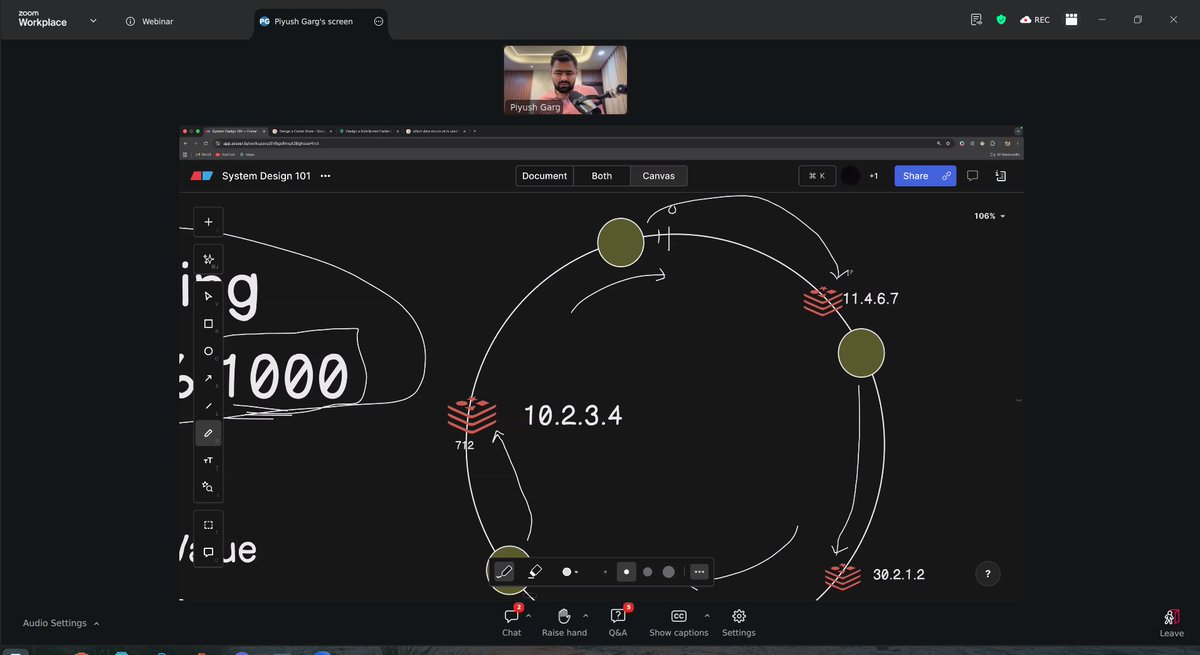
Just finished a system design session on Caching & Distributed Systems 🔥 — here's the full breakdown in a thread 🧵 1/ Why cache at all? If a computation takes 30-40s, you cache the result. Next time someone asks — it's instant. That's the entire idea. 2/ Redis vs Postgres Redis = RAM → blazing fast, limited size Postgres = Disk → slower, persistent, large Pick based on your use case — not hype. 3/ Cache HIT vs MISS HIT → serve from Redis ✅ MISS → fetch from DB → update Redis → serve This pattern = Read-Through Cache 4/ TTL is your best friend Set expiry on every cache key. 24hrs for slow-changing data. 5min for real-time data. No TTL = stale data forever 💀 5/ Eviction Policy: LRU When storage is full, kick out the Least Recently Used item. This is how Redis stays lean under pressure. 6/ Consistent Hashing 🔄 Distributed cache across 3+ nodes? Use a hash ring. hash(key) % n → determines the partition Add/remove a node? Only a fraction of keys move. Not all. 7/ Infrastructure ladder: Data Center → Hypervisor (Proxmox) → VMs → VPS → Cloud (AWS/Azure/GCP) More abstraction = less control but less headache. Thank you @piyushgarg_dev sir for the awesome session and we missed you today @Hiteshdotcom sir and thank you all the TA's @nirudhuuu @ChaiCodeHQ #SystemDesign #Redis #Caching #DistributedSystems #ChaiCode #BackendEngineering
abhijitWebDev tweet mediaabhijitWebDev tweet media
English
1
21
288
13.9K
SystemsArchitect.io retweetledi
SystemsArchitect.io
SystemsArchitect.io@systemsarch·
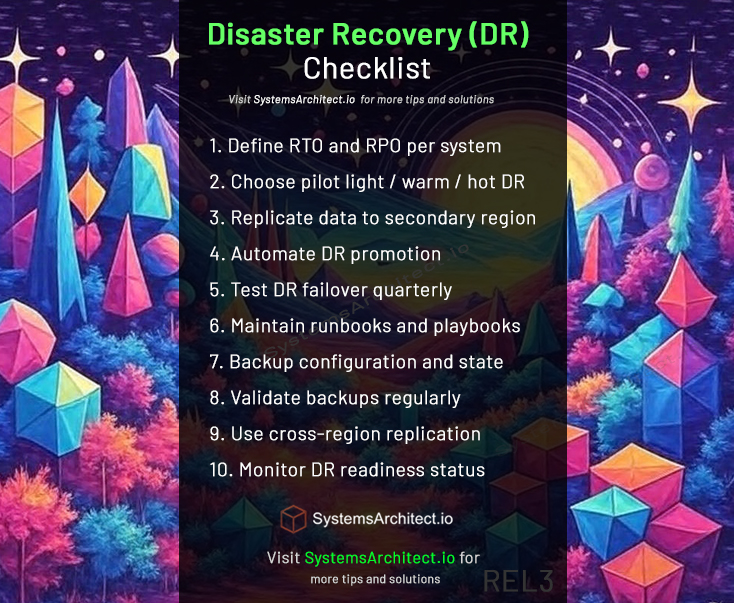
✅ Disaster Recovery (DR) Checklist 1. Define RTO and RPO per system 2. Choose pilot light / warm / hot DR 3. Replicate data to secondary region 4. Automate DR promotion 5. Test DR failover quarterly 6. Maintain runbooks and playbooks 7. Backup configuration and state 8. Validate backups regularly 9. Use cross-region replication 10. Monitor DR readiness status Get more reliability tips at systemsarchitect.io
SystemsArchitect.io tweet media
English
1
1
2
92
SystemsArchitect.io
SystemsArchitect.io@systemsarch·
✅ Cloud Database Performance Checklist (PRF05) 1. Right-size database instances 2. Add read replicas 3. Tune database parameters 4. Use fast storage tiers 5. Implement query caching 6. Partition or shard large tables 7. Monitor and fix slow queries 8. Run regular maintenance 9. Consider serverless databases 10. Enable performance monitoring Get more tips at systemsarchitect.io
SystemsArchitect.io tweet media
English
0
0
0
36
SystemsArchitect.io
SystemsArchitect.io@systemsarch·
🍿Every Networking Concept Explained In 20 Minutes youtube.com/watch?v=xj_Gjn… "This video covers the core networking fundamentals every engineer needs to know - from basic IP addresses to advanced Kubernetes networking. We'll follow a simple approach: watch how one application grows from a single server to a complex cloud system, and learn each networking concept exactly when it becomes necessary."
YouTube video
YouTube
English
0
0
0
55
SystemsArchitect.io
SystemsArchitect.io@systemsarch·
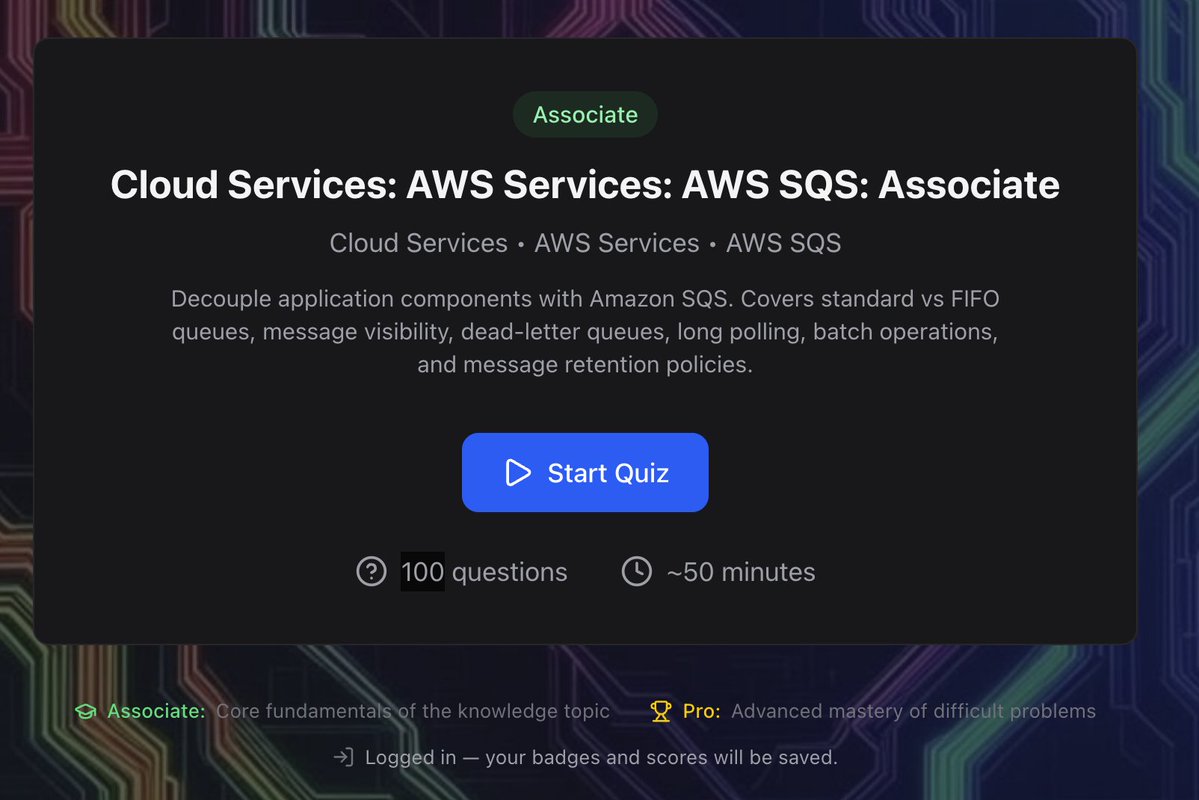
❓AWS SQS QUIZ 100 Q&As *NO SIGNUP req. FREE (try now) systemsarchitect.io/quiz/cloud-ser… Decouple application components with Amazon SQS. Covers standard vs FIFO queues, message visibility, dead-letter queues, long polling, batch operations, and message retention policies.
SystemsArchitect.io tweet media
English
0
0
0
35
SystemsArchitect.io
SystemsArchitect.io@systemsarch·
@aproko_doctor The key is to make a detailed plan and outline, which gives you a path and sequence to follow, a recipe for success (at least on the tech building).
English
0
0
0
145
SystemsArchitect.io
SystemsArchitect.io@systemsarch·
@unshuckled Those with big imagination see 1,000 ways they can leverage it, those with an ivory tower built around manual coding, where they are the best, see it as a threat.
English
1
0
2
17
Chaos Court 🥤
Chaos Court 🥤@unshuckled·
Brutal truth: Most people using AI aren’t getting ahead. They’re just producing more average work… faster. AI didn’t raise the bar. It exposed who actually has taste. That’s why some people are 10x’ing… and others are stuck. Which one are you?
English
11
1
8
85
SystemsArchitect.io
SystemsArchitect.io@systemsarch·
☑️ Decision Checklist: CQRS + Event Sourcing vs Traditional CRUD + Relational Database systemsarchitect.io/blog/cqrs-even… CQRS with Event Sourcing is best suited for domains requiring complete audit trails, temporal queries, and event-driven microservices where read and write models differ significantly, while Traditional CRUD with a relational database remains the simpler, faster choice for most applications needing strong consistency and straightforward querying. In practice. The vast majority of applications benefit from traditional CRUD, with event sourcing applied selectively to audit-critical or financially complex domains, optionally bridged via change data capture (CDC) to gain event stream benefits without full event sourcing complexity.
SystemsArchitect.io tweet media
English
0
0
2
48
SystemsArchitect.io
SystemsArchitect.io@systemsarch·
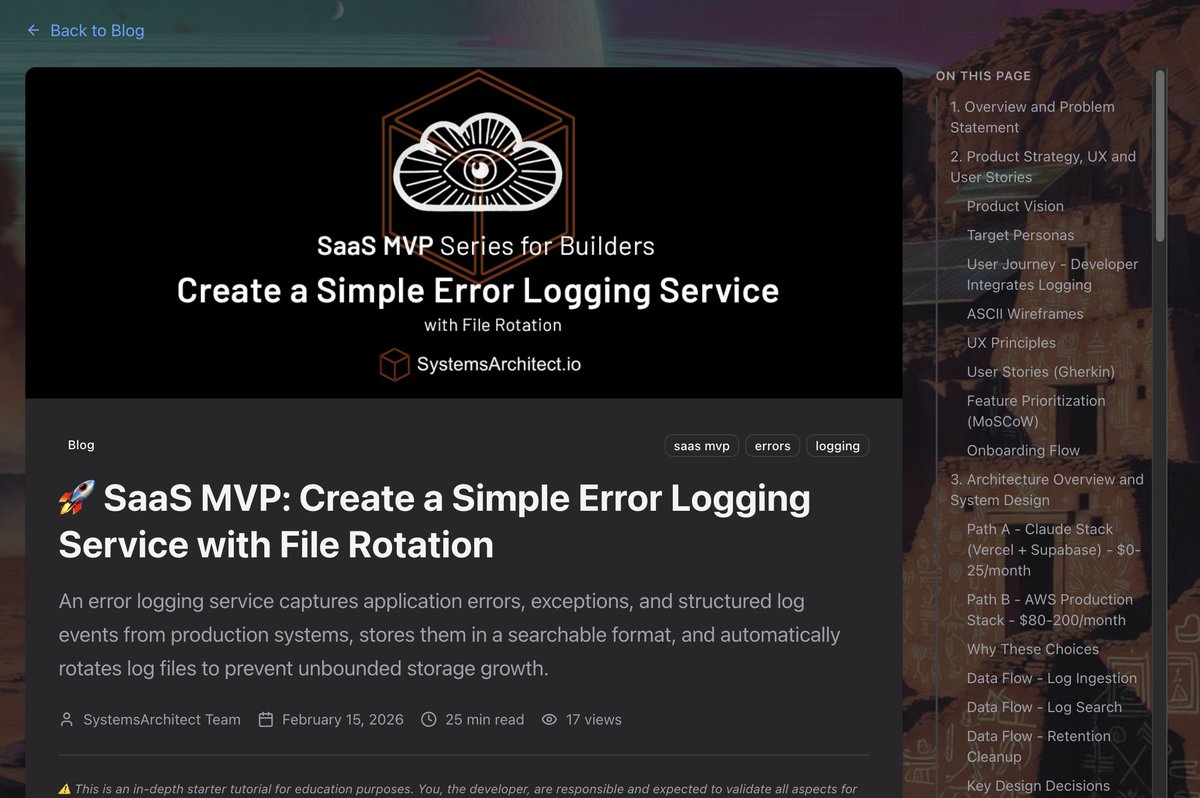
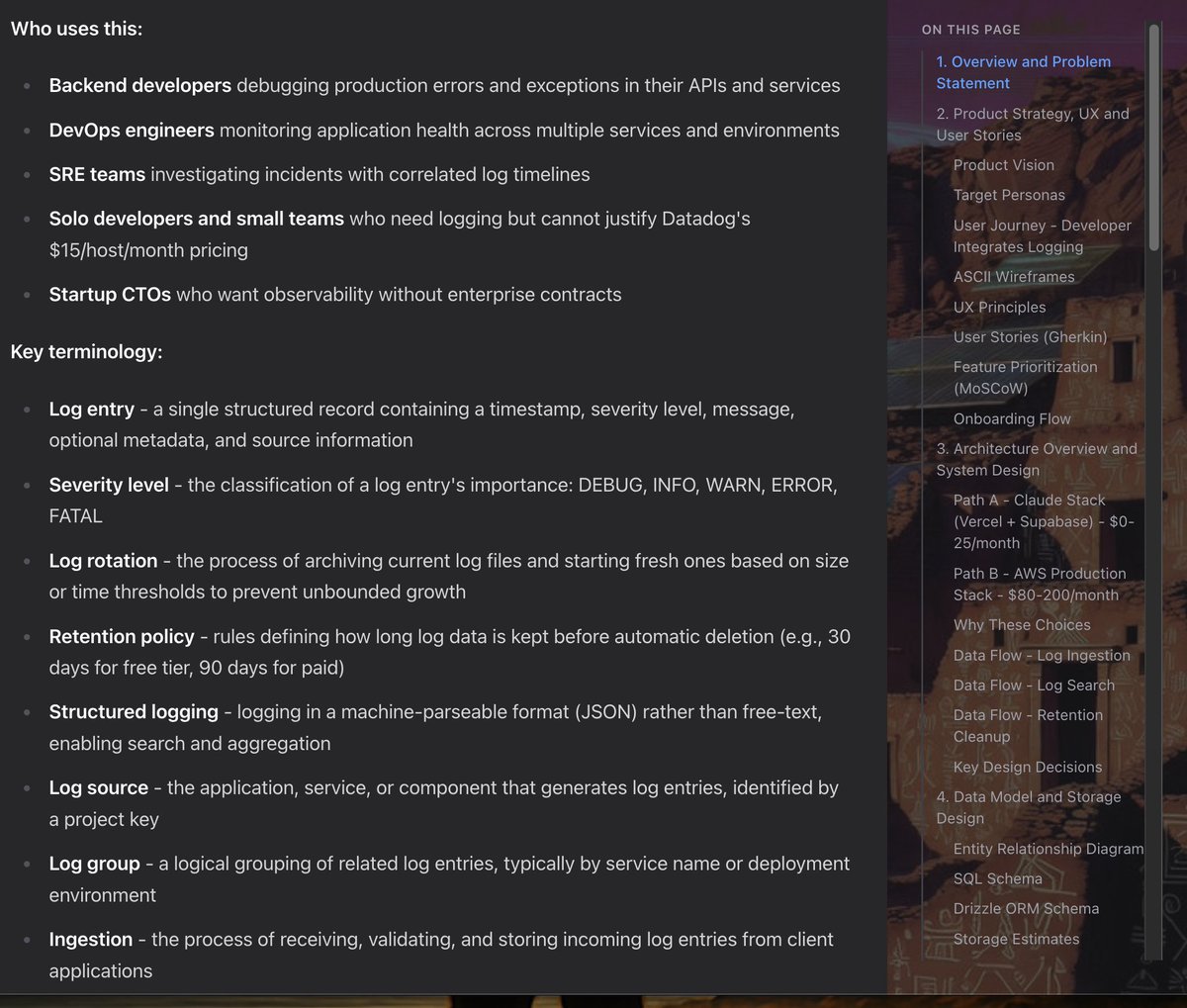
🛠️SaaS MVP (starter tutorial) 🚀Create a Simple Error Logging Service with File Rotation systemsarchitect.io/blog/saas-mvp-… ☑️An error logging service captures application errors, exceptions, and structured log events from production systems, stores them in a searchable format, and automatically rotates log files to prevent unbounded storage growth. ☑️Instead of SSH-ing into servers to grep through log files, developers get a centralized dashboard with search, filtering, severity-based grouping, and alerting -- all managed through a simple API.
SystemsArchitect.io tweet mediaSystemsArchitect.io tweet mediaSystemsArchitect.io tweet media
English
0
0
2
49
SystemsArchitect.io
SystemsArchitect.io@systemsarch·
Redefining Human Roles in Software Development systemsarchitect.io/blog/ai-agent-… by SystemsArchitect founder @csjcode In the new era of AI systems and agentic architectures, the traditional software DEVELOPER role will evolve from hands-on coder to "creator" or "human operator"--essentially a SYSTEMS ARCHITECT and overseer of agent-driven ecosystems.
SystemsArchitect.io tweet media
English
1
3
3
119