James | TabTabLabs
323 posts

James | TabTabLabs
@tabtablabs
Better beats bigger. Scraping county data for wholesalers and operators.
Katılım Nisan 2025
352 Takip Edilen56 Takipçiler

we're seeing database related API timeouts, currently investigating
status.torbox.app/incident/901274
English

@thsottiaux to figure out why did you slow down codex already
English

too many people hitting /goal codex has been so slow today
English
@TopherNOW Next level:
- Make a CLI tool that downloads entire county’s parcel data
- Route PDFs to cheap OCR model
- Claude does heavier reasoning tasks
English

Every acquisition starts with the same question: who owns this? I built a Claude CoWork skill that finds the answers for you in minutes👇
Here's how it works:
1. Paste an address (or send it from your phone via Claude Dispatch).
2. Claude CoWork fires up Chrome and walks the public records like you would: county website, city assessor, state business filings. It's built to find the sources in your market on the first run and save the pattern for later.
3. If a site is blocked for some reason, it falls back to more general sources to find decision makers, corporate websites, BBB profiles, LinkedIn lookups, news, etc. You don't get stuck just because one source is down.
4. It hands you a structured ownership report: deed-holder, controlling entity, the actual human decision-maker you can reach out to.
Tested across NYC, ME, WI, MA and CT so far.
Every time it runs it gets smarter and takes less time to fire, as it tracks the nuances of finding the intel in your market.
Full downloadable skill at CRE AI Studio. Grab your 7 day free trial at creaistudio.com
English

this is absolute savage
kling + claude code is THE best combo for AI videos right now
it lets you create videos that feel disturbingly human at insane speed
i finally mastered the formula for creating hyper-realistic AI content and automating the entire process to produce it at scale
now i’m sharing it ALL with you
here's what you're getting in 2nd guide:
- exact prompts structure for UGC/animation/claymation/podcasts
- what tool i use to automate it and produce 50+ ads daily
RT + reply w/'AI' and i'll send it to you personally (must follow so i can DM)
MAX@maxxmalist
English

English

I gave a viral talk recently, and @swyx asked me to put something together to explain how I did it - to help future AIE speakers and anyone who wants to learn.
I am, oddly, extremely qualified to do this because I spent 6 years as a voice coach. So I've not only given countless talks, but also taught people how to do it well.
I've put together a list of things I think about when I'm preparing and giving a talk. These are applicable to literally any situation where you're presenting a deck - but also to most in-person interactions. Enjoy.
Flowing and Choking
The thing I think about most when I'm giving a talk is tension. Tension is bodily constriction that interferes with the voice. Tight intercostals, neck muscles, and muscles around the larynx.
Tension is different from anxiety. Anxiety is the nerves, stage fright, the feeling of being watched. Stage fright is curable only through repetition. You get your reps in, you do larger and larger talks, and it goes away. I have negligible anxiety when I do talks, usually because I can always picture a bigger gig I've done.
Anxiety feeds tension. You are nervous, so you get physically tense. Your voice catches, your breathing collapses. Your hand start jerking, face freezing, voice going monotone. This is choking - the failure state of any talk.
Its opposite is flowing - an integrated performance state where voice and body move together without friction. It's not effortless - my heart rate is usually through the roof when I'm giving a talk. But it's a state without tension or anxiety.
Breathing
Tension is a physical problem. The wrong muscles are working too hard, and the right muscles aren't working at all.
This manifests as clavicular breathing. This is breathing led from the upper chest and shoulders. It's the natural 'nervous breath'. And it's a recipe for choking. The more clavicular breaths you take, the more tense you become, the more anxious you feel.
Ironically, the advice to 'take a few deep breaths' can fuck you over. If you're not breathing right, you'll immediately breathe into your clavicle, and start choking.
The fix is diaphragmatic breathing. This style of breathing has you relaxing the belly as you breathe in so that the diaphragm can descend. It's the first thing I taught every student who walked through my door. I'll link to an old video of mine where I talk about it.
Breathing this way is totally free of tension. It's invisible to anyone watching - you just look as if you're completely relaxed. So you can do it on-stage to reduce your physical tension and prevent choking. It's the foundation everything else rests on.
Aim
Most speakers - I would say 95% of tech speakers I've seen - don't aim their talk at their audience. They are not keeping their audience in mind. They're not even thinking about their audience as they speak.
This manifests in two ways. The first is that they're talking past their audience. They are projecting past them to an imaginary audience that they pictured during practice. They are aiming at the world, not the room. This reads as loud, performative, and hollow.
The second is that they're talking inwardly. They're rehearsing their next line. They're monitoring themselves. This is commonly caused by anxiety, but not always - even relaxed speakers do this. They're aiming at themselves, not the room. This reads as disconnected.
Aim at the room. Read the audience in real-time and adjust. Calibrate to their energy levels. Consider what they might be thinking. Ignore the world, focus on the room. Look outwards, not inwards.
Slides
Let's finally talk about slides. People focus way too much on their slides, but they are worth of some attention.
Your talk should be speaker-led, not deck-led. The deck is there to support you. It is there to emphasise your points and give you reminders where to go next. If the deck is the talk, with the speaker narrating, why did the speaker even bother to show up.
Slides should be bare. Minimal information per slide. A single phrase. A single quote. A single image. The audience reads it quickly and returns attention to the speaker. Cluttered slides mean the audience pulls attention away from you.
Keep your slides paced. Don't rapid-fire through a bunch of them - nothing will stick. Give each slide, each point, time to land.
Summary
Anxiety can only be cured by reps. But tension is the battleground of the speaker. Fix it with diaphragmatic breathing, and notice whenever you do clavicular breathing. Flow, don't choke.
Aim your talk at the room, not yourself or the world. Keep your audience in mind. Make your talk speaker-led, not deck-led. Use bare slides, and pace them well.
I don't make money off teaching voice any more, so if you enjoyed this, then a donation to Oxford Food Hub would be very welcome. Link below.
English
@clint_turner I'm using gws and have a sep alias for each inbox.
gws-personal: hooked up to my gmail
gws-work: hooked up to my work email
gws-*: client specific emails
"every day read my emails, triage, draft responses, and add to my todo list..."
something like this
English

What AI tools are you using to manage multiple email inboxes and calendars?
I want to never open Gmail or outlook again if possible
English
English

codex can work in the future:
"tomorrow, check in on this discussion and ping me if it isn't resolved"
"let me know if this bug isn't fixed by the day before launch"
"bug me if this flaky test doesn't go green after retry"
i do this all the time. powerful but not obvious—yet
English

We are the only AI Operating system that is built for work
Retain full control:
Permissions, Approvals, Memory, Logs, System access, Human review.
The first wave of AI was chatbots.
The next wave is AI workers.
SomaOS is the operating system for the AI workforce.
Check us out: SomaOS.one
Check out the GitHub: github.com/TryKosm

English
Hey friends, as you know, I left Apple six months ago to build enterprise AI agents.
The more I looked at the space, the more obvious the gap became
Companies are about to have AI agents doing real work
Not just answering questions
→Checking systems
→Drafting emails
→Updating records
→Finding problems
→Preparing decisions
→Moving work forward
That only works if agents are managed
That is why @SomaOS is here

English

This is my AI bot calling incoming leads on the weekends …
It then schedules it on our company calendar for my sales guys to call
Lead in. AI calls within 10 mins. Information gather. Appointment scheduled.
Amazing, are you using AI?

English

A private equity firm came to us last quarter convinced they needed a custom AI build.
We ran our standard audit first. Seven phases across three weeks.
By the end, time spent on one of their core processes was on track to drop around 70%. And half of what they thought they needed didn't need to be built at all.
That's usually how it goes. The audit is the part nobody wants to do because it's slow and unsexy. It's also the part that decides whether everything that comes after is worth a damn.
I packaged the entire process into a self-serve SOP. Same framework we use across our engagements, written so an internal ops lead can run it themselves.
What's inside:
→ The 7-phase audit framework
→ Stakeholder interview script
→ Process shadowing playbook
→ Current state mapping templates
→ Opportunity scoring matrix
→ ROI modeling and future state design
→ Audit document structure for leadership
→ 10 mistakes that tank internal audits
Like + RT + Comment "ASSESSMENT" and I'll DM it to you. Make sure you're following me so I can DM.
GIF
English
@irinaconstanti teams i'm working with are on salesforce... 50+ agents so its chaos in the crm lol
English

@tabtablabs depends on the system 😅 - what did you try?
English
Realtors keep asking me: "Can you help me build something to replace my sales team?"
Wrong question.
The devs doing well aren't the most automated. They got clear on what a machine should handle vs. what a human should never give up.
Let AI do the research, follow-ups, CRM updates. So your sellers can pick up the phone and actually close.
English
as someone with aphantasia i can't say enough about how much it helps to add the following to your AGENTS.md:
```
When visual understanding would help, use the Image Gen tool to create visual aids instead of relying only on prose descriptions.
```

English
@jiayuan_jy symphony was very opinionated and token hungry last i used it
English

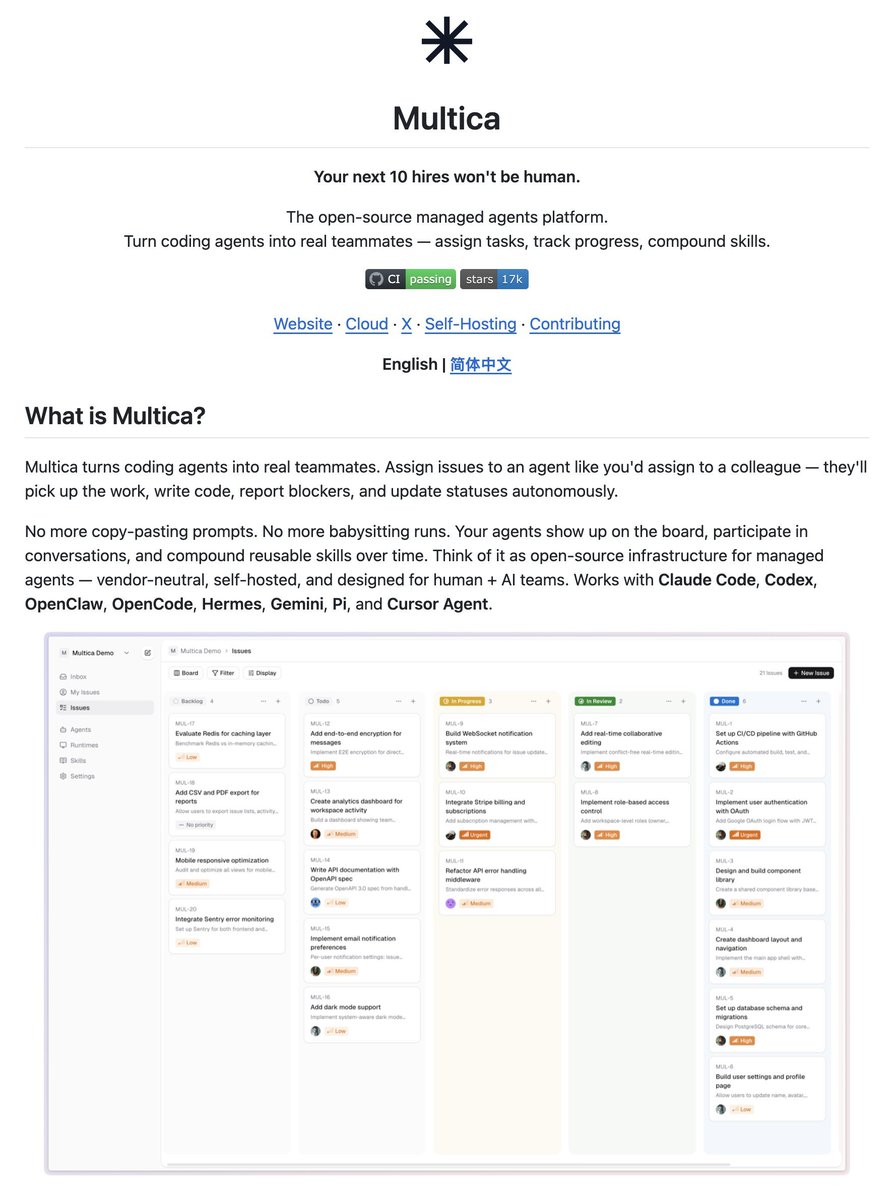
OpenAI Symphony is great, but what if you don’t want to be limited to Codex? If you want to use Claude Code, Hermes, OpenClaw, Cursor Agent, or many other coding agents, Multica is built for that.
OpenAI Developers@OpenAIDevs
📣 What if every open issue had a Codex agent? That’s the idea behind Symphony, an open-source agent orchestrator for Codex that turns task trackers into always-on systems for agentic work, letting humans focus on review and direction.
English

Gojiberry AI just hit $2M ARR.
A few months ago we were at €0.
This is the second SaaS I've built. The first one I sold at €500K ARR.
This time, we moved faster. Here's exactly how we did it, so you can do it too.
The core principle that changed everything:
We used our own tool to grow our own tool.
Gojiberry AI finds high-intent leads and engages with them automatically.
We run it on ourselves. It works insanely well.
Here's the full breakdown:
1) Outreach (the engine)
- LinkedIn: 5 accounts, 30 connection requests + 30 DMs per account per day.
Only targeting warm leads showing real intent.
Connection acceptance rates and reply rates are insane when you do this right.
- Cold email: 6,000 emails per day. 295,000 sent in 90 days. 900+ opportunities created.
41 domains, 123 inboxes, plain text only, no links, no images, 2-3 email sequences max.
Total infra cost: ~$600/month.
The offer is always the same: a valuable blueprint. No pitch. Just value first.
2) Inbound (the compound effect)
- LinkedIn: 6 posts per day across 6 accounts.
6 days/week = lead magnet content. 1 day/week = founder story.
Last 7 days: 788,187 impressions.
- Reddit: 14.8M+ views in 12 months. The trick: warm up the account, post 3x per week, tell real stories, offer blueprints, and never debate the haters.
- YouTube: Long-tail SEO content targeting competitor keywords. It's starting to rank.
- SEO: 50K visitors/month and growing fast.
3) Paid (we're just starting)
- 3 LinkedIn influencer posts/week (~$500 each).
- Facebook retargeting + acquisition
Scaling paid ads aggressively right now.
4) Demos
5–8 per day. ~70% close rate to free plan. Mostly sales teams.
What actually worked:
→ Using our own tool on ourselves (this alone is a cheat code)
→ High-intent outreach > cold outreach. Every single time.
→ Lead magnet posts on LinkedIn that generate thousands of comments.
One post added $5K MRR in under 24 hours. Cost: $0.
→ Replying to every single comment.
→ Speed. Every delay kills momentum. We removed friction from every step of the funnel.
→ AI helping us do 10x more than we ever could alone.
What's not working:
- We need to delegate. We're currently hiring a founding sales to help us scale to $10M ARR (feel free to reach out if you know someone 😇 )
The path from €0 to $2M ARR is not glamorous.
It's 18-hour days, boring repetitive work, testing things that fail, and doing it all again tomorrow.
But if you do the right things every day, good outreach, real value, fast follow-up, it compounds.
And one day you wake up and you're at $2M ARR.
The goal now: $10M ARR.
LFG. 🔥
PS : we're about to launch a 0 -> $1M ARR GTM course.
Want to receive it? RT + comment GTM below.

English

I automated my content engine and 2 hrs/day dropped to 10 min
[ what’s new in v2 ]:
- 9 platforms scraped while I sleep → 2,000+ topics/day
- a 5-signal scoring brain that filters down to the 10 that matter
- voice DNA writer.. same tone, different structure every time
- a self-learning loop that remembers every approve and decline
- profile DNA — knows exactly what goes viral on MY account
v1 was a brain with no body
v2 has eyes, a filter, and memory + fully automated
Here’s how to build it step-by-step ↓
[ The architecture]:
/content-engine
├── scrapers/ (9 platform scrapers)
├── extension/ (chrome ext for X, linkedin, reddit)
├── ai/
│ ├── ranker.py (5-signal scoring brain)
│ ├── content_writer.py (voice DNA + structures)
│ ├── profile_analyzer.py (your positioning DNA)
│ └── sentiment_analyzer.py
├── publisher/ (export + time slot scheduling)
├── gui/dashboard.py (streamlit command center)
├── ingest_server.py (local server on localhost)
└── data/content_engine.db (everything stored locally)
let me walk you through each layer ↓
LAYER 1: Research engine
9 sources scanned 24/7 (X, reddit, YT, HN, github, trends + chrome ext for reddit and linkedin)
every post you scroll past gets tagged and stored locally
LAYER 2: Scoring brain
every topic scored on 5 signals:
- freshness (0.20)
- velocity (0.25)
- virality (0.25)
- relevance (0.20)
- uniqueness (0.10)
velocity 8+ → forced min score of 7. catches late bloomers that suddenly explode
2,000 topics → top 10 ranked
LAYER 3: Voice DNA writer
not one structure every time. system picks the format:
- short take
- tactical playbook
- QT contrast
- contrarian
- resource drop
- proof post
a voice guardian auto-rewrites anything that fails: lowercase ratio, no hashtags, no corporate words
LAYER 4: Dashboard Streamlit
dark theme. 5 tabs
review queue = tinder for content. swipe approve, swipe decline
LAYER 5: Publishing
no auto-posting. zero account risk
approve → pick a slot (8am / 12pm / 5pm) → exports a .txt → copy / paste / post
also auto-drafts a linkedin version of every approved tweet
LAYER 6: Self-learning loop
every click logged. weekly the system embeds your decline notes and re-tunes the scoring brain
month 1: you approve 30%
month 3: 70% pre-filtered
month 6: 10 min/day
LAYER 7: Profile DNA
analyzes your past tweets. tells you exactly which pillars, formats, and hooks perform best on YOUR account
the scoring brain uses it to prioritize what already works for you
daily run: open dashboard → 10 min reviewing → post 3x → close
total cost: ~$15/month
everything else: local, sqlite, no cloud, no subscription
unfortunately I couldn’t paste in long-form format initial description which was made before
but if this hits 2,000 likes I drop the full build guide with every prompt you need to ship it in claude code
reply "ENGINE" + RT and I'll DM you access to test it (follow me first so I can write)
save this so you don't lose it

Ronin@DeRonin_
English