Ted

331 posts

Ted

Ted

@tedtime2

Maths Teacher

Melbourne Katılım Ekim 2012
93 Takip Edilen26 Takipçiler
Ted
Ted@tedtime2·
@DrJenniferWeber When asked what evidence Tom has for his ~750 Schools over ~8yrs, he replied, 8:17-"impossible to know if it is getting better or worse"... I have a quiet confidence we are having a large impact, a ripple impact, but hard to discern at this point” aph.gov.au/News_and_Event…
English
0
0
0
46
Jennifer Weber
Jennifer Weber@DrJenniferWeber·
Restorative justice not only lacks a strong evidence base, but it also misunderstands how behavior actually works in classrooms. Students don’t change behavior through reflection alone. They respond to consistent expectations, reinforcement, and clear consequences.
Tom Bennett OBE@tombennett71

NEW ARTICLE: Restorative justice- it doesn’t restore and it isn’t just. Apart from that, I like it. My article in @Education_NI latest quarterly. Link below.

English
2
10
48
4.6K
Ted
Ted@tedtime2·
@cierzo1 TB's answer, what evidence of him improving behavior in ~750 Schools over ~8yrs: 8:17-"impossible to know if it is getting better or worse"... I have a quiet confidence we are having a large impact, a ripple impact, but hard to discern at this point” aph.gov.au/News_and_Event…
English
0
0
0
48
Ted
Ted@tedtime2·
@supes0 @C_Hendrick The question Carl asked was a general question -"Does teacher centred teaching reduce inequality?" he supplied a Maths study & the English study provides a broader view.
English
0
0
0
17
Carl Hendrick
Carl Hendrick@C_Hendrick·
Does teacher centred teaching reduce inequality? Yes according to this study. Explicit instruction is associated with higher mathematics attainment for low SES pupils, while student centred instruction shows no such equity effect. Takeaways: if the goal is to reduce inequality in mathematics outcomes, structured, explicit, teacher led approaches may provide a stronger academic return for pupils from less advantaged backgrounds. Both approaches were equally distributed across SES groups. The difference lay in outcomes. Student centred teaching is not automatically more equitable. In some contexts, it may simply advantage those who already possess background knowledge. tandfonline.com/doi/abs/10.108…
English
10
86
230
47K
Maya
Maya@supes0·
@C_Hendrick Thanks. I sent it to my city school district ( SF) for all the good it will do.
English
1
0
2
651
Keith Turvey PhD
Keith Turvey PhD@Keith_Turvey·
@Suchmo83 Some do appear to be concerned about the over teaching of phonics (see below). A story can be both linear and non linear in that it may have an over arching meta narrative with other narratives within it.
Karen Vaites@karenvaites

In his recent writing, and especially this talk with @ehanford, @markseidenberg is remarkably direct about the phonics overteaching problem that emerged in the Science of Reading era. “Typically developing children might not need all the instruction that was being specified in structured literacy, but — this is an important point — people said, "Well, that's okay, because it's not going to be harmful. if the kid gets extra instruction on these things or if they get extra opportunities to practice what they know." So there was indeed a sense that there wasn't much danger of too much of a good thing, so if it's good for dyslexics, it's going to be good for everyone. So what's happened? Well, if you treat everyone like they might be dyslexic, you get an intensive, slow, incremental approach to instruction, with no stone left unturned. In practice, what it's meant is a barrage of explicit instruction. So I would say the science of reading has an overteaching problem. Is all this explicit instruction necessary? No, because children don't only learn from explicit instruction. Moreover, the opportunity costs of doing all this instruction are huge. Instruction time in schools is limited. Teachers have enormous demands on their time. Over-teaching the components of reading eats into time for other learning activities, such as reading itself. So, I want to be clear here. Some explicit instruction is needed to help beginning readers get off the ground. There's no question. The whole language balanced literacy approach that came before did not do an adequate job with this. That had to be corrected. But the science of reading has overshot the target, because most kids aren't dyslexic, and most of the knowledge that supports reading isn't actually learned from instruction, as I'm going to illustrate. If you try to teach it all, you're interfering with or taking away from other learning opportunities that kids need.” @C_Hendrick @MeganGierka @ReadSimplified

English
2
0
1
105
Christopher Such
Christopher Such@Suchmo83·
Pupils who can't read fairly fluently never want to read independently. And the number one reason pupils don't become fluent readers is the lack of scaffolded reading practice to build on what they learned from phonics and develop word recognition automaticity. >>
Tes magazine@tes

How to reverse the drop in children reading for pleasure? Experts have made four recommendations, including giving it a ‘higher profile’ within the curriculum tes.com/magazine/news/…

English
11
34
124
16.8K
Ted
Ted@tedtime2·
@Suchmo83 @Keith_Turvey However, you promoted Sold a Story, in which Seidenberg was the key cited researcher, without any acknowledgement of differing educational contexts.
English
0
0
0
28
Christopher Such
Christopher Such@Suchmo83·
@Keith_Turvey I think it's difficult to know precisely what Seidenberg is referring to as overteaching given that US contexts can include explicit teaching of phonics to all pupils well into grade 3 (i.e. four years of systematic phonics). And his focus is more on missed opportunities for...
English
2
0
0
40
Vince Boley
Vince Boley@VinceBoley·
Banger take of the day 🔥
Christopher Such@Suchmo83

@MrZachG But if teachers are just told that they need to avoid over-teaching phonics and that they need to get kids learning with real texts - and no actual practical advice is forthcoming on how to do this and the nature of the challenge - then we end up back at square one.

English
1
0
9
1.8K
Tom Rogers
Tom Rogers@RogersHistory·
I find it really tough to ignore some of the 'commentary' around me and TTR. We absolutely try our best, as a team, to platform as wide a view as possible, whilst also sticking to our own mission statement of not enabling any online bullying/harassment. The last two weeks, we have had Tom Bennett, Jim Gamble, Ruth Swailes and tomorrow - Andrew Old. Lots of education podcasts etc operate in silos. We don't. The other thing we do well is that 80-90% of our hosts currently work in a school. Genuine thanks to everyone who supports @TTRadioOfficial. More great stuff to come in 2026! x.com/ragefighthouse…
English
11
11
137
58.2K
Andrew Old
Andrew Old@oldandrewuk·
I don't read the Hackney Citizen. And back then. I wouldn't have had a reason to be interested in one person's complaint. It was only when Mossbourne's internal review was released that the possibility was raised that the original complaints were part of a one-man crusade over an apparently unrelated grievance.
English
1
0
0
204
Andrew Old
Andrew Old@oldandrewuk·
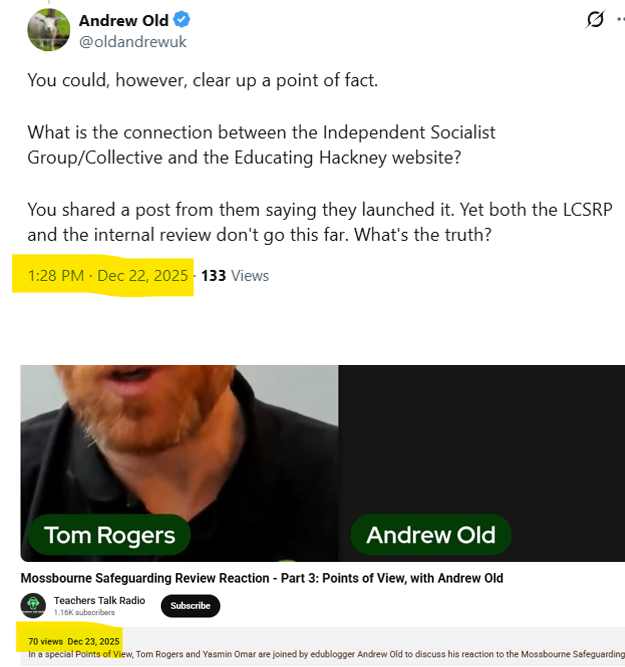
Ted@tedtime2

@oldandrewuk @nunez_cabeza @JRowe_7 @LizzyZeel @RogersHistory @cierzo1 @learymay So that just proves my point more - Ur interaction with Andy Leary-May was on clearly on Dec 22nd this X post linking ur interview is Dec 25 - So again Ur interaction with Andy was before the interview. I copied the live YouTube date which was Dec 24th

QME
1
0
0
145