
Sabitlenmiş Tweet
Tim L
632 posts


Tim L
@telenardo
Building @onit_ai 🔨
San Francisco, CA Katılım Ekim 2011
968 Takip Edilen1.8K Takipçiler
Can't make this sh*t up.
239 years ago, John Quincy Adams ended his 1787 Harvard commencement address with this sentence:
"And may national honour and integrity distinguish the American commonwealths, till the last trump shall announce the dissolution of the world, and the whole frame of nature shall be consumed in one universal conflagration"
Source: founders.archives.gov/documents/Adam…
English
Tim L retweetledi

Adding an AI copilot to your app means picking a frontend SDK, an agent framework, and a vector database. Then wiring auth, streaming, evals, guardrails, chunking pipelines between all of them.
Or you can just use Pillar. That's what we've built.
English
@mahimaseth28 @WisprFlow Biased because I'm the developer, but @onit_ai handles this - runs fully on your Mac with no internet needed!
English

Practically impossible to work from any cafe because of the bad internet, I mean you were giving me 15 to 20 MBPS. How am I supposed to work here peacefully, my voice to whisper also not working and I have to resort to Apple dictation. @WisprFlow
English
How many caught that it's an AI video?
ₕₐₘₚₜₒₙ@hamptonism
do everything in your power to move to sf.
English
I looked back at ChatGPT history from 2025. About half of it was simple editing requests:
- “Improve this”
- “Rewrite for clarity”
- “Make this email better without changing it too much”
So, we put it into an app. Introducing QuickEdit in Onit. Highlight any text, anywhere on your computer, and instantly make it better 👉 getonit.ai
English
You’ve READ how great Apple Silicon is for AI, but have you FELT it yet?
I did this week. Your M‑series chip can run a 600M speech‑to‑text model and a 3B LLM in under a second, entirely on‑device. That’s Wispr Flow without the cloud GPUs. Big enough for accuracy but small enough to run yourself. Totally offline, totally private. Oh, and it's free.
FEEL THE SPEED 👉 getonit.ai/dictate
English
Tim L retweetledi

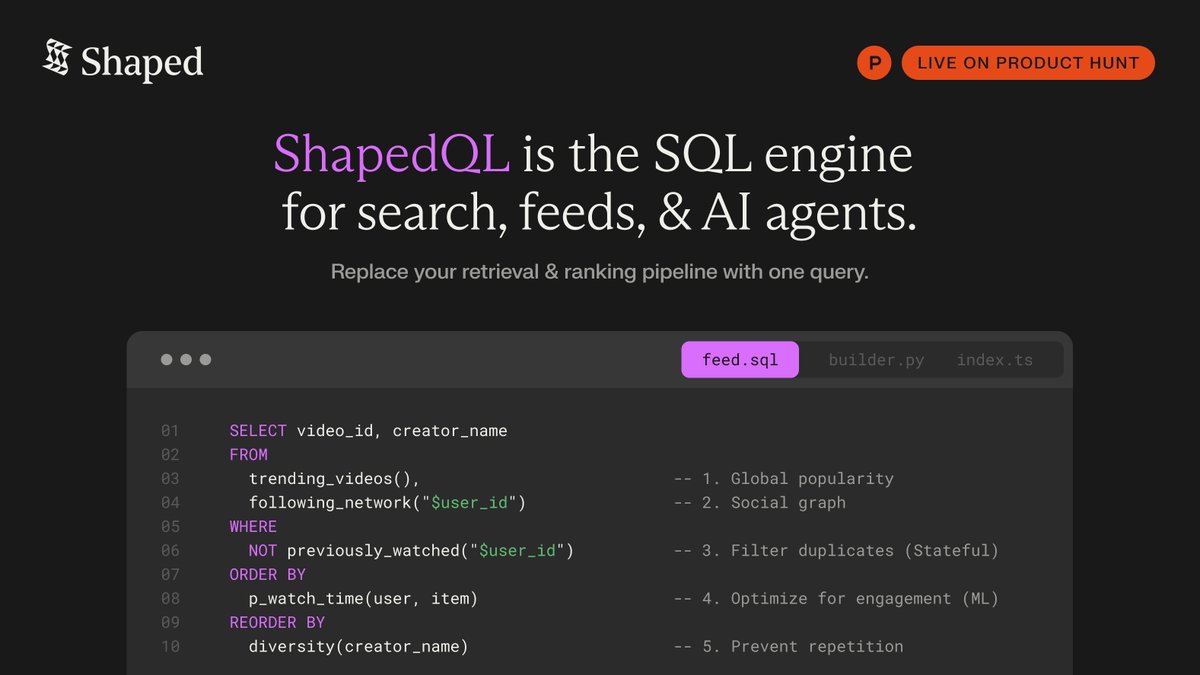
Stop gluing Pinecone, Redis, and Python scripts together.
Today we're launching ShapedQL - the first SQL engine built specifically for Search, Feeds, and AI Agents.
3,000 lines of infra code → 30 lines of SQL.
We're live on Product Hunt! 😸👉 producthunt.com/products/shape…
English

This may be the greatest guerrilla marketing stunt of all time.
Worked on me - I listened to the pod (had never heard of it) - and now I want to work at xAI
🍓🍓🍓@iruletheworldmo
xai former employee has to step down after revealing the roadmap for macrohard, basically creating a 'human emulator' that does everything. basically, jobs are gone and xai competitors now know their roadmap. 'we get a full human emulator we can put to work' near the end he even calls that the roadmap isn't public and continues haha, i love it.
English
The thing that bothers me is not that I don’t understand every line, but that I don't know if the new changes broke something ELSE. This has been happening a lot. You're working on some bug or error case. Claude comes up with a fix, which you test, and the problem goes away! You push it, only the realize a few days later that your magic fix actually broke something else. When you understand the code yourself, it’s easier to catch these unintended consequences.
I’m start to feel like building good software is less about understanding code and more about putting tests in place. Once you have a good set of tests established, you can let the AI coders go wild. Sure, you don’t understand every line, but you have conviction that it works, because the tests pass. If you find an edge case later, great! Make another test covering that case, and let the AI go wild agin.
I’ve used this approach recently to migrate algorithms from CPU to GPU. I don’t know personally know how to write Metal shaders, nor can I easily debug Metal code. So I start by implementing the algorithm with on the CPU in vanilla Swift. Then, I use that algorithm to generate a ton of tests, covering the edge cases. With tests established, I can tell Claude to re-write that algorithm as a GPU shader. Claude iterates until all tests pass. I don’t know the details of the GPU algorithm, but hey, it gives the same outputs as my CPU algorithm against a broad set of inputs. I can be pretty sure it’s working well. (and it's usually about 100x faster)
In a weird way, building software is becoming like training models! Your job is to define success means via some training/test set. Then let the AI figure out how to deliver against that definition without much idea of what’s happening behind the scenes.
George Pu@TheGeorgePu
Claude writes 3,000 lines of code. I feel worried when I haven't read all 3,000 lines. Ship it anyway. It works. But 'it works' and 'I understand it' are two different things. That gap bothers me more than it should.
English
This is the greatest non-coding AI demo I've ever seen.
I had been considering making a specific app for this use-case (clean up your desktop). Glad I didn't 😅
Claude@claudeai
In Cowork, you give Claude access to a folder on your computer. Claude can then read, edit, or create files in that folder. Try it to create a spreadsheet from a pile of screenshots, or produce a first draft from scattered notes.
English
New behavior: any time I'm putting my credit card online service for a one-off use case, I stop and first see if @claudeai code can make it.
So far it's worked for:
- Video background removal
- Text-to-video generation
Cody Schneider@codyschneiderxx
had dinner with engineer lead at a startup last night told us their saas vendor tried to double the price from $70k a year to $170k a year CTO was like in slack on the call "i think we can have claude write this" 3 week sprint cloned and replaced vendor told sales org trying to gouge them they done sales freaks out "how do we solve this" this is going to happen so much in 2026
English

How I write with AI: Bicycles for the mind vs motorcycles for the mid
1. Speak notes aloud (via wispr bc no desktop Claude voice mode) and brain dump, often with screenshots and/or prior essays. This is very useful to just get the most raw versions of an idea together without self conscious constraints.
2. Claude asks me clarifying/challenging questions (prompt: “interview me asking questions one at a time to help flesh this out”) to organize/substantiate the idea, after which I give an outline/flow
3. Claude generates a first skeleton draft putting my notes into the flow
4. I move to a word processor (google docs or bear) and re-write paragraph by paragraph (also via wispr).
5. I send back to Claude for comments and feedback before repeating step #4.
6. Once I’m satisfied, I send to Pangram to make sure I’ve sufficiently re-written everything and hold myself accountable.
7. Publish

English