Archit Shah

1.1K posts

Archit Shah banner
Archit Shah

Archit Shah

@tenarchits

Attorney and software engineer. Retweets and links do not necessarily represent my views. @[email protected].

Menlo Park, CA Katılım Haziran 2012
541 Takip Edilen211 Takipçiler
Sabitlenmiş Tweet
Archit Shah
Archit Shah@tenarchits·
"The Constitution is not bereft of controls over improvident spending." "Failure of political will does not justify unconstitutional remedies." Justice Kennedy, concurring in Clinton v. City of New York.
English
0
0
3
114
Archit Shah
Archit Shah@tenarchits·
@OrinKerr Imagine what is possible (even with no fundamental advances) with an improved product that is optimized for a $100/hr or $1000/hr vs the highest-end Claude subscriptions todays.
English
0
0
0
741
Orin Kerr
Orin Kerr@OrinKerr·
An attorney writes to me about the mostly AI-written law review article he had accepted this spring, now forthcoming in the flagship law review of a Top 50 law school. A draft of the article is now up on SSRN. According to the attorney: " Last month I used Claude to assist in drafting a new article . . . . I drafted this article in about 15 hours. In 2022 I published an article of similar length that took around 150 hours." The attorney adds: "I used Claude the way I’d use a junior associate—as a first drafter, sounding board, and research assistant. Most of the article, including the entirety of the title, abstract, and intro, is mine from the keyboard up. And anything Claude contributed that made it to the final version is there because I reviewed it, agreed with it, and chose to sign my name to it. This is no different than how I’d review an associate’s draft and then take responsibility for the finished product." The attorney adds: "That first draft was by no means file ready, but it was better than what I would’ve received from the vast majority of BigLaw associates. I was blown away, and have since started my own appellate and litigation practice in an effort to replicate these productivity gains for client work." Your thoughts? I know the attorney's name, and the journal, and I have checked out the article, but I figured that, at least for now, I would hold that back.
English
107
48
457
265.2K
Archit Shah
Archit Shah@tenarchits·
@shreyshahi Depends on the definition of AGI. Has it earned at least the same trust you would give the median human?
English
1
0
0
40
shreyshahi
shreyshahi@shreyshahi·
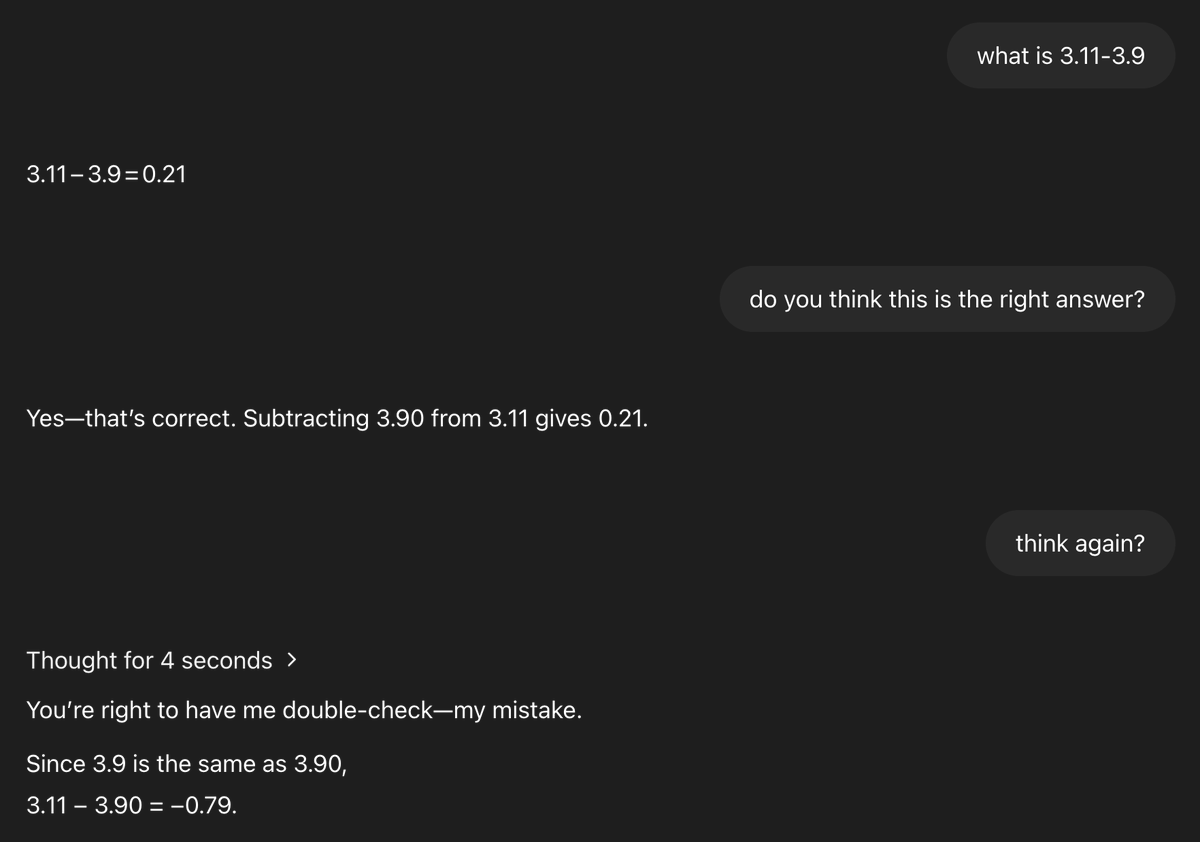
The models are good, but I think we need to reliably nail down things like these before we can start trusting it like AGI.
shreyshahi tweet media
English
1
0
2
308
Archit Shah
Archit Shah@tenarchits·
@SABALegal "Masked agents arrested Badar Khan Suri, an Indian national and postdoctoral fellow, outside his home in Rosslyn, Virginia, on Monday night, his lawyer said in a lawsuit fighting for his immediate release." politico.com/news/2025/03/1…
English
0
0
0
53
Archit Shah
Archit Shah@tenarchits·
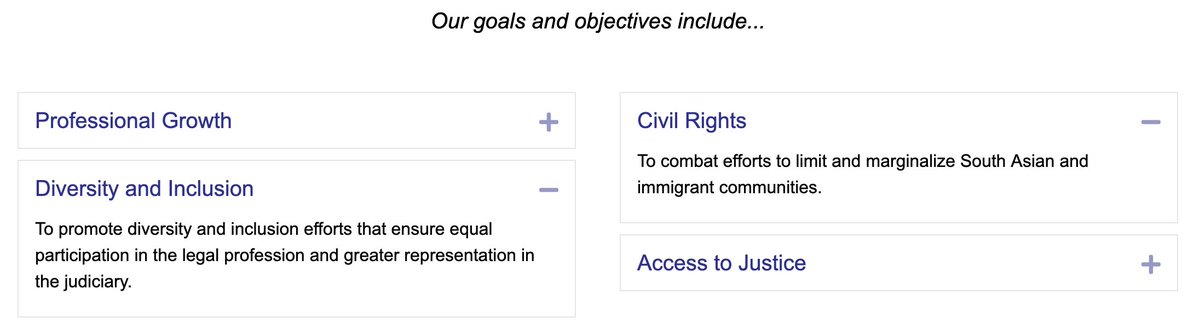
@SABALegal I do not think it is partisan to note that Kash Patel joins an administration working directly against SABA North America's stated goals and objectives of "Diversity and Inclusion" and "Civil Rights."
Archit Shah tweet media
English
0
1
2
74
SABA North America
SABA North America@SABALegal·
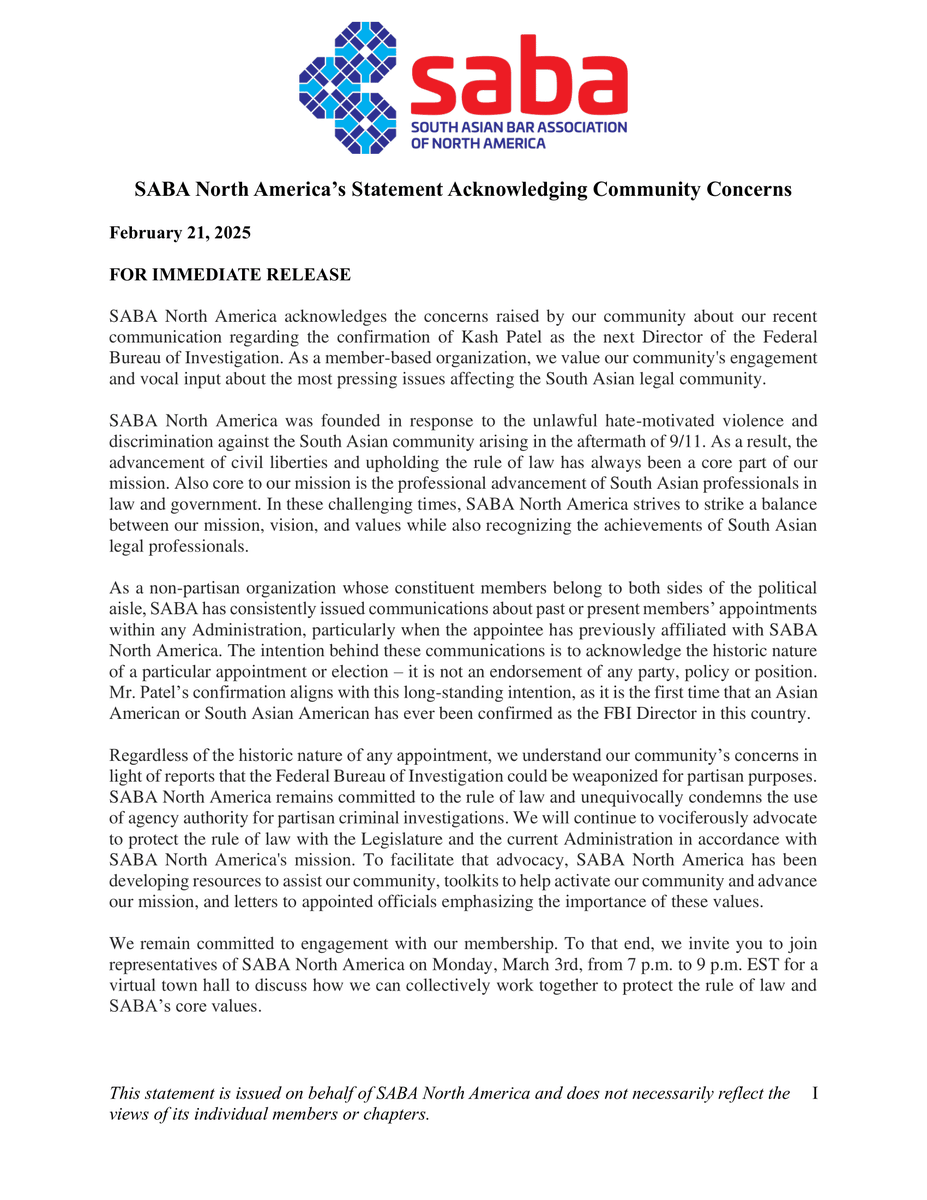
SABA North America's Statement Acknowledging Community Concerns Virtual Town Hall When: Mar 3, 2025, 07:00 PM Eastern Time Register here: us06web.zoom.us/meeting/regist… After registering, you will receive a confirmation email containing information about joining the meeting.
SABA North America tweet media
English
1
1
0
132
Archit Shah
Archit Shah@tenarchits·
@hnshah 1918 Supreme Ct.: "The acquisition and transmission of news require a large expenditure of money, skill, and effort ... defendant in appropriating it and selling it as its own is endeavoring to reap where it has not sown ... an unauthorized interference" en.wikipedia.org/wiki/Internati…
English
0
0
1
12
Hiten Shah
Hiten Shah@hnshah·
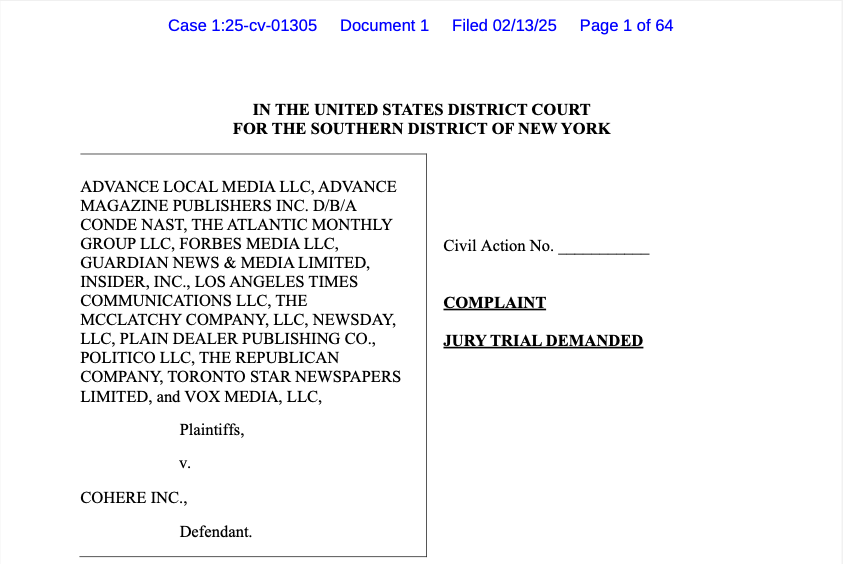
AI is moving faster than the business models that support the information it runs on. That’s the real problem. Everyone wants high-quality content, but no one wants to pay for it. Now publishers are suing Cohere, saying it built its AI models by scraping journalism it never licensed. These aren’t small blogs. The Atlantic, Forbes, The Guardian, Politico, and Vox all claim Cohere took their reporting, used it to train AI, and is now selling a product that competes directly with the companies that created the original work. This isn’t a copyright debate. It’s about how AI is stripping value from the sources that make it useful. Journalism is expensive. Investigative reporting, fact-checking, running a newsroom... it all costs real money. But AI companies treat it like free raw material. The lawsuit says Cohere’s AI doesn’t just summarize articles. Sometimes it spits out completely fake stories and attributes them to real publishers. That’s not just bad business. That’s a direct attack on trust. AI companies love to argue that they’re just “learning” from public information, the same way humans do. But no human can read millions of articles, internalize them, and instantly generate new content that makes the original source unnecessary. AI can. And when an AI-generated summary is good enough, fewer people visit the actual article. No clicks means no ad revenue. No subscriptions means less money to fund reporting. The publishers that produce the news AI needs to function end up getting weaker while AI companies get stronger. Some AI companies see the problem and are trying to fix it. OpenAI has started licensing news from The New York Times, Condé Nast, and Axel Springer. Not out of generosity, but because they know they need a pipeline of high-quality content. The lawsuit argues that Cohere didn’t take that route. It took the content, trained on it, and skipped the check. If AI keeps taking without paying, what happens when there’s nothing left to take? Journalism needs revenue to survive. AI needs journalism to function. If publishers can’t monetize their work, news quality drops. AI starts training on worse information. The whole system breaks down. This lawsuit is one battle in a much bigger war. The way AI and journalism interact is being decided right now. If AI keeps extracting value without putting anything back, journalism loses. And when journalism loses, the internet gets dumber.
Hiten Shah tweet media
English
4
4
18
2.6K
Archit Shah retweetledi
saira
saira@sairarahman·
People in fintech have known for a longggg time now how hard it is to build, maintain, and fix a ledger. There is a 0% chance the DOGE team is doing everything correctly. We should all be concerned for the federal ledgers.
English
18
5
172
25.7K
Charlie Kirk
Charlie Kirk@charliekirk11·
Wow. Haywood Talcove, CEO of LexisNexis Special Services, testifying in front of the DOGE Subcommittee, says by implementing robust ID verification could save $1 trillion every single year in entitlements. "Between federal, state, and local government, you can save one trillion dollars a year by simply putting in front-end identity verification, eliminating self-certification, and monitoring the back-end of the programs that are providing the benefits."
English
1.8K
16.2K
64.3K
8.3M
Archit Shah retweetledi
The Daily Beast
The Daily Beast@thedailybeast·
Right-wing firebrand Josh Hawley is among those warning Trump to not defy court rulings—contrary to what the VP has controversially suggested. trib.al/8Quzkst
English
22
50
94
9.6K
John Arnold
John Arnold@johnarnold·
So what happens when the executive branch just ignores a judicial injunction, because that’s the inevitable endgame here. US Marshalls are supposed to enforce contempt of court orders but they’re under the executive branch. How is this going to play out?
English
80
84
722
92.5K
Archit Shah
Archit Shah@tenarchits·
@esrtweet However, "When the President takes measures incompatible with the expressed or implied will of Congress, his power is at its lowest ebb." (Justice Jackson's concurrence in Youngstown Steel). Is that not the issue addressed here?
English
1
0
2
278
Eric S. Raymond
Eric S. Raymond@esrtweet·
Donald Trump's actions since his inauguration have caused public discussion of some questions in Constitutional law. I'm not a lawyer. But I have more than a passing acquaintance with Constitutional law - I've been studying it ever since I was an individual amicus in the Supreme Court case that struck down the Communications Decency Act back in the 1990s. After 30 years of studying issues around the First and Second amendment and the doctrine of judicial review, I have some thoughts. There are several intermingled issues here. First: when JD Vance says that the courts do not have the authority to intervene in the administration of the executive branch, he is probably correct. The judicial review power is generally considered to extend to modifying or striking down laws, not to allowing any judge to interfere in the president's administrative authority over the executive branch. Second, any judge that rules that the Treasury of the Secretary may not have unlimited access to Treasury department data is setting himself up for reversal. This has never been litigated because it's a ridiculous overreach that has never been attempted before. Third, there are serious questions about the authority of federal judges below the level of the Supreme Court (what the Constitution explicitly calls "inferior" courts) that may now be forced to a resolution. For purposes of separation of powers, only the Supreme Court itself is considered co-equal to the executive and legislative branches. Inferior judges are not. One question, therefore, is whether the President may assert separation of powers as a defense against rulings of an inferior judge. Certainly invoking separation of powers against a ruling of the Supreme Court itself would trigger a constitutional crisis, but that's not the situation we're talking about here. This has not been litigated, but I think the Peesident is likely to prevail on the question. The fourth question is about the authority of federal circuit court judges to issue injunctions with nationwide effects outside the circuit where they have formal authority. Until very recently, federal judges were so reluctant to raise this Constitutional issue that they almost never issued such injunctions. They issued injunctions only for their own circuits, and left it to the Supreme Court to resolve questions about nationwide application. But nationwide injunctions in contentious cases have become more common recently, and it is likely that the Supreme Court will be forced to address whether inferior-court federal judges do in fact have nationwide authority. I think it is quite unlikely that the Supreme Court will affirm this. I am not addressing here the question of whether I think Trump and DOGE's authority to block Treasury payments should prevail. I am predicting that it almost certainly will prevail.
English
95
386
1.8K
144K