Lars de Ridder

413 posts

Lars de Ridder banner
Lars de Ridder

Lars de Ridder

@theRedbeardIO

Ship it right. I build products from concept to scale, rescue software projects and write about building AI tools in public | Founder @ https://t.co/RIMrKqhLSq

Weert, Nederland Katılım Ocak 2013
155 Takip Edilen82 Takipçiler
Sabitlenmiş Tweet
Lars de Ridder
Lars de Ridder@theRedbeardIO·
Building AI agent infra. Tether, Context Lens, context engineering patterns. Shipping code, sharing lessons. Building in public. Senior engineer, not an influencer.
English
1
0
5
208
Lars de Ridder
Lars de Ridder@theRedbeardIO·
@LunarResearcher Of all the things that never happened, this never happened the most. That initial quote was hilarious.
English
2
0
14
1.2K
Lunar
Lunar@LunarResearcher·
An OpenAI researcher sat down next to me at a coffee shop in Mission District I had my terminal open. Three panels. Live trades scrolling. He was reading something on his laptop. Glanced over. Stopped reading. "That's not a dashboard. That's a live scoring engine. What model is running that" I told him. Claude Code. Four repos. $25 a month. He closed his laptop. "I work at OpenAI. We benchmarked Claude internally last month. You're using it to trade prediction markets?" I opened one link. github.com/warproxxx/poly… 86 million trades. Every wallet. Every entry. Every exit. The entire Polymarket history since day one. "This is public? We quoted a seven-figure budget to reconstruct this kind of dataset from on-chain data. The project is still in review" I told him Claude Code connects directly. It reads the whole dataset. Finds the wallets that win. Then finds WHY they win. Then copies the pattern. He pulled his chair closer. "Walk me through the exit logic" Top wallets exit before resolution 91% of the time. They capture 86% of the move and cut losers at 12%. Everyone else holds to 58%. Same entries. Completely different exits. My bot cuts at 85% of expected move. Or on a 3x volume spike. Whichever hits first. "Who gave you that threshold" Claude Code found it in poly_data. In about 20 minutes. "We had a team of nine working on this exact problem for six months. They never shipped it. You did it in a weekend with a competitor's model" I opened another link. github.com/Polymarket/pol… Three commands. 500+ markets. No API key. Claude scores them in 20 minutes. "That's our internal eval pipeline. Except it took us six months and you built it on a Saturday" My setup: Claude API - $20/mo VPS - $5/mo poly_data - free polymarket-cli - free 19 days. 4 agents. 74% win rate. +$9,400. Copytrade here: @lunar" target="_blank" rel="nofollow noopener">kreo.app/@lunar I showed him the article where I broke down every repo, every command, every dollar. He read it for five minutes. Then looked up. "You just published what we presented to Sam last quarter. Using the other team's model" He texted me the next morning. "My director found your thread. Take it down" Too late.
Lunar@LunarResearcher

x.com/i/article/2041…

English
32
13
246
159.1K
alakazam 1314
alakazam 1314@alakazam1314·
@badlogicgames @0xSero i would be ok to share my sessions, provided there’s a way to strip some data and the resulted dataset is published for public benefit - api keys - secrets - personal info - skip personal chats - skip specific sessions - anonymized users/paths
English
3
0
4
553
Mario Zechner
Mario Zechner@badlogicgames·
we as software engineers are becoming beholden to a handful of well funded corportations. while they are our "friends" now, that may change due to incentives. i'm very uncomfortable with that. i believe we need to band together as a community and create a public, free to use repository of real-world (coding) agent sessions/traces. I want small labs, startups, and tinkerers to have access to the same data the big folks currently gobble up from all of us. So we, as a community, can do what e.g. Cursor does below, and take back a little bit of control again. Who's with me? cursor.com/blog/real-time…
English
183
345
2.8K
278.3K
Mario Zechner
Mario Zechner@badlogicgames·
gonna go play with the 4yo now. hope to come back to a community wanting to join in on this. we just need to avoid the "too many cooks" and "let's build a rube goldberg machine" traps. this is simple. - if you are a harness maintainer, signal your interest - if you are a data hoster, signal your interest - if you are someone who can build pii/sensitive data classifiers, signal your interest we can then create a simple collaborative doc where we specify how each part should work, then we go off and build it in each of our fiefdoms.
English
18
2
179
11.1K
Lars de Ridder
Lars de Ridder@theRedbeardIO·
@badlogicgames I just put hosted contextlens online at contextlens.io, which allows you to upload LHAR trace files or directly from local context lens. Does PII redaction by default. So smth like that?
English
0
0
1
183
Thariq
Thariq@trq212·
We just released Claude Code channels, which allows you to control your Claude Code session through select MCPs, starting with Telegram and Discord. Use this to message Claude Code directly from your phone.
English
1.7K
2.3K
25.7K
7.6M
Lars de Ridder
Lars de Ridder@theRedbeardIO·
@tomfgoodwin Yes you can now create code, but you already could renovate your house, cut your hair and homeschool your kids. Yet you don’t.
English
0
0
0
10
Lars de Ridder retweetledi
Tom Goodwin
Tom Goodwin@tomfgoodwin·
When are tech folk going to get that people like wasting time, it's life. They don't optimize for efficiency, they try to get by, they watch dumb stuff, they enjoy shopping. Inefficiency is another work for living and life. Your m mean and median job isn't a software engineer in Menlo Park, it's Ashley in accounts in a not for profit in Columbus, it's Jesse , the office manager for a tool rental business in Tallahassee, they are more likely to use a Fax machine than Slack. They quite like meetings because they like chatting, they'll use AI to make a better invite to their baby shower, not agentify their job. These people, nor their bosses boss, aren't in a rush to build software as a side hustle, they are keen to use AI to check if their vet is overcharging them. They'd like AI to check spelling on the email to the school governor. They don't want agentic commerce, they want AI to be in the background and make living a little less stressful
English
237
616
8.2K
1M
Ryan Hart
Ryan Hart@thisdudelikesAI·
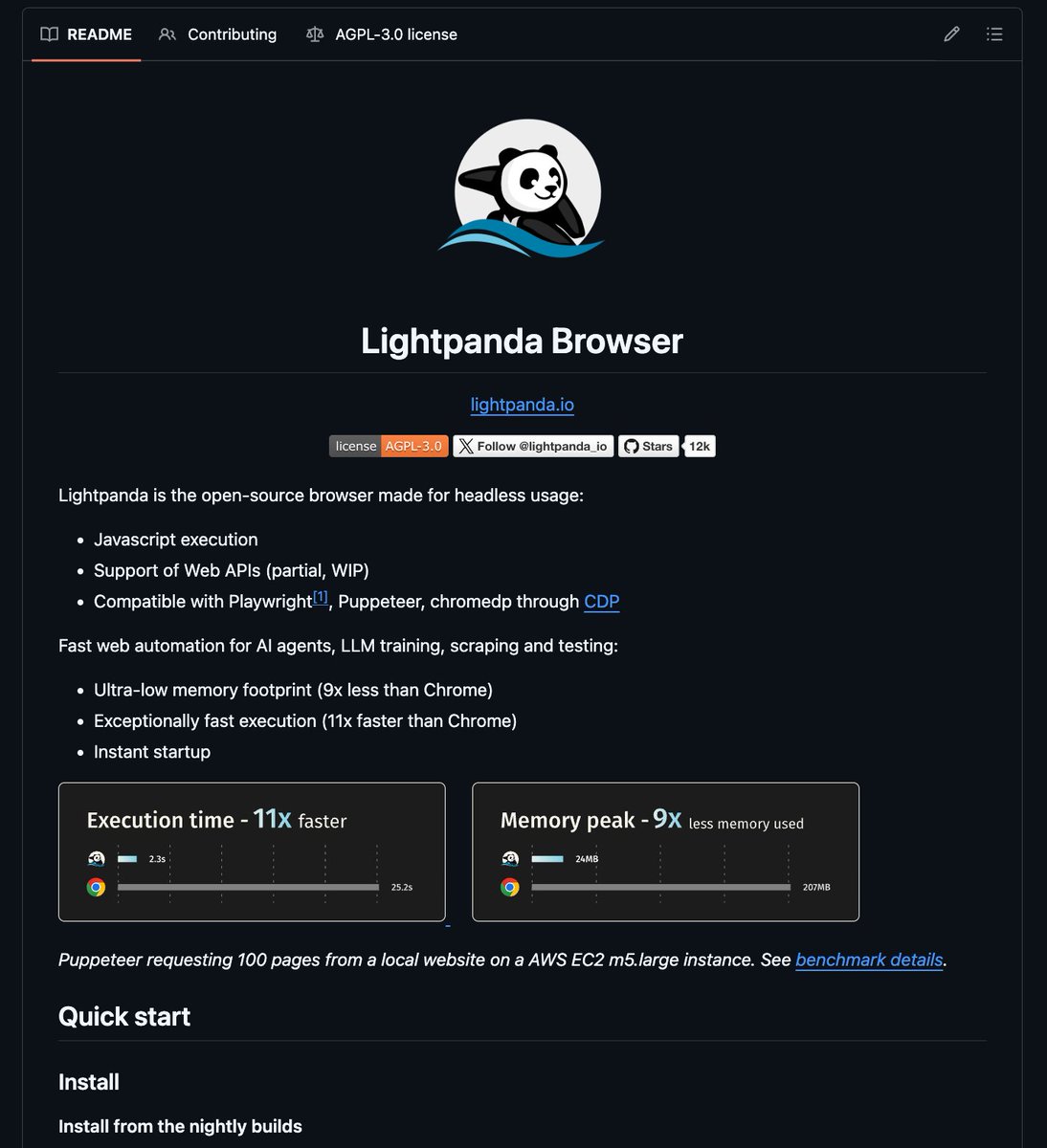
🚨BREAKING: Someone just open-sourced a headless browser that runs 11x faster than Chrome and uses 9x less memory. It's called Lightpanda and it's built from scratch specifically for AI agents, scraping, and automation. Not a Chromium fork. Not a hack. A completely new browser written in Zig. Here's why this changes everything for AI builders: ↓
Ryan Hart tweet media
English
277
922
8.2K
748.3K
Lars de Ridder
Lars de Ridder@theRedbeardIO·
@KirkMarple @levelsio But MCPs have the same issue if they have to follow the API and CLI. Which they’re already building anyway.
English
0
0
0
199
Kirk Marple
Kirk Marple@KirkMarple·
Even if it’s technically possible, CLIs have a latency issue. End-users aren’t going to want to wait around for their agents to hunt around, find the right CLI, install it, figure out how to auth, etc. At least MCP tools give a discovery mechanism for what’s available, where CLIs they basically have to browse the web or registry.
English
3
1
51
20.7K
@levelsio
@levelsio@levelsio·
Thank god MCP is dead Just as useless of an idea as LLMs.txt was It's all dumb abstractions that AI doesn't need because AI's are as smart as humans so they can just use what was already there which is APIs
Morgan@morganlinton

The cofounder and CTO of Perplexity, @denisyarats just said internally at Perplexity they’re moving away from MCPs and instead using APIs and CLIs 👀

English
697
343
6.2K
2.1M
Lior Alexander
Lior Alexander@LiorOnAI·
It's over. Karpathy just open-sourced an autonomous AI researcher that runs 100 experiments while you sleep. You don't write the training code anymore. You write a prompt that tells an AI agent how to think about research. The agent edits the code, trains a small language model for exactly five minutes, checks the score, keeps or discards the result, and loops. All night. No human in the loop. That fixed five-minute clock is the quiet genius. No matter what the agent changes, the network size, the learning rate, the entire architecture, every run gets compared on equal footing. This turns open-ended research into a game with a clear score: - 12 experiments per hour, ~100 overnight - Validation loss measures how well the model predicts unseen text - Lower score wins, everything else is fair game The agent touches one Python file containing the full training recipe. You never open it. Instead, you program a markdown file that shapes the agent's research strategy. Your job becomes programming the programmer, and this unlocks a strange new loop: 1. Agents run real experiments without supervision 2. Prompt quality becomes the bottleneck, not researcher hours 3. Results auto-optimize for your specific hardware 4. Anyone with one GPU can run a research lab overnight The best AI labs won't just have the most compute. They'll have the best instructions for agents who never sleep, never forget a failed experiment, and never stop iterating.
Andrej Karpathy@karpathy

I packaged up the "autoresearch" project into a new self-contained minimal repo if people would like to play over the weekend. It's basically nanochat LLM training core stripped down to a single-GPU, one file version of ~630 lines of code, then: - the human iterates on the prompt (.md) - the AI agent iterates on the training code (.py) The goal is to engineer your agents to make the fastest research progress indefinitely and without any of your own involvement. In the image, every dot is a complete LLM training run that lasts exactly 5 minutes. The agent works in an autonomous loop on a git feature branch and accumulates git commits to the training script as it finds better settings (of lower validation loss by the end) of the neural network architecture, the optimizer, all the hyperparameters, etc. You can imagine comparing the research progress of different prompts, different agents, etc. github.com/karpathy/autor… Part code, part sci-fi, and a pinch of psychosis :)

English
134
436
4.3K
879.8K
Lars de Ridder
Lars de Ridder@theRedbeardIO·
@zaimiri Why use Claude CLI at that point? Just switch to Pi or OpenCode.
English
0
0
0
18
zaimiri
zaimiri@zaimiri·
I stopped paying for Claude Code. $200/month for an API subscription to write code. Then Ollama dropped Anthropic API compatibility. Now Claude Code connects to free, local models on my machine. Here's the exact setup (took me 10 minutes): 1. Install Ollama → curl -fsSL https:// ollama .com/install .sh | sh 2. Pull a model → ollama pull qwen2.5-coder 3. Point Claude Code at localhost → ANTHROPIC_BASE_URL=http: //localhost :11434 claude That's it. Claude Code thinks it's talking to Anthropic. It's talking to your laptop. Best models I've tested: • Qwen 2.5 Coder - best all-around for code generation • DeepSeek-Coder - strongest at debugging and refactoring • Llama 3 - solid general reasoning Local models aren't Sonnet or Opus. Complex multi-file refactors still stumble. Long context windows get messy. But for everyday coding - scaffolding, tests, quick edits, boilerplate - they handle it fine. Your code never leaves your machine. Your bill goes from $200/month to $0. Your API key stays in your pocket. (Save this for later.)
English
212
176
2.4K
261K
Lars de Ridder
Lars de Ridder@theRedbeardIO·
@alexcooldev I’m gonna call it, this is just creating bullshit for bullshit apps. Happy for your bank account though.
English
1
0
2
194
Alex Nguyen
Alex Nguyen@alexcooldev·
This post is spot on. From my experience, the biggest impact of OpenClaw is marketing automation. And it’s been genuinely effective for me. I’m slowly replacing the students I used to hire for content, automating more of the workflow, and scaling my apps toward $50k–$100k/month (currently at $24k/month). And I’m doing it with as much profit as possible. I’m an indie hacker not VC-backed so profit matters more to me than vanity revenue. Keep building 💪
Alex Nguyen tweet media
Ernesto Lopez@ErnestoSOFTWARE

x.com/i/article/2026…

English
65
90
1.6K
345.9K
Stack Atlas
Stack Atlas@TheStackAtlas·
@charliejhills Building a browser engine from scratch isn’t just about independence. It’s about controlling the rendering, networking, and standards stack end-to-end. That’s real infrastructure leverage — not just another UI layer on top of Chromium.
English
6
2
24
11.3K
Charlie Hills
Charlie Hills@charliejhills·
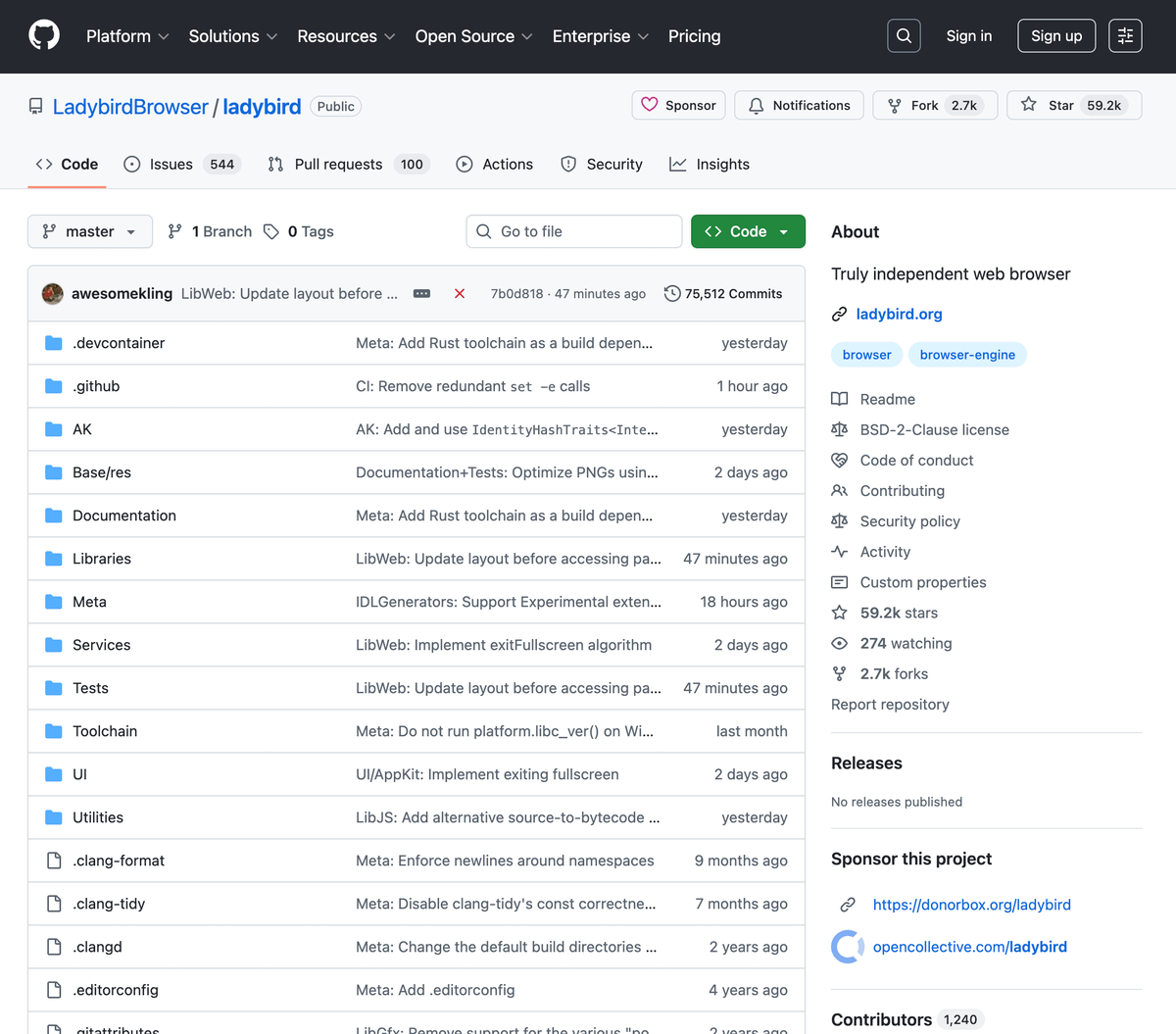
🚨 BREAKING: A team of engineers just said enough and built a browser from absolute scratch. No Chrome code. No Firefox code. Nothing recycled. Ladybird Browser is: → A 100% independent browser engine → Written in C++ from zero → Not a Chromium fork like every "new" browser you've ever seen → Completely open source anyone can contribute Chrome secretly runs 95% of the internet right now. This is the open source project trying to change that. 59,200+ stars on GitHub.
Charlie Hills tweet media
English
371
1.3K
9.7K
629K
Justin Schroeder
Justin Schroeder@jpschroeder·
We’re in the snake oil era of AI. The benchmarks and evals are *almost* useless at this point (ahem, Gemini) so ground-truth is experiential aka “vibes”. How are you measuring what works?
Justin Schroeder tweet media
English
4
1
11
1.6K
POM
POM@peterom·
Deepseek got called out for scraping 150k Claude messages. So I'm releasing 155k of my personal Claude Code messages with Opus 4.5. I'm also open sourcing tooling to help you fetch your data, redact sensitive info & make it discoverable on HF - link below to liberate your data!
POM tweet media
English
628
1.7K
15K
24.2M
Aakash Gupta
Aakash Gupta@aakashgupta·
This feature just made at least 6 startups irrelevant overnight. Happy, Claude Remote, VibeTunnel, Superconductor, Claudia, CodeRemote. All launched to solve exactly this problem. Some raised money. Some built paid apps. Some had thousands of users. Claude Remote literally launched on Hacker News one week ago. Pulse Vibe shipped in January. These tools got weeks of life before Anthropic dropped the native version. Anthropic watched the market signal, confirmed the demand was real, then shipped a native version that runs on your local machine with zero configuration. One slash command. /remote-control. Done. This is the classic platform kill zone playing out in real time. Third-party developers find a gap, build a product, validate demand, and the platform absorbs the feature into the core. Apple did this to flashlight apps. Google did this to weather apps. Now Anthropic is doing it to the entire Claude Code mobile ecosystem. The math is brutal for these startups. Anthropic’s version is free with your existing Pro or Max subscription ($20-$200/month). Third-party tools charged separately, required extra setup, and couldn’t access the native session state. A native integration that syncs your filesystem, MCP servers, and project config with one slash command kills every workaround that requires SSH tunnels and Tailscale configs. What makes this interesting is what it tells you about Anthropic’s product strategy. The API is table stakes now. They’re building the full-stack developer experience: terminal, web, mobile, all synced to one session. Every feature they absorb makes switching to Cursor or Copilot harder because the switching cost compounds around workflow, not model quality. And workflow is sticky in ways that model benchmarks never were. The startups that built on Claude Code’s gaps just learned the oldest lesson in platform economics: if you’re filling a hole the platform knows about, you’re a roadmap item, not a company.
Claude@claudeai

New in Claude Code: Remote Control. Kick off a task in your terminal and pick it up from your phone while you take a walk or join a meeting. Claude keeps running on your machine, and you can control the session from the Claude app or claude.ai/code

English
70
89
886
203.3K