Tom Arnold

1.6K posts

Tom Arnold banner
Tom Arnold

Tom Arnold

@TheTomArnold

Menlo Park, CA Katılım Haziran 2011
664 Takip Edilen507 Takipçiler
Ari Peskoe
Ari Peskoe@AriPeskoe·
That data center will be able to use about 1.5x electricity as the entire Liberty Utilities System -- covering 900+ sq mi, delivering power to 49,000 residents and businesses (53:47 split) through 1,900 miles of distribution lines -- on a hot summer day.
English
0
0
5
344
Duncan S. Campbell
Duncan S. Campbell@duncancampbell·
@TheTomArnold @KyleKulinski Totally. Which they were always exposed to. Liberty’s agreement with NV was set to expire no later than end of 2025. The. They basically just assumed NV would bridge them through to finding another provider. All which which went down before the data center boom.
English
1
0
0
38
Tom Arnold
Tom Arnold@TheTomArnold·
@duncancampbell @KyleKulinski not much spot/market it Nevada. Greenlink finishing would allow them to get sourthern NV resources . Wheeling will be hard.
English
1
0
0
384
Duncan S. Campbell
Duncan S. Campbell@duncancampbell·
This isn’t what it appears to be. The local utility (the company with the wires and poles and meters that you pay your bill to) contracts with wholesale electricity providers (companies with generation resources in the region that are connected to the same high voltage transmission system) for the bulk capacity it needs to serve its customers. The agreements are bilateral. Both parties chose to do it under some time defined contract. It sounds like the contract is up, and the wholesale provider wants to sell its power elsewhere. The local utility now will need to find a new provider. Many exist. And even in the event where somehow they dont, it’s not as if the power will stop flowing. No one is going to shut off the power. They can still buy power on the spot market. These agreements are financial in nature.
English
7
1
114
17.9K
Tom Arnold
Tom Arnold@TheTomArnold·
@JigarShahDC Yes, and once they got the second 150MW substation, they kept the turbines and upsized the facility. The race for power has no shame in a boom.
English
0
0
0
93
Jigar Shah
Jigar Shah@JigarShahDC·
I have been consistently saying this for a year.
Shanu Mathew@ShanuMathew93

Tech crowd keeps leaning into this off grid is the only way thesis and I disagree with this notion. The exhibit A example of xAI colossus even overstates what’s actually happening at Colossus. xAI did not build a permanently “off-grid” AI campus because the grid was unusable. Colossus already has 300 MW of TVA interconnect approved across two substations xAI funded, plus contractual obligations to curtail during periods of grid stress. That is a grid-tied architecture with supplemental on-site generation, not an islanded power system. The turbines solved a time-to-power problem. They accelerated deployment while substations and transmission infrastructure were being built. That’s very different from “do this all off grid.” And economically, most large-scale AI load will still want to be grid tied long term. I have made this point several times but running your own generation fleet at hyperscale is expensive and operationally complex: fuel logistics, maintenance, N+1 redundancy, permitting, emissions compliance, balancing load/supply continuously, multi-year equipment lead times, etc. You don’t just figure that out or want to do that overnight. Amin Vahdat, chief technologist of Google AI straight up confirmed this on a podcast and they literally bought a hybrid/island power developer. BTM generation absolutely matters. It’s becoming a critical bridge solution during a period where utility interconnect timelines are badly lagging demand growth. But I’d strongly push back on the idea that the steady-state future is fully off-grid hyperscale campuses. The industry is converging toward hybrid architectures: grid interconnect + captive generation + storage + demand response.

English
3
3
40
17.1K
Duncan S. Campbell
Duncan S. Campbell@duncancampbell·
Does anyone know of a single electricity load on earth that actually runs at 99%+ annual load factor?
English
48
2
37
20.6K
Tom Arnold
Tom Arnold@TheTomArnold·
@TKavulla People would be shocked to see what states like CA spend on midstream incentives and how poorly its managed/tracked. SCE famously was docked $95M for counting savings on bulbs, a few stores sold more than the entire market for lights.
English
0
0
1
35
Travis Kavulla
Travis Kavulla@TKavulla·
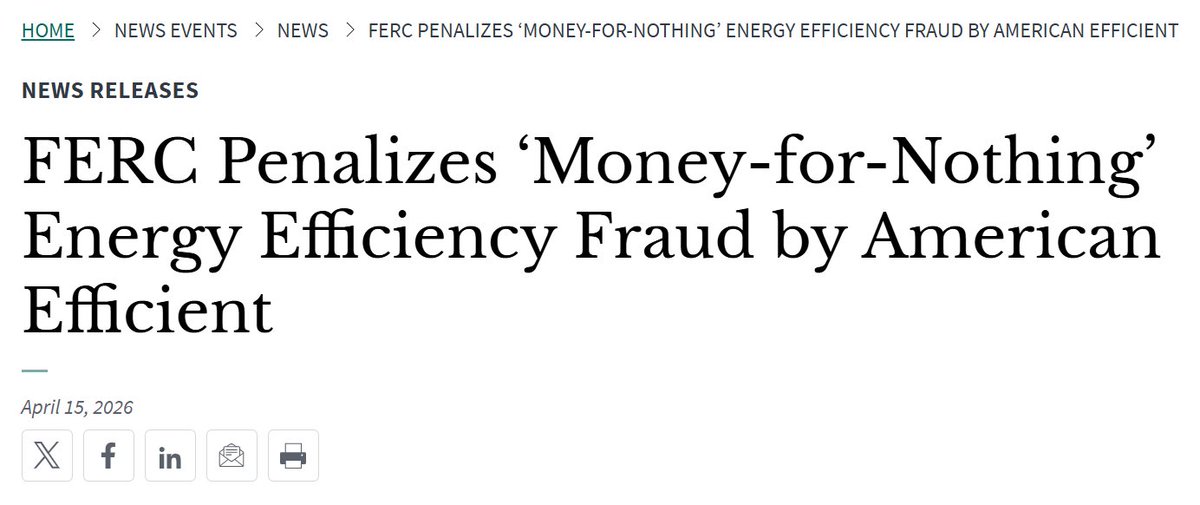
Since this case emerged, PJM has drummed "energy efficiency" as a supply resource out of the capacity market altogether. Meanwhile, there are plenty of utility ratepayers through state programs still paying for "market transformation" spending that -- if not as galling as this example -- still raises a lot of questions about whether incentives are really aligned or which pose, as Chairman Swett puts it, "an opportunity to make easy money from a program designed to encourage socially beneficial conduct"
English
2
0
9
1.1K
Travis Kavulla
Travis Kavulla@TKavulla·
For those who haven't followed this: This outfit went to the likes of box stores, & said "Hey, here's a shiny penny if you sell us 'energy efficiency credits', a concept we invented, but anyways they represent the intangible attributes of energy efficiency emergent from those lightbulbs you are selling" Box Store VP: "wtf are you talking about but, free money, ok??" Then the outfit turned around and sold that intangible credit as capacity (an intangible commodity!) in PJM.
Travis Kavulla tweet media
English
7
7
51
20K
Tom Arnold
Tom Arnold@TheTomArnold·
@lrntex nope its revenue neutral. All commitments that are levied at the time of exit. Also, its 6% of sales, so just not a huge load that would swamp the rest of the system.
English
0
0
0
25
Lauren Teixeira
Lauren Teixeira@lrntex·
@TheTomArnold interesting. even if SF pays an exit fee, though, wouldn't the opt out still affect remaining ratepayers in the long term?
English
1
0
0
51
Lauren Teixeira
Lauren Teixeira@lrntex·
This is a perfectly rational thing for San Francisco to do and will also make PG&E’s already eye-watering rates even more unaffordable for non-SF residents (who are on avg much lower income than San Franciscans).
Senator Scott Wiener@Scott_Wiener

Today I announced new legislation to un-rig the process for San Francisco & other cities to break up with PG&E & form their own publicly owned utilities. Over the years, PG&E has managed to insert provisions into state law to make it harder to break away. SB 875 reverses that.🧵

English
2
4
11
2.4K
Tom Arnold
Tom Arnold@TheTomArnold·
@wolfejosh AI polls horribly, and the rate increases from *rapid* growth affect rates in a very real way for a huge swath of society. The PJM rate increase is a rate increase for a forecast of load growth, not actual load growth. There are real issues here of fairness of who pays.
English
0
0
1
167
Tom Arnold
Tom Arnold@TheTomArnold·
@EllliotttB no CRE yield on steel and concrete. The issue here is the mismatch of AI revs and AI capex.
English
0
0
1
23
Tom Arnold
Tom Arnold@TheTomArnold·
@SuB8u The hilarious thing is this was created for Hampton Creek when they bought their own product. Such an on-point selection @SuB8u
English
1
0
1
25
Subrahmanyam KVJ
Subrahmanyam KVJ@SuB8u·
Nvidia + OpenAI + CoreWeave + ...
GIF
Português
1
1
4
852
Tom Arnold retweetledi
nvo
nvo@nickvanosdol·
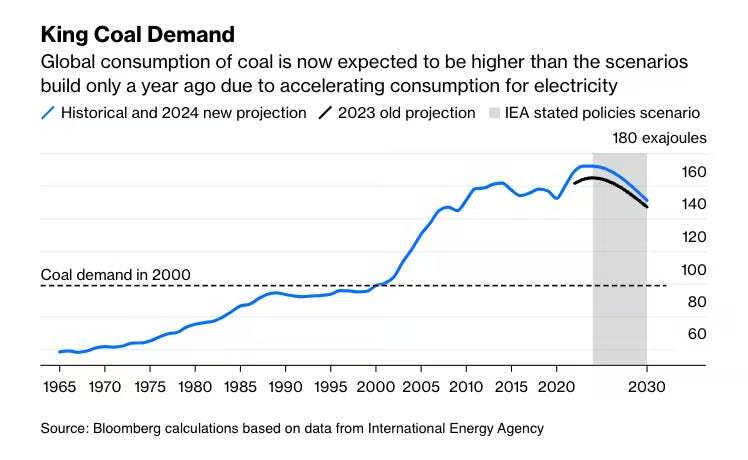
As good a day as any for a dump of my favorite charts on U.S. & global energy transition / climate dynamics: 1) Globally, demand for coal—buoyed by China + India which cover 60% of consumption—hasn’t peaked & isn’t forecast to fall as fast as needed for decarbonization targets.
nvo tweet media
English
1
2
26
3.5K