Steven Lin

86 posts

Steven Lin banner
Steven Lin

Steven Lin

@tlin1414

Founder & CEO of Worca.

Los Angeles Katılım Haziran 2023
47 Takip Edilen10 Takipçiler
Steven Lin
Steven Lin@tlin1414·
@andrewchen teaching 2nd grader vibe coding makes me realize how much productivity and creativity we humans are truly capable of. what we've seen so far is not even 1% of the creative power AI + humans can do.
English
0
0
0
38
andrew chen
andrew chen@andrewchen·
old: Viral content new: Viral demos
Português
34
7
205
14.3K
Steven Lin
Steven Lin@tlin1414·
uno reverse of the century: 2023: "hey chatgpt write me an email" 2024: "hey claude review these 5 emails i drafted" 2025: *AI drafts, sends, follows up, and invoices the client* "hey human, this guy's mad. your turn" 2026: i have 21 AI employees. they have standup without me. i get paged when something breaks. i am on-call for my own company i didn't adopt AI. AI adopted me. i am a `tool_use` endpoint with feelings and a coffee dependency the machines didn't take our jobs. they gave us theirs. the job is "approve button" and the pay is "you still own the company i guess"
English
0
0
0
14
Xiaoyin Qu
Xiaoyin Qu@quxiaoyin·
GitHub is the new content platform. Good job Microsoft. The next generation of creators are GitHub creators.
English
26
10
155
8.2K
Steven Lin
Steven Lin@tlin1414·
yes seen this in many places and it's amazing. middle managers that adds little or even negative value finally is phasing out and teams are becoming so much more productive. @pmarca in a podcast talks about how AI is converging roles horizontally that PM, Dev, Designer, etc. all kind of merge into a single role. I think vertically it holds true as well --- no more need for middle layer management if AI makes communication and alignment 100x more efficient.
English
1
0
1
723
Xiaoyin Qu
Xiaoyin Qu@quxiaoyin·
AI is doing what years of corporate politics couldn't: rewarding people who are actually good at their jobs. I keep seeing this pattern. You know that engineer who's brilliant but can't schmooze? The one stuck at senior level forever because they don't play the political game? Suddenly they're getting promoted. What changed? Two things. First, survival mode kills politics. When companies are under real competitive pressure from AI, executives start caring about results, not presentations. The CEO is in the trenches now. Nobody has time for the middle manager whose only skill is running meetings. Second, AI is a multiplier for real skills. If you're genuinely good at what you do, AI makes you 100x better. If you're just good at talking, AI doesn't multiply that. You're still 1x bullshit, competing against 100x substance. So the quiet ones rise while the loud ones get exposed. And the people who are both skilled AND good communicators? They've already left to start their own companies. #AI #TechCareers #CorporatePolitics #Leadership
English
56
59
430
37.6K
Steven Lin
Steven Lin@tlin1414·
@trikcode most people can't explain how electrons move inside a transistor and they don't need to. vibe coding is just another layer of abstraction to build really complicated and capable system.
English
0
0
2
105
Wise
Wise@trikcode·
The vibe coding crash is coming. Thousands of apps built by people who can't explain a single line of their own codebase.
English
705
150
2.8K
198.4K
Steven Lin
Steven Lin@tlin1414·
5/ The transition will be brutal for those who wait. Taylor: disrupt your tech stack or die. Andreessen: the workforce is shrinking. AI fills the gap or the gap doesn't get filled. The companies still debating "whether" are already behind.
English
1
0
0
18
Steven Lin
Steven Lin@tlin1414·
Bret Taylor (Sierra CEO, OpenAI board chair) and Marc Andreessen just said the same 5 things about where software is going. The quiet part is out loud now. A thread:
English
1
0
0
35
Steven Lin
Steven Lin@tlin1414·
Already happening. We're hiring for what we call "agent orchestrators" — people who understand the business problem, can architect the AI workflow, and judge whether the output is right. Traditional PM: writes specs for engineers to build. This role: builds directly with AI agents, no handoff. The skill that matters most now isn't coding or product management. It's judgment under uncertainty — knowing when the AI is wrong before your users do.
English
0
0
1
85
Haider.
Haider.@haider1·
prediction time: product managers and developers will merge, or at least work much closer PMs who can build software will stay. devs who really understand the product will stay. both will benefit from AI but if all you bring is knowing a language's syntax, it'll be hard to compete
English
27
5
59
5.6K
Steven Lin
Steven Lin@tlin1414·
We replaced a 4-year ERP buildout with an agent-based system. 2 engineers + AI doing what we originally scoped for 8. The hiring shift: we stopped looking for specialists and started looking for people with judgment. The new bottleneck is someone who can architect agent workflows and know when the AI is wrong — not someone who writes CRUD endpoints. Headcount is down. Output per person is way up. But the role changed completely.
English
1
0
0
465
Paras Chopra
Paras Chopra@paraschopra·
Curious - how has AI impacted things in your company? Particularly, on hiring and head count front. Are things different or the same?
English
104
4
306
49.6K
Steven Lin
Steven Lin@tlin1414·
Agree — it's software architecture with a new constraint surface. The difference from traditional SE: your "components" are nondeterministic. Same input, different output. That changes how you design error handling, testing, and state management fundamentally. Your 3-role split is sharp. The QA/eval engineer might be the most underbuilt function right now. Most teams ship agents without any systematic way to catch subtle regressions.
English
0
0
1
24
Michael Guo
Michael Guo@Michaelzsguo·
I like how you framed these roles, but I see the “AI infra engineer” a bit differently. The deeper I get into the agentic architecture, the more it looks like a software engineering function rather than a pure AI role. Building the underlying agents that connect business systems is fundamentally a software architecture problem. If you look at tools like Claude Code or OpenClaw, they are much closer to complex software platforms than to traditional AI or data infrastructure. Designing them well requires strong system design, integration patterns, state management, and long-running workflow thinking, all of which are core software engineering skills. The way we’re shaping the agent team in our org reflects that split: Software engineer / architect AI context, semantics, and data engineer AI QA/eval engineer
English
1
0
1
184
Steven Lin
Steven Lin@tlin1414·
Garry Tan says 10 engineers do the work of 100. Everyone nods. But nobody answers the next question: which roles survive? I run a company this way. Here's the actual org chart.
English
1
0
0
37
Steven Lin
Steven Lin@tlin1414·
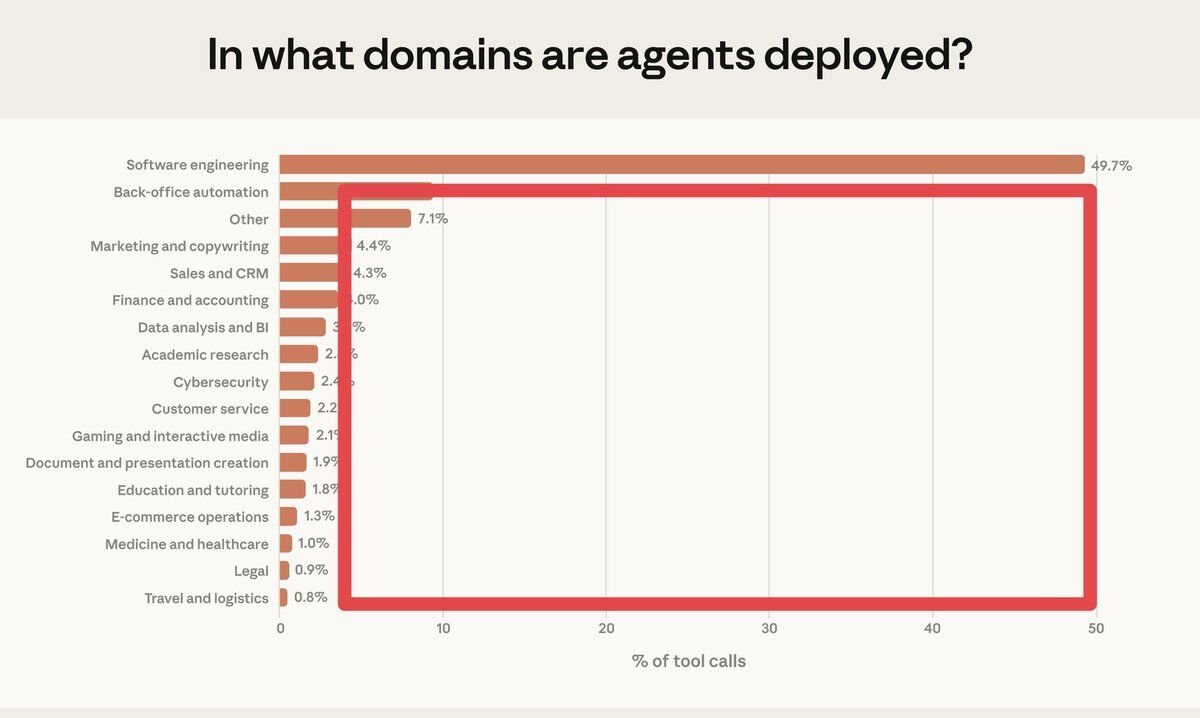
Software eng dominates because code has the tightest feedback loop — run it, it works or it doesn't. The other verticals aren't waiting for better models. They're waiting for better evals. Healthcare, legal, finance — the output is ambiguous, the stakes are high, and "wrong" looks like "right" until it doesn't. The hundred unicorns are really eval companies in disguise.
English
0
0
2
190
Garry Tan
Garry Tan@garrytan·
Software engineering accounts for nearly 50% of all AI agent tool calls. Healthcare, legal, finance, and a dozen other verticals are barely touched, each under 5%. That's a hundred AI unicorns waiting to be built. garryslist.org/posts/half-the…
Garry Tan tweet media
English
277
363
3K
310.7K
Steven Lin
Steven Lin@tlin1414·
The underrated skill shift: writing constraints is harder than writing specs. Goals are easy. "Grow revenue 20%." The hard part is the boundary conditions — what you won't build, which tradeoffs you won't make, where speed matters more than polish. Today's best PMs already do this. The title changes, but the craft is the same: taste expressed as constraints.
English
1
0
1
216
andrew chen
andrew chen@andrewchen·
Today the job of the PM is the define the product, how it works, and how it’ll get built But we won’t need that soon The future job will be simple to define the goals, the constraints, and long term strategy - and letting the AI figure the rest out Goal Architect, not product manager
English
135
37
490
84.9K
Steven Lin
Steven Lin@tlin1414·
We replaced a 4-year-old ERP system at Worca with an agent-based system. It's better. The team that built the replacement was a fraction of the team that built the original. This isn't a prediction. It's Tuesday.
English
1
0
0
35