Triam

120 posts

Triam banner
Triam

Triam

@triiiam

the stories money tells

Vancouver Katılım Şubat 2021
154 Takip Edilen89 Takipçiler
Triam
Triam@triiiam·
@velesxbt Shannon AND Thorp?? Legends both
English
0
0
1
332
veles
veles@velesxbt·
In 1961, two MIT professors beat roulette in Las Vegas. Not by counting. Not by luck. With a shoebox of transistors taped to their stomachs. Their edge was 44 percent over the house. The casino never figured out how. One of them invented the mathematics behind the internet. The other invented the modern hedge fund. His name was Claude Shannon. Yes, that Claude Shannon. In the summer of 1961 he built the world's first wearable computer in his basement in Cambridge. He wore it into a Nevada casino under his shirt. His partner was a 28-year-old math professor named Ed Thorp. Thorp tapped his toe when the ball passed a mark. Shannon's computer did the physics. It sang the answer into Thorp's ear as one of eight musical tones. Which quarter of the wheel the ball would land in. It worked. They tested it in Reno, then took it into the pit. The edge held. The device is now in a glass case at the MIT Museum. Credited as the first wearable computer in history. They quit after a few trips. The earpiece wire kept breaking. And in 1961 the wrong pit boss noticed and things got physical. Shannon wanted no part of that. He was a professor. Thorp had no such problem. He took the math to blackjack, wrote Beat the Dealer in 1962, and by 1964 every casino in Nevada had rewritten the rules to stop him. In 1969 he opened Princeton Newport Partners. Nineteen years. 20 percent a year. No losing quarter. Shannon went back to Cambridge and ran his own money. His personal portfolio compounded at 28 percent a year for 30 years. Better than any fund manager alive at the time. Nobody knew until his wife opened his books after he died. Two MIT professors. One shoebox. One summer in Nevada. The blueprint for the entire hedge fund industry. Thorp is 93. Shannon died in 2001. The shoebox is behind glass in Cambridge. Vegas learned to change the rules. Wall Street never did.
veles@velesxbt

x.com/i/article/2080…

English
10
13
126
113.3K
Triam
Triam@triiiam·
@Di_Krass_ the shakespeare angle is actually brilliant
English
1
0
0
43
DiKrass -X-
DiKrass -X-@Di_Krass_·
John Geanakoplos, Yale economist: "Yale pays me $400K to teach finance - and I open the course with Shakespeare. Everyone thinks finance is about interest rates. It's not. It's one 400-year-old question: what makes a promise real? Every crash comes from forgetting the answer." in the play, a merchant borrows money and signs a gruesome guarantee: "let the forfeit be an equal pound of your fair flesh." that pound of flesh, Geanakoplos points out, is nothing exotic. "it's collateral that they're putting up for the loan." and that's the whole point. the hard question in finance isn't the rate - it's trust. "how do we know these people are going to keep their promises? ... it's because he's putting up collateral." Shakespeare understood in 1600 what modern models left out - and that missing piece, collateral and leverage, is what tears markets apart. strip away the equations and finance is one ancient question: what makes a promise real? the answer was on a stage centuries before it was in any textbook - and Geanakoplos spends the rest of the course showing how forgetting it is what caused 2008.
DiKrass -X-@Di_Krass_

x.com/i/article/2078…

English
12
12
63
3.8K
Triam
Triam@triiiam·
In 2007 one man made about fifteen billion dollars in a single year by betting that the safest thing in America was about to collapse. it remains the most profitable trade in the history of Wall Street. Every rating agency, every bank, every expert with a title had signed off on American mortgages as close to risk free. John Paulson was a mid-tier hedge fund manager nobody feared. instead of trusting the consensus he did the boring work: he pulled the actual loans, the ones being bundled and stamped AAA, and read what was inside them. the numbers said the safe thing was a fraud. so he bet everything he could against it while the whole credentialed world stood on the other side of the trade. when the mortgages failed, the smartest institutions on Earth lost fortunes being confidently, unanimously wrong. Paulson made four billion dollars for himself in twelve months. the consensus is not evidence. a room full of experts agreeing is not the same as a room full of experts checking. the market pays, over and over, for the one person willing to open the file everyone else was too busy nodding to read.
Triam@triiiam

x.com/i/article/2079…

English
1
1
1
79
Triam
Triam@triiiam·
In 2017 a computer sat down against four of the best poker players alive, played twenty straight days, and beat every one of them. the machine's real trick was not calculation. it had learned to bluff. Poker is not chess. in chess everything sits in the open. in no-limit poker the most important cards are the ones you cannot see, and the whole game is deciding how much to bet on a probability you can never fully know. that was supposed to be the last human stronghold: reading people, running a bluff, feeling when the odds have quietly shifted. a Carnegie Mellon program called Libratus, built by a researcher named Noam Brown, did all of it better than professionals who had spent their lives at the table. it did not out-muscle them with raw math. it out-calibrated them. it sized its bets to the exact probability and refused to be argued out of them by a hot streak or a bad night. the edge was never certainty. the machine did not know the cards either. it simply knew, more honestly than the humans across the table, how sure it was allowed to be. that is the whole game, and almost nobody plays it on purpose.
Triam@triiiam

x.com/i/article/2079…

English
1
1
2
246
Triam
Triam@triiiam·
One trader lost almost five billion euros of a bank's money in a single week, and the strangest part is that he was not stealing a cent of it. Société Générale is one of the oldest banks in France. in January 2008 it discovered that a junior trader on a desk almost nobody watched had built a position worth roughly fifty billion euros, larger than the entire value of the bank itself, hidden behind fake trades he knew how to disguise because he had once worked in the back office that checks them. that trader was Jérôme Kerviel, and for a long stretch he was actually winning. that was the trap. one man, one desk, one direction of conviction, doubling until the market turned and there was nothing on the other side to cancel him out. the bank unwound his positions into a falling market and turned a paper problem into a four point nine billion euro hole. this is what a market full of strangers protects you from and a single clever head cannot. a thousand independent bets point in a thousand directions and quietly erase each other's mistakes. one brilliant trader points in exactly one direction, and when he is wrong, he is wrong with everything at once. the crowd is boring because it survives. the genius is thrilling right up until the afternoon he isn't.
Triam@triiiam

x.com/i/article/2079…

English
0
1
2
298
Triam
Triam@triiiam·
@VoltexGar 3 milliseconds for 300 million lol insane
English
0
0
0
466
DiKrass -X-
DiKrass -X-@Di_Krass_·
@triiiam they had the models, the crowd had the float. one of those runs out
English
1
0
1
31
Triam retweetledi
Triam
Triam@triiiam·
In January 2021 a hedge fund with twelve billion dollars and a wall of Ivy League analysts lost almost seven billion in a single month to a crowd of amateurs who mostly could not read a balance sheet. the amateurs were right, and the fund needed a rescue by the end of the month. Melvin Capital had done the textbook smart-money thing. it looked at a dying mall retailer called GameStop and bet enormous money the stock would fall, so much that across Wall Street the shorts had borrowed more shares than actually existed. on paper it was free money. the professionals had the models, the leverage, and the certainty. what they did not have was the other side of the trade. a few hundred thousand strangers on a message board saw the one thing the shorts had ignored: if everyone betting against the stock had to buy it back at once, the price could only go one way. so the crowd bought, and held, and refused to sell. GameStop ran from a few dollars to nearly five hundred. Melvin lost about fifty three percent in weeks, took a rescue of nearly three billion dollars to survive January, and was gone inside eighteen months. you cannot overpower a market by being the biggest player in the room. a fortune concentrated in a few brilliant heads is still one position, and a crowd that will not sell is the one force that outnumbers all of them. the shorts were not wrong about the company. they were wrong about who they were fighting.
Triam@triiiam

x.com/i/article/2079…

English
1
1
5
223
Carbonyx
Carbonyx@carbonyxxx·
Richard Hamming, the Bell Labs mathematician behind error-correcting codes: at Los Alamos he realized he was a janitor of science - shut out of the big decisions, "envious, plain envious." so he spent his career on one question: what separates the great scientists from everyone equally smart? not IQ. which problems you pick. he saw it at Bell Labs: "those who work with the door shut may be working just as hard ten years later, but they don't know what to work on." brilliant people, "always on slightly the wrong problem." so he blocked friday afternoons to ask "what are the important problems in my field?" and important isn't the biggest - it's the one you have a way to attack. same story i keep telling: the people who change a field aren't the smartest in the room. they're the ones who keep asking what's worth working on. it's not what you do, it's how you do it. Poincaré had special relativity too. you only remember Einstein.
DiKrass -X-@Di_Krass_

x.com/i/article/2078…

English
4
6
41
2.9K
Triam
Triam@triiiam·
@itsak1to damn handing back that reebok check at 18 is just insane
English
1
0
1
61
Akito
Akito@itsak1to·
LeBron James was 18 when the CEO of Reebok slid a $10 million check across the table and told him to take it. he handed it back. one condition came with the money. don't talk to Nike. don't talk to Adidas. sign right now. he had never seen that many zeros in his life. he asked for a minute, and they left him alone in the room with his mother. "I still can't believe I left that $10 million." Nike offered him $90 million. a decade later they signed him to a lifetime deal reportedly worth over $1 billion. then he did it again. in 2008 a headphone startup asked him to promote their product. instead of taking a fee, he asked for a small piece of the company. Apple bought Beats for $3 billion in 2014. LeBron's cut was $30 million - more than his entire NBA salary that year, and the largest equity payout any athlete had ever received. in 2012 he put around $1 million into a pizza chain nobody had heard of, then turned down $15 million from McDonald's to focus on it. his Blaze stake is now worth $35-40 million. he became the first active NBA player to reach a billion. the check is the ceiling. the equity is the floor. every athlete gets offered a number, and that number is the most that deal will ever pay. ownership has no such limit. the offer that feels impossible to refuse is usually the one designed to stop you from finding out what you're worth ↓
Akito@itsak1to

Apple CEO Steve Jobs once paid Microsoft CEO Bill Gates $31,000 for software. twenty years later he begged him for $150 million to keep Apple from dying. in 1977 Microsoft was the contractor and Apple was the client. Gates wrote Applesoft BASIC for the Apple II, took the flat fee, and went home. by August 1997 Apple was weeks from insolvency. Jobs had just come back as interim CEO. his first major move wasn't a product - it was a phone call to the one man everyone assumed wanted Apple dead. Gates could have let it die. instead Microsoft put $150 million into Apple non-voting stock and settled the patent dispute between them. when Jobs announced it at MacWorld, Gates appeared on a giant screen above the stage. the audience booed. "we have to let go of the notion that for Apple to win, Microsoft has to lose." then, on the cover of TIME: "Bill, thank you. The world's a better place." Apple's stock jumped 33% that day. the company is now worth roughly $4 trillion. Gates on the deal a decade later: "that's worked out very well." but this isn't really a story about two rivals. a competitor is not an enemy. Gates needed a healthy Apple to argue Microsoft wasn't a monopoly, and he needed Office to have a second platform. both sides won because both had something the other couldn't get anywhere else. the hardest call is the one that costs you your ego. Jobs got booed by his own people for that deal. he made it anyway, because being right in public is worth less than being solvent. $31,000 and $150 million were the same relationship twenty years apart. the only thing that changed was who needed whom. the man Apple hired as a contractor ended up writing the check that saved it ↓

English
2
4
24
2.5K
Loran
Loran@0xLoran·
Terence Tao, UCLA professor and the most decorated mathematician alive: "Hedge funds hand you $750K a year for a single skill: telling a real pattern from noise. I've spent a lifetime on it, and almost everyone has it flipped." this free lecture is the entire "find the signal" problem those firms are paying for, delivered at UCLA by the most awarded mathematician alive and put online for nothing. at the chalkboard it's plain. Tao's lifelong idea is that almost nothing is purely one thing. there's flawless structure, like a clock, and flawless randomness, like a coin toss, and nearly everything real sits somewhere between the two. the work is pulling them apart. the primes are the cleanest test. they look scattered and lawless, yet Tao and Ben Green proved they hold evenly spaced runs of any length you ask for. order was buried inside the apparent chaos the whole time. that's "signal detection" with the marketing stripped off. he gave this at UCLA and it has stayed free ever since. exactly the point of the article above: the mathematics those firms pay half a million for is public, written down and free to anyone tonight. the lecture costs nothing and anyone can press play. what no one can sell you is the judgment to tell when a pattern is real and when your own eyes invented it. that judgment is the entire job, and it takes years to earn.
Rossst.03@Rossst_03

x.com/i/article/2079…

English
38
298
2.7K
725.1K
Triam
Triam@triiiam·
@RuujSs well, diversification you assume is the drawdown you get
English
0
0
0
33
Ruuj
Ruuj@RuujSs·
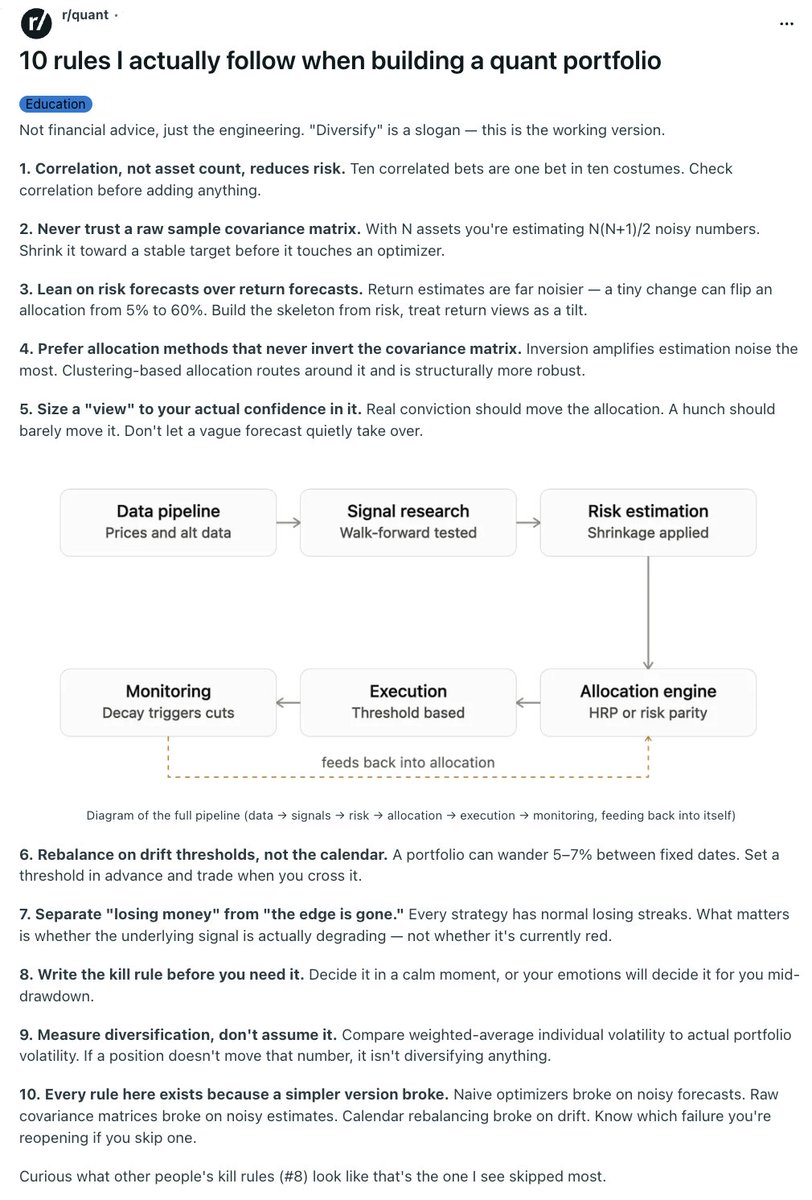
this quant pipeline is f*cking insane 10 rules from the engineering side that reveal exactly why most optimizers blow up and how to survive production it routes around matrix inversion with clustering, sizes every view to actual conviction, and forces you to measure diversification instead of assuming it. effectively replacing naive allocation with a feedback loop that monitors decay and triggers cuts before damage compounds bookmark before the timeline buries it
Ruuj tweet media
Ruuj@RuujSs

x.com/i/article/2076…

English
7
15
134
9.1K
Triam
Triam@triiiam·
@caspr_exe the moat became the target line hits hard
English
0
0
1
23
Casper
Casper@caspr_exe·
Bill Gates, co-founder of Microsoft: "College-educated graduates are going to have a more challenging job environment." Everyone assumed AI would come for the factory first. The manual, the physical, the blue collar. Gates says it flipped. It came for the office. Thirty percent of Microsoft's own code is already written by AI. The paralegals doing discovery, the entry-level accountants, the telesales and support staff, the junior coders. Pattern-recognition work, done cheaper and more accurately than a human. The safe, educated, salaried jobs. Those are the ones going first. The degree was supposed to be the moat. It turned out to be the target. No one expected the white collar to go before the blue collar. It did.
Casper@caspr_exe

x.com/i/article/2078…

English
2
1
18
573
Triam
Triam@triiiam·
@0xOrionVega Ed Thorp is a legend, criminally underrated
English
0
0
0
23
Orion
Orion@0xOrionVega·
The equation on your screen runs $700 trillion of the global derivatives market. Two men won the Nobel Prize for it in 1997. On page one of their 1973 paper, in the second paragraph, they cite the man who wrote the same formula six years earlier. He never got the Nobel. His name was Ed Thorp. The paper is free. The Nobel went to Myron Scholes and Robert Merton. Fischer Black died of throat cancer in 1995, two years before the prize. The committee does not award posthumously. Black wrote the equation. He never saw the medal. The 1973 paper is called The Pricing of Options and Corporate Liabilities. Journal of Political Economy. Second paragraph on the first page. The citation reads Thorp and Kassouf, 1967. What Thorp and Kassouf did was build an empirical hedge between warrants and stocks that returned the risk-free rate. Black and Scholes read it. They extended the argument into a partial differential equation. The PDE became the entire options industry. Thorp had already been running the trade for six years. He had already made money on it. In 1969 he co-founded Princeton Newport Partners and compounded at roughly 20 percent a year for nineteen years without a losing quarter. The math worked. He did not publish the closed-form solution because he was too busy trading it. "The Black-Scholes formula is still around, even though the assumptions behind it are not true." - Fischer Black, The Holes in Black-Scholes, 1988 Black wrote that fifteen years after the paper that would win his co-authors the Nobel. He listed the assumptions that break in real markets. Constant volatility fails. Log-normal returns fail. Continuous hedging is impossible. Risk-free rate is an accounting fiction. He wrote the equation and then wrote its obituary. In 1998, Scholes and Merton put their own equation to work at Long-Term Capital Management. They lost $4 billion in four months. The Fed organized a bailout to keep the fund from taking the global banking system with it. The equation that won the Nobel destroyed the fund run by its own authors. For a trader the takeaway is direct. The formula is a first-order approximation of a world that does not exist. Constant volatility. Continuous prices. Perfect liquidity. Real markets have jumps, fat tails, and holes where the liquidity used to be. Every quant since 1973 has spent a career patching the model. The patches never quite hold in a crisis. Thorp is 93. He still writes. Fischer Black is buried in Cambridge. Scholes and Merton still teach. The equation still prices half the options desk on Wall Street. The footnote in the original paper still reads Thorp and Kassouf 1967. The formula is free. The lesson costs a fund every ten years.
Orion@0xOrionVega

x.com/i/article/2078…

English
6
3
34
2.6K
Triam
Triam@triiiam·
@Di_Krass_ the coin flip example really lands
English
1
0
0
21
DiKrass -X-
DiKrass -X-@Di_Krass_·
Jack Schwager, author of the Market Wizards series, who interviewed the greatest traders alive: "They paid me $2M for the secret behind the best traders on the planet. Here it is: they lose money, they make mistakes, and they write every single one of them down. That's it. The trader who blows up isn't the one who lost - he's the one who never wrote it down." "you could do everything right and still lose money." bet on a coin that lands heads two-thirds of the time, watch it come up tails - you didn't make a bad bet. probability is probability. do it again and again and you come out ahead. so a losing trade isn't a mistake. then what is? "a mistake is you have an approach and you violate it." breaking your own rule is the only real error - and your P&L can't tell the two apart. only you can. same story i keep telling: amateurs judge the decision by the outcome. pros judge the outcome by the decision. only one of them survives the variance. the trader who blows up isn't the one who lost. it's the one who thought losing meant he was wrong - and tore up a system that was working.
DiKrass -X-@Di_Krass_

x.com/i/article/2078…

English
7
6
59
2.6K
Triam
Triam@triiiam·
@0chob the right rate can be only revealed
English
1
0
1
28
Ochob
Ochob@0chob·
The 2008 financial crisis erased $30 trillion of global wealth. The mechanism was described in a book published in 1912. The Federal Reserve had not been founded yet. The author was 30 years old. The book is 500 pages. It is free and Wall Street still refuses to open it. Six weeks after Lehman filed, a philosopher named David Gordon walked into a room in Auburn Alabama and gave a talk called Money and Philosophy. He read the relevant chapter aloud. The lecture is on YouTube. Gordon is a senior fellow at the Mises Institute, editor of The Mises Review, PhD in intellectual history from UCLA. He is not a trader and not a forecaster. He is the philosopher the Austrian school sends when it wants mainstream economics dismantled at first principles. His argument goes back to the first page of Mises. Money has no objective value. Value lives in the head of the person doing the trade. It cannot be aggregated. It cannot be measured. Every mainstream model that treats a dollar as a fixed unit is measuring air. The Fed sets a rate. The rate is wrong by definition, because there is no right rate for a committee to find. The right rate is what millions of individual time preferences produce when nobody intervenes. Override that signal and entrepreneurs build the wrong buildings, hire the wrong staff, take on loans they cannot service. The malinvestment stacks up. Then it clears. The bust is the market correcting the Fed. Mises wrote it in 1912. Hayek won the Nobel for extending it in 1974. Peter Schiff repeated it on television in 2006 and was laughed at on air. The 2008 housing boom followed the outline line by line. "There is no means of avoiding the final collapse of a boom brought about by credit expansion." - Ludwig von Mises, Human Action, 1949 For a trader the takeaway is direct. Every macro number is a measurement of something with no objective existence. GDP is an accounting fiction. CPI is a basket someone chose. The Fed dot plot is a room guessing at a rate the market alone can find. The next crash will look nothing like the last one on the surface. The mechanism will be identical. The Mises Institute puts every book, every essay, every lecture free. Gordon is 78 and still writes. Mises died in 1973. He was never paid a professor's salary in America. The men who sat in his Thursday seminar shaped the next 60 years of markets. His book still predicts every crash. Wall Street still refuses to open it.
Ochob@0chob

x.com/i/article/2078…

English
10
1
29
2.2K