Mirai

71 posts

Mirai banner
Mirai

Mirai

@trymirai

Run your models locally with full control and custom logic. The fastest inference engine built from scratch for  Apple devices.

San Francisco Katılım Ocak 2025
20 Takip Edilen299 Takipçiler
Sabitlenmiş Tweet
Mirai
Mirai@trymirai·
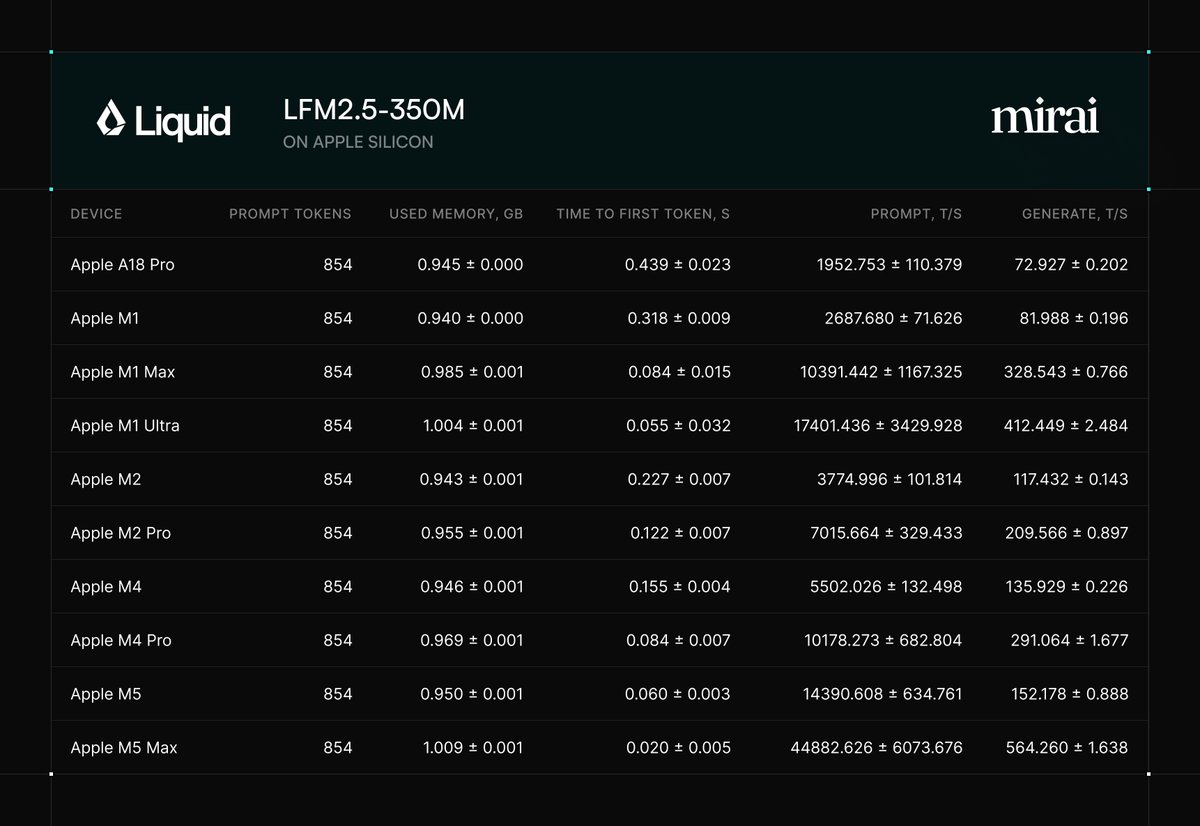
We raised $10M led by @uncorkcap to make on-device AI inference accessible to developers building on Apple Silicon. We're using the funds to expand model coverage across text, voice, and vision, working directly with model makers to bring their models on-device where latency, cost, and privacy favor local execution over cloud. Our proprietary inference engine is up to 37% faster than Apple's MLX with up to 59% faster prefill. Developers integrate it in a few lines of code without needing specialized systems expertise. The runtime supports hybrid deployments, routing inference between device and cloud seamlessly. Models running on-device are becoming a new capability layer where developers can build system-level experiences independently. We're building the infrastructure that enables that future. The round includes participation from an incredible group of angels including @dps @FrancoisChauba1 @marcinzukowski @matiii @gokulr @scooterbraun @krishnanvijay @benparr @MattPRD @adityajami and others. More on it at our blog trymirai.com/blog/mirai-rai…
Mirai tweet media
English
7
5
37
6.4K
Mirai
Mirai@trymirai·
We tend to think AI quality = model quality. Bigger model → better answers. However, for local inference, performance depends on model + hardware + execution together. The same model can be much more or less efficient depending on how it’s run on-device. That means local AI isn’t just a model problem. It’s a systems problem. Of how efficiently can your model run on a real device. That’s the shift. Mirai is building the on-device inference layer, the runtime between hardware and models, turning local compute into predictable, efficient, production-ready intelligence.
Mirai tweet media
English
1
0
10
161
Mirai
Mirai@trymirai·
AI isn’t moving from cloud → device. It’s splitting. Local models already handle a share of real-world queries, while frontier models remain essential for complex tasks. It’s redistribution. Simple workloads move closer to the user. Complex workloads stay in the cloud. The system becomes hybrid by default. Once part of your AI stack runs locally: • latency drops • costs collapse • privacy improves • reliability increases Mirai exists for this new architecture. Where intelligence is split across layers, but feels like one system.
Mirai tweet media
English
0
1
10
123
Mirai
Mirai@trymirai·
The biggest constraint in AI isn’t models. It’s energy ⚡ Inference demand is exploding: • Google Cloud saw a 1300× increase in token processing. • NVIDIA reported 10× year-over-year growth But data centers take years to build and require massive energy infrastructure. So the real question isn’t just: “How do we build bigger models?” It’s: “How do we turn energy into intelligence more efficiently?” That’s why intelligence-per-watt matters. Just as performance-per-watt moved computing from mainframes to PCs, intelligence-per-watt may move AI from data centers to devices. Mirai is building for that transition.
Mirai tweet media
English
1
0
8
179
Mirai
Mirai@trymirai·
AI today looks a lot like computing in the 1960s. Massive centralized systems. Shared infrastructure. Users renting time on powerful machines. Mainframes didn’t disappear because PCs became more powerful. They disappeared because efficiency improved enough to run useful workloads locally. Performance-per-watt doubled every ~1.5 years. Now we’re seeing the same pattern in AI. Local models are getting better. Local hardware is getting faster. Intelligence per watt is improving rapidly. That’s how computing moved from mainframes to PCs. And it may be how AI moves from data centers to devices. Mirai is building for that transition.
Mirai tweet media
English
0
0
7
107
Mirai retweetledi
Dima Shvets
Dima Shvets@dmitrshvets·
Apple "failing" at AI is now the exact reason they're about to win it. Here are my 5 cents on the longest patience trade in tech. Everyone laughed when Apple skipped the model race. $700B in GPU capex. OpenAI at $300B valuation. Meta training Llama in secret. Apple: silent. Now everyone seems surprised they were playing a completely different game. When we started building @trymirai around on-device AI a year ago, almost nobody got the play. The common reaction was: "why not just use the API?" Cloud inference was cheaper, easier, good enough. On-device seemed like a technical curiosity. While the hyperscalers spent $700B+ training proprietary models, Apple spent a decade building silicon. 10 years of building chips optimized for one thing only a few people talked about yet: inference efficiency at the edge. The result: 2.5 billion devices that can run AI locally. Now it's obvious. The race everyone thought mattered (who builds the best model) is finishing. The race that actually matters (who controls inference at scale) is just starting. A decade of silicon investment paying off at exactly the right moment.
English
1
2
7
615
Mirai
Mirai@trymirai·
Computing progress used to be measured by raw performance. Then the metric shifted to performance per watt, and that shift moved us from mainframes to personal computers to smartphones. AI is entering a similar phase. The metric that matters isn't just model size or tokens per second. It's how much useful inference you get per unit of energy. Why this matters: – Data centers are energy-constrained, – Most AI queries are lightweight enough to run locally, – Devices already have powerful accelerators. As on-device inference gets more efficient, it naturally moves closer to the user. The same pattern that moved computing from centralized systems to personal devices. Mirai is building for that shift.
Mirai tweet media
English
1
0
10
221
Mirai
Mirai@trymirai·
Local inference is compounding from every direction: • Models are getting better. • Models are getting smaller. • Hardware acceleration keeps improving. • “Intelligence per watt” keeps rising. When it crosses a critical threshold, inference becomes effectively zero cost, because the user already owns the hardware. We’re getting very close. Mirai is building the runtime layer that turns this trend into infrastructure, so models can run predictably, efficiently, and production-ready on real devices. Local isn’t the future. It’s crossing the threshold now. Learn more: trymirai.com
Mirai tweet media
English
9
0
15
237
Mirai
Mirai@trymirai·
Most AI doesn’t need hyperscale Frontier labs should build frontier models. But using the same infrastructure to answer: “write me an email” or “summarize this document” is architectural overkill. Local LMs (≤20B parameters) now accurately answer ~88% of those queries, and their capability has improved 3.1× in two years. So the real question becomes: Why serve lightweight workloads with heavyweight infrastructure? This isn’t about replacing frontier models. It’s about matching the workload to the right execution layer. That shift, from “biggest model everywhere” to “right model, right place”, is exactly what on-device inference enables. That’s the layer we are building for.
Mirai tweet media
English
6
0
17
374
Mirai
Mirai@trymirai·
@TradedVC Hey hey, thanks for featuring our round!
English
0
0
0
27
Traded: Venture Capital
Traded: Venture Capital@TradedVC·
London-based startup Mirai has raised $10 million in a seed round led by Uncork Capital to advance on-device AI infrastructure for smartphones and laptops. Founded by Dima Shvets, co-founder of Reface, and Alexey Moiseenkov, co-founder of Prisma, Mirai aims to let developers run sophisticated AI models directly on consumer hardware without relying on the cloud. The company has built a proprietary inference engine for Apple Silicon that boosts model generation speed by up to 37% and prefill by up to 59%, while maintaining output quality. The funding will support expansion across text, voice, and vision modalities, extend platform support to Android, and further develop Mirai’s orchestration layer for hybrid on-device and cloud AI workloads. Individual backers include Mati Staniszewski, Marcin Żukowski, Gokul Rajaram, and Francois Chaubard, alongside participation from Sarah Smith Fund, Garuda Ventures, I2BF Global Ventures, and Theory Forge Ventures. FOUNDERS: Dima Shvets & Alexey Moiseenkov INVESTORS: Uncork Capital, Sarah Smith Fund, Garuda Ventures, I2BF Global Ventures, Theory Forge Ventures, Mati Staniszewski, Marcin Żukowski, Gokul Rajaram, Francois Chaubard, Sequoia Capital Scout Fund & Index Ventures Scout Fund ROUND: Seed AMOUNT: $10,000,000 HQ: London, United Kingdom #VentureCapital #Mirai #DimaShvets #AlexeyMoiseenkov #TradedVC
English
1
1
3
672
Mirai
Mirai@trymirai·
We’re hiring 2 engineers: - ML Engineer (edge models under tight memory &latency constraints) - Inference Engineer (bridging ML research and high-performance inference) Requirements: deep on-device AI experience, reads papers for fun, thrives in a senior team moving fast trymirai.com/careers
English
2
0
14
341